Speed decides the comparison
Not one of the seven says how far its microphone stood or which test standard it followed. Each figure here is a manufacturer's dB(A) for a bare fan in free air, and with nothing else to anchor them, two brands' figures only meet when both were stated at the same speed. Our explainer on why decibel ratings rarely compare across brands covers the wider problem.
Speed itself turns up in three forms on the sheets.
| How the maker states speed | Who does it | How we read it |
|---|
| A single speed per column | Noctua, once at full speed and again with its Low-Noise Adaptor (L.N.A.) | Each column names its speed, so both are usable |
| A maximum | Thermalright marks every row "(MAX)"; Lian Li prints "dB(A) Max" beside a range ending at 1600 RPM | The figure at the top speed |
| A range with both ends | Scythe: "4.19 ~ 19.4 dBA / 16.8 ~ 67.2 CFM" across "300 ± 200 ~ 1200 rpm" | Figures at both ends of the range |
Fractal Design and Phanteks print one noise figure beside a speed range and leave out which speed it belongs to. ARCTIC rates loudness in sone instead of dB(A). Those fans appear below the picks, unranked.
What is the quietest 140mm fan at 800 RPM?
The Noctua NF-A14x25 G2 LS-PWM, rated 11.4 dB(A), with the NF-A14 ULN half a decibel behind. Only Noctua publishes 140mm figures this slow, so the group is one maker's fans, yet for a PC that sits on a desk all day it is the most useful group on the page.
| Fan at 800 RPM | Noise | Airflow | Static pressure |
|---|
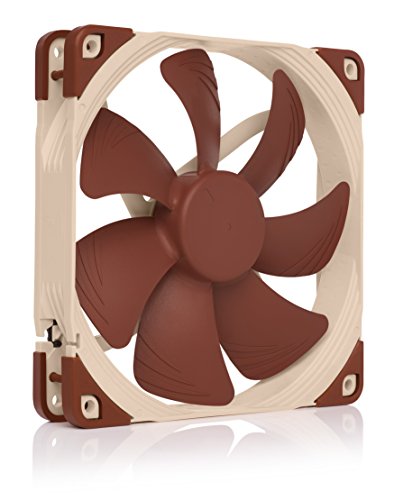
| NF-A14x25 G2 LS-PWM | 11.4 dB(A) | 81.6 m3/h | 0.71 mmH2O |
| NF-A14 ULN | 11.9 dB(A) | 79.8 m3/h | 0.69 mmH2O |
The newer G2 wins on all three numbers and keeps 4-pin PWM; the ULN is a 3-pin fan whose speed is set by its adaptor.
With the adaptors fitted, the two fall to different speeds, 600 RPM on the G2 and 650 RPM on the ULN. Their figures there, 8.6 and 9.1 dB(A), are therefore not a matched pair. ARCTIC's 3-pin F14 Silent also turns at a fixed 800 rpm, but its 0.08 Sone has no dB(A) counterpart and keeps it out of the group.
Every other Noctua 140mm figure, by condition, is on our Noctua fan decibels page.
At 1200 RPM, three fans sit within 0.4 dB
Two makers state three fans at exactly 1200 RPM, which makes this the best-populated group, and the Noctua NF-A14 PWM on its Low-Noise Adaptor comes out lowest.
| Fan at 1200 RPM | Noise | Airflow | Static pressure |
|---|
| Noctua NF-A14 PWM with the L.N.A. | 19.2 dB(A) | 115.5 m3/h | 1.51 mmH2O |
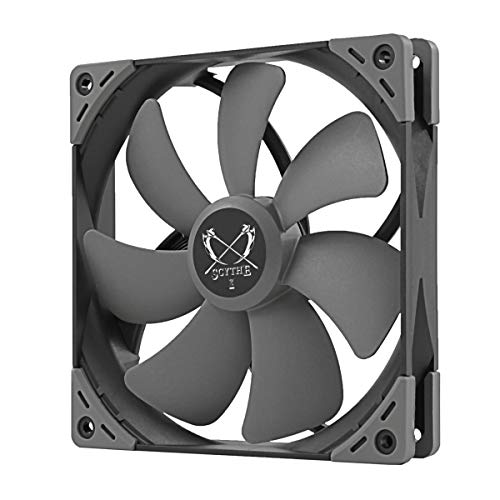
| Scythe Kaze Flex 140 Square PWM 1200rpm, top speed | 19.4 dBA | 67.2 CFM | 1.25 mmH2O |
| Noctua NF-P14s redux-1200 PWM, top speed | 19.6 dB(A) | 110.3 m3/h | 1.29 mmH2O |
A 0.4 dB spread, from fans measured under conditions nobody states, does not pick a winner. Everything else does. The NF-A14 PWM keeps 300 RPM of headroom for a hot day, because 1200 RPM is only its adaptor setting. Scythe is alone in printing a low end, 4.19 dBA at the bottom of the range. The redux is the plain option, with Noctua's six year warranty and nothing in the box beyond the fan and four screws.
Noctua leads at 1500 RPM, Thermalright follows
Four 140 x 140 x 25 mm fans carry a figure at 1500 RPM.
| Fan at 1500 RPM | Noise | Airflow | Static pressure |
|---|
| Noctua NF-A14 PWM | 24.6 dB(A) | 140.2 m3/h | 2.08 mmH2O |
| Noctua NF-A14x25 G2 PWM | 24.8 dB(A) | 155.6 m3/h | 2.56 mmH2O |
| Thermalright TL-C14C | 26.4 dBA (MAX) | 75.8 CFM | 1.93 mm H2O |
| Thermalright TL-B14 | 27.6 dBA (MAX) | 82.5 CFM | 2.35 mm H2O |
The Noctua pair are 0.2 dB apart, and the G2 spends that 0.2 dB on more airflow and pressure. It also arrives with an anti-vibration gasket pre-installed "to create a tighter seal on radiators".
Thermalright's fans sit 1.8 and 3.0 dB above the NF-A14 PWM. Because Noctua quotes airflow in m3/h and Thermalright in CFM, compare each fan's airflow with its sibling's rather than across the brand line.
Two more Thermalright 140mm fans run at 1500 RPM but miss the 25 mm square group: the TL-C14, 26.6 dBA in a 26 mm frame, and the TL-D14, 25.6 dBA in a 140 x 152 x 27 mm frame. Check the mounts before counting either.
Lian Li's trio at 1600 RPM, and two fans at 1800
Lian Li rates all its 25 mm 140mm fans at 1600 RPM, and they line up neatly.
| Fan at 1600 RPM | Noise | Airflow | Static pressure | Frame |
|---|
| UNI FAN AL140 V2 | 26.8 dB(A) Max | 81.6 CFM | 2.80 mmH2O | 140 x 140 x 25 mm |
| UNI FAN SL Infinity 140 | 28 dB(A) Max | 72.7 CFM | 2.88 mmH2O | 140 x 142 x 25 mm |
| UNI FAN SL140 V2 | 29 dB(A) Max | 77.6 CFM | 2.09 mmH2O | 140 x 140 x 25 mm |
The AL140 V2 has both the lowest figure and the most air.
Go up to 1800 RPM and two fans appear. Scythe's round Kaze Flex 140 PWM reads 26.45 dBA with 100.8 CFM, and Thermalright's TL-C14X reads 30.2 dBA with 92.5 CFM in a 26 mm frame. Scythe itself points out that its round fan mounts only on 120mm holes.
Are slim 140mm fans quieter?
By the numbers, a little, at the cost of air. Slim 140mm fans exist for low-profile coolers and cramped top panels, and only Thermalright ties a slim 140mm figure to a speed.
Its 15 mm TL-B14015 reads 24.6 dBA at 1600 RPM with 62.8 CFM and 1.0 mm H2O, while the faster TL-B14015 EXTREM reads 34.2 dBA at 2600 RPM and 92.3 CFM. At 1600 RPM the slim fan beats every 25 mm fan on noise and loses to every one of them on air. That trade is the thin frame's, and it is why slim fans get their own group.
ARCTIC's P14 Slim PWM PST is 16 mm thick. Its only noise figure is 0.3 Sone, with no speed, and its product page and spec sheet disagree on speed range, airflow and pressure.
Are 140mm fans quieter than 120mm fans?
Not by size alone. A 140mm fan moves more air on each turn, so it can spin slower for the same flow, and the slower speed is what lowers the figure. Three makers publish a 120mm and a 140mm version of one design, and their numbers show both the gain and its limits.
| Pair | 120mm version | 140mm version |
|---|
| Lian Li UNI FAN AL V2 | 77.3 CFM, 28.7 dB(A) at 2000 RPM | 81.6 CFM, 26.8 dB(A) at 1600 RPM |
| Lian Li UNI FAN SL V2 | 64.5 CFM, 29.2 dB(A) at 2000 RPM | 77.6 CFM, 29 dB(A) at 1600 RPM |
| Noctua | NF-A12x25 G2 PWM: 107.3 m3/h, 22.5 dB(A) at 1800 RPM | NF-A14 PWM with adaptor: 115.5 m3/h, 19.2 dB(A) at 1200 RPM |
| Thermalright | TL-C12C: 66.17 CFM, 25.6 dBA at 1550 RPM | TL-C14C: 75.8 CFM, 26.4 dBA at 1500 RPM |
The AL140 V2 shows the case for the bigger fan: more air, 400 RPM slower, a lower figure. Thermalright's pair breaks the rule. Its 140mm fan moves more air at a slightly lower speed, and still reads higher.
The gain comes from running the larger fan slower. Lian Li's 120mm AL and SL fans are also 28 mm thick against 25 mm for the 140s, so these are the makers' own pairings, not identical frames.
Every 10 dB is roughly a doubling of perceived loudness. Between the NF-A14x25 G2 LS-PWM at 800 RPM and the full-speed G2 at 1500 RPM the sheets show 13 dB, more than a doubling, while the whole 1200 RPM group spans 0.4 dB. On the makers' own figures, then, the speed you run a fan at moves its number far more than the brand you buy at that speed.
In a quiet home office the PC's fans are often the one steady sound in the room, and several of them add up. Our quiet home office explainer covers the other sources, and the decibel chart sets these figures beside everyday sounds.
Choosing a case at the same time? The PC case guide shows which cases ship with 140mm fans, and the CPU cooler guide covers the 140mm fans on tower coolers.
Only ARCTIC posts its own prices
US$12.99 for the F14 Silent and US$13.99 for the P14 Slim PWM PST, both MSRPs on ARCTIC's US shop and both excluding VAT. On November 8, 2026 that shop showed the F14 Silent as "currently not available", and the P14 PWM PST we listed before, at US$12.99, had moved to ARCTIC's US end-of-life list.
No prices appear anywhere on Noctua's website. Its product pages send buyers to Noctua's own Amazon store, sold by Noctua Cooling Solutions, where prices move often enough that the buy buttons here are the place to check. Scythe, Thermalright, Lian Li, Fractal Design and Phanteks show no price either and point to resellers.