
"How loud is 60 decibels?" has no single answer, because a decibel figure depends on what made the sound, how far away you stood and how the number was measured. What we can do is put the published numbers side by side. This page sets out the everyday sound levels published by US government agencies and the World Health Organization, and next to them the figures appliance makers publish for products in our own guides.
One caution before the chart, and it matters more than anything else on this page. The reference sounds come from agencies, some at stated distances. The appliance figures come from makers, and makers rarely state the distance they measured from. So when a dishwasher figure sits in the same band as a humming fridge, that tells you roughly what the number means. It does not tell you the dishwasher sounds like a fridge in your kitchen, and it is not a ranking. For why, see why you cannot compare dB ratings across brands.
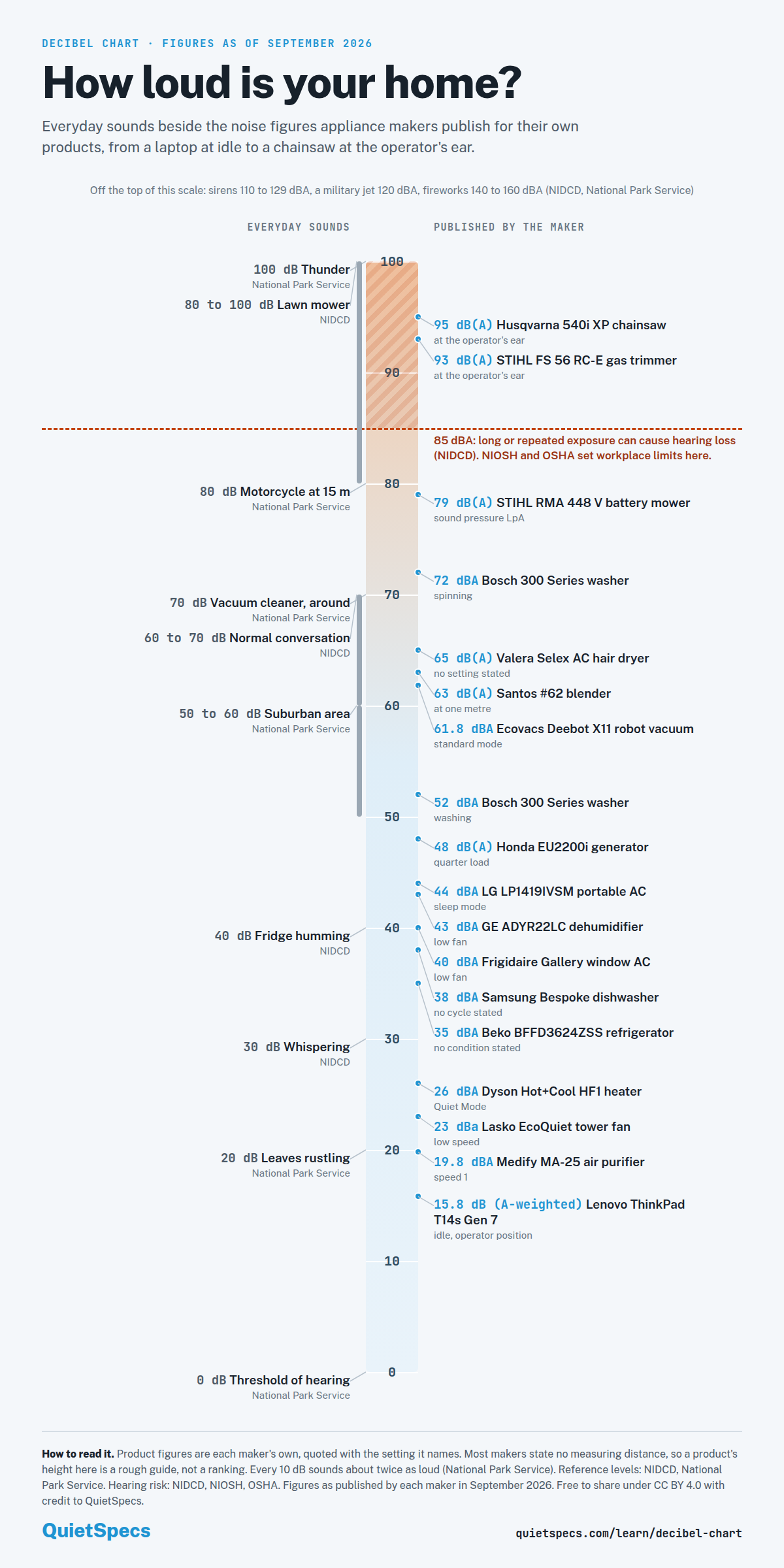
The decibel chart
Reference levels are quoted from the agency that published them, in the unit it used. Appliance figures are the maker's own, with the setting the maker gives, and each links to the guide that covers it. Only A-weighted sound pressure figures appear here, written dBA or dB(A), plus the one laptop figure Lenovo labels A-weighted.
0 to 29 dB
- 0 dB: threshold of human hearing (National Park Service)
- 10 dBA: volcano crater, Haleakala National Park (National Park Service)
- 20 dBA: leaves rustling, Canyonlands National Park (National Park Service)
- Lenovo ThinkPad T14s Gen 7: 15.8 dB A-weighted sound pressure at the operator position, idle, and 26.7 with the CPU working (laptops)
- Medify MA-25 air purifier: 19.8 dBA at speed 1 (air purifiers)
- Lasko EcoQuiet 42-inch DC tower fan: 23 dBa on low (tower fans)
- Dyson Hot+Cool HF1 heater: 26 dBA in Quiet Mode (space heaters)
- Vornado 80X box fan: 28 dBA, the low end of an unlabelled 28/61 (box fans)
30 to 39 dB
- 30 dB: whispering (NIDCD)
- Beko BFFD3624ZSS refrigerator: 35 dBA, no condition stated (refrigerators)
- Medify MA-25 air purifier: 37 dBA at speed 2 (air purifiers)
- Samsung Bespoke DW90F89T0USRAA dishwasher: 38 dBA, no cycle stated (dishwashers)
40 to 49 dB
- 40 dB: the sound of your fridge humming (NIDCD)
- 40 dBA: crickets at 5 m, Zion National Park (National Park Service)
- 45 to 65 dB: the sound of your dishwasher running (NIDCD)
- Midea MRS25I7BST refrigerator: 40 dBA, no condition stated (refrigerators)
- Frigidaire Gallery GHWW085TE1 window AC: 40 dBA on low, 46 on medium (window air conditioners)
- GE ADYR22LC dehumidifier: 43 dBA on low, 45 dBA at maximum (dehumidifiers)
- LG LP1419IVSM portable AC: 44 dBA in sleep, 47 on low (portable air conditioners)
- Dyson Hot+Cool HF1 heater: 44 dBA at maximum (space heaters)
- Lasko EcoQuiet 42-inch DC tower fan: 46 dBa on high (tower fans)
- Bosch 100 Series SHE41CM5N dishwasher: 48 dBA, no cycle stated (dishwashers under $800)
- Honda EU2200i generator: 48 dB(A) at quarter load, distance not stated (generators)
- Medify MA-25 air purifier: 49.3 dBA at speed 3 (air purifiers)
50 to 59 dB
- 50 to 60 dBA: a typical suburban area (National Park Service)
- Frigidaire Gallery GHWW085TE1 window AC: 50 dBA on high (window air conditioners)
- LG LP1419IVSM portable AC: 50 dBA on medium, 53 on high (portable air conditioners)
- Bosch 300 Series WGA12400UC washer: 52 dBA washing (washing machines)
- Champion 2500-watt inverter generator: 53 dBA from 23 feet, load not stated (generators)
- Milwaukee M18 FUEL 3017-20 leaf blower: 54 dB(A) at 50 feet, ANSI B175.2 (leaf blowers)
- Honda EU2200i generator: 57 dB(A) at rated load (generators)
60 to 69 dB
- 60 dBA: conversational speech at 5 m (National Park Service)
- 60 to 70 dBA: normal conversation (NIDCD)
- 65 to 80 dB: your normal talking voice at arm's length (NIDCD noise meter)
- Vornado 80X box fan: 61 dBA, the high end of its 28/61 (box fans)
- Ecovacs Deebot X11 robot vacuum: 61.8 dBA sweeping in standard mode (robot vacuums)
- SEBO AIRBELT E3 canister vacuum: 62 dBA, no power level stated (vacuums)
- Santos #62 blender: 63 dB(A) at one metre (blenders)
- Valera Selex AC hair dryer: 65 dB(A), no setting stated (hair dryers)
70 to 84 dB
- Around 70 dB: a vacuum cleaner (National Park Service)
- 70 to 104 dB: a movie theater (NIDCD noise meter); the NIDCD's hearing loss page gives 74 to 104 dBA
- 80 dBA: cruiser motorcycle at 15 m, Blue Ridge Parkway (National Park Service)
- 80 to 100 dB: lawn mower (NIDCD noise meter)
- Bosch 300 Series WGA12400UC washer: 72 dBA spinning (washing machines)
- STIHL RMA 448 V battery mower: 79 dB(A) measured sound pressure LpA (lawn mowers)
- Hamilton Beach Commercial Eclipse HBH755 blender: less than 81 dB(A) at maximum speed with no load (blenders)
85 dB and above
- 85 dBA: the level at which NIDCD, NIOSH and OSHA all draw a line (see below)
- 94 to 110 dBA: music through headphones at maximum volume, sporting events and concerts (NIDCD)
- 100 dBA: thunder, Arches National Park (National Park Service)
- 110 to 129 dBA: sirens (NIDCD)
- 120 dBA: military jet at 100 m above ground, Yukon-Charley Rivers (National Park Service)
- 140 to 160 dBA: fireworks show (NIDCD)
- STIHL FS 56 RC-E gas trimmer: 93 dB(A) at the operator's ear with a mowing head, ISO 22868 (string trimmers)
- Husqvarna 540i XP chainsaw: 95 dB(A) sound pressure at the operator's ear (chainsaws)
Where the sources disagree
The agencies do not always agree, and the differences are worth knowing.
- Conversation. The NIDCD's hearing loss page gives 60 to 70 dBA for normal conversation. Its noise meter gives 65 to 80 dB for a normal talking voice at arm's length. The National Park Service lists conversational speech at 5 m at 60 dBA, and describes a normal speaking voice as under 60 dB. The spread is mostly distance: arm's length is louder than 5 m.
- Movie theaters. The NIDCD gives 74 to 104 dBA on one page and 70 to 104 dB on the other.
- Rock concerts. The NIDCD noise meter gives 95 to 115 dB for rock concerts, parties or nightclubs. The National Park Service puts a rock concert at around 125 dB.
- Thunder. The Park Service's own table lists thunder at 100 dBA, while its text says the crack of thunder can exceed 120 decibels. One is a measurement at one place, the other a ceiling.
Where two figures differ, the chart gives the one with its source named, and this list gives the other. Neither is wrong. They describe different listeners in different places.
Why sound power and sones are not in the chart
Some of the figures in our catalog look like they belong on this chart and do not.
Sound power. Sound pressure is what reaches a microphone at one spot. Sound power is the total a machine gives off, wherever you stand, and it is usually a much bigger number. Lenovo declares the ThinkPad T14s at 2.5 bels of sound power at idle, next to its 15.8 dB of sound pressure. Husqvarna lists the 540i XP chainsaw at 95 dB(A) at the operator's ear and 104 dB(A) of measured sound power. Miele prints sound power for its dishwashers, 39 dB(A) re 1 pW for the G 7766 SCVi. Setting those beside a whisper or a fridge would put them in the wrong place, so we leave them out. See sound power vs sound pressure.
Sones. Bathroom fans and range hoods are rated in sones, a unit of loudness that is not a decibel. The body that certifies those ratings publishes no conversion, and neither do we. See sones vs decibels, and the range hood and bathroom fan guides for the figures themselves.
Is 30 dB loud?
No. The NIDCD puts whispering at 30 dB, and the National Park Service says some remote trails in Grand Canyon National Park, at 20 dBA, are softer than a whisper. It is also the World Health Organization's line for bedrooms: its community noise guidelines recommend less than 30 A-weighted decibels in bedrooms during the night for a sleep of good quality.
Very few appliance figures in our catalog reach this band, and those that do are the quietest setting of the product. Medify lists its MA-25 air purifier at 19.8 dBA on speed 1. Lasko lists the EcoQuiet tower fan at 23 dBa on low. Dyson lists its HF1 heater at 26 dBA in Quiet Mode, and Vornado lists its 80X box fan at 28 dBA at the quiet end of its range. Laptops sit lower still on their declared figures: Lenovo gives the ThinkPad T14s 15.8 dB of A-weighted sound pressure at the operator position when idle, measured to ISO 7779. That figure has a defined listening position, which the fan figures do not, so the two are not comparable. For the bedroom, see setting up a quiet bedroom.
Is 40 dB loud?
It is quiet, but it is not silent. The NIDCD puts the sound of a fridge humming at 40 dB, and the Park Service lists crickets at 5 m at 40 dBA. The WHO's night noise guidelines recommend less than 40 dB(A) of annual average outside bedrooms, which is a figure for outdoor noise at night, not for a machine in the room.
The 40s are where most of the quiet appliances in our catalog live. Midea lists its MRS25I7BST refrigerator at 40 dBA, which the guide notes is low for Midea, whose range mostly lists 43. Frigidaire lists its Gallery window air conditioner at 40 dBA on low and 46 on medium. GE lists its ADYR22LC dehumidifier at 43 dBA on low and 45 at maximum. LG lists its LP1419IVSM portable air conditioner at 44 dBA in sleep and 47 on low. Bosch lists its entry SHE41CM5N dishwasher at 48 dBA, and Honda lists the EU2200i generator at 48 dB(A) at quarter load.
So is 40 dB loud for a fridge, a fan or a dishwasher? For a fridge it is typical, going by the NIDCD. For a dishwasher it is quiet: the NIDCD puts a running dishwasher at 45 to 65 dB, and Samsung lists its Bespoke at 38 dBA. For a fan, it depends on the speed; the Lasko EcoQuiet runs from 23 dBa on low to 46 on high. For sleep, the WHO's bedroom figure is 30, not 40.
Is 50 dB loud?
It is moderate. The National Park Service says the din of a typical suburban area fluctuates between 50 and 60 dBA, and describes a normal speaking voice as under 60 dB.
In our catalog this is the band for machines at full speed and for louder jobs done gently. Frigidaire's window unit lists 50 dBA on high, and LG's portable 50 on medium and 53 on high. Bosch lists its WGA12400UC washer at 52 dBA washing. Champion lists its 2500-watt generator at 53 dBA from 23 feet, one of the few figures here with a distance. Milwaukee rates its M18 FUEL leaf blower at 54 dB(A) at 50 feet under ANSI B175.2, which is a figure for a neighbor, not for the person holding it. Honda's EU2200i reaches 57 dB(A) at rated load.
Is 60 dB loud?
It is the level of talking. The Park Service lists conversational speech at 5 m at 60 dBA, and the NIDCD gives 60 to 70 dBA for normal conversation. A machine at this level will compete with a voice on a call, which is why our room by room guide uses speech as the yardstick for a home office.
The figures here are for machines at work. Vornado lists its 80X box fan at 61 dBA at the top of its range. Ecovacs lists the Deebot X11 robot vacuum at 61.8 dBA sweeping in standard mode. SEBO lists its AIRBELT E3 canister vacuum at 62 dBA. Santos declares its #62 blender at 63 dB(A) at one metre, a rare figure with a distance and a standard behind it. Valera lists its Selex AC hair dryer at 65 dB(A).
Is 70 dB loud?
It is loud enough to notice from another room, but by the NIDCD's account it is not a hearing risk: sounds at or below 70 dBA, even after long exposure, are unlikely to cause hearing loss. The Park Service puts a vacuum cleaner at around 70 dB.
Bosch's washer climbs from 52 dBA washing to 72 dBA spinning, which is why the washing machine guide treats the spin figure as the one that matters. STIHL's UK page lists its RMA 448 V battery lawn mower at a measured sound pressure of 79 dB(A). Hamilton Beach Commercial's manual for the Eclipse blender gives a ceiling rather than a measurement: less than 81 dB(A) at maximum speed with no load.
Is 85 dB loud? Where hearing risk starts
Yes, and this is where the agencies set limits. Each is quoted as published:
- NIDCD: long or repeated exposure to sounds at or above 85 dBA can cause hearing loss.
- NIOSH: its recommended exposure limit for occupational noise exposure is 85 A-weighted decibels over an eight-hour shift, and for each 3 dBA increase in noise level, NIOSH recommends reducing the exposure duration by half.
- OSHA: employers must run a hearing conservation program when employee noise exposures equal or exceed 85 decibels (dBA) as an 8-hour time-weighted average. OSHA's permissible exposure limit is 90 dBA for all workers for an 8 hour day.
The NIOSH and OSHA figures are workplace limits over a working day, not a rating for a single sound. They are useful here as the point at which official bodies start to treat a level as a risk.
The loudest sound pressure figures in our catalog are at the operator's ear on outdoor tools, which is where the operator stands. STIHL's manual declares its FS 56 RC-E gas string trimmer at 93 dB(A) at the operator's ear with a mowing head, measured to ISO 22868. Husqvarna lists the 540i XP chainsaw at 95 dB(A) at the operator's ear. Above that, the NIDCD lists sirens at 110 to 129 dBA and a fireworks show at 140 to 160 dBA. The NIDCD's own advice for loud activities is to wear earplugs or other protective devices.
How decibels add up
Decibels are not ordinary numbers. OSHA's technical manual says decibels are logarithmic values, so it is not correct to sum multiple sound values using arithmetic addition. Two 50 dBA machines do not make 100.
Two rules make the scale usable:
- Ten decibels sounds about twice as loud. The National Park Service says an increase of 10 dB causes a doubling of perceived loudness and represents a ten-fold increase in sound level. In its example, if one vacuum cleaner measures 70 dB, 80 dB would be the equivalent of 10 vacuum cleaners. So Bosch's washer at 72 dBA spinning sounds about four times as loud as it does washing at 52.
- Doubling the source adds about 3 decibels. OSHA's manual says that as a general rule, doubling the sound power increases the noise level by 3 dB. Two identical fans side by side are about 3 dB louder than one, not twice the number.
Distance works the other way. OSHA's manual says the sound pressure level decreases 6 dB each time the distance from the point source is doubled, in open space. Rooms reflect sound, so indoors it falls away more slowly. That is one more reason a maker's figure, taken at a distance it does not state, cannot tell you what your room will measure. For more on the A in dBA, see dBA explained.
Share this infographic
The infographic is licensed under Creative Commons Attribution 4.0 (CC BY 4.0). You are free to use it on your own site, in a newsletter or in teaching material, including commercially, as long as you credit QuietSpecs with a link to this page. Please keep the figures unedited, since each one is quoted with the setting its maker names. Use the button to copy the embed code, then paste it into your page:
<a href="https://www.quietspecs.com/learn/decibel-chart"><img src="https://www.quietspecs.com/images/infographics/how-loud-is-your-home.png" alt="How loud is your home? A decibel chart of everyday sounds beside appliance noise figures published by their makers" width="1200" height="2400" style="max-width:100%;height:auto" /></a>
<p>Infographic by <a href="https://www.quietspecs.com/learn/decibel-chart">QuietSpecs</a>: everyday sounds beside the noise figures appliance makers publish.</p>
We did not measure any of these sounds or products. Every reference level on this page is quoted from the agency that published it, and every appliance figure is the maker's own, quoted with the setting it describes in the guide that covers it.