How many sones is a quiet bathroom fan?
A bathroom fan rated at 1.0 sone or less is quiet by the standard of the Home Ventilating Institute (HVI), the independent body that certifies fan ratings. Bathroom fans are rated in sones, not decibels.
According to HVI, one sone is roughly the sound of a quiet refrigerator, and the lowest rating a fan can be certified at is under 0.3 sone.
The useful thing about sones is that they scale the way you hear. A 2-sone fan sounds twice as loud as a 1-sone fan, and a 4-sone fan twice as loud again.
Decibels do not work that way, and there is no simple conversion between the two. So compare fans on sones, and be skeptical of any article that quotes exact decibel equivalents for them. Our explainer on sones vs decibels has the definitions.
Why is a bathroom fan louder than its sone rating?
A bathroom fan's boxed sone rating is taken at a standard static pressure of 0.1 inch of water, a short, straight, easy duct, and a real installation pushes against more resistance, so the fan gets louder.
This is the most important thing in this guide, and almost nobody explains it.
Fans are rated at a standard static pressure of 0.1 inch of water. Static pressure is the resistance the fan pushes against, and 0.1 inch represents a short, straight, easy duct. Real bathrooms are rarely like that. Ducts run through attics, turn corners and climb to a roof or wall vent. Panasonic cites industry research putting typical installations between 0.20 and 0.375 inch.
More resistance means a fan works harder, moves less air and gets louder. That is why so many fans claim "under 0.3 sone" on the box yet sound louder once installed. Some manufacturers also publish ratings at 0.25 inch, closer to a real installation, and those figures separate the genuinely quiet fans from the rest:
- The Panasonic WhisperGreen Select stays at 0.3 sone at 110 CFM at 0.25 inch on a 6-inch duct.
- The Panasonic WhisperCeiling DC 50/80/110 model rises to 0.9 sone at 110 CFM at 0.25 inch.
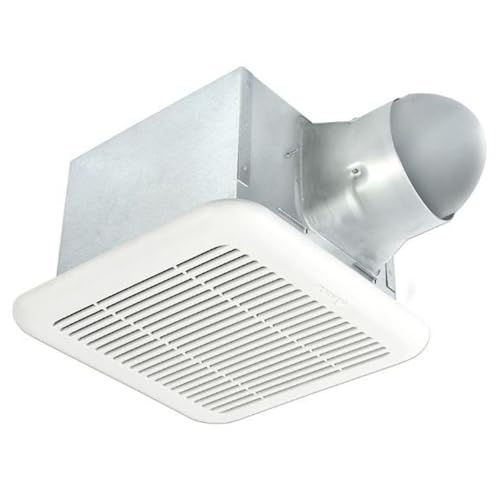
- The Delta BreezSignature rises to 0.8 sone at 110 CFM at 0.25 inch on a 6-inch duct.
All three are "under 0.3 sone" on the box. Once installed, they are not the same fan. We ranked on the 0.25-inch figure wherever the manufacturer publishes it, and we flag the ones that don't.
Panasonic publishes that tougher figure for every current model, and our Panasonic bathroom fan sones page lists all 24, series by series.
Broan prints that figure for fewer of its fans: our Broan bathroom fan sones page lists all 89 current Broan-NuTone fans at 0.1 inch and names the few, the EVOLVE among them, with a full sone table at 0.25 inch. Delta prints it for almost every current Delta Breez fan, and our Delta Breez bathroom fan sones page lists all 103 with the duct size behind each figure.
What size duct does a bathroom fan need for quiet running?
A 6-inch duct is the quieter choice for a bathroom fan, because a 6-inch duct lets air out with far less resistance than a 4-inch duct, and the manufacturers' own numbers show how much that matters:
- Delta rates the BreezSignature at 0.8 sone at 110 CFM on a 6-inch duct, and 2.0 sones on a 4-inch duct, at the same test pressure.
- Panasonic rates the WhisperGreen Select at 0.3 sone at 110 CFM on a 6-inch duct, and 0.8 sone on a 4-inch duct.
If you are building new or already opening the ceiling, run a 6-inch duct. In the manufacturers' own figures, it is one of the biggest noise upgrades available. Panasonic's own advice is that short runs can use a smaller duct, but longer runs should move up to 6-inch.
If you are replacing a fan and the existing duct is 4-inch, you have two sensible options: re-duct while the ceiling is open, or buy a fan designed for 4-inch ducts, like the Panasonic WhisperFit. Fitting a 6-inch fan to a 4-inch duct with a reducer gives away much of its advantage.
Inline fans, which sit in the duct itself rather than in the ceiling, are covered in our inline duct fan guide, where most makers publish decibels rather than sones.
How many CFM does a bathroom fan need?
A bathroom fan needs 1 CFM per square foot up to 100 square feet, with 50 CFM as the minimum for small bathrooms, by HVI's sizing guidance. HVI's sizing guidance is simple:
- Up to 100 square feet: 1 CFM per square foot, with 50 CFM as the minimum for small bathrooms.
- Over 100 square feet: add 50 CFM each for a toilet, a shower and a tub, and 100 CFM for a jetted tub. Or use more than one fan.
- Ceilings above 8 feet may need more ventilation, and an enclosed toilet should have its own fan.
Buying far more airflow than you need does not help, and a fan working at its top speed is at its loudest. That is where selectable-speed fans earn their keep: set the airflow your room needs and the fan runs at its quietest for that job.
For a powder room or small bathroom that needs only 50 to 80 CFM, our guide to the quietest bathroom fans for small bathrooms ranks fans on certified sones at those settings at 0.25 inch, on the 4-inch duct most small bathrooms already have.
How do lights, humidity sensors and heaters affect bathroom fan noise?
A light adds little bathroom fan noise in the one pair we could compare, a humidity sensor runs the fan at full speed when it decides to, and heater fans vary, so read the sone rating.
Lights add little noise in the one pair we could compare directly: Panasonic's lighted WhisperCeiling DC is rated 0.4 sone at 110 CFM on the box, against under 0.3 for the fan-only model. For a fuller ranking of fan-lights, including heater models and what each light does at night, see our guide to the quietest bathroom fans with a light.
Humidity sensors are the upgrade we'd pay for in a family bathroom. HVI recommends running a fan for 20 minutes after a shower, and a sensor does that without anyone remembering. A sensor, though, runs the fan at full speed whenever it decides to, so our guide to humidity sensor bathroom fans ranks sensor fans on their HVI-certified sones at that boost setting, and reads the manuals for how each sensor starts and stops.
Heaters are worth checking carefully. Broan's 110 CFM PowerHeat BHFLED110 is rated at 2.0 sones. That is several times louder than our top picks, and at ENERGY STAR's noise ceiling for a fan of its size.
The 80 CFM heater fans we have since checked, Delta's BreezRadiance RAD80LED and Broan's PowerHeat BHF80, are each rated 1.5 sones at 80 CFM at 0.1 inch, and neither has a sone figure at 0.25 inch. Heater fans vary, so read the sone rating before assuming. If you want the heat without a ceiling fan, our guide to the quietest wall heater for a bathroom covers wall-mounted heaters, which carry decibel figures instead of sones.
Does an ENERGY STAR label mean a bathroom fan is quiet?
No, an ENERGY STAR label on a bathroom fan is a floor, not a mark of quiet: for fans up to 200 CFM, the rating can be no louder than 2.0 sones.
An ENERGY STAR label on a bathroom fan guarantees a few useful things. For fans up to 200 CFM, the rating can be no louder than 2.0 sones, and the fan must meet a minimum efficiency.
It must also keep at least 70% of its rated airflow when tested at the higher 0.25-inch pressure, a small guarantee that the fan won't collapse once installed. According to HVI, its certification is a prerequisite for ENERGY STAR, so a labeled fan's ratings have been independently checked.
Every fan in our picks is well below ENERGY STAR's noise limit.
A bathroom fan clears moisture in bursts. For a tight house that needs fresh air all day, Panasonic also rates its WhisperComfort ventilator in sones, and our ERV and HRV guide compares it with through-wall and whole-house units.
Which buying mistakes leave you with a louder bathroom fan?
Five mistakes come up when buying a bathroom fan: comparing sones at different test pressures, ignoring the duct, oversizing, choosing a heater fan without checking its sones, and assuming a missing figure is a good figure.
Comparing sone ratings at different test pressures
A fan rated at 0.1 inch and one rated at 0.25 inch are not comparable. Check which figure you are reading.
Ignoring the duct
A quiet fan on a long, narrow, kinked duct will not be quiet.
Oversizing
A fan running flat out to move air your bathroom doesn't need is a fan running at its loudest.
Choosing a heater fan without checking its sones
The heater fans we could verify are rated 1.5 to 2.0 sones.
When a manufacturer doesn't say what test pressure its rating uses, you cannot compare it fairly with fans that do.
On a 4-inch duct at the tougher 0.25-inch pressure, Delta rates the BreezSignature at 2.0 sones at 110 CFM, double HVI's 1.0-sone mark for a quiet bathroom fan; on a 6-inch duct it stays under that mark at 0.8.