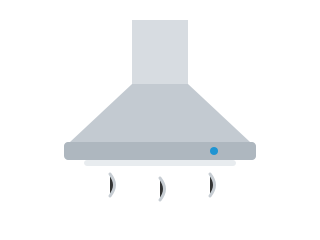
A wall-mount chimney hood is the classic range hood: a canopy over the range, a decorative chimney running up to the ceiling, and nothing on either side but the wall it hangs on. That wall is an advantage. It helps hold the smoke in, and it is why HVI recommends a third less airflow for a wall hood than for an island one. Less airflow means a lower step, and a lower step is quieter. The trouble is that the figure on the box is usually the slowest speed, and the figure you need is the step that actually clears the smoke from your cooktop.
We took every 30 and 36-inch hood that the Home Ventilating Institute (HVI) directory files as a chimney hood, matched the current models to their makers' pages, and ranked them on certified sones at high speed. Then, for each hood, we read off the figure at the airflow a 30-inch and a 36-inch cooktop need, and looked at the duct, the chimney, the blower and the make-up air rules that come with putting a hood on a wall. For the room as a whole, see our page on planning a quiet open-plan kitchen.
Our picks are listed above, with full specifications for each.
How we ranked them
Picks are in order of their HVI-certified rating at high speed, measured at 0.1 inch of static pressure, because that is the one speed every hood here has certified in the same way. The two cooktop lines on each pick show the figure at the first step that reaches HVI's airflow target, and say whether that figure is certified or the maker's own.
Sones are linear: 4 sones sounds twice as loud as 2, and 8 twice as loud as 4. So the EMS9026 at 2 sones on the step a 36-inch cooktop needs and the Best WCP1 at 9.5 on that step are not close; the Best sounds almost five times as loud. Decibels are logarithmic and work differently, and there is no reliable way to convert one into the other, so we rank sones against sones only and keep every decibel figure in a group of its own. Our explainer on sones vs decibels covers why.
Step one: the airflow your cooktop needs
HVI's table is written for exactly this layout. For a hood against a wall, it recommends 100 CFM per linear foot of range:
- 30-inch hood: 250 CFM, with 100 as a minimum.
- 36-inch hood: 300 CFM, with 120 as a minimum.
For professional-style cooktops, HVI says to follow the cooktop maker's advice instead, and for an island it multiplies the rate by 1.5. HVI also notes that hoods with several speeds "allow low-level, quiet ventilation for light cooking with the ability for higher rates when needed." So the useful question is which step first reaches 250 or 300 CFM, and how loud that step is certified to be.
Step two: read the sones at that step
- FOTILE EMS9026 (36-inch): the lowest step is 360 CFM at 2 sones, certified. It covers a 36-inch cooktop without moving up.
- FOTILE EMG9050 (36-inch): low is 283 CFM at 0.6 sone, enough for a 30-inch cooktop. A 36-inch cooktop needs medium, 3.5 sones at 450 CFM. Both are certified.
- Zephyr Siena ENERGY STAR: 210 CFM at 2 sones, then nothing certified until 400 CFM at 6.5. For either width, the step you can rely on is high.
- FOTILE EMG7508S-i and EMG9008S: low is 257 CFM at 1 sone, certified, which covers 30 inches. A 36-inch cooktop needs medium, 4.5 sones at 416 CFM.
- Broan EW48: medium is 250 CFM at 3.0 sones, not certified. A 36-inch cooktop needs high, 7.5 sones at 400 CFM.
- Zephyr Amalfi: 180 CFM at 0.7 sone, then nothing published until 8 sones at 500 CFM.
- Best WCP1: medium high is 280 CFM at 2.5 sones through an 8-inch duct, or 270 CFM at 3.0 through a 6-inch one, neither certified. A 36-inch cooktop needs high, 9.5 sones.
The pattern is the point. The Broan and the Best look loud on high, but over a 30-inch cooktop their published middle steps are quieter than the Siena's only usable figure. A hood with a gap in its table leaves you guessing at exactly the step you use most.
Pyramid, box or glass canopy
The style is the first thing most people choose, so it is worth saying plainly: we found nothing in the certified figures that ties noise to the shape. The three pyramid hoods here, from Broan, Zephyr and Best, are certified at 7.5 to 9.5 sones on high. The FOTILE box and glass canopy hoods are certified at 4 to 7. Those are different blowers from different makers, not a test of the shape.
What the shape does change is the install. A pyramid with a narrow chimney leaves room on the wall; a deep box or glass canopy like FOTILE's needs headroom. FOTILE's EMG9050 also moves its capture plate: its Auto Turbo Mode sets the fan speed and the plate height from a fume sensor, which is convenient and also means the hood can step up by itself.
Outside wall or inside wall: the duct run
On an outside wall, a hood can vent straight out the back through a short duct. On an inside wall, the duct has to go up through the ceiling and out through the roof or along the joists to another wall. That is the biggest noise decision you make after the hood itself, because every foot and every elbow makes the blower work harder.
Zephyr's Amalfi manual includes a ducting calculation sheet that shows how fast it adds up. A 90-degree round elbow counts as 15 equivalent feet, a wall cap with damper or a roof cap as 30, and Zephyr says the total "should not exceed 150 equivalent feet." Broan's EW48 guide puts it more simply: "A straight, short duct run will allow the hood to perform most efficiently," and "Larger ducting may be required for longer duct runs."
Not every hood can go straight out the back. FOTILE's wall hoods are top vented, with a 6-inch round vertical duct only, and so is the Amalfi. The Siena ENERGY STAR takes an 8-inch duct either way, and HVI certifies it at 6.5 sones at 400 CFM both vertical and horizontal. Best's WCP1 takes a 3-1/4 x 10-inch duct out the back, and HVI certifies 9.5 sones on high for that duct as well as for 6 and 8-inch round. In the certified ratings we read, direction made no difference; the length and the number of elbows are what you control.
Chimney height kits
The decorative chimney has to reach your ceiling, and the kit it comes with often does not. Broan's EW48 needs a flue extension for ceilings of 9 feet or more. Best's WCP1 telescopes for 8 to 9 foot ceilings, with an extension for up to 11. FOTILE sells ceiling covers for the EMS9026 and EMG9030 at $200 for a 9-foot ceiling and $220 for 10, and the EMG9050 and EMG7508S-i have their own. Zephyr's Siena ENERGY STAR and Amalfi reach 12 feet with an extension.
This is a noise question too. Zephyr's Amalfi table shows that on a 10-foot ceiling the standard cover only works if the hood hangs 35 to 36 inches above the cooktop; the extension lets it come down to 24. A hood that hangs higher captures less smoke, and a hood that captures less has to run on a higher step.
External and inline blowers
The classic way to quiet a big hood is to take the motor out of the kitchen. An in-line blower sits in the duct, often in the attic; an external blower mounts on the roof or an outside wall. Best's spec sheet for its EB6 and EB9 exterior blowers says that, "to achieve reduced sound levels at the range hood," the blower should be "at least 10 feet away from the hood location," with one 90-degree elbow between them.
Among wall hoods, Zephyr's Horizon and Apex glass hoods and its Vista take an in-line or external 1,000 CFM blower. Zephyr lists both as "sones NA", and notes that their 10-inch duct must step down to 8 inches before it passes through the ceiling. None of the hoods we could rank offers a remote blower, and no maker we checked publishes a sone figure for one. It may well be quieter at the hood. Nobody publishes a number that lets you compare it with the picks here. Our guide to range hood inserts covers the custom hood shells where remote blowers are most common.
Make-up air limits
A hood that pulls air out of the house needs that air replaced, and past a point the code says so. Our main range hood guide explains the International Residential Code rule, which starts above 400 CFM in homes with fuel-burning appliances that are not direct-vent. Zephyr sells its make-up air damper "for use with any Zephyr hood operating over 300 CFM."
For a 30 or 36-inch cooktop you need 250 to 300 CFM, so you rarely need to cross that line, and the makers give you ways not to:
- Zephyr's Siena ENERGY STAR tops out at 400 CFM. With ACT 290, Zephyr rates it at 200 to 290 CFM and 2 to 3 sones, the only capped figure we found on any sheet.
- Zephyr's Amalfi can be set to ACT 390 or 290. The manual says the speeds then change from 1-2-4 to 1-2-3 or 1-2-2.
- Broan's EW48 offers a CRT reduction to 300 CFM.
- Best's WCP1 can be limited to 300 or 400 CFM, and Best's guide warns that "this change CANNOT be reverted."
FOTILE lists CAT as "N" for the EMS9026 and EMG7508S-i and shows no CAT setting for the EMG9050, and all three move more than 400 CFM on high.
What else you hear from the range
Automatic modes. Best's SmartSense starts or adjusts the fan with cooktop heat, and Best warns that removing a hot pan can make the fan speed up. Its Heat Sentry turns the blower on high if it senses excessive heat. FOTILE's EMG9050 has Auto Turbo Mode, and the EMG9030's Intelligent Air Management, once you switch it on, runs the motor when it judges the air quality moderate or bad.
Memory. The Amalfi "will remember the last speed and light level." The EMG9030 manual says the motor starts "from the previous gear state." If you switched off on high, that is where it starts.
Delay off. The Amalfi, Best WCP1 and Broan EW48 run on for 10 minutes; the EMS9026 for 2 and the EMG9050 for 5.
The low-speed trick. Broan's page for the BWPR302SSE promises "Quiet 1.0 sone operation". HVI certifies that 290 CFM hood at 7 sones on high. Best's WCP1 page leads with "0.3 sones at low speed" for a hood certified at 9.5 on high.
Decibels stay in their own group
FOTILE prints decibels beside its certified sones: 40.5, 52.8 and 57 dB for the EMS9026's steps. Its EMG9030 manual explains that those are sound pressure levels under IEC60704, and gives sound power levels of 54.5 to 70.5 dB(A) for the same hood. Bosch's own sheet rates its 800 Series pyramid at 4.6 to 9.9 sones, but it is not in HVI's directory, so that figure stays apart from the certified ones; its 300 Series sheet leaves the silence level blank. We rank none of these against the picks. Our explainer on sound power vs sound pressure explains why the two kinds of decibel do not mix either.
What quiet costs
The quiet hoods here cost more. The EMS9026 is $1,499 on sale and the EMG9050 $2,349, against $569 for the 30-inch Broan EW48 and $624 for the 36-inch; Zephyr and Best show no prices. Quiet can also cost you headroom, since FOTILE's canopies are deep, and duct work, since none of FOTILE's wall hoods can vent straight out the back. If your range sits under wall cabinets instead, our guide to under-cabinet range hoods ranks those, and the island range hood guide shows how much louder the same cooktop gets in the middle of the room.
How we chose
We downloaded the HVI certified products directory (data generated September 23, 2026), took every hood filed under Chimney Hood or with no subcategory in 30 or 36 inches, and kept the models we could match to a current page on their maker's site. We reopened each product page, spec sheet and manual from FOTILE, Zephyr, Broan-NuTone, Best and Bosch, recorded every sone and CFM figure with the speed and duct it describes, and noted where the maker's figures differ from the directory. HVI also lists Frigidaire, Electrolux, Venmar, Vissani and Wolf chimney hoods; we could not confirm those models on their makers' sites, so they are not ranked. Airflow targets come from HVI's own table. Prices are the makers' own, checked on October 4, 2026.
We did not measure any of these hoods ourselves. Every sone and CFM figure is HVI's certified rating or the maker's published one, quoted with the speed and duct it describes, and we say each time which is which.