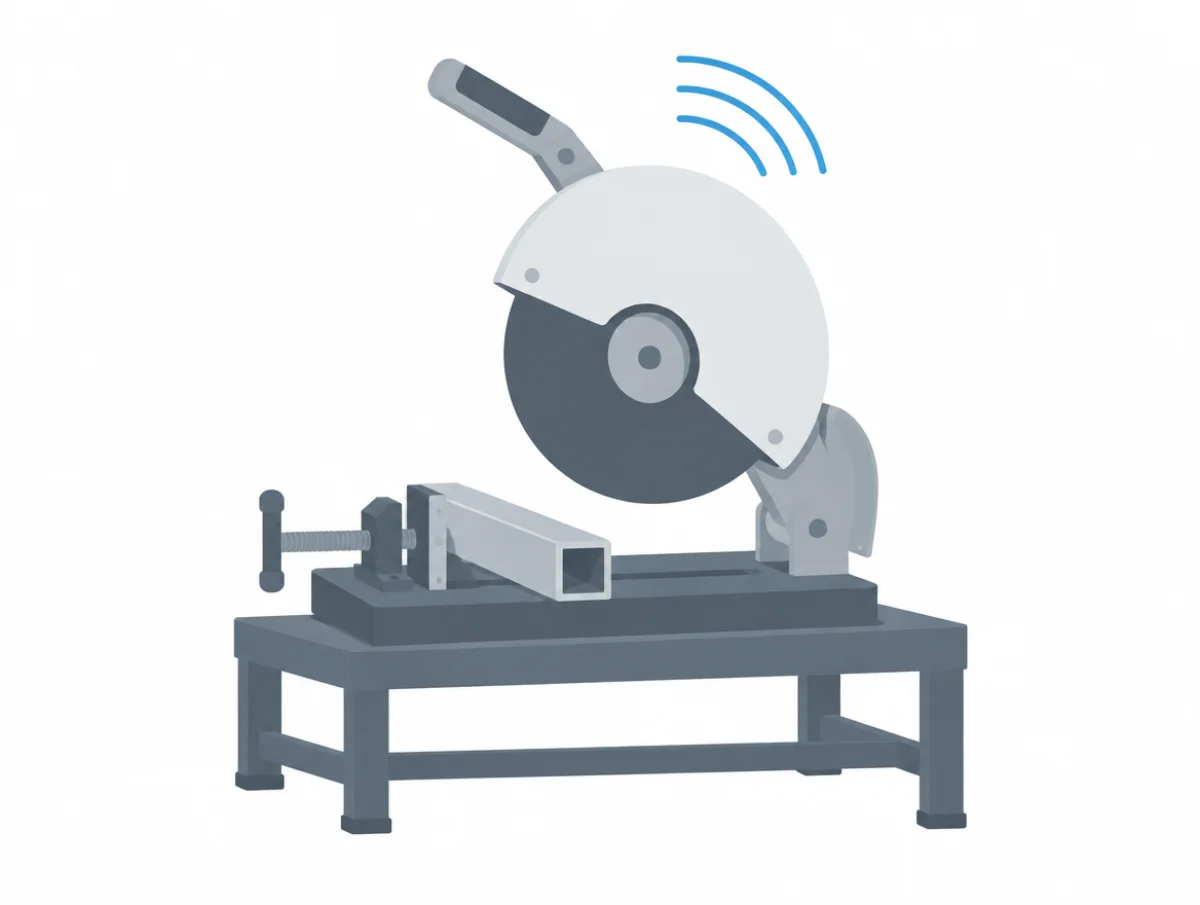
Which chop saw is the quietest?
DEWALT's D28730 is the quietest chop saw on the one shared basis, EN 62841-3-10, at 97.5 dB(A) for the operator; Makita's LW1401 has that group's lowest sound power, 110 dB(A).
Four saws carry figures their makers say were taken under EN62841-3-10, all with K 3. By sound pressure at the operator:
- DEWALT D28730: 97.5 dB(A)
- DEWALT D28715: 100 dB(A) at 230 V
- Makita LW1401: 102 dB(A)
- Makita LC1230: 107 dB(A)
By sound power, the first two swap: the LW1401 at 110, the D28730 at 110.5, the D28715 at 112 and the LC1230 at 115. A half decibel gap is well inside K, so the LW1401 and D28730 are level for a room. At the handle, the D28730's 4.5 decibel lead over the Makita is larger than K.
How do chop saw makers rate noise?
Chop saw makers who publish noise give two figures: LpA, measured at the operator's working position, and LwA, the whole acoustic output of the saw. Each comes with an uncertainty, K, of 3 dB on every saw here.
The EN 62841-3-10 group
Within the EN 62841 series for power tools, part 3-10 deals with cut-off machines. DEWALT and Makita name it in the line above their noise tables for the D28730, D28715, LW1401 and LC1230. DEWALT's declarations cite different amendments of it, a 2015 text for the D28715 and the 2015 text with three later amendments for the D28730.
Each of these figures comes from a European manual. The US saw shares the model number in all four cases, and every US manual and product page we opened for them prints no noise figure at all.
Evolution's US manuals
Evolution prints its figures in US manuals, the corded ones at 120V, which is unusual. It says only that they were measured "in accordance with a standard test method", without naming one, so Evolution's saws are ranked among themselves:
- S14CPS-Li cordless: 94.2 dB LpA, 107.2 LwA
- S355CPSL: 94.9 and 107.9
- S14CPS and S15CPS: 98.5 and 111.5
Metabo's US manual for the 120 V CS 22-355 prints 91 dB(A) and 104, but names EN 62841 only for its vibration figure. With no basis stated for noise, the CS 22-355 sits on its own.
DEWALT's DW872 multi-cutter lists 104.0 and 112.0 "according to EN62841", and its declaration names part 3-9, the table and miter saw part. A different part of the standard means a different test, so it is not ranked with the cut-off machines.
Are cold cut saws quieter than abrasive chop saws?
No, not on the only like-for-like figures we have: Makita's carbide LC1230 declares 107 dB(A) and 115 of sound power under EN62841-3-10, against 102 and 110 for its abrasive LW1401.
That runs against the usual pitch for carbide saws. The LC1230 turns its 12 inch blade at 1,700 rpm, less than half the LW1401's 3,800, and still comes out five decibels louder on both figures.
DEWALT's slow DW872 points the same way at 104.0, above both DEWALT abrasive saws, but its test is a different part of EN 62841, so we only note it. Evolution's carbide saws print lower numbers, 94.2 to 98.5, with no standard named, so they say nothing about abrasive saws from other makers.
Is a cordless chop saw quieter?
Within Evolution, yes, slightly: the cordless S14CPS-Li prints 94.2 dB at the operator and 107.2 of sound power, 0.7 below the corded S355CPSL and 4.3 below the corded S14CPS.
Those gaps are within or close to the K of 3, so the cordless saw is best read as level with the S355CPSL and a little quieter than the newer corded models.
Milwaukee's M18 FUEL 2990-20 is the other cordless 14 inch chop saw we checked. Its US page and the operator's manual Milwaukee's search returns for it print no noise figure, so the S14CPS-Li cannot be set against it.
DEWALT's EU manual for the D28715 gives one column per supply voltage: 100 dB(A) LpA and 112 LwA for the 230 V saw, 98 and 111 for the 115 V version. DEWALT gives no reason for the gap.
The US D28715 runs on 120V, closer to the 115 V column, but DEWALT prints no 120 V figure. We rank the 230 V pair because Makita's figures, and the D28730's single column, are European ones as well. Even at 98, the D28715 would sit half a decibel above the D28730.
Evolution shows a similar split for models without a 120 V figure. Its R355CPS lists 100.5 dB(A) at 110V and 97.3 at 220 to 240V, and its mitering S14MCS lists 94.4 and 95.8. With no US voltage printed for either, neither saw is ranked.
Do US chop saw manuals print decibel ratings?
Only two makers' US manuals do: Evolution's, for the S355CPSL, S14CPS, S15CPS and S14CPS-Li, and Metabo's NAFTA manual for the CS 22-355.
Makita's US manuals for the LW1401 and LC1230, and DEWALT's for the D28715, D28730 and DW872, carry no figure, so those numbers come from European manuals for the same model numbers. Every listing on this page records which document each figure was taken from.
The Metabo manual and US page also disagree on the saw itself: the manual gives 4000 rpm and an 1800 W input, while the page lists 3700 RPM and 2300 W.
Milwaukee, Bosch and Metabo HPT give no noise figure for their US chop saws in the documents we could open.
Milwaukee's operator's manuals for the cordless 2990-20 and the corded 6177-20 print no decibels. Bosch's US instructions for the GCO15-14 print none, and we found no European manual under that name.
Metabo HPT's US tool card for the CC14SFS gives speed, capacities and weight but no noise. A European HiKOKI manual for the CC 14SF does print figures, but it names a different model and came from a distributor's server rather than the maker's, so we left it out.
Do you need hearing protection with a chop saw?
Yes, every chop saw manual we read asks for it, and Metabo's says the level "can exceed 80 dB(A)" while the saw runs.
Makita's LW1401 manual for the US reads "Wear hearing protection during extended period of operation." DEWALT's two US chop saw manuals name "ANSI S12.6 (S3.19) hearing protection" as the gear to wear. Evolution's tell you to "Wear noise protection." With the lowest operator figure here at 91 dB(A), a quieter chop saw makes each cut less harsh, but ear protection stays on.
A chop saw rarely runs alone in a shop. Our quiet workshop page covers the other tools and the room around them, and the portable band saw guide covers a slower way to cut tube and strut.