How loud is an Amana air conditioner?
Anywhere from 61 to 77 dBA on the spec sheets, depending on line and size. The two S-Series inverters give AHRI 270 sound power, and the six single and two stage lines give unexplained "Decibels" rows from 66 to 76.
Sizes follow the usual code, where 18 means 18,000 Btu per hour, or 1.5 tons. Side by side, the inverter pair reads:
| Model | 1.5 ton | 2 ton | 2.5 ton | 3 ton | 3.5 ton | 4 ton | 5 ton |
|---|
| AXV6S, dBA sound power | 61 | 64 | 67 | 68 | 71 | 72 | 73 |
| AXV9S, dBA sound power | none | 67 | none | 71 | none | 73 | 77 |
Neither sheet names the compressor speed behind the rating. Neither gives a minimum speed figure outside quiet mode either, so read each value as that size's rating and not as the floor an inverter reaches on a mild night. A dBA rating with no distance attached still compares units well, as our sound power explainer shows.
The AXV6S rates under the AXV9S at every shared size
At 1.5 tons the AXV6S carries 61 dBA sound power under AHRI 270, and at 2 tons 64, with one to four dBA in hand over the AXV9S at each of the four sizes both lines offer. The widest gap comes at 5 tons, 73 against 77. That AXV9S 5 ton is also the only Amana condenser whose low pitched sound outruns its overall rating: its 125 Hz octave band reads 79.6 dB, where the AXV6S 5 ton lists 62.9.
Efficiency is the price, "UP TO 17.2 SEER2" against 19, and the AXV6S is coded for the Southeast and North only.
Rival brands' inverters are ranked in our central air conditioner guide.
The ALXS4B leads most single stage sizes
Among single stage Amana condensers, the ALXS4B is first or joint first at 1.5, 2.5, 3 and 3.5 tons, and its 66 at 3 tons is the best figure in the group. The ALXS5B takes 2 tons. At 4 and 5, the North-only lines win.
| Model | 1.5 ton | 2 ton | 2.5 ton | 3 ton | 3.5 ton | 4 ton | 5 ton |
|---|
| ALXS4B | 71 | 68 | 68 | 66 | 71 | 72 | 75 |
| ALXS5B | 71 | 67 | 71 | 69 | 72 | 73 | 74, two stage |
| ALXS3B, North | 72 | 68 | 68 | 69 | 73 | 71 | 74 |
| ALXS3N, North | 73 | 74 | 74 | 69 | 73 | 71 | 74 |
| ALXS4N | 74 | 74 | 71 | 67 | 72 | 73 | 76 |
All five sheets label the row "Decibels (dBA)" and share a layout, so they rank against one another. Whether the number is power or pressure goes unsaid on every one. That alone keeps them apart from the AXV6S.
The two "N" lines, which Amana's nomenclature calls "Introductory", use rotary compressors up to 2.5 tons and list no sound blanket, and they post the group's highest small size figures, 73 or 74 at 1.5 and 2 tons. Foam wrapped scroll compressors go into every ALXS4B and ALXS3B size.
The ALXT7C prints one number under a High/Low label
"Decibels (High/Low)" heads the ALXT7C's sound row, yet each size gets a single figure: 69 and 70 for the 2 and 3 ton units, 73 and 75 for the 4 and 5 ton. Amana does not say which compressor stage it belongs to.
Credit for quiet goes to a "Quiet two-speed ECM outdoor fan motor" and a foam compressor blanket on the sheet, plus "a specially designed sound-control top" on the product page. No standard, distance or quantity is named for the numbers.
Because the label differs from the single stage rows, the ALXT7C stays in a group of one. A two stage unit spends mild weather in its lower stage. Without a low stage figure, there is no telling how much quieter that gear runs.
Are Amana and Goodman air conditioners the same?
For sound, often yes, to the digit. The AXV6S, AXV9S, ALXT7C, ALXS3N and ALXS4N print the same figures as Goodman's GXV6S, GXV9S, GLXT7C, GLXS3B and GLXS4B, and each Amana sheet says the unit is "Manufactured under license by Daikin Comfort Technologies North America, Inc."
Two Amana lines break the pattern. The ALXS4B and ALXS3B use scroll compressors and sound blankets at every size and post separate rows. Then there is the ALXS5B. Its row runs 71, 67, 71, 69, 72, 73 and 74 across the 1.5 to 5 ton sizes, against 73, 69, 73, 71, 74, 75 and 76 on Goodman's GLXS5B sheet checked the same day. The rows share a label but no stated basis, and neither company explains the gap, so it is reported here with no cause read into it.
Two dBA, at every size.
Quiet mode is where "as low as 45dBA" comes from
That headline is the quiet mode LV.3 sound pressure 3 feet from an S-Series unit, not the normal running rating. Each S-Series sheet prints sound power, sound pressure and the capacity lost at three suppression levels.
At LV.3 the AXV6S rates 57 to 59 dBA sound power and the AXV9S 57 to 66, with capacity cut by roughly 35 to 50 percent. The smallest AXV6S sizes dip under the headline, to 40 and 41 dBA pressure at 1.5 and 2 tons.
The AZV9S heat pump page is the odd one out with "as low as 47dBA", while the feature list on the AZV9S sheet says 45 and its LV.3 rows print 45 at every size. Whichever is right, quiet mode is a setting a dealer or homeowner switches on, and it trades away cooling to get there.
How loud are Amana heat pumps?
The three inverter heat pumps rate 61 to 77 dBA sound power under AHRI 270, with separate cooling and heating tables. Wherever sizes overlap with the AZV7S and AZV9S, the AZV6S rates lowest.
| Model and mode | 1.5 ton | 2 ton | 2.5 ton | 3 ton | 3.5 ton | 4 ton | 5 ton |
|---|
| AZV6S cooling | 61 | 64 | 67 | 68 | 71 | 72 | 73 |
| AZV6S heating | 61 | 63 | 70 | 71 | 72 | 72 | 73 |
| AZV7S cooling | none | 67 | none | 71 | 73 | 73 | 77 |
| AZV7S heating | none | 70 | none | 72 | 73 | 73 | 77 |
| AZV9S cooling | none | 71 | none | 71 | none | 77 | 77 |
| AZV9S heating | none | 75 | none | 75 | none | 75 | 75 |
The AZV7S cooling column repeats the AXV9S air conditioner at 2, 3, 4 and 5 tons. Its product page lists only 2 to 4 tons, though the sheet has a 5 ton column. As the cold climate model, the AZV9S pays in sound, with 75 in heating even at 2 tons.
At 3 feet, heating keeps the same order. With no wall nearby, the AZV6S 2 ton estimate is 56 dBA and the AZV9S 2 ton 68, both "Compliant with AHRI 275".
Single stage heat pumps print a bare Decibels row
From 1.5 to 2.5 tons the ALZS4B reads 69, 69 and 71, lowest among single stage Amana heat pumps, and the ALZS5B takes 3 and 4 tons with 71.1 and 73.6.
| Model | 1.5 ton | 2 ton | 2.5 ton | 3 ton | 3.5 ton | 4 ton | 5 ton |
|---|
| ALZS4B | 69 | 69 | 71 | 74 | 72 | 74 | 75 |
| ALZS5B | 70.0 | 73.0 | 73.0 | 71.1 | 72.0 | 73.6 | 74.8, two stage |
| ALZS4N | 74 | 74 | 77 | 75 | 72 | 74 | 75 |
| ALZT7C, two stage | none | 72 | none | 71 | none | 75 | 75 |
These rows do not even print "dBA". Nor do they say whether they describe cooling or heating, which leaves them comparable only with one another. The two stage ALZT7C shares the label, and its 71 at 3 tons is the group's low at that size.
Check one quirk before ordering. The ALZS4B's 3 ton, at 74, lists higher than its 3.5 ton at 72, and Amana prints no explanation. Look up the row for the exact size a load calculation calls for instead of assuming a smaller unit runs quieter.
Where Amana's pages and sheets disagree
The sound figures live in the spec sheets, and the product pages and listings part ways with them on several points, mostly efficiency and sizes. This page follows the sheet each time.
| Model | Product page or listing | Spec sheet |
|---|
| AZV9S | "as low as 47dBA" | "as low as 45dBA" |
| AZV7S | "2, 3, 3.5, and 4 TONS" | Adds a 5 ton |
| ALXS5B | "Up to 17 SEER2" | "Up to 16.5 SEER2" |
| ALXS3B and ALXS3N | "UP TO 14.5 SEER2" | "Up to 15 SEER2" |
Smaller slips turn up too. The AZV9S page lives at an address spelled "az9vs", the AZV7S sheet's page footer reads "SS-AXV7S-R32", and the ALZS5B sheet's SEER2 row prints 15.2 under a cover that says up to 16. Why a datasheet outranks a marketing line is covered in comparing decibel ratings.
Why is my Amana AC unit making a loud noise?
We found no noise troubleshooting guide on Amana's consumer site. What Amana does publish is a rated figure for every size, and that gives a dealer a number to measure a complaint against.
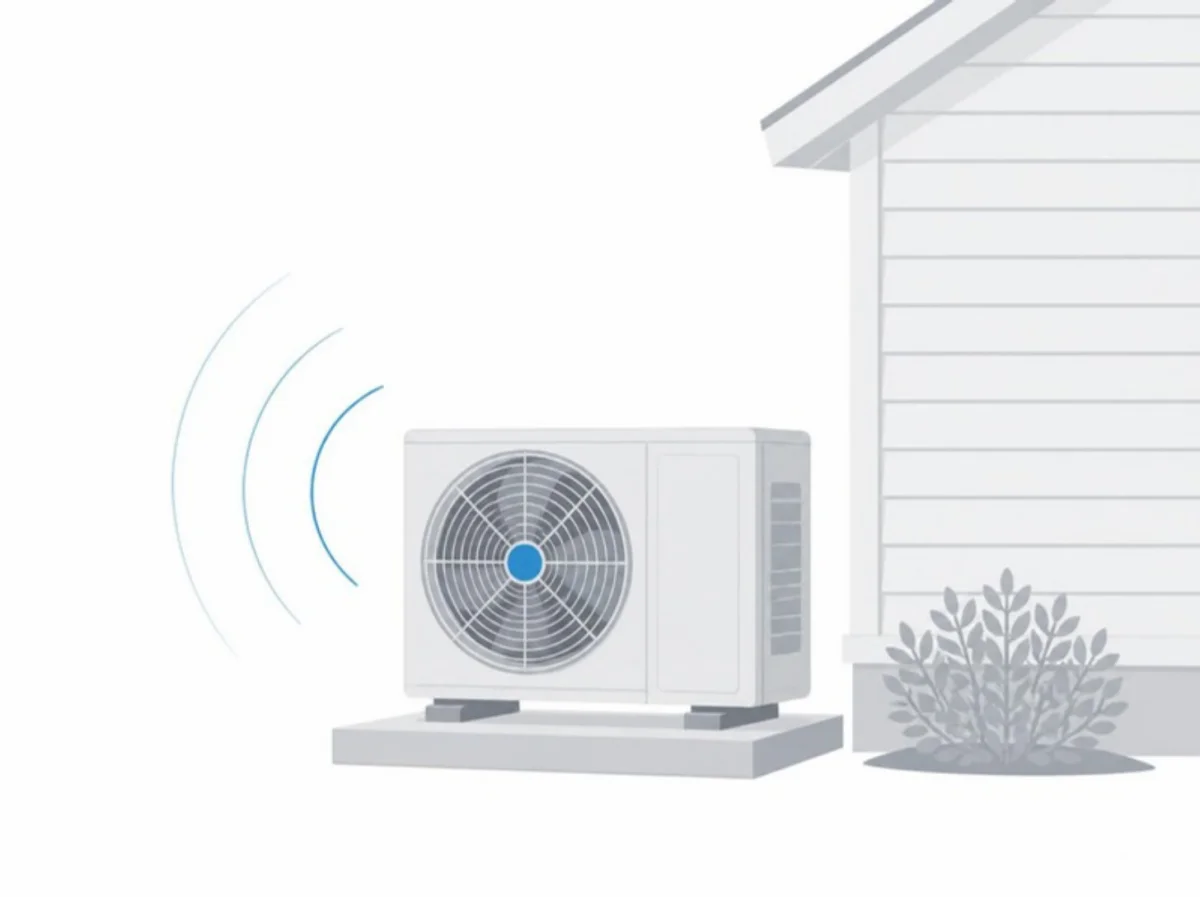
Placement changes what you hear, and the sheets put a number on it. Amana's AHRI 275 distance tables add 3 dBA for each reflective surface beside the unit, so a condenser with walls on two sides reads 6 dBA louder than one in open ground. That takes a 2 ton AXV6S from 43 to 49 dBA at 15 feet. A corner is the worst spot on those numbers, and a new install has the most room to avoid one.
For heat pumps, Amana credits "SmartShift® technology" on its single stage pages, and the ALZT7C's "Time-delay technology with short-cycle protection", with quiet defrost. Defrost and other winter sounds are covered in our heat pump noise explainer, and a unit that recently got louder is the subject of why appliances get louder.
Which Amana air conditioners are discontinued?
Amana no longer lists a single R-410A model in the US. On November 6, 2026 every air conditioner and heat pump on the site was R-32, and the product addresses we tried for older names such as the AVXC20, ASXC18, ASXH5, AVZC20 and ASZC18 redirected to amana-hac.com's 404 page.
With no current page or sheet on Amana's site, those models stay out of every table here. If one already sits in your yard, the spec sheet from its install year is where its rating lives.