Bosch's two washer figures split the cycle: one dBA value for washing, the tumbling hour, and one for spinning, the short high speed finish. A product page row reads "Noise level washing: 52 dBA" and "Noise level spinning: 72 dBA"; the spec sheet repeats both under Silence level rows.
Neither document names a cycle, a measuring distance, a load or a test standard. That leaves the figures solid for setting one Bosch against another on the same phase, and shaky for anything further; the limits are traced in comparing decibel ratings.
The split itself is the useful part. On the same machine, Bosch's spin figure sits 20 to 24 dBA above its wash figure, and a rise of ten reads to most ears as a doubling of loudness. Any brand quoting one flattering number for a washer is probably describing the wash.
How many decibels is a Bosch washing machine?
A current Bosch washer lists 51 or 52 dBA while washing and 72 or 75 dBA while spinning. Bosch's US washer listing carried three models on October 22, 2026, and a fourth page stayed live from the previous 300 Series. All are 24 inch front loaders.
- 52 and 72 dBA: 300 Series WGA14400UC, 2.2 cu ft, 1,400 rpm, $1,349, in stock. The earlier WGA12400UC prints the same pair, $1,249, out of stock and off the listing.
- 51 and 75 dBA: 500 Series WGB24600UC, 2.4 cu ft, 1,600 rpm, $1,599, out of stock. 800 Series WGB246AXUC, 2.4 cu ft, 1,600 rpm, Pearl Steel, $2,199, in stock.
Each pair appeared identically on the product page and its spec sheet the day we read them. Bosch's US laundry listing is compact machines only, so the brand's figures all describe 24 inch washers; the quietest washing machines guide sets them beside the few other brands that publish anything.
Which Bosch washer is quietest, the 300, 500 or 800 Series?
The 300 Series holds the lowest spin figure, 72 dBA, and the 500 and 800 Series hold the lowest wash figure, 51 dBA, so no single series wins both halves of the cycle on Bosch's own numbers.
Through a floor or a shared bedroom wall at night, the spin is usually the half that matters, which favors the 300 Series. Beside a kitchen or home office in the daytime, the hour of washing counts for more than the few minutes of spin, and there the 500 and 800 lead by one decibel.
Between the 500 and the 800 there is no noise contest at all. Both print 51 and 75 dBA, and the $600 between them buys i-DOS dosing and the Pearl Steel finish. Bosch's dishwashers run the other way, with figures that fall as the series climbs, as the Bosch dishwasher decibels page shows.
Does a faster spin make a Bosch washer louder on paper?
Yes. Bosch's two 1,400 rpm washers each list 72 dBA spinning, and its two 1,600 rpm washers each list 75, a three decibel step that tracks the speed exactly. Bosch never states the cause, and with two models on each side the pattern is thin, but it repeats the industry's usual direction.
Every model carries a spin speed reduction control, so a 1,600 rpm machine can run slower. Bosch publishes no decibel figure for reduced speeds, and a slower spin leaves laundry wetter, which its own energy advice trades against dryer time.
How loud are Bosch dryers?
Bosch's three current compact dryers carry one Silence Level each: 67 dBA for the 300 Series condensation model, and 63 dBA on the product pages of both heat pump models, whose spec sheets print 62. A dryer's single figure forms its own group here, never ranked against the washers' two phase pairs.
- 67 dBA: 300 Series WPA12100UC, condensation, 4.0 cu ft, $1,349, in stock. Page and sheet agree. The retired WTG86403UC listed the same figure.
- 63 dBA on the page, 62 on the sheet: 500 Series WQB245B0UC, heat pump, $1,699, out of stock. 800 Series WQB245AXUC, heat pump, Steam Restore, $2,299, in stock.
All three are ventless 24 inch machines built to stack on the matching washer. Their pages share one noise claim, that Anti Vibration sidewalls and insulation leave the machines "specially quiet even for an undisturbed night's sleep", wording Bosch applies to the range rather than any model. Rivals with published figures sit in our compact dryer roundup.
Why do the dryer page and spec sheet disagree by one decibel?
Bosch gives no reason. Its US product pages list a 63 dBA Silence Level for the WQB245B0UC and WQB245AXUC heat pump dryers, while the spec sheets both carry 62 dBA, and the two documents went unreconciled on every date we checked in October 2026.
The washers show no such gap, and neither does the condensation dryer at 67. One decibel is beneath notice in a laundry room; the lesson is about paperwork. When a retailer listing quotes a Bosch dryer figure, it may trace to either document, so match the number to the exact source before comparing models.
Which Bosch washers and dryers stack?
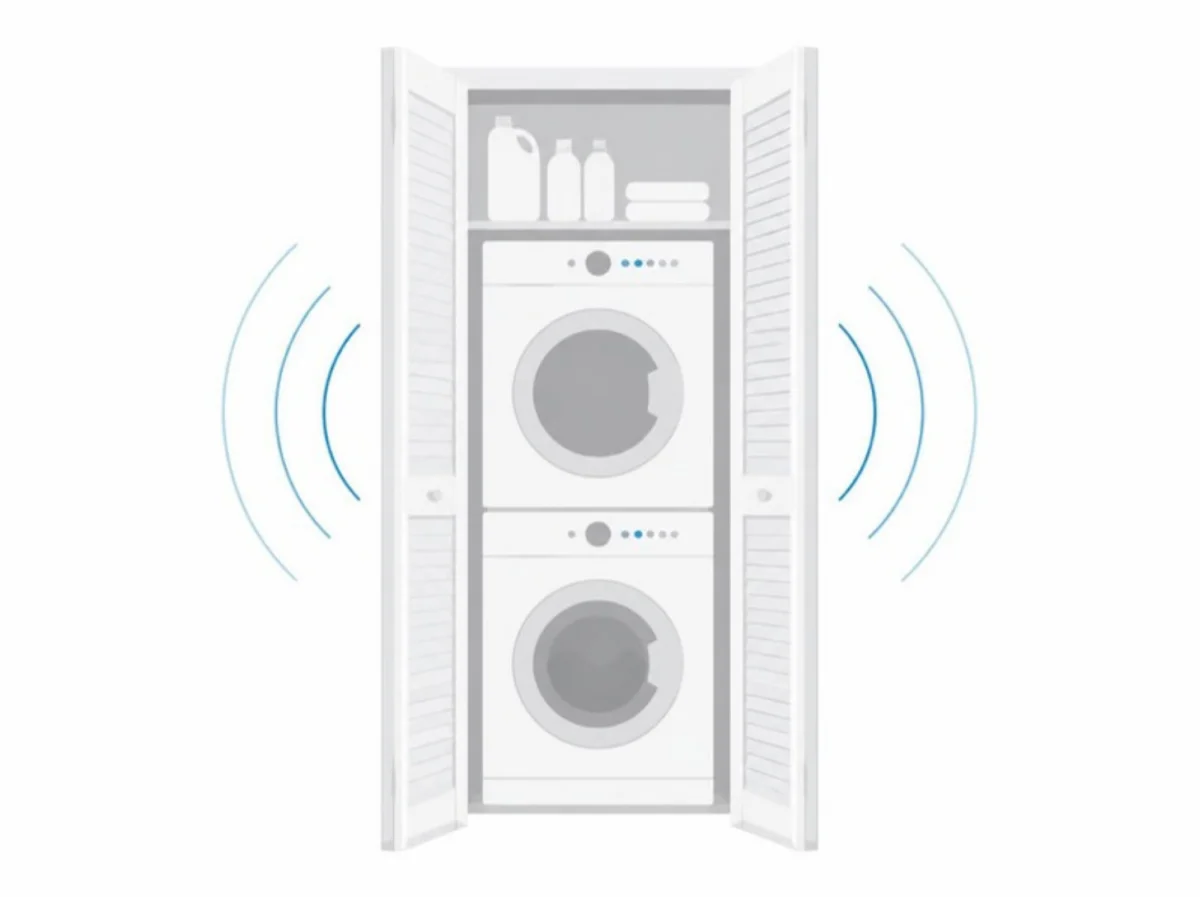
Every current Bosch compact washer accepts a matching Bosch dryer on top, using a stacking kit the spec sheets tie to each series. The 300 Series pair takes WTZ11400UC, WTZ20410UC or WTZSB30UC, the 500 takes WTZ27500UC or WTZ27510UC, and the 800 takes WTZ2750XUC or WTZ2751XUC.
A finished stack is 67 3/4 inches minimum. Bosch's manuals allow stacking only its own dryer on its own washer with the maker's kit, and warn against putting a stack on a platform. For pairs from every brand with published figures, see the stackable washer and dryer guide.
Noise is part of why the pairing matters. The washer passes its spin vibration into whatever carries it, and the kit, not friction, is what holds the dryer. A 300 Series stack puts the 72 dBA spin under the 67 dBA dryer; a 500 or 800 stack pairs 75 with the heat pump models' lower figure.
Why is a Bosch washer loud during the spin cycle?
A Bosch washer that roars or wanders while spinning is usually installed wrong before it is faulty. The 500 Series manual's troubleshooting table blames three things for spin noise and vibration: an appliance that is not correctly aligned, feet that are not fixed, and transit bolts never removed from the back.
Bosch's installation documents add the fixes. Align the machine, then take a 17 mm wrench to the lock nuts on the feet; on a wooden joist floor, screw down a water resistant board at least 1.18 inches thick and stand the washer on that. The published 72 or 75 dBA assumes this groundwork.
The figures above describe the machine, not the room. What a spin sounds like through your particular floor also hangs on joist direction and flooring, which is why our compact washer guide treats installation notes as part of each pick.