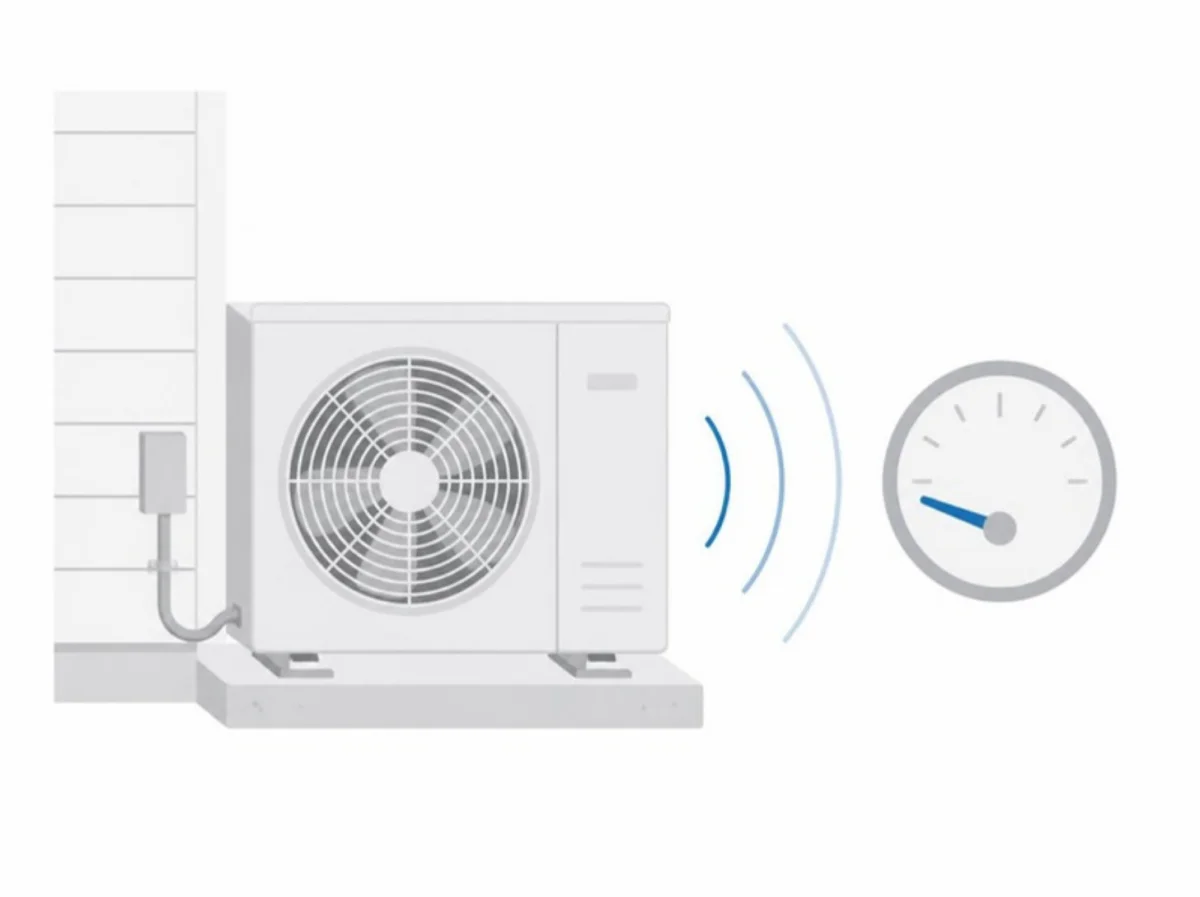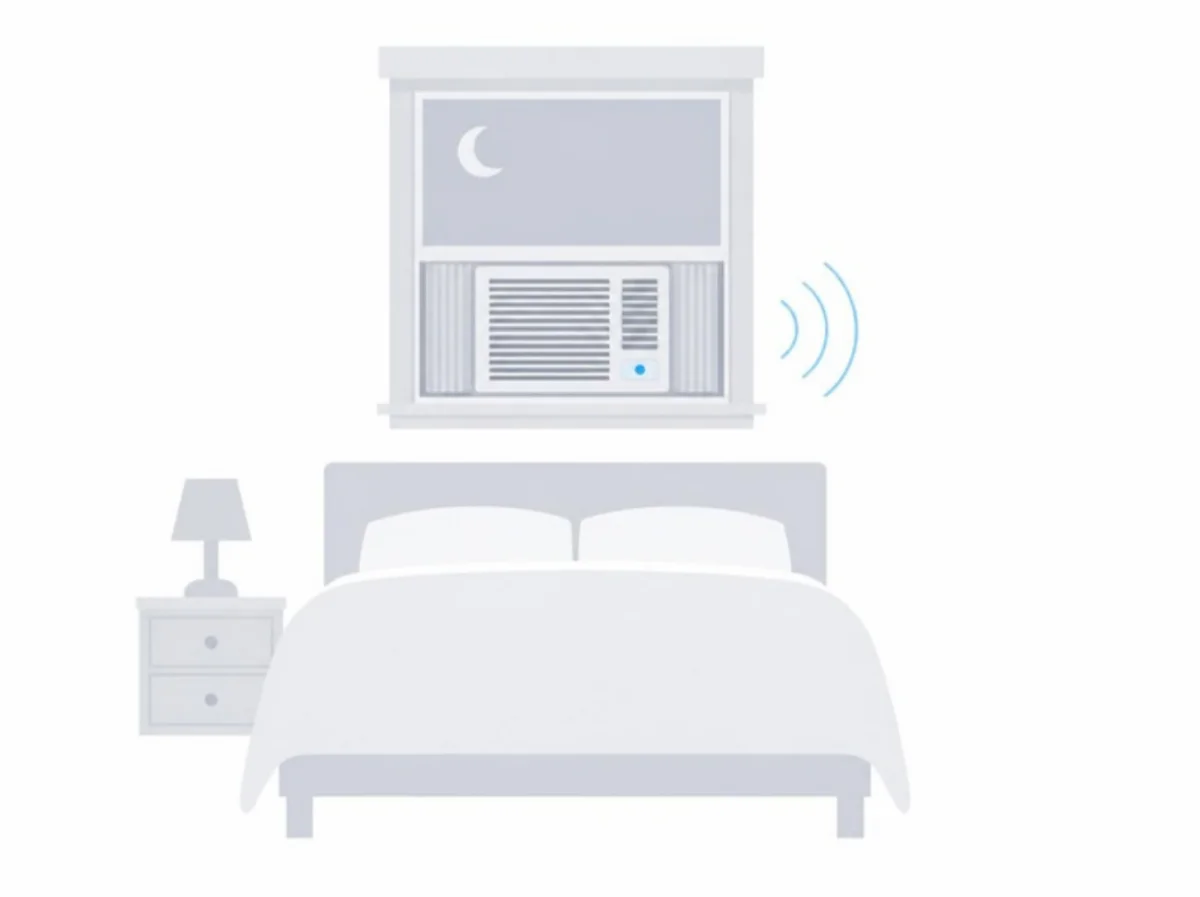
Sleep mode on an air conditioner usually changes three things. It lets the set temperature drift up by 2 to 4°F over the first hour or two, which GE says is to reduce energy use while you sleep. It holds the fan on a slow speed. And it ends on a timer, either by switching the unit off or by putting your old settings back. Quiet mode is a different control: it caps the fan, and on some units the compressor, for as long as it is on, and it does not move your temperature.
Other machines borrow the same words for different jobs. On an air purifier, Sleep is a fan speed below Low with the lights off. On a robot vacuum, Quiet is a lower suction setting, while Do Not Disturb stops the dock from emptying at night. On a dishwasher, Night or Extra Quiet is a slower, longer program. This page goes through each appliance in the makers' own words: what the mode does, what it gives up, and the noise figure, where a maker prints one, with the condition attached to it.
Three jobs hiding behind one button
Read enough manuals and the night modes sort into three kinds of change. Most products combine two or three of them under one name.
The first is a speed cap. The fan, the pump, the compressor or the motor is held at or below a set level. This is what lowers the sound, and it is also what costs you cooling, cleaning or drying.
The second is drift and a timer. The target moves gently over time, then the unit stops or goes back to normal. Air conditioners and mini-splits do this with temperature; tower fans do it with fan speed.
The third is silence and darkness: the display dims or goes off, button beeps stop, voice prompts stop. That changes nothing about the motor, yet it is often what keeps a light sleeper awake.
Window and portable air conditioners
What sleep mode does
LG's owner's manual for the LW1222IVSM says Sleep Mode "keeps operating noise to a minimum and turns the air conditioner off after a set time", with a timer of 1 to 12 hours. The set temperature "increases by 2 °F after 30 minutes and additional 2 °F after another 30 minutes", up to 4°F above where you set it.
GE's manual for the Profile AHTT06BC and AHTT08BC describes an 8 hour program. In Sleep the fan stays on Quiet if it was on Quiet or Auto. GE says the unit "will then raise the set point by 2°F after 1 hour and 2°F more after another hour where it will remain for the next 6 hours", and that after 8 hours it "will resume the settings that were in place before the SLEEP mode button was pressed." So an LG switches off at the end and a GE carries on, which matters on a hot night.
Frigidaire's Gallery GHWQ guide shows that sleep does not always mean slow. Sleep turns the display and lights off and raises the temperature 2°F twice, 30 minutes apart, holding it for 7 hours. But "the unit will automatically select the Auto fan speed", and the same guide says that on Auto, "Initially, fan starts on High Speed and adjusts to a slower speed dictated by room temperature." Soleus Air takes the opposite line: in its WS5 manual, in SLEEP "the fan will run on quiet to keep fan noise at a minimum", and the display dims after 10 seconds.
GE gives the reason for the drift in its AWGP manual: Sleep Mode "gradually changes the unit settings over an 8-hour period to reduce energy usage while sleeping." LG frames it as comfort instead, saying the rise is "for a more comfortable sleep."
What quiet mode does
GE's AWGP manual is the clearest: Quiet "will set the unit in the lowest capacity and/or the lowest fan speed to achieve the best noise performance", in Eco, Cool and Heat. The manual for GE's inverter PHNT units sets the fan to Low and spells out the cost. Quiet "will ensure the most quiet mode of operation to satisfy the set temperature", and "It is normal for the unit to operate for a longer period at lower energy consumption levels to achieve this." GE adds that it is normal to hear the unit change speed "if it senses the room becoming uncomfortable", and that "It is not suggested to use QUIET MODE when the temperature is above 104ºF(40ºC)."
The figures makers print for these modes
Two makers put a mode figure in the spec table beside the normal fan speeds, measured by the same maker in the same way, so the gap within each row means something. Neither states a distance or a test standard, so do not compare one row with another.
| Model | Fan speed figures | Mode figure |
|---|---|---|
| LG LW1222IVSM (window) | 58/54/46 dBA High/Mid/Low | 44 dBA Sleep |
| LG LW2422IVSM (window) | 62/59/55 dBA High/Mid/Low | 44 dBA Sleep |
| LG LP1419IVSM (portable) | 53/50/47 dBA, front, High/Mid/Low | 44 dBA Sleep |
| GE Profile PHNT10CC (window) | 54 dBA High Fan, Cool; 51 dBA Low Fan, Cool | 40 dBA Quiet Mode, Low Cool |
| GE Profile PHNT12CC (window) | 56 dBA High Fan, Cool; 53 dBA Low Fan, Cool | 40 dBA Quiet Mode, Low Cool |
Two things stand out. LG's sleep figure is 44 dBA on all three, portable and window alike, while the Low figure moves from 46 to 55; on the LW1222IVSM sleep is only 2 dBA under Low, and on the LW2422IVSM it is 11 under. GE's quiet figure sits 11 dBA under its own low fan figure on the PHNT10CC and 13 under on the PHNT12CC.
Elsewhere the figures get vaguer. TCL says its H8W25WQ runs "as low as 42dB on Quiet mode", based on "internal test reports using 'indoor side' noise level results". De'Longhi's US FAQ says its portables are normally around 55 dBA and can go down to 50 dBA in Arctic Whisper mode, on the one model with that feature. BLACK+DECKER's BPP10WTB page offers "sleep mode for quiet operation while you rest at 58 dBA on highest setting", which leaves it unclear what the 58 describes. Our bedroom window AC guide and portable AC guide rank units on the figures their makers print.
Mini-splits
A ductless head usually has a named quiet fan speed below Low, plus a sleep function that drifts the temperature. MRCOOL documents both. Its DIY 5th Gen service manual says that with Silence on, "the indoor unit will run at a faint breeze (1% fan speed), which reduces noise to the lowest possible level." Its remote manual names the cost: "Due to the compressor's low frequency of operation, it may result in insufficient cooling or heating capacity." In Sleep, when cooling, "the temperature rises 1.8°F (1°C) (no higher than 86°F (30°C)) every hour", and after 2 hours it stops rising "and the indoor fan is fixed at a low speed."
Fujitsu's Australian support team describes a similar Sleep Timer on units run from its UTY-LNHY remote: in cooling and dry, "The set temperature automatically rises by 1°C every hour", up to 2°C; in heating, "The set temperature automatically drops by 1°C every 30 minutes", up to 4°C. In heating, the drift runs the other way.
Mini-split makers publish the quiet speed as its own column, so the gap to Low is easy to read off each sheet. These are indoor figures in cooling; each maker measures in its own way, so read across a row, not down the table.
| Model | Quiet speed | Low | Top speed | Condition |
|---|---|---|---|---|
| Daikin FTXV09AVJU9 (AURORA) | 19 dB(A) SL | 31 dB(A) | 43 dB(A) H | anechoic chamber, 1 m in front |
| Fujitsu ASUH18KPAS | 26 dB (A) Quiet | 37 dB (A) | 44 dB (A) High | manufacturer's anechoic chamber |
| Mitsubishi Electric MSZ-GX09NL | 19 dB(A) Quiet | 22 dB(A) | 43 dB(A) Super High | anechoic room, compressor stopped |
| MRCOOL DIY 12k 115V | 18 dB(A) Si | 24 dB(A) Lo | 43 dB(A) Turbo | no distance or standard stated |
Daikin defines SL in its data book as "The quiet fan level of the airflow rate setting", and its reference guide footnotes the "as low as 19 dB(A)" claim "On SL fan speed in cooling mode". Mitsubishi Electric warns that its level "can be higher by about 2 dB than the displayed level during cooling and heating operation." The step from quiet to Low ranges from 3 dB(A) on the Mitsubishi Electric to 12 on the Daikin, which is why the quiet figure alone says little about the speed a head will settle on once the room warms up. Fujitsu also lists a "Low-noise outdoor unit operation mode" for the outdoor unit, with no figure for it. Our mini-split guide compares heads speed by speed.
Air purifiers
Here Sleep is a fan speed, not a program. Levoit's Eleva 300X manual says "Sleep Mode operates quietly by using a fan speed lower than the lowest speed" and turns the display off after 3 seconds. Winix's 5510 and 5520 manual says "Fan speed will automatically set to minimum speed (lower than 'Low') which will be nearly silent."
Many purifiers switch to Sleep on their own when the room goes dark. Coway's Airmega 250 manual adds a condition: Sleep starts automatically "when the room is dark and the air quality is Good(Level 1) for 3 minutes". Levoit's Vital 200S-P manual says that with Light Detection on in a dark room, Auto Mode "will not use the high or turbo fan speed to avoid making too much noise."
The cost is cleaning speed, and Levoit says so plainly in its Vital 100S-P manual: "Turbo fan speed (4 indicator lights) is the loudest, but cleans air the quickest." None of the sleep mode descriptions we read gives a clean air delivery rate for that speed.
Figures exist for a few: Levoit says the Eleva 300X "operates as quietly as 20 dB in Sleep Mode", and Coway says the Airmega Halo in Sleep Mode "drops to an industry-leading 17.8 dB(A)". Winix gives the 5510's slowest speed as "Nearly silent on slowest speed (23.5dB)". None states a distance. Our air purifier guide sets these against each maker's top speed.
Dehumidifiers
Frigidaire's use and care guide for the FHDD2234W1 describes Quiet mode this way: "The unit will run in low fan speed for the whole time and the unit will automatically set a comfortable humidity according to the indoor environment", with the display off. The same guide gives the trade in one line about the fan: "A higher fan speed will result in quicker moisture removal." Frigidaire gives no noise figure for Quiet mode. Levoit's pump dehumidifier page gives "Fan mode operates at a minimum of 42dB, while Turbo mode reaches up to 49dB", and no separate figure for its quieter settings. See the dehumidifier guide for the figures makers do publish.
Humidifiers
Levoit's OasisMist 600S manual says "Sleep Mode changes the humidifier's mist setting to low and turns off the display lights", and "Sleep Mode automatically turns off warm mist to reduce noise levels." On the LV600S, Sleep switches to an automatic mist level that holds "50-60% relative humidity". Venta's Original Connect manual says that in Sleep mode "The unit switches to speed level 1", with only two buttons lit at reduced brightness. Vornado's EV3 guide marks fan speeds 1 to 4 for "quiet, nighttime use or smaller rooms".
The figures are all for the mode itself: Levoit lists "21dB ultra-quiet Sleep Mode, zero display lights" for the NeoClassic 450, Dreo lists "Sleep mode at 26dB" for the HM735S, and Venta prints "Sound Levels 24 / 34 / 44 dB(A)" for the LW15 Comfort Plus, whose sleep mode "switches the lowest speed". Less mist is the price, and Dreo shows the other side of it, quoting "up to 30 hours of continuous mist in sleep mode" for the HM306. The humidifier guide covers the rest.
Fans
Fan sleep modes step the speed down over the night. Dreo's FAQ for the 519S says that in Sleep mode "fan speed decreases every 30 minutes. Speed decreases by two levels at most and will remain constant if at level 1. The sound of the prompt will automatically turn off." Lasko's Pinnacle DST100 manual says that in Night Mode "The display will shut off and the speed will gradually decrease as you sleep." Rowenta's Turbo Silence Extreme stand fans have a fixed slowest setting: "Thanks to the silent night position at only 35 dB(A), you can sleep without hearing the fan." The cost is airflow late in the night, and none of these makers gives an airflow figure for the night setting. Our tower fan guide lists the low and high figures Lasko and others publish.
Robot vacuums
Robot vacuums have two separate quiet controls. The first is a quiet suction level. Tapo's RV30 Max datasheet lists "Noise: 52dB (Quiet mode), 55 dB (Default/Standard)", and Dreame's blog gives the X60 Max Ultra "59 dB in Quiet Mode, 60 dB in Standard, 66 dB in Turbo, and just 70 dB at Max." Neither says how far away the microphone was. Quiet mode buys runtime: Ecovacs lists the DEEBOT T80 OMNI at 297 minutes in silent mode against 223 in standard mode, sweeping hard floor. eufy's Omni C20 guide adds that "If the vacuuming noise caused by BoostIQ™ disturbs you, you can disable this feature", BoostIQ being the automatic suction boost on carpet.
The second control is Do Not Disturb, and it governs the dock, often the loudest part. Ecovacs publishes the X9S PRO OMNI's "dust collection noise (dBA) Silent mode: 71 dBA Standard mode: 76 dBA". Roborock's Qrevo CurvX manual sets a default DND period of 22:00 to 08:00 and says "The robot will not auto-empty after returning to the dock in DND mode." eufy's Omni S2 guide says "During the Do Not Disturb period, RoboVac will remain silent, with automatic dust collection and voice notifications disabled." Tapo's guide adds that a schedule will not run inside the DND period. Compare models in our robot vacuum guide.
Dishwashers
A quiet dishwasher program slows the pumps and runs longer. Cove's EXTRA QUIET cycle is "For lightly soiled dishes. Reduces pump speeds." Fisher & Paykel's QUIET modifier "Lowers the motor speed to reduce noise, ideal for open plan living and night use", and its guide offers it on the MEDIUM program only. Miele's G 7766 SCVi AutoDos lists "Extra Quiet 37 dB(A)" against a standard "Operating noise dB(A) re 1 pW: 39", a sound power figure, and the manual calls Extra Quiet a program "with a longer program cycle time." ASKO says its DBI776IXXLSSOF runs at "only 39dB(A) (37dB(A) with Night mode)" and that in Night mode "The program time is extended."
Samsung's Night cycle, downloaded through the SmartThings app, "takes a longer time but less energy than the Normal cycle", with no noise figure. Bosch lists an "Extra Quiet Option" on the 300 Series SHE3ADF5N, also without one. Our dishwasher guide explains why a dBA rating from one brand rarely lines up with another's.
Washers and dryers
Laundry quiet programs trade time for spin and tumble speed. Blomberg's DHP24404W heat pump dryer guide says of its Silent program, "In this programme the level of noise emitted to the environment will be the lowest", and its chart gives Silent 240 minutes for 18 lb against 145 minutes on Cottons. Equator says its washer's Quiet cycle runs "at low RPM with noise level less than 60 dB."
At night, the end-of-cycle signal is often the louder problem, and most makers let you turn it off. Speed Queen's TR3 and TR5 guide says the signal sounds "for three seconds at the end of each cycle. To turn it off, hold the Heavy Soil button for three seconds." Bosch's WPA12100UC manual sets the buzzer from 0 (off) to 4. See the dryer guide and the washing machine guide for full-cycle figures.
How to read a mode figure
A mode figure is usually the quietest number a maker can print, so read it as the floor, not as what you will hear all night. On an air conditioner the unit can leave that floor: GE's PHNT manual says the unit may change speeds if the room gets uncomfortable, and Frigidaire's Sleep mode can start the fan on High. Check whether your manual's sleep mode ends by switching off, as LG's does, or by restoring your settings, as GE's does, before a hot night.
Compare a mode figure only with other figures from the same maker's sheet. Makers state different distances, rooms and standards, or none at all, and our page on comparing decibel ratings explains why. To judge whether a figure is low enough for a bedroom, see how quiet is quiet enough, and for everything else that runs while you sleep, the quiet bedroom page.
We did not measure any appliance for this page and did not test any of these modes. Every description and figure is quoted from the maker's own manual, data sheet, support page or product page, with the condition the maker gives.