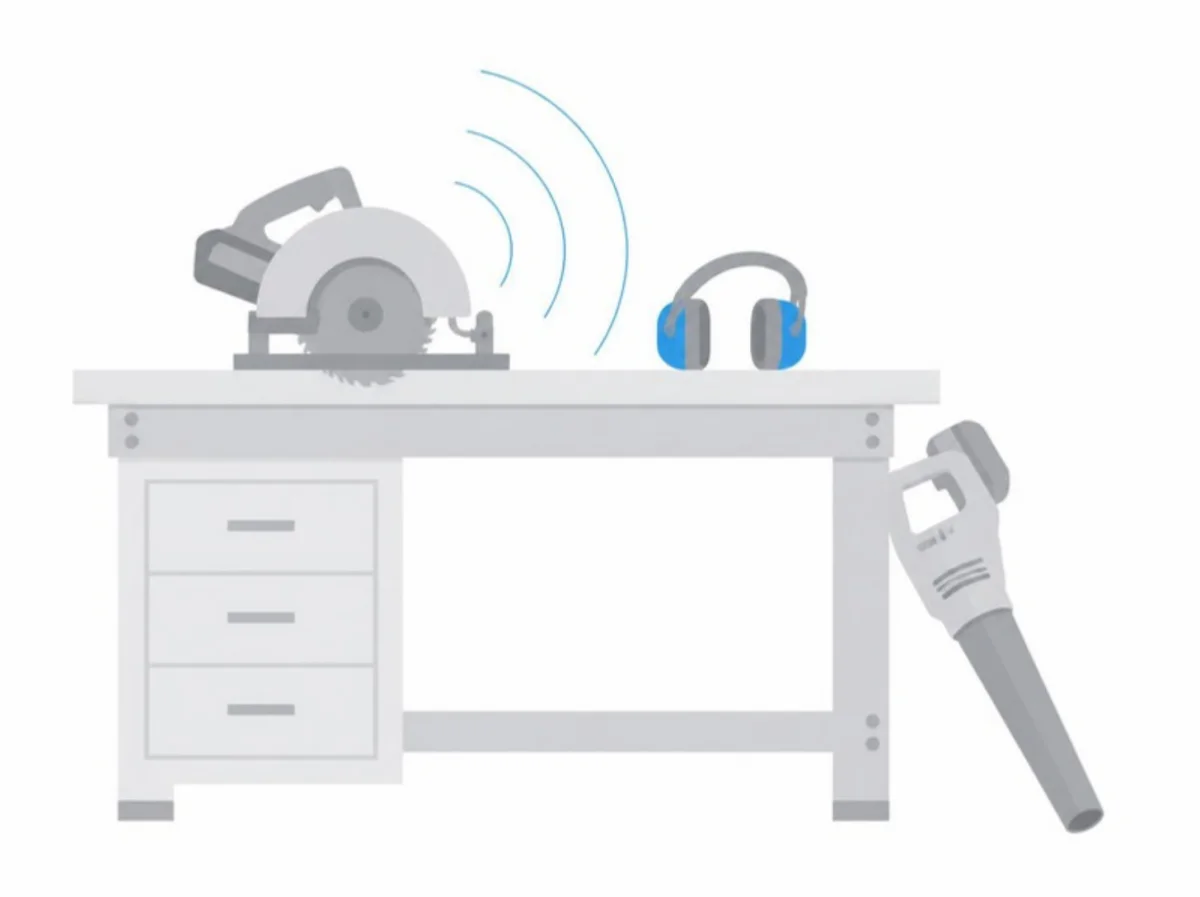
Yes, for nearly every power tool and gas or battery yard tool, by their makers' own account. The saws, grinders, hammers and chainsaws in our guides declare figures at the operator's position from 82 dB(A), for a Makita cordless grinder, to 101 dB(A), for a Makita corded masonry saw, both under EN 62841. NIOSH, the federal institute that studies workplace hearing loss, recommends keeping exposure under 85 dBA averaged over eight hours, and halves the allowed time for every 3 dB above it: one hour a day at 94 dBA, 15 minutes at 100. And a leaf blower's familiar rating, taken 50 feet away for the neighbors, is not what reaches the person holding it: Husqvarna's 525iB Mark II manual gives 64.4 dB(A) at 50 feet in normal mode and 85 dB(A) at the operator's ear.
The sections below set the agency limits out in minutes, show how to read the noise lines in a manual, collect declared figures for the tools we cover, and quote what the makers say about ear protection. Health statements come from NIOSH, OSHA, the CDC, the NIDCD and the EPA, in their words. Tool figures come from the makers, with the standard and uncertainty each one prints.
The NIOSH and OSHA limits
NIOSH set its limit in a 1998 criteria document on occupational noise: "The REL is 85 decibels, A-weighted, as an 8-hr time-weighted average (85 dBA as an 8-hr TWA). Exposures at and above this level are considered hazardous." REL stands for recommended exposure limit. The same document says NIOSH "has also found that scientific evidence supports the use of a 3-dB exchange rate for the calculation of TWA exposures to noise", so each 3 dB step up halves the time. Its formula gives the allowed minutes as 480 divided by 2 raised to the power (L minus 85) divided by 3, where L is the level in dBA.
OSHA, which enforces workplace rules, starts higher and steps more slowly. Its noise page says "OSHA's permissible exposure limit (PEL) is 90 dBA for all workers for an 8 hour day. The OSHA standard uses a 5 dBA exchange rate." The same page puts the two side by side: "OSHA allows 8 hours of exposure to 90 dBA but only 2 hours of exposure to 100 dBA sound levels." It adds: "At 100 dBA, NIOSH recommends less than 15 minutes of exposure per day." OSHA does draw a line at 85 too: employers must run a hearing conservation program, with free hearing protection, "when employee noise exposures equal or exceed 85 decibels (dBA) as an 8-hour time-weighted average (TWA)".
The gap between the two is about risk. NIOSH's document estimates an 8% excess risk of occupational noise-induced hearing loss over a 40-year working lifetime at its 85 dBA limit, against 25% at OSHA's 90 dBA limit.
Minutes at 91, 94, 97 and 100 dBA
Here are the daily durations from NIOSH's Table 1-1 and OSHA's reference durations from Table G-16a in Appendix A of 29 CFR 1910.95.
| Level (dBA) | NIOSH REL (Table 1-1) | OSHA reference duration (Table G-16a) |
|---|---|---|
| 85 | 8 hours | 16 hours |
| 88 | 4 hours | 10.6 hours |
| 91 | 2 hours (120 minutes) | 7.0 hours |
| 94 | 1 hour (60 minutes) | 4.6 hours |
| 97 | 30 minutes | 3.0 hours |
| 100 | 15 minutes | 2 hours |
These times are a daily allowance, and different levels in one day add up. NIOSH's daily dose formula divides the time spent at each level by the time allowed at that level and sums the fractions; the total should stay under 100. Half an hour at 94 dBA uses half the NIOSH day, and fifteen minutes at 97 dBA uses the other half. A morning of ripping boards followed by an afternoon with a string trimmer is one dose, not two.
NIOSH also warns against treating the table as permission to skip protection. A footnote to its hearing protector section says "it would be prudent for a worker in and out of noise or habitually exposed to loud noise (e.g., 91 dBA for 1hr and 59 min) to wear hearing protection while in noise", even when the day's dose stays under 100 percent.
Workplace limits, not a home comfort line
The NIOSH and OSHA numbers were written for workers over a working lifetime. For the general public, the EPA in 1974 identified "a 24-hour exposure level of 70 decibels as the level of environmental noise which will prevent any measurable hearing loss over a lifetime." The NIDCD gives the same two landmarks for everyday life: "Sounds at or below 70 A-weighted decibels (dBA), even after long exposure, are unlikely to cause hearing loss. However, long or repeated exposure to sounds at or above 85 dBA can cause hearing loss."
Home tools are named directly. The NIDCD lists "lawnmowers, leaf blowers, and woodworking tools" among harmful noises at home. The CDC lists "Mowing the lawn" and "Using power tools" as noisy exposures, and says "The louder the sound, the shorter the amount of time it takes for hearing loss to occur."
Reading the noise lines in a manual
Tools sold in Europe carry a noise declaration under EN 62841, the power tool safety standard, which has a part for each kind of tool. Bosch's manual for the GCM 12 GDL miter saw, sold in the US as the GCM12SD, shows the full form: "Noise emission values determined according to EN IEC 62841-3-9. Typically, the A-weighted noise level of the power tool is: Sound pressure level 93 dB(A); sound power level 106 dB(A). Uncertainty K = 3 dB. Wear hearing protection!"
That one line carries three numbers. LpA is the emission sound pressure at the operator's position, the same kind of A-weighted level the agencies write as dBA, and it is the only figure in the declaration that belongs beside the NIOSH table. LWA is sound power, the tool's total acoustic output into the room. It is always the larger number and is not a level at anyone's ear, so it never goes against an exposure limit. K is the uncertainty the maker states. Most tools here carry 3 dB; Festool declares its TSC 55 KEB-Basic track saw at 96.00 dB(A) sawing wood, with a K of 1.50 dB, and DEWALT's UK manual for the D24000 tile saw prints 91.8 dB(A) with K at 2.5. Two tools closer together than their K values may sound the same in use.
A declared LpA is a standard test, not a reading of your own day. DEWALT's DWS780 manual says the level "has been measured in accordance with a standardised test given in EN62841 and may be used to compare one tool with another. It may be used for a preliminary assessment of exposure." It goes on to warn that "if the tool is used for different applications, with different accessories or poorly maintained, the vibration and/or noise emission may differ." Makita's grinder manual is more pointed, warning that grinding thin sheet metal "can result in a total noise emission much higher (up to 15 dB) than the declared noise emission values".
Two checks make the figures safe to read, in a workshop or in the yard. Check the standard: a figure under EN 62841 is not ranked against one under the older EN 60745, or against one that names no standard, as Milwaukee's European pages and Husqvarna's US pages often do. And check the quantity: a figure labeled sound power, a figure at 50 feet and a figure at the ear are three different things.
The leaf blower's 50 foot rating
Leaf blowers sold in the US usually advertise a bystander figure measured 50 feet away under ANSI B175.2, the number that matters to the neighbors and to local blower rules. Milwaukee's manual for the 3017-20 lists "50' Bystander Sound Pressure Level........ 54 dB(A)" per ANSI B175.2. STIHL lists the gas BR 800 C-E backpack blower at "Sound pressure level 15 m distance 77 dB(A)", measured to ANSI/OPEI B175.2-2012 (R2019).
None of that is the level at the handle. The 525iB Mark II manual pairs its 64.4 dB(A) bystander figure with "Equivalent sound pressure level at the operator's ear, measured according to EN ISO 11203 and ISO 22868" of 85. The October 2024 edition of Husqvarna's 125B manual gives 93 dB(A) at the operator's ear under ISO 22868 and 71 dB(A) at the bystander's ear under ANSI B175.2. So the answer to how loud a leaf blower is depends on who is asking: the person next door, or the person holding it.
NIOSH has also cited field measurements. In a 2018 post on grounds crews, it published maximum levels measured by Balanay and colleagues among North Carolina university groundskeepers, with leaf blowers at 95 to 106 dBA and chainsaws at 105 to 109 dBA. A maximum is the loudest moment of a work period, a different quantity from either declaration, so it sits apart from the makers' figures here.
Declared figures by tool
Each figure below is the maker's sound pressure at the operator's position, quoted with its standard and uncertainty. Within each tool type, our guides rank only figures declared the same way.
Saws, grinders and hammers
Table saws are among the loudest tools in a home shop. DEWALT's UK manual for the DWE7492, the European twin of the DWE7491RS, declares 92.0 dB(A) under EN62841-3-1 with a K of 2. SawStop's EU manual for its Compact Table Saw gives "Lpa = 99.4 dB" under EN 62841 with an uncertainty of 3 dB, written without the (A).
Miter saws sit close behind. Bosch declares 93 dB(A) for the GCM 12 GDL and 88 dB(A) for the cordless GCM 18V-305 GDC, sold in the US as the GCM18V-12GDCN, both under EN IEC 62841-3-9 with K of 3 dB.
Circular and track saws run in the 90s. Bosch's EXKT18V-52G, the European version of the GKT18V-20GCL, declares 99 dB(A) under EN 62841-2-5 with K of 3 dB.
Angle grinders declare lower than most saws. Makita's DGA504, the XAG04Z in the US, declares 82 dB(A) under EN62841-2-3 with K of 3 dB(A), and Bosch's GWS 18V-10 declares 85 dB(A) with K of 3 dB. The thin sheet metal warning above is the reason those figures deserve a margin.
Rotary hammers declared under EN 62841 sit in the 90s. Hilti gives 90 dB(A) for the TE 4-22 and 95 dB(A) for the TE 2-22, each with a KpA of 3 dB(A) under the EN 62841 standards.
Tile saws show the widest spread from one maker. Makita declares 87 dB(A) for the 12V CC301D, the CC02Z in the US, and 101 dB(A) for the corded 4101RH, both under EN62841-2-22 with K of 3 dB(A).
Yard tools
String trimmers split by power source and by standard. STIHL's FS 56 manual declares the gas FS 56 RC-E at 93 dB(A) with a mowing head, as Lpeq under ISO 22868 with a K-factor of 2.0 dB(A). Its battery FSA 57, one of the cordless trimmers we cover, declares 74 dB(A) under EN 50636-2-91 with K of 2 dB(A). The standards differ, so the two are not ranked against each other; set beside the NIOSH table, the FS 56 RC-E figure matches the NIOSH row for 1 hour 16 minutes.
Hedge trimmers follow the same pattern. STIHL's HS 45 gas trimmer declares 97 dB(A) under ISO 22868 with K of 2 dB(A), the NIOSH 30 minute row. The battery HSA 26 shrub shear declares 72 dB(A) under EN 62841-4-2.
Chainsaws are the loudest yard tools we cover. STIHL's gas MS 250 declares 99 dB(A) as Lpeq under ISO 22868 with K of 2.0 dB(A). Makita's corded UC4051A, one of the electric chainsaws we cover, declares 95 dB(A) under EN62841-4-1 with K of 3 dB(A). The battery MSA 60 declares 83 dB(A) under EN 62841-4-1 with K of 2 dB(A).
Mowers are quieter at the handle than most saws, but not quiet. STIHL's European manual for the RMA 765 V, a battery mower, declares 84 dB(A) under EN IEC 62841-4-3 with KpA of 3 dB(A).
What the manuals say about ear protection
Bosch ends its noise declarations for the GCM 12 GDL, the GCM 18V-305 GDC and the GWS 18V-10 with "Wear hearing protection!" Makita's grinder and chainsaw manuals print "WARNING: Wear ear protection." DEWALT's DWS780 manual says "WARNING: Always wear proper personal hearing protection. Under some conditions and duration of use, noise from this product may contribute to hearing loss." It then lists ways to lower the noise at source, such as using "only well sharpened saw blades". DEWALT's US manual for the D24000 tile saw says "Wear appropriate hearing protection during use." Husqvarna's TS 60 manual says "Long-term exposure to noise can result in permanent hearing impairment. So always use approved hearing protection."
Yard tool makers say it as often. "ECHO recommends wearing hearing protection whenever unit is used," says the PB-265LN manual. STIHL's BR 200 manual says "Wear sound barriers (ear plugs or ear muffs)" and "Regular operators should have their hearing checked periodically." The 125B manual tells owners to "Always use approved ear protection while you operate the product. Noise for a long period can cause noise-induced hearing loss." Milwaukee's 3017-20 manual says "Always wear eye protection, hearing protection, and protective clothing and footwear."
The quieter tools carry the same instruction. STIHL prints "STIHL recommends wearing ear defenders." directly above the 83 dB(A) it declares for the MSA 60. Worx's EU manual for the WG163E trimmer prints "Wear ear protection" beside a declared "LpA = 74dB(A)". Husqvarna's 525iB Mark II manual explains why: "In general, battery powered products are relatively quiet but damage can result from a combination of noise level and long usage."
Choosing and wearing protection
The agencies agree that protection only works when it is worn, and worn well. The NIDCD's advice for everyone is to "Wear earplugs or other protective devices when involved in a loud activity", and it notes that "activity-specific earplugs and earmuffs are available at hardware and sporting goods stores." NIOSH's post on grounds crews says protectors rank low among controls because "oftentimes they are not worn, or they are worn incorrectly."
The number on the package is a laboratory figure. OSHA's technical manual says "The actual level of protection is likely lower than indicated on the label", and NIOSH's criteria document tells workplaces to derate the labeled NRR before relying on it: subtract 25% for earmuffs, 50% for slow-recovery formable earplugs and 70% for all other earplugs. For workplace exposures above 100 dBA as an 8-hour average, NIOSH says workers "should wear earplugs and earmuffs simultaneously".
Protection has a cost the manuals name. STIHL's HS 45 manual says to "Be particularly alert and cautious when wearing ear protection because your ability to hear warnings (shouts, alarms, etc.) is impaired." The 525iB Mark II manual adds "WARNING: Hearing protectors limit the ability to hear sounds and warning signals."
A quieter tool buys time
OSHA lists "using quieter machines" first among the ways to prevent hearing loss, and NIOSH's grounds crew series describes a Buy Quiet approach: "purchasing or renting quieter equipment to reduce worker noise exposure." The 3 dB exchange rate is why it pays. A tool declared 5 or 6 dB lower, under the same standard, by the same maker, gives roughly three or four times the NIOSH allowance.
The makers' own figures show the size of the gap within one brand. Bosch declares 88 dB(A) at the operator for its GCM 18V-305 GDC miter saw and 93 dB(A) for its GCM 12 GDL. Hilti declares 90 dB(A) for the TE 4-22 rotary hammer and 95 dB(A) for the TE 2-22. Makita declares 87 dB(A) for the CC301D wet cutter and 101 dB(A) for the 4101RH. Each pair shares a maker, a standard and a K value, which is what makes the comparison fair, and each gap is 5 dB or more, enough on the NIOSH scale to cut the safe daily time to a third or less.
Do not read a declared figure as a timer for your own day. It is measured under the test conditions the standard sets, with an uncertainty of K, which is 3 dB on most of these manuals, and a 3 dB swing doubles or halves the NIOSH allowance. The material being cut, a hard-walled room and how close you work all change the level at your ear. The figures are for choosing between tools, not for deciding how long to go without hearing protection, and every one of these manuals tells you to wear it.
We did not measure any tool, take any reading at an operator's ear, or test any hearing protector. Every limit, duration and health statement here is quoted from NIOSH, OSHA, the CDC, the NIDCD or the EPA, and every tool figure is the maker's own declaration, quoted with the standard and uncertainty it prints.