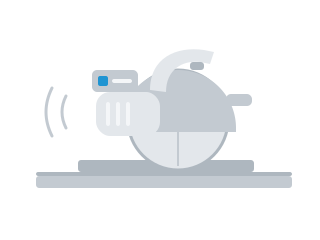
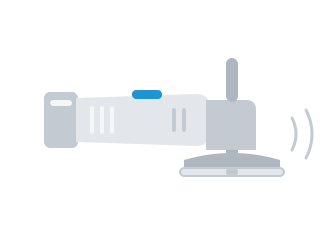
A wet tile saw spins a diamond blade at thousands of revolutions a minute through porcelain, stone or glass, and a pump keeps water running over the cut the whole time. The person feeding tile into it stands an arm's length from the blade for as long as the job lasts, often in a bathroom or kitchen with hard walls on every side.
Five wet tile saws sold in the US have a noise declaration from their maker that we could read and tie to the US model. Three are tabletop saws and two are handheld cutters, and the two kinds are tested to different standards, so they are grouped apart below. The tabletop saws come within 0.3 dB of each other at the ear.
Our picks are listed above, with full specifications for each.
Two kinds of wet saw, two tests
Husqvarna and DEWALT declare their tabletop saws to EN 12418, the European safety standard for masonry and stone cutting machines used on site. DEWALT cites EN62841-1 as well, and says the emission level was measured to the test in EN 12418. Makita declares its handheld cutters to EN62841-2-22, the part of the power tool standard written for cut-off machines held in the hand.
A figure from one test is not ranked against a figure from the other, because each standard sets its own operating conditions for the test. The handheld cutters also do a different job: they notch, trim and cut in place, while a tabletop saw rips and crosscuts tile pushed through on a cart. So the picks fall into two groups, and each is ranked only within itself.
The tabletop saws, within 0.3 dB
These are the three declarations at the operator's ear, each as its maker printed it:
- Husqvarna TS 60: 91,5 dB(A), standard deviation 1.0 dB(A)
- DEWALT D24000: 91.8 dB(A), K 2.5 dB(A)
- DEWALT D36000: 91.8 dB(A), K 2.5 dB(A)
The Husqvarna is lowest by 0.3 dB. Husqvarna gives a standard deviation of 1.0 dB(A) where DEWALT gives an uncertainty K of 2.5, two different ways of stating spread, and the gap is smaller than either. On the makers' own paperwork, these three saws are level at the ear.
DEWALT's two saws make the point from another side. The D36000 rips 37 in. and weighs 91 pounds, the D24000 rips 25 in. and weighs 69, and DEWALT's UK manuals give them the same 91.8 at the ear and 101.5 sound power. Both run a 10 in. blade on a 4200 RPM motor, and longer rails do not change what DEWALT declares.
Sound power, printed two ways
Husqvarna prints two sound power figures for the TS 60: 97,3 dB(A) measured and 98,3 dB(A) guaranteed. A guaranteed level is a ceiling the maker commits to, while DEWALT's 101.5 dB(A) is a declared value with a K of 2.5, a different kind of figure. We list each beside its saw and do not rank the three on sound power.
The handheld cutters, 14 dB apart
Both handheld picks are Makita's, both are declared to EN62841-2-22 with a K of 3, and both figures come from Makita's EU manuals, so they can be compared directly. The cordless CC02, sold in Europe as the CC301D, declares 87 dB(A) at the ear and 95 sound power. The corded 4101RH declares 101 and 109.
Fourteen decibels at the ear is far more than the uncertainty. It also tracks the job each saw is built for. The CC02 runs a 3-3/8 in. wheel at 1,600 RPM and cuts 1 in. deep; the 4101RH runs a 5 in. wheel at 13,800 RPM and cuts 1-5/8 in. If the cuts are wall tile, backsplash or glass, the smaller saw is the quieter choice on Makita's own figures.
A product page and a manual that disagree
Makita UK's product pages print a lower figure at the ear than Makita's manuals for both tools: 84 dB(A) for the CC301D against the manual's 87, and 98 for the 4101RH against 101. The sound power figures and the K of 3 match. Makita does not say why, and we use the manual figures, because the manuals name EN62841-2-22 and the pages name no standard.
US pages, European paperwork
None of the five saws has a noise figure on its US product page, and the US manuals we opened for the D24000, D36000, CC02 and 4101RH print none. Every figure here comes from the same maker's European documents.
DEWALT's D24000 and D36000 and Makita's 4101RH carry the same model number in both markets, and their US and European manuals give the same blade, speed and depth. Makita's US CC02 and EU CC301D share the 85 mm wheel, the 1,600 RPM rating, both cutting depths, the overall lengths and the weights in their manuals. Husqvarna's US page for the 120 V TS 60 links an operator's manual whose technical data covers the TS60, 230V, so the TS 60 figures describe the 230 V saw.
Rubi's data sheets for the DU-200 EVO 850 and ND-180 give no noise figure, and its DU-200 EVO manual gives a vibration value but none for noise. MK Diamond's MK-370EXP manual prints none, and neither does Husqvarna's US manual for its bigger TS70 and TS90 saws. SKIL's US page for the 3540-02 7 in. wet saw and RYOBI's US page for its 7 in. wet saw with a folding stand give no figure either.
What the declarations leave out
A standard test fixes the blade, the material and the feed so that saws can be compared, and a real cut changes all three. Porcelain, natural stone and soft wall tile load the blade differently, a worn or segmented blade sounds different from the continuous rim blade these saws ship with, and a fast feed loads the motor harder than a slow one. Treat the figures as a way to rank saws within each group rather than a prediction of your room.
In a garage or a shared workspace the saw rarely runs alone. Our quiet workshop page covers the tools likely to run beside it, and the table saw guide ranks the saws that cut the trim and subfloor around the tile.
How we chose
Our reading started with the US product pages, and the manuals linked from them, for DEWALT, Makita, Husqvarna, SKIL and RYOBI, and Rubi's data sheets and manuals from its own site. For DEWALT and Makita we then read the same model's UK or EU manual, and Makita UK's product pages. RIDGID's site and MK Diamond's product pages refused our requests; MK Diamond's manual for the MK-370EXP loaded and prints no figure. Our searches turned up no wet tile saw from Milwaukee or Evolution, and we did not reach a QEP, Kobalt or Bosch wet tile saw manual, so none of those makers is counted.
A saw made the picks only with a noise declaration from its own maker that we could tie to a model sold in the US. Each figure is quoted with its unit, its standard and its uncertainty as printed, decimal comma included for Husqvarna. Tabletop saws tested to EN 12418 and handheld cutters tested to EN62841-2-22 are ranked only within their own group, and sound power is never ranked against sound pressure. The only maker price we found was Husqvarna's $1,475 list price, on October 17, 2026; DEWALT and Makita show none on their US sites.
We did not measure any of these tile saws; every decibel figure here was copied from DEWALT's UK manuals, Makita's EU manuals and UK product pages, or the Husqvarna manual linked from Husqvarna's US page.