One rating, taken 50 feet away
In the US Milwaukee uses a single kind of noise figure: the sound level a bystander would measure 15 m, about 50 feet, from a running blower, under the ANSI B175.2 standard. City blower rules use the same figure, often with a 65 dB(A) limit, and it is roughly what the house next door hears.
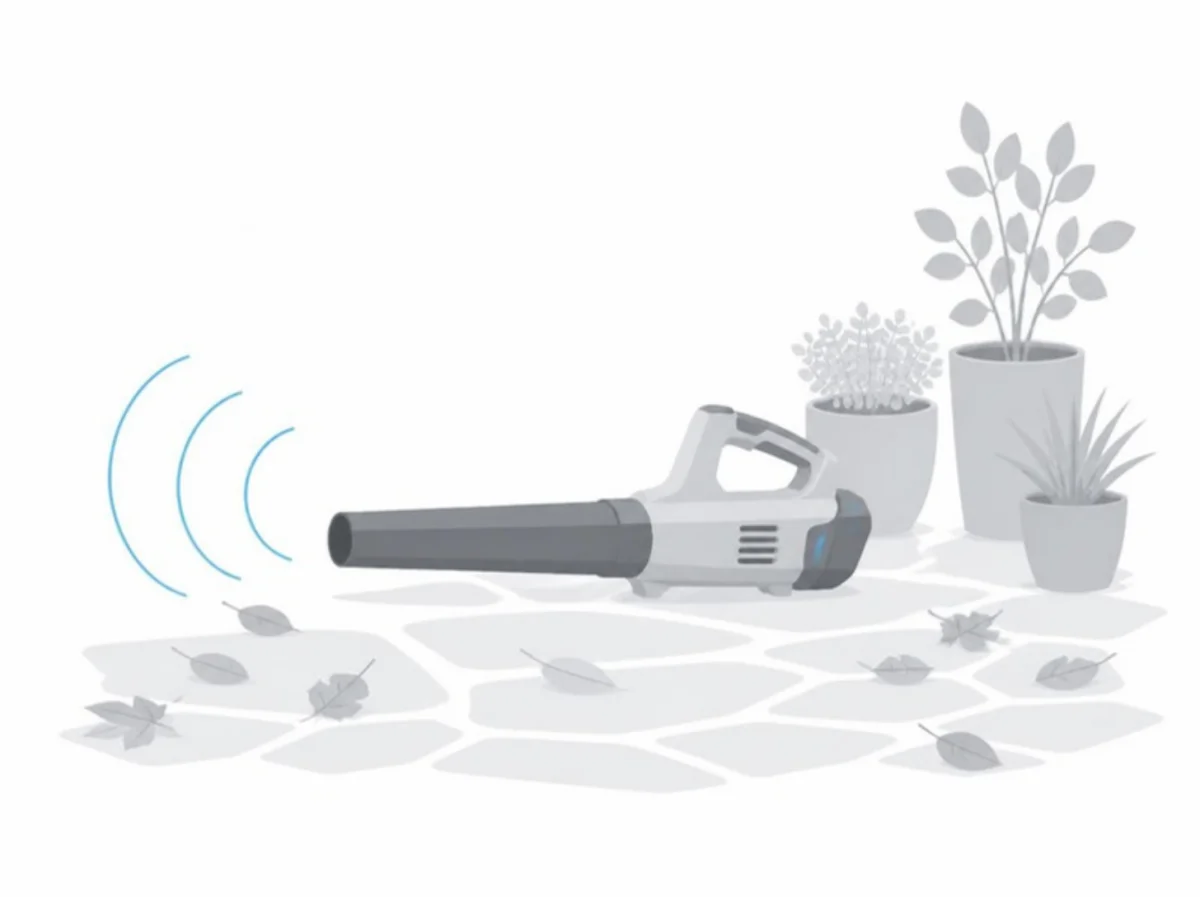
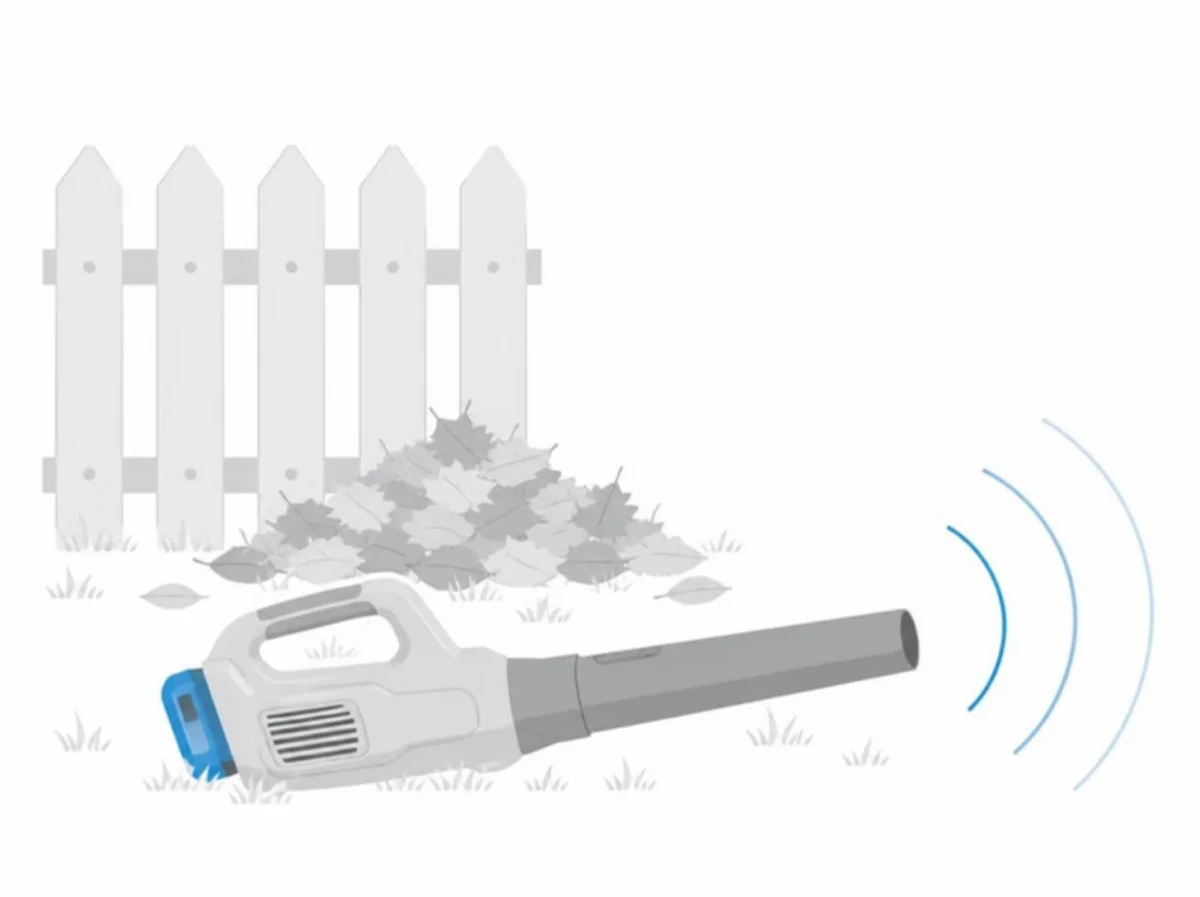
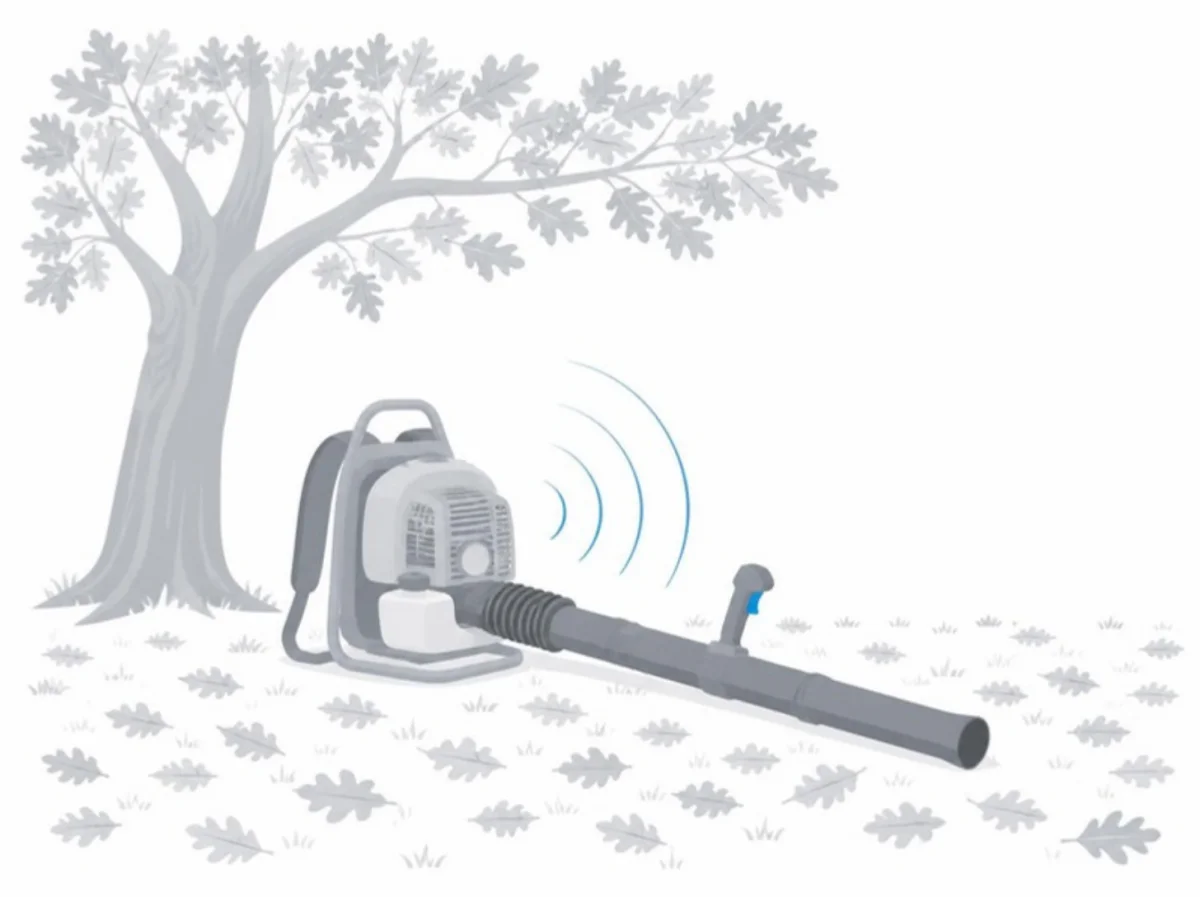
It shows up in three places. The 3017-20, 3009-20 and 2824-20 manuals list it in the specifications as "50' Bystander Sound Pressure Level", in dB(A), and repeat it among the safety symbols beside the words "per ANSI B175.2". Product pages carry a spec row called "Decibel Rating" with the same number written as plain dB, such as "54 dB" for the 3017-20. Feature text and FAQs restate it, sometimes with the standard named: "operates at just 54 dB(A) per ANSI B175.2 standards" for the 3017-20, "a noise rating of 64 decibels according to ANSI B175.2 standards" for the MX FUEL backpack.
Missing from the US paperwork are an operator's-ear figure and a sound power level. EU rules require both, and Milwaukee declares them on its European site, but for European models with their own names.
A 50 foot bystander figure, an ear figure and a sound power level measure three different things. Milwaukee's ANSI numbers are ranked here only against each other, and numbers with no stated basis are listed apart.
Which Milwaukee blower is the quietest?
The M18 FUEL Blower 3017-20, at 54 dB(A) from 50 feet under ANSI B175.2. The five rated blowers run up to 64.
| Blower | Format and power | 50 ft rating | Airflow | Where printed |
|---|
| M18 FUEL Blower 3017-20 | Handheld, one M18 battery | 54 dB(A) | 500 CFM | Manual and product page |
| QUIK-LOK Blower Attachment 49-16-2793 | On the M18 FUEL power head 3016-20 | 59 dB(A) | 500 CFM | Product page |
| M18 FUEL Dual Battery Backpack Blower 3009-20 | Backpack, two to four M18 batteries | 62 dB(A) | 650 CFM | Manual and product page |
| M18 FUEL Dual Battery Blower 2824-20 | Handheld, two M18 batteries | 64 dB(A) | 600 CFM | Manual and product page |
| MX FUEL Backpack Blower MXF600 | Backpack, one MX FUEL battery | 64 dB(A) | 800 CFM, 30 N "in high mode" | Product page |
For the QUIK-LOK attachment and the MXF600, the documents linked from those pages print no sound data, so the product page is the only source.
The two battery platforms meet at the backpack. There the M18 FUEL 3009 lists two decibels less than the MX FUEL MXF600, while the MXF600 moves more air and carries a 2 year warranty against 3 years for the M18 blowers.
Kits carry the figure of the blower inside them. The 3017-21HD kit and the 3031-21 string trimmer and blower combo kit both include the 3017-20, which the combo kit page credits with "low noise levels of 54dB(A)". The 3009-24HD kit is the 3009-20 with four HD12.0 batteries and two chargers, and the MXF600-2HD is the kit version of the MXF600.
With the basis shared, the 3017-20 and 2824-20 can be held against other handheld battery blowers rated at 50 feet, and the 3009 and MXF600 against other backpack blowers.
Three blowers list decibels with no distance
These three carry a number with no distance or standard, so they are kept apart from the ANSI figures above.
| Blower | Figure as printed | Notes |
|---|
| M18 Brushless Blower 3044-20 | "Sound level of 62dB(A)" | 450 CFM, 4.4 lb; no manual found |
| M12 Compact Spot Blower 0852-20 | "Decibel Rating" 78 dB | 175 CFM jobsite blower; manual prints no sound figure |
| M18 Brushless Precision Blower 0887-20 | "Decibel Rating" 90.5 dB | 39 CFM, built for 570 MPH air speed rather than leaves |
The 3044-20 page compares it with the M18 FUEL blower, which it says has "substantially lower noise at 54 dba". That hints at a shared basis. The page never names one.
The M18 Compact Blower 0884-20 shows a "Decibel Rating" of 0 dB, a blank field rather than a figure. An older M18 FUEL blower page, the 2724-20, is still live with a "Sound Pressure" row of 62dB, but its manual prints no noise figure and the page gives no distance. Milwaukee's data list the 2728 blower as discontinued, so it is left out.
How loud are Milwaukee trimmers, chainsaws and mowers?
No figure is printed for any of them, in the US operator's manuals or as a "Decibel Rating" row on the product pages.
The manuals checked were those for the 2727 chainsaw, the 2826 top handle chainsaw, the 2827 dual battery chainsaw, the 3004 and 2527 HATCHET pruning saws, the 3013 telescoping pole saw and the QUIK-LOK pole saw attachment, the 3006, 2828 and 3015 trimmers and the QUIK-LOK trimmer attachment, the 2533, 2726, 3001, 3033, 3034 and 3043 hedge trimmers, and the 3016 power head. The saw manuals mention ANSI B175.1, but only to certify low kickback chain. None of the product pages for these tools, or for the 3046 trimmer, the 3012 and 3035 pole hedge trimmers, the 3014 mulching vacuum or the 2823 mower, has a "Decibel Rating" row.
Two pages do show a number, inside comparison charts against gas tools. The 3006-20 dual battery trimmer page describes "87.7 dB noise level" beside a "leading 36cc gas competitor", and the 3011-20 edger page says it "produces lower noise (78 dB(A) vs. 97 dB(A))" against a "leading 31cc gas competitor". With no distance or standard, neither can be compared with anything outside its own chart. They are claims, reported as claims.
That silence keeps every Milwaukee US trimmer, saw and hedge trimmer out of any ranking against the string trimmers, chainsaws, hedge trimmers and pole saws whose makers do publish a figure.
European figures stay off this page
EU rules require operator and sound power figures, and Milwaukee's European site declares them for many outdoor tools. The catch for a US buyer is the naming. In Europe the tools carry European names, such as M18 F2BPB for a dual battery backpack blower, M18 FOPH2 for a QUIK-LOK power head and M18 F2LM53 for a dual battery mower, and the European pages opened for this page cite no US catalog number.
Specifications can look alike while motors, settings or decks differ. A European figure is used here only when the maker ties the two models by its own numbering, and Milwaukee does not.
The mower is where this bites. The M18 F2LM53 looks like the European version of the US 2823-20, but the match is only probable, so anyone weighing the 2823-20 among battery lawn mowers should treat that European declaration as unconfirmed for the US model.
Stronger Milwaukee blowers mostly run louder
The two loudest rated blowers, both at 64 dB(A), are the strongest: the 2824-20 at 600 CFM and 17.7 N, and the MXF600 at 800 CFM and 30 N. The quietest, the 3017-20, moves 500 CFM at 12.2 N.
Design matters for the same air. The QUIK-LOK attachment matches the 3017-20 at 500 CFM and 120 MPH yet lists 59 dB(A) against 54, so a dedicated blower is the quieter way to get that airflow.
Size does not always decide it either. The 3009 backpack lists 62 dB(A) with 650 CFM, two decibels under the 2824-20 handheld at 600 CFM.
Mode and throttle are the open question. Milwaukee publishes one figure per blower without saying which mode or throttle it was measured at, though it does publish run times by mode and throttle. Running below full power is the plain way to cut noise in practice.
Is the Milwaukee M18 FUEL blower really 40% quieter?
Nobody can check. The 3017-20 is sold as "Up To 40% Quieter than the competition", with low noise "reducing disturbance to bystanders", and the competition is never named.
The 3009 backpack gets similar treatment: "a higher blowing force than up to 60cc gas while maintaining a noise level of 62dB(A)", and a comparison with a gas blower at "62 dB(A) vs. 74 dB(A)". "Low Noise" appears among the reasons to choose the 2824-20, 3009 and MXF600 over gas. Without named competitors, none of these can be tested, and none is repeated here as a finding.
What can be said rests on the ANSI figures. At 50 feet the 3017-20's 54 dB(A) sits 10 decibels under the 2824-20 and the MXF600, a gap most listeners hear as roughly half as loud. The decibel chart places the 3017-20's 54 dB(A), and the 64 dB(A) of the 2824-20 and MXF600, among everyday sounds.
Every figure here is Milwaukee's, from its US product pages and the operator's manuals they link, as read on October 5, 2026.