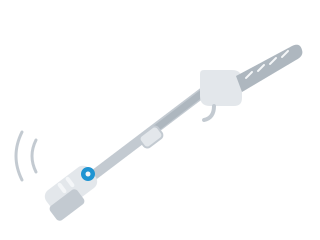
A pole saw puts the chain up in the tree and keeps everything else near you. On battery models the motor sits at the top of the shaft, but the battery, trigger and your ears are all at the bottom, looking up. The operator ear figure is the one that decides whether you want hearing protection, and in this category it varies more than most buyers would guess.
Sixteen pole saws are declared by their makers in figures we could read. Under ISO 22868, battery pole saws declare from 77 to 93 dB(A) at the ear. Gas declares 92 and 93. Declarations that name no test run from 82 to 95.1 for battery and 89 to 89.2 for gas.
The tests behind the numbers
STIHL and Makita declare their pole saws under ISO 22868, the noise test for portable hand held forest and garden machinery. Makita cites it as "ISO22868(ISO11680-1)", naming the pole pruner safety standard alongside it. Each gives two quantities. LpA is sound pressure at the operator's ear. LwA is sound power, the total noise the saw puts out. STIHL gives a K value, the uncertainty, of 2 dB(A); Makita gives 3.
Husqvarna prints both quantities on its US product pages but names no test and no K value. EGO's European manual gives a K value but also names no test for its measured figures. We rank those two brands together, apart from the ISO 22868 group, and say so wherever a claim depends on it.
STIHL's gas pruners use a different label. Its HT 105 and HT 135 declare Lpeq and Lweq, and the manual says the measurements "include idling and rated maximum speed with the same duration of exposure". That is an average across running states rather than the battery LpA, so the gas figures form their own group.
We rank on the ear figure and show sound power beside it, never in one list, as in our chainsaw guide. The sound power vs sound pressure explainer covers why.
The ranking, by group
ISO 22868, battery, at the ear: STIHL HTA 86 at 77, HTA 50 and HTA 66 at 78, HTA 135 at 83 with 1/4 inch P chain or 88 with 3/8 inch P, Makita GAU01 and GAU02 at 90, XAU02 at 92 and XAU01 at 93.
ISO 22868, gas, Lpeq at the ear: STIHL HT 105 at 92 and HT 135 at 93.
No test named, battery, at the ear: EGO PS1000 at 82, Husqvarna 530iPT5 at 83, 530iP4 at 88 and 330iKP at 95.1. Gas: Husqvarna 525PT5S at 89 and 122LKP at 89.2.
Sound power follows a similar order within the ISO 22868 group: STIHL's HTA 66 and HTA 86 declare 93 dB(A), the HTA 50 94, the HTA 135 96 or 102 depending on chain, and the four Makitas 103 to 105.
On hedge trimmers and chainsaws, makers declare a guaranteed sound power level under the EU's outdoor noise directive 2000/14/EC, a ceiling they promise no unit will exceed. For pole saws, STIHL and Makita declare none. STIHL's declarations of conformity for the HTA 50, HTA 66 and HTA 86 cite the machinery, EMC and RoHS directives and no guaranteed figure. Makita's manuals print the directive's symbol in a legend but no guaranteed value in the noise section.
Two brands print one anyway. EGO's PS1000E manual declares a guaranteed 100 dB(A) "according to 2000/14/EC". Husqvarna's US pages print a guaranteed figure for most models: 98 for the battery 530iPT5 and 530iP4, and 107 for the gas 525PT5S. We compare those only with each other. On that basis the two Husqvarna battery saws tie for the lowest guaranteed dB(A) figure here, two below the EGO.
None of it is printed for US buyers
STIHL's North American manual for the HTA 66 and HTA 86 prints no noise figure; the international English edition of the same manual prints a full declaration. Every STIHL figure here comes from an international edition on STIHL's own document server, matched to the US model by serial prefix: the HTA 50 manual declares serial number LA02 and STIHL USA's part number for the US HTA 50 starts LA02, the HTA 66 and HTA 86 share LA03, the HTA 135 is LA01, and the gas HT 105 and HT 135 share 4182.
Makita's US pages print no noise figure either. Its European manuals do, under different model names. The US GAU01 is the fixed shaft 40V max XGT pole saw and matches the fixed UA003G; the telescoping GAU02 matches the telescopic UA004G. The 18V X2 XAU01 matches the fixed DUA300 and the telescoping XAU02 the DUA301. Each pair shares shaft type, length within the difference a bar makes, 3/8 inch low profile chain and a 20 m/s chain speed, which Makita USA gives as 3,940 FPM. One caveat: the European manuals list a 30 cm standard bar, and the US saws ship with 10 inch bars.
EGO's US page for the PS1000 prints no figures. Its European PS1000E shares the 10 inch bar, 1/4 inch chain with 56 drive links, 20 m/s chain speed, carbon fiber telescopic shaft and LED cut line guides. EGO's European manual for the PSA1000 multi head attachment gives three ear figures depending on the power head it runs on, from 87.0 to 93, and we found no current US page for the PSA1000, so it stays out.
Where the decibels go
The spread inside STIHL's own range is worth knowing. The small HTA 50 and the HTA 66 and HTA 86 cluster at 77 to 78 dB(A) at the ear. The HTA 135, STIHL's heavier professional pruner, declares 83 with 1/4 inch P chain and 88 with 3/8 inch P. Chain pitch alone moves its declaration by five decibels at the ear and six in sound power. If you run an HTA 135, the chain you fit changes what you hear.
Makita compares its 18V X2 saws with a 30cc gas pole saw, and their declarations sit close to gas: 90 to 93 at the ear under ISO 22868, overlapping the 92 and 93 of STIHL's own gas pruners under the same test. Husqvarna's professional 530iPT5 prints 83 at the ear, while its consumer 330iKP prints 95.1, the loudest battery ear figure among the declarations that name no test.
With a K of 2 or 3 on these figures, saws a decibel apart may sound the same in use. The HTA 86, HTA 50 and HTA 66 are a group, not a podium. The larger gaps are real: 16 decibels separate the HTA 86 from the Makita XAU01 under the same test.
What gas costs
STIHL's gas HT 105 declares 92 dB(A) Lpeq at the ear and 105 dB(A) Lweq. Against the HTA 86's 77 and 93, the gap at the ear is about 15 decibels from one maker's paperwork, even allowing that the gas figure averages in idling. Husqvarna's gas 525PT5S prints 89 at the ear and a guaranteed 107 on its US page. Husqvarna's own dielectric 525DEPS lists 91 at the ear. Whichever figure you read, a gas pole saw is hearing protection territory.
The silent aisle
DEWALT's US manuals for its DCPS620 pole saw print no noise figure. Its UK product emission data for the European DCMPS567 declares LpA 82 and LWA 92, K 3, and a guaranteed 95 under 2000/14/EC, but prints the unit as plain dB, so we keep it apart, and we could not tie that model firmly to a current US saw. Milwaukee's US manual for the M18 FUEL 3013-20 prints no figure, and its European page for the M18 FTPS30 listed specifications but no noise data. Greenworks' US page for its 40V 8 inch pole saw prints none. Husqvarna's 120iTK4-P page, which prints 80.6 dB(A) at the ear, is marked discontinued. These saws may be quiet or loud. Their makers' US documents do not say.
We did not measure any of these pole saws. Every figure is the maker's own, quoted as published, with the standard, K value and document identified wherever the maker identified them.