A filter runs every hour of every day. For a tank in a bedroom it is the most constant sound in the room, and on paper it is the hardest noise to shop for. We looked for maker noise figures on canister, hang-on-back and internal filters sold in the US. We found eighteen filters with a figure, all from two brands, and list sixteen of them.
Our picks are listed above, with full specifications for each.
The canister makers print no numbers
The brief for this guide said the European filter makers print dB(A) figures in their EU manuals, and that we could map those onto the US versions. We went and checked. We read Eheim's operating instructions for the professionel 5e, classic, ecco pro, eXperience and professionel 3 XL, in every language they contain. We read Fluval's FX series manual and its AquaClear manual, JBL's 243 page CristalProfi e1902 manual, Sicce's instructions for the Whale, Space EKO, Micron and Shark ADV, and Aqueon's QuietFlow canister instructions. Hydor's filter pages describe the Professional 2.0 as silent and give no figure. Sicce makes the Tidal hang-on-back filters with Seachem, and neither the Tidal page nor its instructions give a number.
None of them prints a decibel figure. We could not check Oase, Tetra or Marineland at all: their sites refused our requests throughout, so we say nothing about what they publish. Because there were no EU figures, there was nothing to map onto US models.
So the numbers in this guide come from hygger and AQQA, two brands that sell mostly through Amazon and their own US stores. They print a figure on almost every filter. None is a canister, which is why the picks are hang-on-back and internal filters. Our air pump guide found the same pattern for pumps.
Every figure here is written as a plain "dB", never dB(A). None gives a microphone distance, and none names a test standard. Most are ceilings: under 25, 30 or under, 35 or under. One maker, AQQA, attaches a condition to one product. We keep that one apart from the rest and never rank it against them.
Read the ceilings as claims about roughly where a filter sits, not as measurements you can subtract. Most filters here claim 30 dB or under. Several of those figures cover every size in a range, and a 3W and a 10W motor are unlikely to sound the same. A 30 dB ceiling does put a filter at the level of a quiet bedroom at night, which you can see on our decibel chart. A 35 dB ceiling is 5 dB higher, a difference most people can hear in a silent room. Because the scale is logarithmic, roughly every 10 dB sounds twice as loud. The one gap in this guide that clearly crosses that line is not between two products at all. It is between two positions of the same outlet.
Splash is louder than the motor
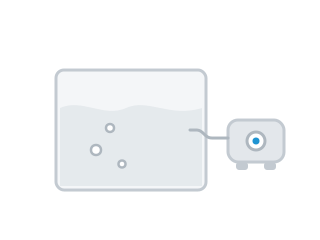
AQQA's electric sponge filter page gives the most useful sentence we found from any filter maker: "When the pump is working, the water outlet is completely immersed in the water, and the noise is about 30db. If the water outlet is higher than the water surface, the noise is about 50db."
That is a 20 dB swing from where the water comes out, with the same motor and the same filter. It is larger than the whole spread of figures between the products in this guide. Other makers say the same without numbers. hygger's 5-in-1 internal filter page says "For reduced noise, insert the black plug or fully submerge the outlet nozzle." Its Crystal filter uses a waterfall outlet shaped to reduce "splashing noise" and asks you to keep the water level steady so it runs quietly. Its Current UV filter page tells you to block one port with an end cap "to reduce the noise caused by rainfall".
In practice this means three things. Top up evaporation before the drop from a hang-on-back lip gets long. Use a spray bar or a submerged nozzle rather than a rainfall bar in a bedroom. If you want surface movement for oxygen, get it from a gentle ripple, not a waterfall.
Trapped air: the first week is the loudest
New filters gurgle and rattle, and the makers expect it. JBL says that after a new installation, air left in the filter media comes out "during the first 5-7 days", and that this causes gurgling or intermittent rattling. hygger's FAQ says the noise "may occur within the first two days" and "will disappear" once the air is out of the cartridge and hose. Aqueon's canister instructions say "You will hear a distinctive gurgling sound until the air is completely evacuated from the system." AQQA says its 74 GPH hang-on filter can make some noise at first if there is air in the water pipe, and should be filled with water before it is switched on.
If the gurgling does not stop, JBL gives the likely causes: a seal or hose connection letting in air, CO2 or air-pump bubbles released near the intake, or heavily clogged media giving off gas. Eheim adds that the pump head should sit at least 10 cm below the water surface, and says not to put an airstone near the intake.
Impeller wear: why a quiet filter gets loud
A filter that was quiet for months and then starts to grind or rattle has usually worn its impeller. JBL says: "The impeller of the filter is subject to constant wear and tear. We recommend you replace it." Fluval's AquaClear manual says motor noise usually means the impeller assembly needs cleaning, and that the impeller, "as the only moving part in the filter that operates 24 hours/day", eventually wears and is not covered by the warranty. Eheim's troubleshooting table lists a missing or wrongly fitted bearing sleeve and a broken ceramic axle as the causes of loud operating noise. Sicce's manuals say limescale and natural wear can raise the pump's noise.
This is where AQQA's claim for its internal filter matters: its FAQ says the noise "will not get louder after use for a long time", with the advice to clean the pump monthly. We cannot check that, but it is the right question. When you compare filters, ask what a replacement impeller costs and whether you can buy one, because you will.
The cabinet is a speaker
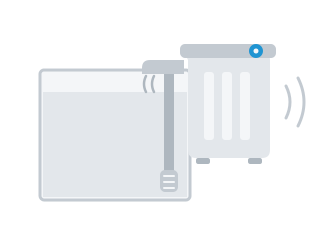
JBL has the best advice here. It says many aquarium cabinets act "like the sound box of a guitar", amplifying the smallest noise in the hollow body. Its test is simple: take the filter out, stand it on a thick towel with the hoses touching nothing, and listen. If it goes quiet, the filter is fine and the cabinet is the problem. The fixes are a soft underlay, making sure the filter touches the cabinet only through its rubber feet, and keeping the hoses away from the cabinet sides. hygger's waterfall filter and Crystal filter both have anti-vibration feet or pads for the same reason.
If the tank shares a room with a bed, our quiet bedroom guide covers the other sources of night noise.
What quiet costs
The filters with figures here are small hang-on-back and internal units, moving roughly 48 to 264 gallons an hour. None is a canister, so if you keep a large tank you are choosing between a figure on a hang-on-back filter and a well-known canister with no figure at all. Internal filters take up room inside the tank, and the quietest outlet setting gives you less surface movement. Hang-on-back filters splash unless you keep the water topped up. And whichever you buy, plan on replacing the impeller.
How we chose
We read every filter page listed in hygger's and AQQA's US stores and kept the ones that print a noise figure. We quote each figure word for word, with its condition where there is one. Prices are from each maker's own store on the date shown in our catalog. We checked the established brands' manuals and pages for any figure, and say above what we could not load. For why these numbers do not carry across brands, see comparing decibel ratings.
We did not measure any of these filters. Every figure is the maker's own, quoted as published. The advice on splash, trapped air, impellers and cabinets comes from the makers' own manuals and support pages.