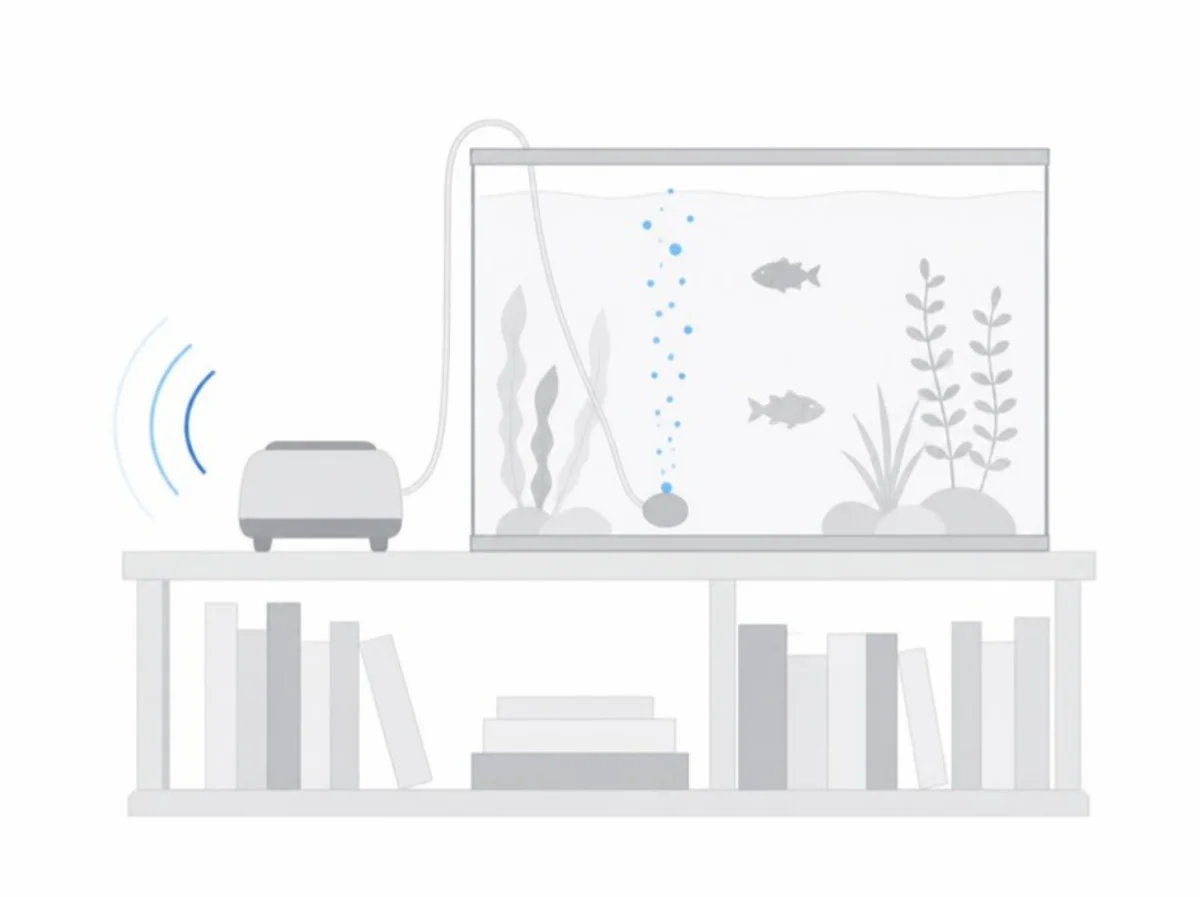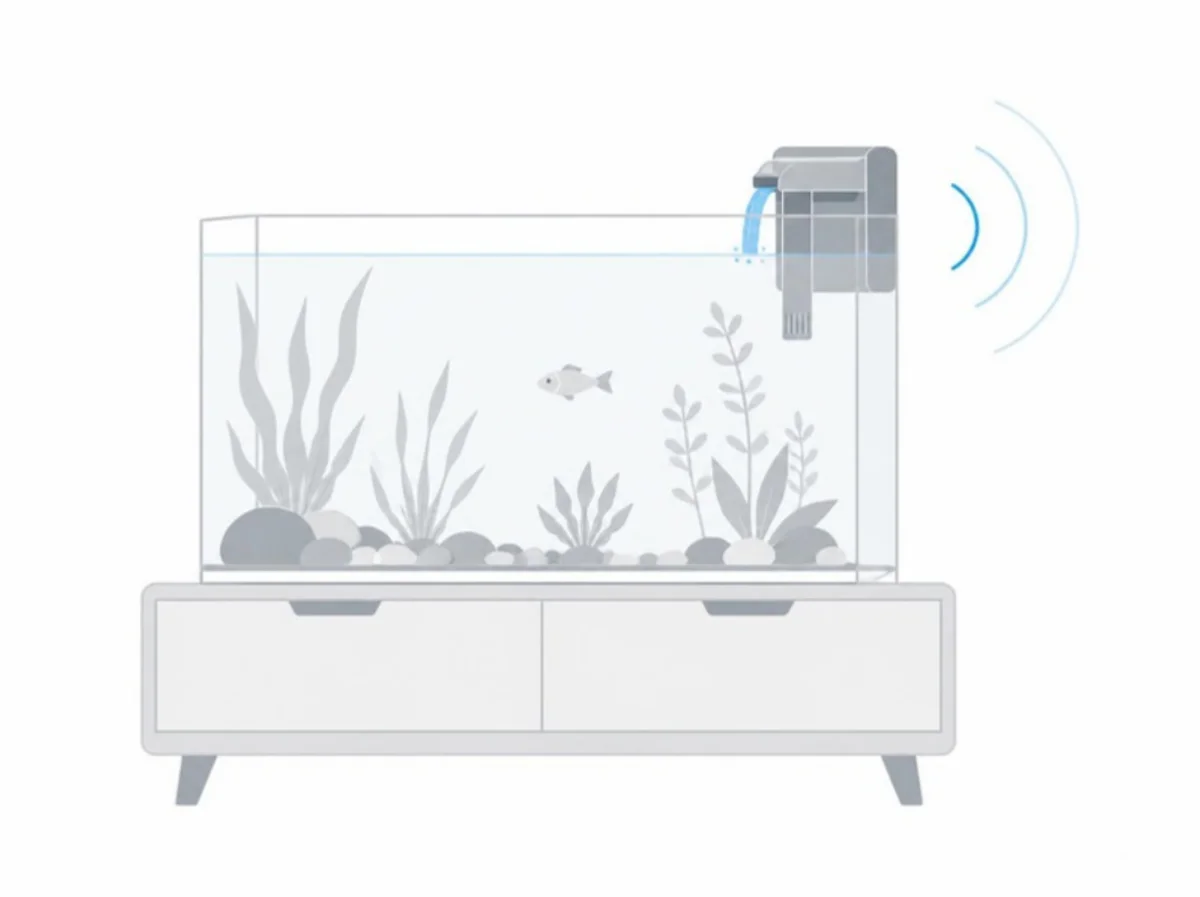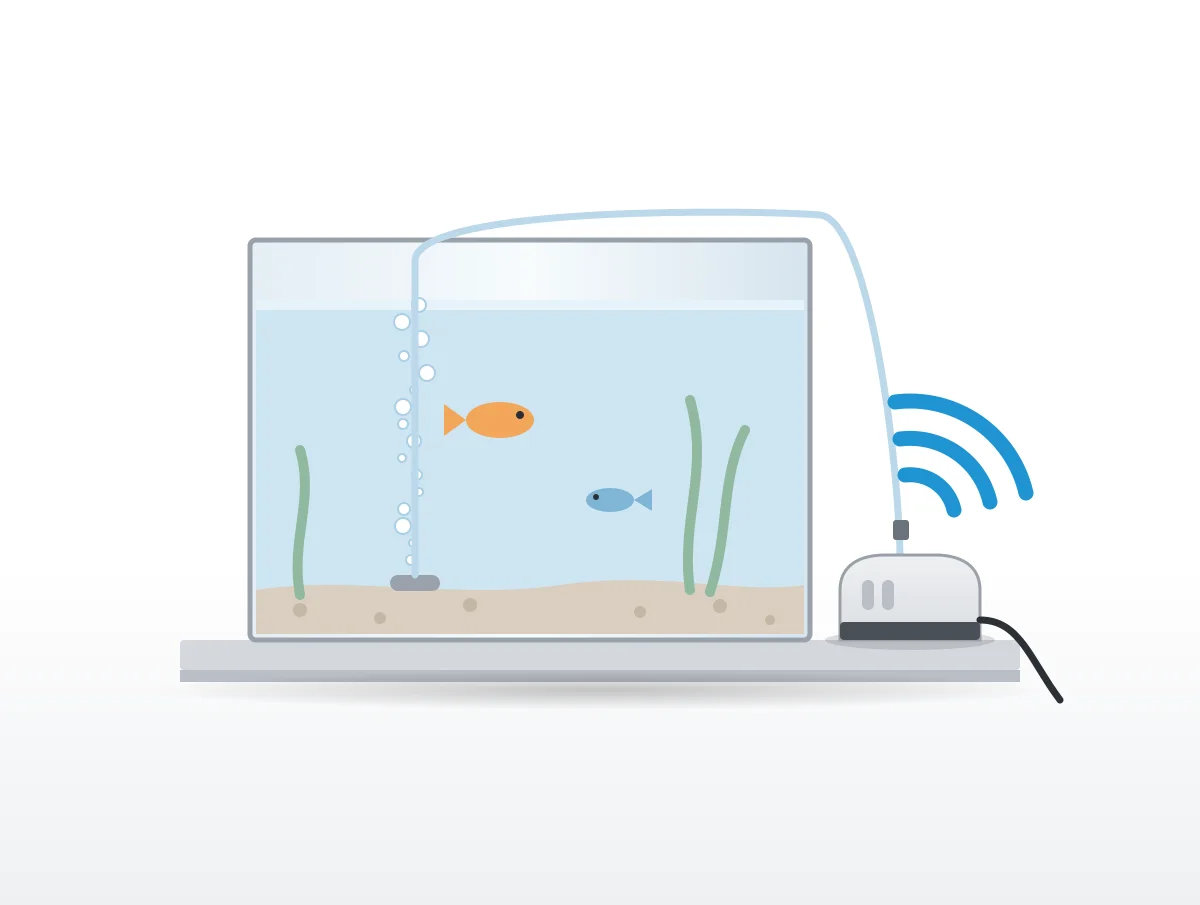
A rubber diaphragm flexing many times a second is the whole engine of an aquarium air pump, and that is why a loud one so often sounds like the shelf is humming. Stand it on glass, a tank lid or a hollow cabinet and the furniture turns a small buzz into a drone.
Filters are a different machine. A canister, hang on back or sponge filter spins an impeller in water, so its complaints are rattles, gurgles and splashing, and most of them trace back to air in the system, a low water line or a dirty impeller.
What follows comes from manuals, product pages and support articles by Aqueon, Eheim, Penn-Plax, Seachem, Sicce, hygger, JBL and AQQA. Tetra, Fluval, AquaClear and Marina refused our requests. Their pumps work the same way, but nothing here is quoted from them.
Why is my aquarium air pump so loud?
Vibration, nearly always, passed into whatever the pump stands on. For a pump that "is vibrating and making too much noise", hygger's answer is to "place it on a soft surface, which will reduce the sound of the vibrations."
That article mentions "some soft material under your air pump, like a towel or foam". A second hygger piece wants pumps and filters kept "at a sturdy and stable place, instead of a glass surface."
The rubber is designed in. Aqueon credits the QuietFlow's "wide rubber base helps absorb air pump vibrations to lessen the noise", and its instructions read "Place Air Pump on flat surface near aquarium." Eheim fits the air pump 100, 200 and 400 with anti skid feet and a vibration damper. The hygger Submarine page sums it up in one line: "Mount the pump in a stable position; rubber feet reduce vibration and noise."
Hanging a light pump off the shelf
Small pumps have another option: "hang the air pump up above the water level with the power cable in the case of a light air pump." That is hygger again. Eheim's manual shows wall mounting through an eyelet and asks for a spot where the pump "cannot drop into the water or “walk”", and walking is exactly what a buzzing pump does on a smooth shelf.
A pump that grows louder is wearing its diaphragm
Slow, month by month, the diaphragm wears out, and a blockage further down the line speeds that up.
Eheim's manual draws the chain: a clogged outlet causes "an increased counter pressure reducing the flowrate and increasing the wear to the diaphragm." Aqueon treats the diaphragm as a spare part. "Replacing worn internal rubber diaphragms, check valve(s) and dirty filter pads (sold separately in repair/replacement kits) is recommended," the QuietFlow instructions read, and a kit holds one or two diaphragms depending on the model, plus check valves and an intake filter. Eheim also asks owners to check the pump's air filter "for contamination, and replace if required." A dirty intake pad makes the pump work harder for the same air.
Machines in general get noisier with age for related reasons, set out in why appliances get louder.
Sudden noise usually means something moved
A sudden change tells a different story from a slow one. Check that the pump still sits on its feet and that no cable, tube or wall is resting against the case. None of these documents describes a diaphragm failing all at once, so a sudden rattle inside the case is best treated as a fault, covered further down.
Can a clogged air stone make an air pump louder?
Yes. A clogged stone adds resistance, and hygger and Eheim both tie that to noise or wear. hygger says to change the stone "Because it may be clogged, which is also one reason for a noisier air pump."
On an Eheim pump the matching part is the felt washer in the outlet, which "may become clogged after some time" and should be replaced "at regular intervals." Anything else running off the pump, a sponge filter for instance, needs checking for clogs and cleaning too.
New stones want a soak of one to two hours before use "to ensure even bubbling," according to the Submarine page. Its usage tips add: "Clean air stones and tubing regularly for consistent airflow."
Never run an open outlet
Eheim's two outlet pumps must never run an air connection without a load, "i.e. without hose and outlet". Using only one outlet? Join the pair with a T connector. An open port blowing freely is louder, and it leaves the valve no back pressure to work against.
Tubing and check valves
Stiff or kinked tubing carries noise into the tank: "Replace the stiff airline tubing, as it can also produce noise in the tank." Aqueon angles the QuietFlow's outlets upward in a design it says prevents "airline kinking."
A check valve does a different job altogether. Aqueon's integrated valve helps "prevent back siphoning should power be lost", while the valves hygger includes "prevent backflow if the pump is placed below the aquarium’s water level." Eheim sidesteps the problem with placement: "Always install above the water level and outside the aquarium," so water has no way back into the pump.
Penn-Plax gives the direction for its sponge filter setup. "The “In” side should point toward the air pump and the “Out” toward the filter," with the valve placed where the tubing has crossed the rim and dropped about 1 to 2 inches outside the tank.
Can a check valve chatter or hum by itself? No manual or support page in this set answers that. A worn valve is still a part the makers expect owners to replace, since Aqueon packs one in its repair kit beside the diaphragm.
Gurgling at the surface comes from the bubble count
The sound is bubbles breaking. "Adjust the optimal bubble count. High bubble count causes vibration and noise in the tank." Turning the airflow down is the first fix on hygger's list.
Smaller bubbles help as well, from "an air stone, which creates smaller bubbles", in place of an open tube or a large bubbler. Eheim's pumps and hygger's AC and Submarine pumps carry airflow controls for this, so a gentler pattern needs no separate valve.
Lids join in. "If your tank’s lid is not tight and producing noise, add foaming or other sound-absorbing material under the lid," the same hygger article suggests, and it lists keeping "the water level high in the tank" among its maintenance steps.
Why is my aquarium filter rattling?
Look at the impeller first, for dirt, wear or play. A sound that "is more of a rattle, and sounds like something might be broken" points to a faulty impeller in Penn-Plax's experience. On the Cascade canister the fix is to take off the impeller retainer under the motor head, then "Remove the impeller from the motor head, rinse under water, and reinstall." Aqueon's LED PRO power filter follows the same route: unplug the pump, take it out and "Separate and clean all parts including impeller."
Eheim's professionel 5e table names two causes of "loud operating noise". One is "Bearing sleeve not or incorrectly installed", cured by fitting or replacing the sleeve; the other is "Ceramic axis broken", and the cure is "Replace the ceramic axis."
Limescale and wear
"The limestone deposits and the natural wear-out of the components might cause a raise of the pump’s noise," warn Sicce's Whale instructions, which go on: "In this case, we recommend you to replace the impeller." JBL is blunter. "The impeller of the filter is subject to constant wear and tear. We recommend you replace it."
Seachem counts the impeller as a wear part too. The Tidal's three year guarantee covers the filter "except for the pump’s impeller", and replacement impellers are on sale.
A new filter gurgles until the air is out
Gurgling or swishing from a filter is usually trapped air, normal after setup or cleaning. On a newly set up Cascade canister it "usually self corrects itself after about 24 hours," and tilting the running filter "on a 45 degree angle so the trapped air can escape through the outlet tube" hurries it along. Aqueon prepares canister owners in advance: "You will hear a distinctive gurgling sound until the air is completely evacuated from the system."
Some makers allow longer. JBL says air leaves new filter media over "the first 5-7 days", and for its Backpack filter hygger's FAQ expects the noise "may occur within the first two days" and "will disappear" once the air has gone.
Gurgling that does not stop
Eheim lists why air will not clear: a pump head that sits too high, air "being sucked in via the hose installation", heavily soiled media, and an air pump nearby. For that last one the fix reads "Do not install diffuser in the vicinity of the suction pipe."
An air stone parked by the intake can make a filter noisy, then. Placement rules from two makers point the same way. "The top edge of the pump head should be at least 10 cm beneath the surface of the water," says Eheim, and Aqueon: "Do not install canister filter above the aquarium water level."
How do you prime a filter so it runs quietly?
Priming fills the filter with water before the pump runs, so it is not churning air. For Aqueon's canister to work, "the air must be evacuated from the system", and the instructions walk through filling it via the head. If water does not flow at once, the next step is to "unplug the motor, wait a few seconds for air to rise, then remove the Vent Cap and vent air or add more water as necessary."
Penn-Plax offers two ways to start a Cascade. Press the prime button repeatedly, or fill the canister to about 90% before fitting the motor head.
Self priming filters skip all this. With the Tidal's pump "there's no need to fill the filter basket with water", and after a power cut "the filter will automatically restart itself."
Does low water level make an aquarium filter louder?
Yes, by a wide margin on a hang on back filter, because the water falls further before it hits the tank. AQQA put numbers on one of its own models: "When the pump is working, the water outlet is completely immersed in the water, and the noise is about 30db. If the water outlet is higher than the water surface, the noise is about 50db."
That 20 dB gap comes from outlet position alone.
Three instructions set the level. Aqueon's LED PRO wants owners to "Top off aquarium water level to outside bottom edge of top frame." Seachem's Tidal keeps working "as long as the water level does not drop below the “minimum water level” line marked on the filter." And for its canister, Aqueon draws a hard limit: "The water line should never be more than 8 inches below the frame of the aquarium."
Canister returns follow the same logic. Eheim's classic manual places the outlet pipe "approx. 1 cm below the water surface", which keeps the return quiet, and the aquarium filter guide goes further into outlet choices.
Debris makes an impeller grind and run hot
Build-up around the impeller makes a filter or water pump grind. Aqueon wants the impeller well cleaned thoroughly "to remove any buildup", warning "Excess build up can cause the motor to heat up." Its routine is to remove the impeller well cover, wipe the impeller with a paper towel, and rinse "any debris trapped on the strainer" under a tap or hose. For poor flow on the professionel 5e, Eheim's table says to "Clean pump chamber, cooling and lubrication channel" with the cleaning brush set.
One line from hygger's air pump article fits filters as well: "Dirty moving objects produce more noise."
Cabinet stands amplify filters
Shut a canister in a hollow stand and it can boom. Many cabinets act "like the sound box of a guitar", in JBL's comparison.
The cures are the air pump ones: a soft underlay, rubber feet, and hoses kept clear of the cabinet walls, with the equipment on something sturdy and stable. A tank in a bedroom has company at night, and the quiet bedroom guide covers the other sources.
How do you make an aquarium air pump or filter quieter?
Isolate the vibration, keep the air paths clear and keep the water topped up. Most of that costs nothing; only diaphragms, check valves and impellers mean buying parts.
For an air pump:
- Stand it on a soft, stable surface, or hang it, never on glass (hygger)
- Keep it outside the tank and above the water line, or fit a check valve (Eheim, hygger, Aqueon)
- Replace clogged air stones or outlet washers (hygger, Eheim)
- Turn down the bubble count (hygger)
- Replace worn diaphragms and check valves from a repair kit (Aqueon)
- Replace stiff or kinked tubing (hygger, Aqueon)
For a filter:
- Let new filters purge air, and tilt a Cascade canister to help (Penn-Plax)
- Keep the water at the level the maker marks (Aqueon, Seachem)
- Keep the outlet just under the surface (AQQA, Eheim)
- Keep air stones away from the intake (Eheim)
- Clean or replace the impeller (Penn-Plax, Aqueon, Sicce, JBL)
Signs the noise is a fault
Cleaning and moving a pump should change its sound. When they do not, or when the noise arrives with leaking or lost flow, something has failed. Aqueon's instruction for an appliance that is "malfunctioning", or that shows "any sign of abnormal water leakage", is to return or discard it.
Some pumps are sealed. "This appliance has no user serviceable parts," reads Aqueon's LED PRO filter booklet, and Eheim's manuals say "Repairs must only be carried out by an EHEIM service centre." Where a part can be changed, the makers name it: a new impeller for Sicce's worn pump, a new axis for Eheim's broken ceramic one.
Unplug first. Aqueon wants appliances unplugged "before putting on or taking off parts, and before cleaning", and Eheim says to switch off or unplug everything in the aquarium "Before undertaking any maintenance work".
How loud should an aquarium air pump or filter be?
Air pumps in the guide carry figures from 25 dB to 48 dB, and most filters with a figure claim 30 dB or under. At the loud end, hygger labels its 39 to 48 dB Submarine piston pump "Not suitable for bedroom use."
In quietest aquarium air pumps, hygger's AC Ultra Quiet has a 25 dB ceiling and Uniclife prints 25 dB on low flow and 45 dB at maximum. Piezoelectric pumps, which have no motor or diaphragm, claim 30 to 33 dB. The guide found no decibel figure for Tetra, Eheim or Fluval air pumps, and Eheim's manual says only that its housing keeps noise "to the level of a whisper".
Not one of these figures comes with a distance or a test standard, so they place pumps roughly rather than measure them. The decibel chart shows what 25 to 50 dB sounds like, comparing decibel ratings explains why one maker's number does not line up with another's, and outdoor pumps have their own quietest pond pumps guide.