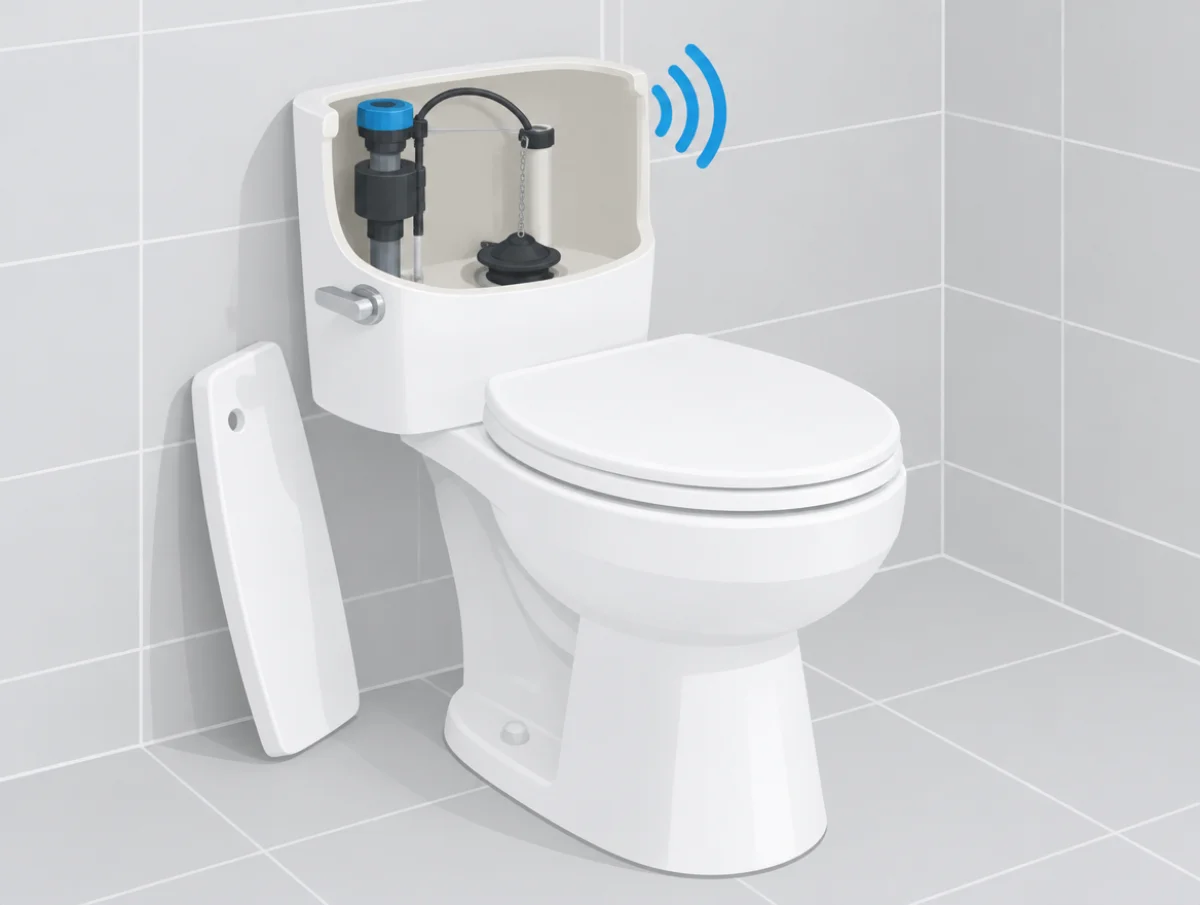
A toilet that runs for a few seconds every so often, with nobody near it, is not haunted. Fluidmaster has a name for that sound, the "Water Waste Signal", and it means the tank is leaking while the fill valve tops it back up.
Most toilet noises are that literal. A hiss, a refill nobody asked for, a whistle, a foghorn hum and a bang each report on a tank part or the water supply, and between them Fluidmaster, Korky, Kohler, TOTO, American Standard and Delta explain all five in repair pages, troubleshooting tables and FAQs read on November 10, 2026. The causes come down to a short list: a leaking flapper or flush valve seal, a fill valve that is dirty, worn or set too high, and household water pressure. A gurgle in the bowl is the odd one out, and TOTO traces it to the drain and the vent stack.
"When your toilet is making noise, your fill valve is usually the cause," says Korky's page on loud fill valves. Its ghost flushing page adds that "the most common cause of a leaking toilet is your toilet flapper". Both can be true, and the leak test below tells you which applies before you buy any part.
Six sounds, six causes
| What you hear | What it usually means |
|---|---|
| A refill every few minutes or hours | Water leaking out of the tank |
| A constant hiss | A fill valve that never shuts off |
| A whistle or squeal while filling | A narrowed passage in the fill valve |
| A low hum or foghorn while filling | Resonance in the valve or supply |
| A bang as the tank finishes filling | Water hammer in the pipes |
| A gurgle in the bowl during a flush | A drain or vent starting to clog |
Korky sorts them in much the same way. Hissing is "Likely a leak or water level issue", squealing or whistling "Debris or worn internal parts", vibrating "Diaphragm or pressure resonance", and banging "Water hammer or a valve shutting off too abruptly."
Why does my toilet refill by itself every few minutes?
Because it is losing water from the tank. Ghost or phantom flushing, as it is often called, can come "every few minutes or every few hours", and the usual leak runs past the flapper.
The sound "is usually alerting you that your toilet is losing water, either internally or externally," according to Fluidmaster. Its 400A fill valve FAQ goes further, calling the on and off cycling the "Water Waste Signal" and insisting the valve "is working properly and is not failing."
That is where people go wrong. Ghost flushing "signals that your flapper is leaking and needs replacement," in Korky's account, but because you can hear the fill valve working, "it is easy to assume that it is the main issue." Kohler's occasional running page gives the mechanism in one line: "Once the water drops low enough, the fill valve will turn on to refill the tank."
Every maker fixes it in the same order, and Fluidmaster starts with the refill tube: if it "is inserted too far into the overflow pipe, pull it out and reattach to outside of overflow pipe." Next, wipe the flapper and the flush valve seat clean. Then replace the flapper, and replace the whole flush valve only if neither of those works. Check the chain too. Korky and Kohler both want one to two links of slack, Kohler so that "the excess chain does not get caught on the trip lever arm," while American Standard's running toilet answer asks for about a quarter inch.
Flappers wear out.
Seals "may wear down over time due to water conditions or from the use of in-tank cleaners," Kohler warns, and Fluidmaster's pages say in capitals that drop-in bowl cleaners containing bleach or chlorine damage tank parts. A flapper that leaves black residue on your hands has reached "the end of its lifespan and should be replaced with a new flapper before leaks occur," per TOTO.
Touchless toilets can flush for real
On a Kohler touchless toilet, a phantom flush may be a genuine one. The touchless page blames water that "splashes on the Touchless Module and/or the underside of the tank lid when the toilet is refilling", and the fix is to push the refill hose as far into the flush valve as it goes.
Repeated flushing after a single use has a different cause: "When refilling, the water rises too rapidly and activates the sensor," and partially closing the supply stop slows the refill.
Why is my toilet hissing?
Water is running through the fill valve without stopping.
Korky blames a worn flapper or flush valve seal most often. "A constant hissing means water is continuously escaping into the bowl," its fill valve page explains, and that keeps the fill valve on. Three causes are listed: a worn flapper or seal, a fill valve that does not shut off fully, and a water level set too high. Set the water half an inch below the top of the overflow tube, then replace the fill valve if the hiss continues.
Fluidmaster's noise page goes straight to debris stuck in the fill valve and hears the hiss differently, as "constant and sounds like forced air moving through the toilet", meaning "water is constantly passing through the fill valve and going into the tank." Its cure is to shut off the water, lift off the valve cap, hold a cup upside down over the opening and run the supply "full force for 10-15 seconds" to clear debris.
Kohler and American Standard flush the valve the same way. Debris under the cap is "common during new toilet installation because turning the water supply on and off can loosen sediment within the water lines," Kohler explains, and American Standard runs the water "for three or four seconds" over the uncapped valve, twice.
The hiss shows up by name in American Standard's VorMax answer as a fill valve symptom: "The water control valve is hissing or continually dripping water through the refill tube into the overflow tube on the flush valve." And among the problems that flushing the valve may fix, Kohler's fill valve video page lists "The toilet is noisy".
A toilet that keeps running is usually overfilling
After a flush, a toilet that will not stop running is most often filling past the overflow tube, held open by its chain, or stuck on fill valve debris. Kohler describes the sound as "a constant filling or running noise coming from the toilet tank that does not stop", sometimes with "a slight ripple of water in the toilet bowl." Take the lid off and you may see water spilling into the overflow tube.
Set the water level first. American Standard wants it "about a quarter to half of an inch below the top of the overflow tube", Korky half an inch below, and Kohler's homeowners guide points to the waterline marked inside the tank.
Delta's fill valve instructions give three reasons the "Fill valve does not shut off". A float blocked by the tank wall, a leaking flush valve, and a water level that "exceeds overflow pipe of flush valve." For the float, "make sure that it can be moved freely." Kohler's rule is simpler: replace the fill valve "if the valve float sinks."
A fourth part joins the usual three in an American Standard answer: "A bent or broken trip lever can cause the flapper to remain open, causing water to run."
A leak test finds the faulty part
Mark the tank water level, shut off the supply and wait. A dropping level means the flapper or flush valve leaks; a level that holds puts the fill valve under suspicion.
How long to wait is where the makers part company. Korky says at least 25 minutes, then "a couple of hours" to see where the level stops. TOTO's FAQ gives 2 to 4 hours in one answer and 4 to 6 hours in another, and American Standard says to let the tank "sit overnight."
Where the level stops names the part. A drop to the flapper or seal calls for a new flapper or seal, Korky and American Standard agree, and a drop to the bottom of the flush valve calls for a new flush valve. TOTO adds the other half: "If the water level remains the same but runs when the water is turned back on, the fill valve needs replacement."
Why does my toilet whistle or squeal when it fills?
Water is being pushed through a narrowed passage in the fill valve. Debris, mineral buildup, a sticking float or diaphragm, or a restricted supply line can each do it.
"A high-pitched squeal or whistle happens when water is forced through a restricted internal passage inside the fill valve." Korky's first check is that the supply line is "turned completely open and is free of kinks or restrictions", and for an older valve it prefers replacement to clearing the mineral buildup.
Kohler and Delta print another first step for a noisy fill. "Partially close the water supply shut-off valve if the water pressure to the toilet is too high," reads the Kohler homeowners guide, before checking the flush and removing dirt from the valve head. Delta's Riosa installation manual gives the same two steps for "excessive noise when the tank is filling."
Those two pieces of advice look contradictory, but they cover different cases. Korky's check is for a valve starved by a kinked or half-closed supply, and Kohler and Delta are dealing with pressure that is too high. Since Kohler's own table lists a supply valve that is not fully open as a cause of a poor flush, watch the flush after easing the valve.
A whistle that comes with a slow refill points the same way. "Calcium, sediment, and other debris can collect inside the valve and slow down the refill," according to Korky's slow fill page, and American Standard also blames debris stuck in the valve.
A foghorn hum is the fill valve fluttering
That low hum or rapid thumping as the tank fills is resonance, a vibration in the fill valve or the supply. Two makers locate it differently: a weakened diaphragm for Korky, an obstruction in the shut-off valve for Fluidmaster.
Korky's causes include "Water pressure causes the diaphragm to flutter", along with a supply line that vibrates as pressure changes suddenly. For an older valve the answer is replacement. On a Korky valve, check that the bottom of the cap lines up with the overflow tube.
Fluidmaster's label is "WATER RESONANCE", a "Constant thumping" while the toilet runs water during its flush cycle, and it "is alerting you that your shut-off valve at the wall has an obstruction in the flow path of the water." The water hammer page calls the same thing "rapid banging" in a pipe during the fill.
The Fluidmaster remedy is a fill valve that slows the incoming water. Its PerforMAX valves have "a regulator built into the valve", and if one does not stop the noise, the buildup is bad enough to replace the shut-off valve. The 400H page muddies this, saying the 400H "does not have a regulator but a restrictor", unlike the 400AH.
Why does my toilet bang after flushing?
It is water hammer: moving water stopped dead when the fill valve closes. TOTO ties it to high household pressure, Korky to a worn valve slamming shut.
Water hammer "occurs when the toilet's fill valve shuts off abruptly against high household water pressure," TOTO writes, suggesting a slightly closed supply valve or a plumber to install a water hammer arrestor. Worn valves can make the shut-off "slam", on Korky's account, and if the hammering happens only during the refill, a new fill valve is the fix.
Fluidmaster's definition is "A loud bang in your pipes after a fill valve shuts off", and it adds causes outside the toilet: worn faucet washers and "heavy build-up of minerals and rust inside shut off valves." Its first fix drains the house. Shut the main, open every cold faucet from the top floor down, and wait 20 to 30 minutes, then restore the water and close the faucets from the bottom up.
If draining the lines and reducing the flow at the shut-off valve do not cure it, Fluidmaster's advice is a plumbing professional. A plumber "can check the water pressure safely," as Korky puts it, and may fit an arrestor if other fixtures bang as well.
Gurgling comes from the drain, not the tank
A gurgle during a flush is "a sign that your drain line or the house vent pipe (vent stack) is starting to clog." TOTO is the one maker of the six with a page on it, and its explanation is physical: "Because air cannot escape smoothly during a flush, air is sucked through the toilet bowl trap, making a noise." When the bowl water "rises high for a moment, then drains very slowly over time", that is a partial clog in the trapway or drain pipe, to plunge at once or have a plumber clear.
Pressure-assisted and electronic toilets are louder by design
Pressure-assisted toilets "are noisier than traditional gravity-fed models", American Standard admits, and the sound "will dissipate in approximately four seconds." Its answer opens with "Your toilet is functioning normally", then suggests rugs on the bathroom floor and closing the lid before you flush.
Electronic toilets bring sounds of their own. A whirring sound and mist after flushing is TOTO's EWATER+ cleaning feature. A hissing or spraying sound as you approach the bowl is the "Premist" feature wetting the bowl, which TOTO calls "normal." If a NEOREST flush suddenly turns much louder, the supply pressure may be too high or air may be trapped in the pipes.
Do quiet fill valves make a toilet quieter?
They are sold on noise, but no decibel figure turned up for either. Korky calls its QuietFILL Platinum "Proven quietest in lab testing", and Fluidmaster calls its 400H "one of the quietest fill valves available."
Neither claim comes with a test method or a number, so there is no way to rank the two. Fit is the better guide. The QuietFILL Platinum page calls it "ideal for toilets made since 1994 (1.6 GPF or less)", while Fluidmaster's 400A is "Best for toilets manufactured prior to 1994".
Both makers sell the parts their pages recommend, so their diagnoses are quoted here and their product picks mostly left out. Both also treat a new valve as the usual end point for an old, noisy one: a fill valve "over 5 years old or is not serviceable" is easiest replaced, Korky says, and Fluidmaster suggests "replacing the flapper along with the fill valve."
When the noise needs a plumber
Water hammer that survives draining the lines, a supply line that delivers little water, a clogged shut-off valve: once a noise points beyond the tank, the makers themselves hand the job on.
Korky's slow fill test sends the supply line into a bucket, and if little or no water flows, "Contact a licensed plumber to diagnose and fix the issue." If a regulated fill valve does not stop resonance, Fluidmaster wants the shut-off valve at the wall replaced, and it sends water hammer that survives its fixes to a plumbing professional.
Some fill valves are awkward to reach. The nut under some skirted one-piece TOTO models may need a basin wrench or the toilet loosened from the floor, and TOTO recommends "consulting a professional plumber if it is difficult to reach." On a concealed trapway toilet, American Standard notes, detaching the tank may be necessary.
Water outside the toilet is a separate problem, and Fluidmaster traces water at the back of a toilet to the bottom of the fill valve, the supply line or the tank to bowl seals: "It is always a good idea to replace the water supply line if it's older than 5 years."
Other plumbing that bangs and hisses
Water heaters, dishwashers and washing machines bang, tick and hiss as valves open and close, and their makers explain those sounds in the same terms. A water heater's ticking comes from pressure swings caused by things like a toilet flushing, in A. O. Smith's account on the water heater noises page. GE calls dishwasher pipe banging water hammer in the dishwasher noises explainer, and LG's arrestor advice for washers is in how to make a washing machine quieter.
There is no toilet buying guide on this site. The other steady sound in most bathrooms is the exhaust fan, which the quietest bathroom exhaust fans guide ranks on the sone ratings its makers print.