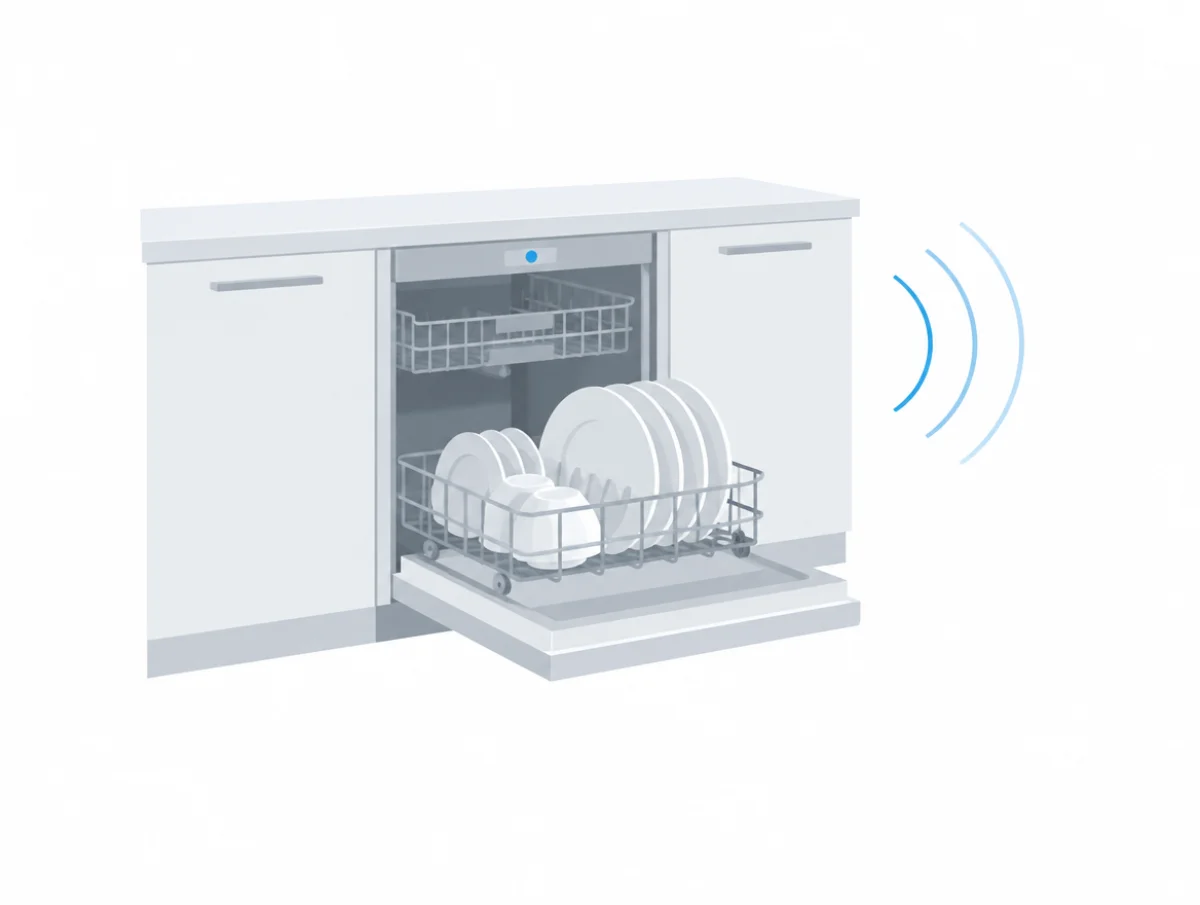
A dishwasher making noise is usually filling, spraying, pumping or drying, which is the ordinary work of a cycle. Whirlpool, Maytag, GE, LG, Samsung, Bosch, Frigidaire and Miele all publish support pages or manual entries on dishwasher sounds, and between them they file the hiss, swish, hum, whine, snap and click under normal operation.
The sounds they treat as a problem are fewer: grinding with no water in the tub, rattling from glass or debris in the drain pump, a squeal from dry pump seals, and loud buzzing that returns on every cycle.
Below, the sounds are grouped by the part of the cycle they belong to, quoted from the makers with the conditions they attach. Whirlpool and Maytag run the same normal sounds page, so we quote it once, under Whirlpool's name.
Is it normal for a dishwasher to make noise?
Yes, a dishwasher always makes some noise, and most of it is routine. Samsung says its dishwashers "cannot operate in complete silence", and Bosch UK says of strange noises: "Usually, they are nothing to worry about."
GE splits its list into two halves and says "Some sounds are normal while others may be abnormal." The abnormal half, it adds, "sometimes" has easy solutions, which is why loading and water supply come up again and again below.
Where the dishwasher sits changes what you hear. Whirlpool says "Dishwashers installed on the ends of cabinet rows may allow more sounds to be heard than those installed between two cabinets", and that a unit that is not level or securely mounted can pass vibration into the cabinets, "making normal sounds seem louder."
Samsung suggests recording any sound that worries you, because "dishwasher noises tend to be random and intermittent" and a recording helps if you end up booking service.
What sounds does a dishwasher make during a normal cycle?
A dishwasher cycle moves through filling, washing, draining and drying, and the makers tie a hiss, swish, hum, whine, snap, click and fan noise to particular parts doing their jobs along the way.
Whirlpool's overview puts the order plainly: "During the fill phase, you may hear a gentle hum or a short whoosh as water enters the tub." The wash brings "rhythmic swishing and a steady whooshing", and near the end "a soft hum from the drain pump and a brief gurgle at the sink drain are typical."
Filling: a hiss, a whistle or a short valve hum
Frigidaire puts the water valve hiss first on its list: "This is typically the first sound you will hear from the dishwasher as the water goes through the valves." Whirlpool agrees: "It is normal to hear a hissing sound periodically. This is caused by the water valve."
The valve can hum as well. GE says the water valves "do make a hum that lasts about sixty to ninety seconds several times during the wash cycle", and that this "should not be confused with the hum of the primary motor."
LG describes a whistle as water comes in and calls it normal. "If the water pressure is too high, it will be louder", LG says, and turning down the water valve may then be needed. Samsung adds that water running through pipes "can often make a high pitched sound such as whistling or whining."
Washing: swishing, whooshing, a pump hum and a whine
Most of the wash is water hitting dishes. Whirlpool: "It is normal to hear a sound similar to water swishing as the water is sprayed on the dishes during the cycle." Frigidaire says its spray arms "switch back and forth from the bottom to the top and the sound can change when this occurs."
Frigidaire's wash pump hum "starts and stops when the spray arms alternate", and Whirlpool says that on some models "a variable-speed wash motor may change pitch as it adjusts power for different soil levels." GE goes further: "The Dishwasher wash pump motor can make a whining sound when operating. This is normal."
GE traces on and off humming during the wash to three parts: the fan that cools the main pump motor, the soft food disposer "grinding up food waste", and the drain pump. On Samsung's WaterWall models, the swishing may come from "the WaterWall vane moving back and forth."
Mid-cycle snaps, clunks and clicks
The detergent cup makes the loudest single sound in many cycles. GE says the clunk "will occur once during the wash cycle", as the cup opens at the start of the main wash, "about ½ way through the complete cycle."
Whirlpool hears a snap from the dispenser opening, which "will also occur when the door is opened at the end of the cycle." GE also blames a drain solenoid that snaps each time a drain starts, "about six times during each run cycle", on models that have one.
Clicks are switching. GE says "a clicking noise occurring 4 to 8 times during a cycle is normal. This is the sound of the pump switching from circulation to drain." Timer controls and some electronic ones also click, or even grind, as the cycle advances. Frigidaire lists a ball valve clunk "when the spray arms alternate."
Draining: a hum, a gurgle and a stop and start pump
Whirlpool: "It is normal to hear a humming noise while the dishwasher is operating. This noise is heard when the dishwasher drain pump is running." Frigidaire says the drain pump hum "is usually steady at first and fluctuates when all the water is pumped out."
GE warns that the pump will not run smoothly to the end: "The drain pump starts and stops several times during each drain. This helps pump out food debris more effectively." Bosch UK says the machine can buzz "when it forces water down the drain."
LG describes a growl, or air sucking sound, that "can be air being pulled through to clean the filter", depending on the cycle. A loud gulping, or a sink that drains slower than usual, is the version LG links to too much detergent or a clogged drain pipe.
Drying and after the cycle: the fan
Fan-dried models stay audible after the wash. Whirlpool says "It is normal to hear a fan or humming noise after the end of the cycle", and that the fan "may continuously run up to 8 hours or until the door has been opened" to dry the dishes and clear heat.
Frigidaire says that on models with Even Dry or Perfect Dry, "it's normal to hear the fan operate at various times during the cycles." Whirlpool adds that heated dry models may give off "a low fan or heater hum."
Why is my dishwasher making a grinding noise?
A grinding dishwasher usually has something hard caught in the filter or drain pump, or a pump turning with no water in the tub. Whirlpool names one normal case: some models have a built-in chopper.
Bosch UK says a grinding sound most likely means a foreign object has lodged in the pump, "hard food or an item which was being cleaned and has broken during the wash cycle." Samsung says "loud humming, buzzing, or grinding noises imply that something is caught in the drain pump's impeller below the filter."
Whirlpool says "Items stuck in the filter could potentially cause a grinding noise", but also that some dishwashers have "a built-in chopper that might make a grinding noise while in use." GE's version is a dry pump: grinding "Occurs when no water is in the Dishwasher and the circulation pump is running." LG says squealing and grinding "could be an indicator of a problem with the pump."
If you look in the pump yourself, follow your manual. Bosch's SHV68T53UC manual starts with "Disconnect the appliance from the power supply" and warns "some debris may be sharp." Miele's G 5266 manual also says to disconnect power first, and warns of "Risk of injury from glass splinters."
Bosch UK says to wear protective gloves in the pump area, "because broken glass fragments can collect here", and to book an engineer if the impeller is damaged. Samsung says that if your filter and pump opening are not accessible and the grinding is loud every cycle, request service.
Why is my dishwasher humming but not washing or filling?
A dishwasher that hums without filling or washing is usually short of water: a closed supply valve, a kinked line, or, according to GE, pump seals that have dried out after a week or more without use.
Whirlpool says "The water supply valve must be completely open for the dishwasher to fill, wash, and rinse the dishes." Samsung's list starts with checking the supply is connected and the home's water turned on. Bosch's manual adds kinks or clogs in the supply line, and a delay start still counting down.
GE says that a dishwasher left idle for "a week or longer" can hum without filling because "the Dishwasher pump seals" dry out and stick, and that running it "at least once a week" prevents this. GE gives a citric acid soak for the sump, step by step, and says that if it does not work, "service will be required."
A door that has not latched stops the cycle too. Whirlpool says the Start/Resume light flashes after the door is opened or power is interrupted, and that you resume by pressing START/RESUME and closing the door within 3 seconds.
Do not confuse a hum that stops in a minute or so with a fault, since GE's water valve hum lasts 60 to 90 seconds. Grinding with no water in the tub is the version GE files as abnormal, and it points to its article on fixing a dishwasher that will not fill.
Why is my dishwasher making noise when it is off?
A dishwasher heard after its cycle has ended is usually running its drying fan, which Whirlpool says may keep going for up to 8 hours on some models, or until the door is opened.
Miele lists one exception in the fault messages of its manual: the Waterproof system has reacted, and "The drain pump may still be running, even with the door open." Miele says to turn off the dishwasher, turn off the water-supply faucet and contact Miele Customer Service.
Samsung adds a check for whistling heard while no water is running: make sure the sound "isn't coming from other pipes in the home instead of the dishwasher." If it is the dishwasher, Samsung says to clean it and look for plastic or debris at the bottom, and to request service if the whistle continues during the dry cycle.
Why is my dishwasher knocking, banging or rattling?
Knocking and rattling inside a dishwasher usually come from the load: a spray arm striking a tall item, light pieces moved by the jets, or a loose filter. Banging in the water pipes is water hammer, a plumbing matter.
GE says a rhythmic knock "is most likely caused by the way the Dishwasher was loaded", with the spray arm hitting something as it turns. Miele: "A spray arm is knocking against a wash item." Frigidaire says the same of an item "that is too tall."
Light items move. Bosch UK says baby bottles and other light pieces can shift and need securing, or clipping with an accessory. The Bosch SHE43DM5N manual adds that "With a small load the water jets directly strike against the tub", and says to distribute dishware evenly or load more.
GE's test is to run the dishwasher empty: "If the noise is not present", look up the loading suggestions in your owner's manual. Samsung and LG both say a removable filter that is not secured can rattle or bounce around, and Miele lists a foreign object such as a glass shard in the drain pump as another cause of rattling.
Banging from the pipes is outside the dishwasher. GE calls rattling, banging or booming in the pipes "a household plumbing issue called water hammer" and says a plumber can fit an anti-hammer device. Bosch's SHE43DM5N manual says knocking from the filling valves is "Caused by the domestic installation", with "No fault present in the appliance."
Miele says knocking in the water pipes "will not affect the functioning of the dishwasher in any way. If in doubt, contact a suitably qualified plumber." Samsung covers one door noise: a clicking or popping as the door opens can mean a loose kickplate rubbing the door, which it says to move down and tighten.
Why is my dishwasher squealing or squeaking?
A squealing dishwasher that is new, or that has not run in a long time, has dry pump seals, according to GE. A squeak from the door is usually the hinge, which Samsung treats separately.
GE says a new dishwasher "may not have any water in it", causing a squeal or rattle the first time it runs. "Add one quart of water to the bottom of the tub and the noise should go away." Its normal noises page says two quarts, so check your model's installation instructions, which GE also points to.
LG treats squealing alongside grinding as a possible pump problem. For the door, Samsung says to find which part squeaks and, if it is the hinge, to try "a food safe lubricant (not WD-40)", requesting service if that does not help.
Why is my dishwasher beeping?
Dishwasher beeping is usually a signal: a finished program, a door opened mid cycle, or on LG models a high temperature alarm. A beep that comes with a flashing code or fault number means the dishwasher is reporting a fault.
GE lists beeping when the door is opened mid cycle, "including the dry portion", and says to shut the door and press Start. LG's beep is "a high temperature alarm" that sounds after a steam, heated wash, rinse or dry cycle as soon as the door opens. If an error code shows as well, LG says to see its error code article.
Bosch UK says the end of program beep can be switched off or turned down in the settings. Miele's G 5266 manual says its tones sound four times "with a short pause between each set." End of program signals are off as standard, but "The alarm tone that sounds in the event of a fault is always switched on."
On Whirlpool models with the settings menu, "The sound is On by default" and can be turned off. For flashing lights after the door was opened mid cycle, Whirlpool says to close the door firmly, and that a control reset means cutting power for 30 seconds at the plug or the breaker.
Why is my dishwasher so loud all of a sudden?
A dishwasher that turns loud suddenly has usually changed in load, mounting or pump: an item hitting a spray arm, debris in the pump, loose insulation or toe kick, or a unit no longer level.
Whirlpool says to check the leveling legs and mounting brackets, and that "the insulation and toe kick panel are in place." Samsung says the cabinet insulation, the fabric on the outside, "is there to dampen sound and hold in heat." Bosch says "The noise level can vary, depending on what kind of dishes are loaded and where they are placed."
Samsung's rule for service is simple: if the dishwasher is clean but the noise continues on an empty cycle, request service. For appliances that grow louder with age in general, see why your appliance got louder.
One warning applies to every check. Bosch's manuals say "Do not fully open the door until water noises have stopped and steam has subsided", because hot water or steam may escape during or after a cycle.
How loud is a normal dishwasher?
A normal modern dishwasher is rated by its maker at about 38 to 53 dBA. Whirlpool calls 44 dBA or lower quiet and 50 or above average, and Bosch calls 48 dBA or lower quiet.
Whirlpool says dishwashers "typically have noise levels between 40 to 50 decibels (dBA)", and that "Older dishwashers may have a 60 dBA." Bosch says its quietest models run "between 38 dBA - 48 dBA", and advises buyers to "look for models under 45 dBA."
In our quietest dishwashers guide, the lowest maker figure is 38 dBA, from three brands, and JennAir alone says which cycle its figure describes: "Based on Normal Cycle." Under $800, the figures in our budget dishwasher guide run from 42 to 53 dBA.
No maker publishes a noise limit for an individual clatter or grind, so these ratings describe a whole cycle, not one sound. Samsung says to check your model's Sound level (dBA) on its product page. Miele prints sound power, "dB(A) re 1 pW", a different quantity explained in our dBA explainer and decibel chart.
For one brand's figures, see the Bosch, GE, Samsung, LG, Whirlpool, KitchenAid and Miele dishwasher pages. A dishwasher next to a living area is what planning a quiet open-plan kitchen covers, and our panel-ready dishwasher guide covers models hidden behind cabinet doors.
How did we build this dishwasher sound guide?
Our dishwasher sound guide quotes the noise and troubleshooting pages of Whirlpool, Maytag, GE, LG, Samsung, Bosch and Frigidaire. We also read Bosch's SHV68T53UC and SHE43DM5N manuals and Miele's G 5266 operating instructions, and give each sound, cause and remedy as the maker states it.
We did not open, run, listen to or repair any dishwasher for this page. Where a maker gives a step, such as clearing the drain pump or adding water to the tub, we repeat its own conditions, and where makers disagree, as GE's two water amounts do, we say so.