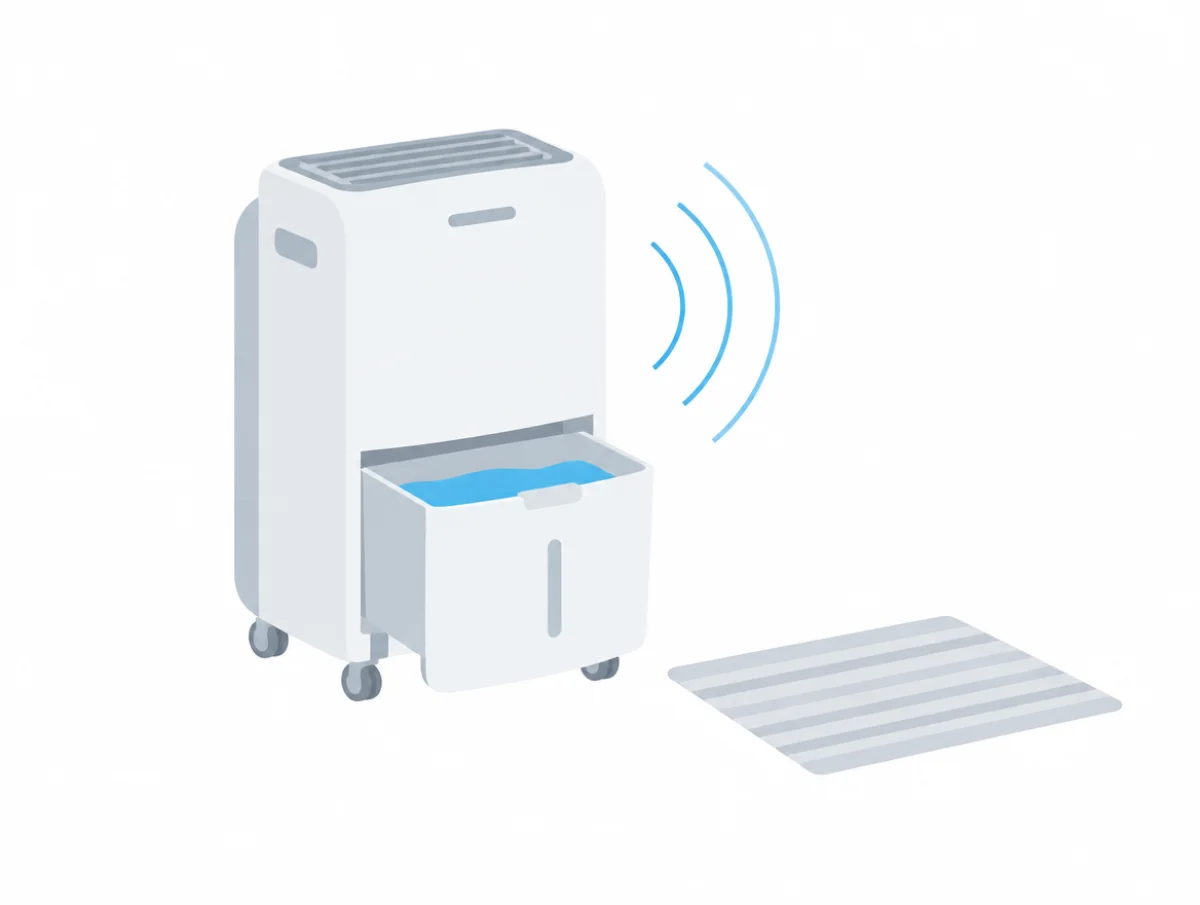
A dehumidifier making noise is usually a sign that it is drying the room. It has a compressor and a fan like a small refrigerator, so it hums, moves air, gurgles as refrigerant circulates, drips into its bucket and clicks as it cycles. GE, Frigidaire, Hisense, Midea, LG, Danby and AprilAire list these sounds as part of normal operation.
The sounds makers do not explain away are fewer: a loud rattle or vibration from a unit that is tilted, unlevel or missing its bucket, and any strange sound that comes with a smell or smoke. For those, the manuals say to check the bucket, filter and floor, or to unplug the unit.
Each explanation below is taken from a maker's support page or owner's manual, quoted where the wording matters. If no maker covers a sound, the page tells you that instead of guessing.
Is it normal for a dehumidifier to make noise?
Yes, a running dehumidifier is expected to make noise. GE says it "operates basically like a refrigerator and has the same components", so you will hear the compressor, the condenser fan and the unit cycling on and off.
GE's full list reads: "compressor noise, a condenser fan noise, possible water dripping into the storage bucket and normal cycling on and off sounds much like you hear with your refrigerator."
Fan noise sits in the troubleshooting tables of three makers, with the same verdict. GE's owner's manual for its ADYR and APYR models, LG's manual for the LD40E, LD50EL and LD65EL, and Frigidaire's use and care guide for the FHDD2234W each give the cause as air moving through the dehumidifier.
GE and LG answer "This is normal." Frigidaire's wording is "This is a normal sound."
A dehumidifier also blows warm air, which owners sometimes read as a fault along with the noise. GE says that because it has an evaporator and condenser, "you will also feel warm air blowing from the dehumidifier." Hisense's manual says the same: it "will put out warm air under normal operating conditions."
Which dehumidifier sounds do the makers call normal?
Rushing air, a hum or high-pitched chatter from the compressor, gurgling or hissing refrigerant, dripping water, clicks and short beeps are all on the makers' lists. A built-in pump can also be loud for its first few minutes.
While it is drying: rushing air, hum and chatter
Most of what you hear while the bucket fills is the fan and the compressor. Frigidaire's use and care guides list the "Sound of Rushing Air" at the top of the unit, from air "being moved by the fan." Hisense's manual for its DH5024K1W and DH5024KP1G lists "Air movement from the fan."
Hisense also lists "A high-pitched hum or pulsating noise caused by the high-efficiency compressor cycling on and off." Frigidaire's entry for the same part reads "Today's high efficiency compressors may have a high pitched chatter during the dehumidification cycle."
Santa Fe, which makes ducted whole-home units, treats the hum as a sign of health. Its Ultra98 and Ultra120 manual tells installers checking a unit that removes too little water to "Listen for a distinct buzzing/humming sound of a compressor starting up."
Gurgling, hissing and dripping
A gurgle is refrigerant on the move. Frigidaire's guides list a "Gurgle/Hiss" and explain that the noise "may be heard due to refrigerant passing through evaporator during normal operation." The same page lists a "Dripping Sound", the sound of water dripping "during the dehumidification cycle."
GE's support page puts "possible water dripping into the storage bucket" on its own list. That drip is condensed water leaving the cold coil, which is the job the machine is there to do.
Neither maker sets a volume or a duration for these sounds, so the only test the manuals offer is whether the sound is steady and familiar or new and harsh.
Clicks and beeps
Clicks come from switches and the bucket. Hisense lists "Clicks from the thermostat cycling" as normal. Frigidaire's guides say that when you return the bucket, "You should hear a click when the bucket is in the correct position." A missing click is the sign to reseat it.
Beeps are signals rather than faults. GE's beeping page says one beep is normal when the cord is connected, after a power interruption and when a button is pressed. Midea's Cube manual says the unit beeps "to indicate that it is changing modes."
A longer alarm means the bucket needs attention. GE says its dehumidifier will beep for 10 seconds when the bucket is full outside pump mode, or when water "is not pumped out" in pump mode on 70-pint models, with error code E0. Frigidaire says that if the bucket is removed while the unit is on, it "will beep 8 times" and show "Eb".
The built-in pump
A pump adds a sound of its own. Midea's Cube manual carries a notice that "The pump may generate a loud noise for the first 3~5 minutes of operation." None of the other pump manuals we read, from GE, Frigidaire and Hisense, describes a pump noise at all.
Frigidaire's FHDP5033Y guide says its pump only starts once the bucket fills: "The unit will not pump untill it reaches the full bucket point." On that model a pump starting at intervals is the expected pattern, not a fault.
Why is a dehumidifier making noise when off?
A dehumidifier that sounds busy while "off" has usually stopped drying but still has power. Fans that wake to read the humidity, an air-sampling blower, a defrost cycle or a delayed restart all make noise with the compressor idle.
The first case is a unit that has reached its target. Hisense says that once the room hits the set humidity, "the compressor will stop and the fan will be off periodically. The fan may periodically turn on, to read the humidity level, without the compressor running." To an owner, that reads as a machine switching itself on.
Whole-home units do the same on a timer. AprilAire's E070 manual says the blower turns on and AIR SAMPLING appears; after 3 minutes, if the humidity is below the setting, "the blowers turn off". It adds: "The dehumidifier will sample again every 60 minutes, or at any time if the humidity setting is lowered."
The power button is the third piece. GE's manual says "Turning off the power by pressing the Power button does NOT disconnect the appliance from power supply." AprilAire says the E070 uses less than 3W when idle, with neither fan nor compressor running. Only pulling the plug, or a power switch where fitted, cuts the supply.
A unit restarted soon after being switched off can also pause before it sounds normal again. Frigidaire's guides describe "an automatic 3 minute time delayed start if the unit is turned off and on quickly", which "prevents overheating of the compressor and possible circuit breaker tripping." GE gives the same delay of up to 3 minutes after a power failure.
None of the manuals we read describes a sound from a dehumidifier that is unplugged. If yours makes one, that falls outside every maker's list of normal sounds.
Why does a dehumidifier fan run while the compressor is off?
A dehumidifier fan that runs alone is usually defrosting the cold coil. GE, Frigidaire, Danby and Hisense all say frost on the evaporator makes the compressor stop while the fan keeps blowing until the frost melts.
GE's wording: "When frost builds up on the evaporator coils, the compressor will cycle off and the fan will continue to run until the frost disappears." When the coil is clear, GE says, "dehumidifying will resume." Frigidaire's FHDD2234W guide says the same and adds that the display "will show 'dF'."
Danby's owner's manual says the compressor "temporarily shuts off while the fan continues to operate", then resumes its previous settings. Hisense calls it de-icing and says "Some freezing is normal when dehumidifiers are used at low temperatures."
Cool rooms bring it on more often. GE says its coils "can become covered with frost at temperatures below 41°F". LG's manual names "room temperature is below 65°F (18°C)" as one cause, while GE, LG and Frigidaire agree that "Frost will usually disappear within 60 minutes."
AprilAire says frosting on its whole-home units "occurs when the incoming air is cool and dry, normally during Spring or Fall", that it "is a normal part of operation", and that DEFROSTING will show on the display.
Heavy ice is different. Frigidaire's frost buildup page says restricted airflow "can prevent the from ice melting", and lists its checks: change a "CO" setpoint to the 35 to 85 range, clean the filter and look for error codes. Do not melt the ice yourself: GE, Hisense and Danby warn against any means to speed up defrosting beyond what the maker recommends.
Why is my dehumidifier making a loud noise?
Midea, Danby and Frigidaire all trace a loud or new dehumidifier noise to the same few causes: a dirty filter, a bucket that is not seated, and a unit that is tilted or standing on an uneven floor.
Midea's Cube troubleshooting table, under "The unit makes a loud noise when operating", lists an air filter that "may be dirty", a unit that "is tilted instead of upright as it should be", and a floor surface that "is not level." Danby's table under "Noise" lists a dirty filter, a bucket "not in proper position" and an unlevel floor.
A clogged filter also makes the unit work harder. GE and Frigidaire say to keep curtains and furniture off the grilles; Frigidaire asks for at least 12 inches of clearance around its 22-pint model, and GE for 18 inches on all sides of its own units.
Danby's manual says to install the unit "on a flat, sturdy surface", or the result could be "damage or excessive noise and vibration." GE says to place it "on a smooth, level floor strong enough to support the unit with a full bucket of water", and to roll it on its casters "only" on smooth, flat surfaces, never over carpet.
If the noise began after a mode change, check the fan speed first. Frigidaire's FHDP5033Y guide says Quick mode runs "in continuous dehumidifying and High fan speed mode", with the fan "fix in 'Hi'", so a louder unit in that mode is working as designed.
Why is my dehumidifier rattling or vibrating?
Rattling usually means a part is loose and vibration usually means the unit is not sitting square. Frigidaire's noise guide points first to the bucket and filter cover for a rattle, and to uneven casters for humming or vibration.
Frigidaire's noise guide for rattling: "The unit may have loose component. Check to make sure that the bucket and filter cover are properly installed." For humming or vibrating: "The unit may not be properly supported and not resting on the castors evenly. Makes sure the unit is on a flat level surface."
Frigidaire adds that units installed within the past 30 days should go back to the installer, and that later ones need a service call through Frigidaire. The guide does not tell you to open the cabinet.
Ducted whole-home units carry vibration into the house differently. Santa Fe warns that its Ultra98 should not sit "directly on structural building members without vibration absorbers or unwanted noise may result", and recommends levelling feet with "vibration pads and/or risers" on the floor, or brackets if hung.
A rattle in the ductwork is the same problem one step further along. Santa Fe recommends "A short piece of flexible ducting" on every duct connection "to reduce noise and vibration transmitted to rigid ductwork in the structure." Honeywell's DR90 installation guide says flex duct at the collars helps "reduce vibration noise."
AprilAire's E070 manual says ductwork on the inlet and outlet will "reduce the noise level of the dehumidifier", and that "For attic installations, suspending the dehumidifier is recommended to reduce noise transference." Ducting changes are installer work, and AprilAire, Santa Fe and Honeywell write these instructions for professionals.
Which dehumidifier noises mean you should stop using it?
A strange dehumidifier noise that comes with an odor or smoke is the case four portable makers single out: unplug the unit. LG, Midea, Danby and Hisense say so in their safety sections, and Hisense adds to contact customer service.
LG: "Unplug the unit if strange sounds, odors, or smoke come from it." It warns that otherwise the unit "may cause a fire or an electric shock." Midea's Cube manual uses almost the same words, Danby says to "Disconnect the power if strange sounds, smells or smoke comes from it", and Hisense says to "pull the power plug out and contact customer service."
Repairs stay with the maker. GE: "GE Appliances does not support any servicing of the dehumidifier. We strongly recommend that you do not attempt to service the dehumidifier yourself." Frigidaire's units contain "no user-serviceable parts", and it says to "Always call an authorized Electrolux servicer for repairs."
GE's manual also warns that its unit "contains flammable refrigerant" and that maintenance, cleaning and service "should only be performed by technicians properly trained and qualified". Error codes follow the same rule. Frigidaire and Danby say to unplug the unit and call for service if a sensor or memory code persists, and Hisense says to contact customer service for any error code.
How loud is a normal dehumidifier?
A typical compressor dehumidifier is rated in the 40s to mid 50s in dBA, by the makers' own figures. Frigidaire lists 43 dBA on low and 49 on high for one 22-pint model, and AprilAire's whole-home units run from 45 to 55 dBA ducted.
Frigidaire's FHDD2234W spec sheet lists "Noise Level dBA (Low)" at 43, medium at 46 and high at 49. No distance is given. Its manual says Quiet mode holds the fan at low speed throughout.
Low speed is the setting the makers suggest for quiet. GE says to set the fan to Low "When the humidity has been reduced and quiet operation is preferred", and Hisense says Low reaches the set humidity "with lower sound level."
For whole-home units, AprilAire's E080 sheet gives "45 dBA ducted". Its E100V sheet separates the two states covered above: 52.8 dBA ducted with the fan only, and 55.0 dBA ducted with compressor and fan.
That E100V gap is small. A sampling or defrosting blower is nearly as loud as full drying on that unit, which is why a fan-only cycle at night can sound like the machine never stopped.
To compare more models by their published figures, see our quietest dehumidifiers guide. For a unit below a living space, the quietest dehumidifier for a basement ranks pump and gravity-drain units by low and high speed, and our quiet basement plan covers placement. The dBA explainer shows how to read the figures.
How did we put this together?
QuietSpecs built this dehumidifier noise guide from maker documents only. For portable units we used GE's two support pages and its ADYR and APYR owner's manual, Frigidaire's noise and frost pages, two use and care guides and a spec sheet, and the owner's manuals from Hisense, Midea, LG and Danby.
For whole-home units we used AprilAire's E070 manual and two of its spec sheets, Santa Fe's Ultra98 and Ultra120 manual and Honeywell's DR90 installation guide. We quote each maker's own wording with the conditions it attaches.
We have not run, listened to, measured, opened or repaired a dehumidifier for this article. Sounds that no manual describes are left unexplained rather than filled in from forums or repair sites.