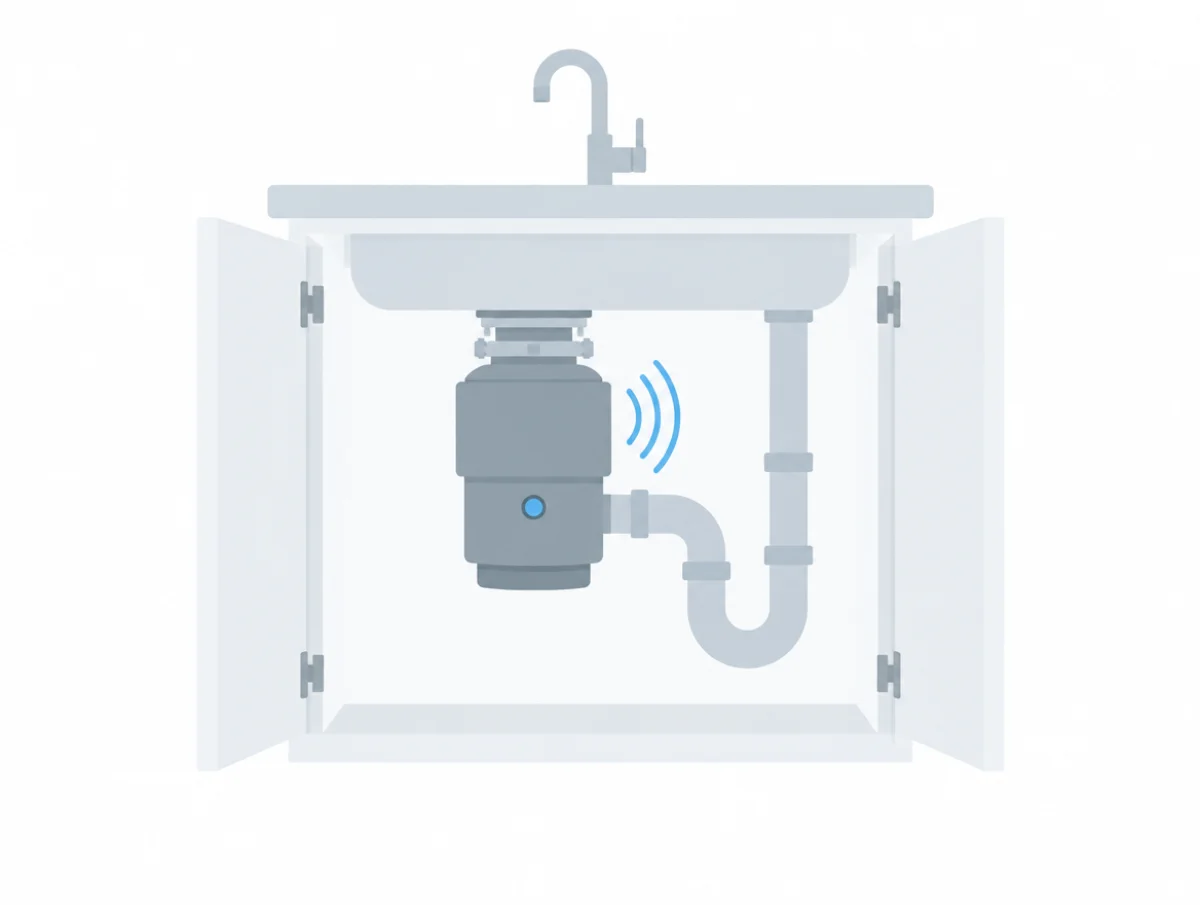
A garbage disposal humming but not grinding is, by its makers' own account, almost always jammed: the motor is getting power, but something stuck inside stops the turntable from moving. InSinkErator, Moen, Waste King and GE publish nearly the same fix, and every version starts in one place, with the power switched off and your hands kept out of the unit.
Other sounds have other causes. A start-up click is the swivel impellers swinging out, a metallic clatter usually means a dropped spoon or bottle cap, and silence after a hum often means the overload protector has tripped.
Everything below is quoted from those four makers' manuals and support pages. Where their figures differ, as on cooling times, we list each one, and where none covers a sound, we say so.
Why is my garbage disposal humming but not working?
A garbage disposal that hums without grinding usually has a jammed turntable, according to Moen, Waste King and InSinkErator: the motor has power, but something lodged in the grind chamber stops the grinding parts from turning.
Moen walks through the sequence. Smaller units "are not intended to pulverize bones or process fibrous materials like husks", which can lodge in or wrap around the parts inside, and then "the motor may hum because it's unable to turn the grinding mechanism."
Keep flipping the switch and, Moen says, "Repeated attempts to run the unit can trip the internal breaker", after which the disposal "will no longer grind, move internally, or make any sound." A hum that turns into silence is the same jam, one step further on.
Waste King's installation instructions say it in one line: "A humming noise with no grinding could be that the turn table is not rotating." Its FAQ gives three signs of a jam: a noise "different from the typical grind sound" with waste left unground, a mess at the splash guard, and a smell of rotten food from the sink opening.
The usual culprits are the items the manuals ask you to keep out. Moen names "a chicken bone, a metal spoon, broken glass/ceramic" and fibrous scraps such as "a corn husk or broccoli stem". InSinkErator's Badger manual bans shellfish shells, glass, china, plastic and metal "such as bottle caps, steel shot, tin cans, or utensils".
How do you unjam a garbage disposal that hums but will not spin?
Unjamming a humming disposal starts the same way for every maker: turn the power off, keep your hands out of the unit, then turn the grinding parts by hand with the maker's wrench or a long wooden tool.
The makers differ on how far to cut the power. InSinkErator's jam page says "Make certain that the garbage disposal's switch is in the off position. Do not place your hand in the garbage disposal at any time." Moen says to unplug the unit "or turn off the power at the main electrical service panel".
Waste King says to unplug the cord or turn the wall switch or breaker off, "depending on your model and wiring configuration." GE asks for both steps: switch off, then disconnect power "at the main fuse or circuit breaker."
No maker allows a hand inside, powered or not. GE: "Never put your hand or any portion of your body in the disposer." Waste King: "Never put your hands or fingers inside disposal." Objects come out with tongs, after a look with a flashlight.
InSinkErator: the wrench in the bottom of the unit
InSinkErator ships every disposal with a small crank-shaped wrench that fits a hole at the center of the underside, and its pages say to work it back and forth until the grinding parts turn freely.
The company describes the tool as "silver colored, and shaped like a little crank, about four inches long", and says a standard 1/4-inch Allen wrench will do if yours is lost. The Evolution Excel manual calls it the Jam-Buster Wrench; the Badger manual calls it a wrenchette.
With the switch off, InSinkErator's jam page gives these steps:
- Put the wrench in the hole "dead center, facing the floor" and use it like a crank.
- Work it back and forth in both directions.
- Keep going "until it turns freely in complete circles in both directions."
- Check the red overload protector on the underside and press it if it has dropped.
- Shine a flashlight into the grind chamber and lift out anything you see with tongs or pliers.
- Turn on the water, then the disposal.
Force is allowed. InSinkErator says "If the wrench will not turn easily, it is OK to use some force. The wrench is designed to bend before any damage is done to the garbage disposal." If the unit jams again, use the wrench again: "You may need to repeat the process several times."
The Badger manual adds a warning about the tool itself: "Remove wrenchette before reconnecting power to the disposer. Do not hold the wrenchette when operating the disposer. Failure to do so can result in broken bones or cuts."
Moen: the unjamming wrench from the sink side
Moen's method works from above: with the power disconnected, its unjamming wrench, part 1037 and sold separately, goes down through the sink opening and pushes against the two swivel impellers to turn the turntable.
Moen says to lay the wrench "flat on the floor of the Turntable" with its two ends against the impellers, then turn it either way. Keep turning until the turntable rotates "at least two full revolutions". That rotation also lets anything caught in the grind ring pass through. Then lift the wrench out.
Before switching back on, Moen asks you to clear tools from the sink opening and to "Assure no one is close to the opening of the sink." If you still hear a hum, disconnect the power again and repeat the steps. After a second failure, Moen points to its no-power checks and its support line.
Waste King and GE: a wooden spoon or a broom handle
Waste King and GE free the turntable from above with a long wooden tool, a wooden spoon in Waste King's instructions and a broom handle, mop handle or long wooden spoon in GE's, always with the power disconnected first.
Waste King's instructions: "Dislodge any object(s) by rotating the turntable, in either direction, with a wooden spoon and remove the object(s)." Its FAQ explains that you press against "one of the two impellers to put force on the turntable", adding that "it is not the impellers that need to be moving freely".
GE says the flywheel "turns clockwise". Its Disposer stopped running page says that if the unit will not restart after you remove the cause, "use a short lever to turn the flywheel to free the jam."
Where is the garbage disposal reset button?
The garbage disposal reset button is a small red button near the bottom of the unit: on the underside for InSinkErator, opposite the power cord for Moen, and opposite the discharge elbow for Waste King and GE.
That button is the overload protector, and it cuts the motor when a jam or a heavy load overheats it. GE's reset page says "If the Garbage Disposer gets jammed and the motor overloads, the reset button will pop out and shut the Disposer off." GE places it on "the bottom or lower back side".
InSinkErator calls its version "a small square red button" that, once tripped, sits "dropped down about a quarter of an inch (5mm)". Moen warns that its button "may be set back slightly and may require a screwdriver to prod it." Waste King and GE say to push the button "in until it clicks and remains depressed".
The wait before pressing it varies by maker:
| Maker and document | Wait before pressing reset |
|---|---|
| InSinkErator Badger and Evolution manuals | 3 to 5 minutes |
| InSinkErator jam support page | Up to 20 minutes |
| GE reset page | Two to five minutes |
| Moen and Waste King | No time given |
The 20 minute figure is for an InSinkErator that has shut itself off: wall switch off, or an air switch model unplugged, while it cools. If its button will not stay in, the company says to "wait ten minutes and try again."
Makers also disagree on whether the power should be on when you press it. InSinkErator's Badger manual says to switch off before "pressing reset button", and GE says "Before resetting, disconnect the power supply". Waste King says "After turning the power back on, press the red reset button". Follow the manual for your own brand.
Why is my garbage disposal humming but not jammed?
A garbage disposal that still hums once the turntable turns freely points past the jam, to the reset, the wiring or the motor itself, and Moen, Waste King and GE all end that path at service or replacement.
Waste King sets out the order. Check the reset button; if it has not tripped, check for "shorted or broken wires connecting to the disposal", then the switch, the fuse box or the breaker. With all of that intact, "the unit may have an internal problem that requires service or replacement."
Waste King adds: "if you are not familiar with electrical power and procedures, call a qualified electrician." GE's owner's manual reaches the same end, saying that if no foreign object is present and the turntable will not turn, "there may be internal problems."
Moen's no-power article says that if a working outlet and a pressed reset button do not bring the unit back, "it may need to be replaced", and that a dead outlet "may require an electrician to replace it." Not one of the four makers offers a repair inside the motor that owners can do themselves.
Which garbage disposal noises are normal?
Normal garbage disposal noises, per the makers, are a start-up click from the impellers, slowing and crunching as small bones and pits go through, and a steady sound of motor and water once the food is gone.
At start-up: a click from the swivel impellers
A click when the motor starts is normal on GE and Waste King disposals, both built with swivel impellers. GE's manual for its GFC model lines says "This disposer uses anti-jam swivel impellers that make a clicking sound as they swing into place. This indicates normal operation." Waste King prints almost the same sentence.
While grinding: slowing down and the crunch of hard scraps
A disposal that slows while grinding is working as designed, say GE and Waste King. GE: "Do not be alarmed that the disposer slows down while grinding. The disposer is actually increasing torque (grinding power) and is operating under normal conditions."
Hard scraps are meant to sound hard. InSinkErator's manuals tell owners to "Grind hard materials such as small bones, fruit pits, and ice", because "A scouring action is created by the particles inside the grind chamber." GE's chart only counts loud noises as a fault when they are "other than those during grinding of bones and fruit pits".
GE and Waste King still suggest cutting or breaking large bones, rinds and cobs first, saying "Large bones and fibrous husks require considerable grinding time and are more easily thrown away with other trash."
At the end: only motor and water
The end of a grind has its own sound cue. InSinkErator says "Don't turn off disposer until grinding is completed and only sound of motor and water is heard." GE says to keep water and disposer running "approximately 25 seconds after shredding stops", and Waste King says about 15 seconds, both to flush waste through the trap.
Why is my garbage disposal making a grinding or metal noise?
A metallic grinding, clatter or rattle from a running disposal usually means a foreign object, according to GE, Waste King and InSinkErator: a spoon, bottle cap or similar item that has dropped into the grind chamber.
InSinkErator's unusual noise page covers sounds "like clicking machine-gun, metallic or rattling". With the switch off, it says to "Look down into the garbage disposal using a flashlight", paying "special attention to the area around the outer edge of the garbage disposal's shredding disk where you see the little teeth."
Anything there comes out with tongs or pliers. GE's chart blames "Silverware, bottle cap or other foreign object" and says to remove the splash guard and lift the object out "with long-handled tongs". Waste King says to turn off the switch and the water and wait until the disposal "has stopped running" first.
A new disposal that rattles after installation
A brand-new disposal fitted to a dishwasher can rattle for a reason both GE and Waste King name: the knockout plug that falls inside when the dishwasher inlet is opened.
Waste King lists the "dishwasher knockout plug" beside spoons and bottle caps as a cause of noise. GE says that once it drops in "you may remove it or simply grind it up when the disposer is used", which "will not damage the disposer in any way, but may take some time to grind, over the course of several uses."
Why is my garbage disposal rattling or vibrating?
A garbage disposal that rattles or vibrates loudly may be loose rather than broken: InSinkErator says to check that every plumbing connection is tight and that the lower mounting ring is still locked to the mounting assembly.
InSinkErator's fix for an unlocked ring uses the same wrench: insert it "into the left side of the metal loop on the lower mounting ring and rotate right. You should feel or hear a click when it locks into place." If the ring is already locked, its next step is to check for stuck impellers.
The parts that quiet a disposal matter as well. The Evolution Excel manual says "Do not operate disposer without Quiet Collar® Sink Baffle in place", and InSinkErator's SoundSeal page says that baffle exists "to block noise from the sink opening". If you took it out for washing, refit it before the next run.
The SoundSeal page says the Anti-Vibration Mount "Reduces noise and vibration transferred from the disposal to the sink." Moen, Waste King and GE do not address vibration in the documents we read.
Why is my garbage disposal clicking but not turning on?
No maker lists a disposal that clicks without starting as its own fault, so the closest guidance is the no-start checklist: the reset button, the switch, the outlet and the breaker, in roughly that order.
Moen's no-power article begins with how the unit is switched on. Its disposals can run from a wall switch, a stopper that presses a switch inside the housing, or an air switch button on the sink deck. On stopper models, "If the cherry switch gets stuck or breaks the unit will not turn on." On air switches, Moen says to check the tube to the outlet below.
Next, Moen says to test the outlet with a lamp or similar device. If it works, plug the disposal back in and press reset; if not, look for a tripped breaker or blown fuse. GE's batch feed models only start when the stopper slot lines up "with the switch plunger inside the neck".
A click from a disposal that is switched off and idle is not covered in any manual or support page we read, so we have no maker's explanation to give for it.
How loud should a garbage disposal be?
How loud a garbage disposal should be has no answer in decibels: InSinkErator, Moen, Waste King and GE publish no dB figure for any home disposal, so the only maker measures are relative claims.
InSinkErator comes closest. Its SoundSeal page says disposals with its Quiet SoundSeal parts "are 75% quieter than our Badger® 5 disposal", and that the Quietest SoundSeal models "are 80% quieter". It names no test method, distance or baseline level, which our InSinkErator noise claims page works through model by model.
So judge a noise against your own unit on a good day, as Waste King does when it describes a jam as a noise "different from the typical grind sound". For a disposal that is simply loud, our quietest garbage disposals guide compares the insulation and mounts that make one quieter.
When should you stop and call for service?
Service is the makers' answer when a disposal still will not run after the jam is cleared and the reset pressed, or when the turntable stays stuck with nothing visible inside.
GE recommends service if the disposer will not start after its reset steps. InSinkErator's help line is 1-800-558-5700, Moen's is 1-800-BUY-MOEN and Waste King's is 1-800-854-3229.
InSinkErator's Badger warranty is blunt about home repairs: it "is void if you attempt to repair the InSinkErator Product." The same manual lists a leak hazard and asks owners to "Regularly inspect disposer and plumbing fittings for leaks".
How did we put this together?
We built this page from disposal makers' own manuals and support pages. They are InSinkErator's jam and unusual noise pages, Badger and Evolution Excel manuals and SoundSeal page; Moen's unjamming and no-power articles; Waste King's FAQ and EZ Mount instructions; and GE's Disposall manual with three disposer support pages.
We did not take apart, unjam, reset or listen to any garbage disposal for this page, and we have not tried any of the steps above under a sink ourselves. Every cause, waiting time and instruction is the maker's, quoted with the conditions it gives, and your own model's manual comes first where it differs.