Which sound tier does each InSinkErator model sit in?
InSinkErator's comparison table sorts its eleven current disposals into four tiers: Standard Sound, Reduced Sound, Quiet SoundSeal Technology and Quietest SoundSeal Technology. The two SoundSeal tiers carry the "75% quieter" and "80% quieter" claims; Reduced Sound carries "55% quieter".
The same table repeats on the Advanced, Power and Badger series pages, so the tier assignments below come straight from it. Grouped from loudest to quietest, with each model's warranty:
- Standard Sound: Badger 1 (1/3 HP, 2-year), Badger 5 (1/2 HP, 5-year) and Badger 5XP (3/4 HP, 6-year). No quietness claim attaches to any of the three; the Badger 5 is instead the baseline the percentages reference.
- Reduced Sound: Power .75HP (6-year) and Power 1.0HP (7-year). The Power Series page says "These disposals operate at reduced noise levels over our standard disposal. They are 55% quieter than our Badger 5 disposal."
- Quiet SoundSeal Technology: Evolution .75HP, Evolution .75HP LED, Evolution Septic Guard and Evolution Cover Control, all 3/4 HP with 9-year warranties. The SoundSeal page: "These units are 75% quieter than our Badger 5 disposal."
- Quietest SoundSeal Technology: Evolution 1.0HP and Evolution 1.0HP LED, both 1 HP with 10-year warranties. The SoundSeal page: "These units are 80% quieter than our Badger 5 disposal."
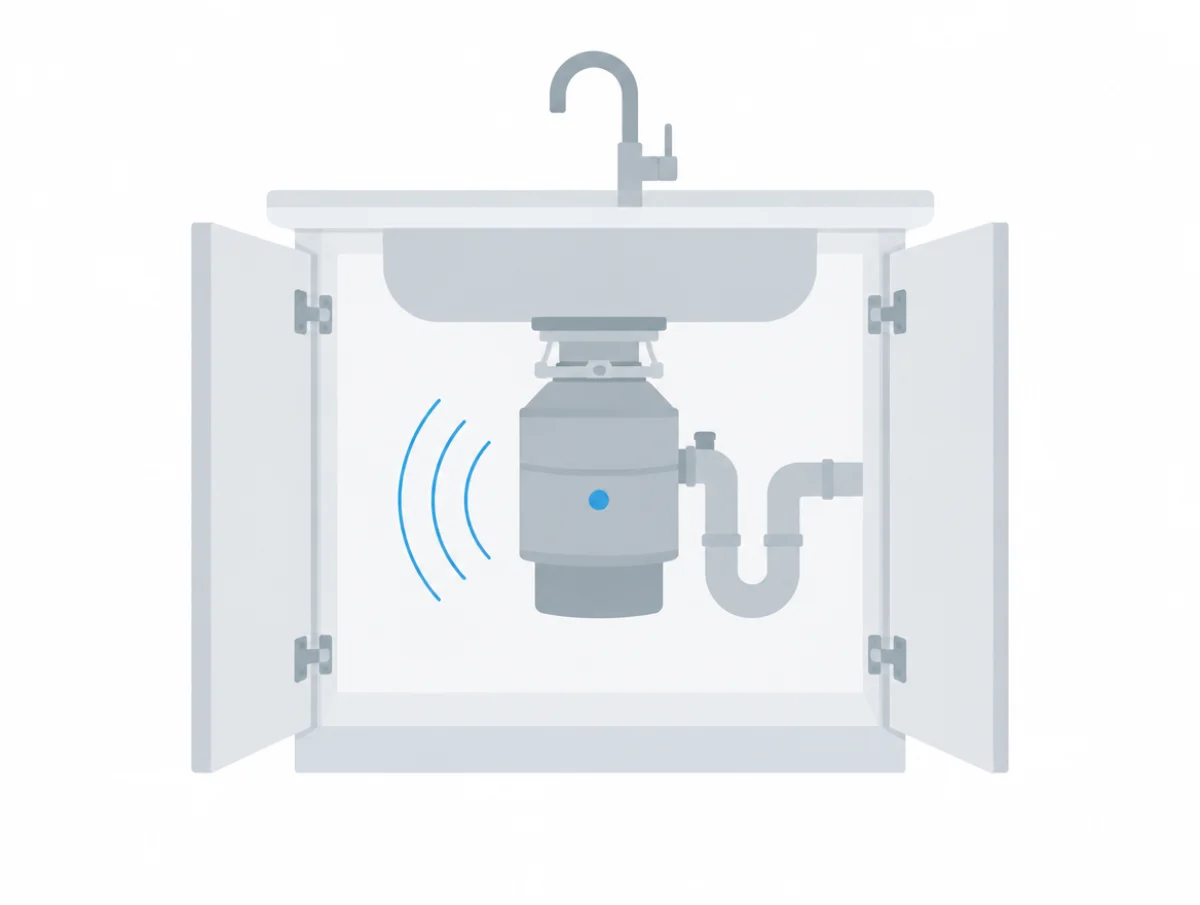
Each step up the ladder corresponds to hardware. Reduced Sound reflects the Power Series build. The Quiet tier adds the Quiet Collar baffle at the sink opening, vibration-damping mounting and a full trim shell. The Quietest tier then wraps the chamber in a molded Sound Jacket and isolates the drain line with an Anti-Vibration Tailpipe Coupler.
A fine-print line travels with all of it. The SoundSeal page's headline about a "quieter kitchen" carries the footnote "Compared to Badger 5 and Power Series Models", so even the vaguest wording on these pages is a within-brand comparison.
Can InSinkErator's percent-quieter claims be converted to decibels?
No, an InSinkErator percent-quieter claim cannot be converted to decibels, because the company publishes no measured level for the Badger 5 baseline, no test method, no distance and no definition of what quantity the percentage describes.
A real acoustic comparison needs all of those. Husqvarna or Bosch can say a machine emits so many dB(A) under a named standard; a reader can then subtract. InSinkErator's 80% has nothing to subtract from, since the Badger 5's loudness exists on its site only as the word Standard.
Percentage and decibel arithmetic also disagree with each other. Sound energy, sound pressure and perceived loudness each halve at different decibel steps, and InSinkErator never says which of the three its marketing means. Any conversion would start by guessing the units of the original claim.
What the claims do support is ordering. Within one brand, measured by one unstated yardstick, 80 beats 75 beats 55 beats nothing, and the physical parts climb in the same sequence. Our cross-brand disposal guide ranks on those parts for exactly this reason.
That ordering stops at the brand's edge. Moen's SoundSHIELD and Kraus's QuietStorm disposals publish no percentages at all, so nothing connects an InSinkErator tier to a competitor. Comparing "80% quieter" against another maker's insulated model is comparing a sentence against silence.
Is the InSinkErator Quiet Series the same as the Advanced Series?
Yes, in practice: the models InSinkErator once marketed as its Quiet Series are today's Advanced Series, and the Quiet Garbage Disposals page that survives at the old quiet-series address now presents Advanced Series models.
That legacy page remains useful, and not only for its chart of MSRPs. It is where InSinkErator describes the goal in plain terms, saying its quietest disposals are designed so that "you can carry on a normal conversation in your kitchen while your disposal is running". No model is named in that sentence, and no level is attached to it.
Shoppers hunting the old names will find them gone from the current tables. A Quiet Series Evolution Compact, the discontinued 3/4 HP compact model, appears on neither comparison chart we read; the 3/4 HP slot in the quiet lineup now belongs to the Evolution .75HP and its LED, Septic Guard and Cover Control variants.
The legacy page also shows its age in smaller ways. Its FAQ credits quietness to "Sound Limiter insulation", a term the current SoundSeal page does not use, and its nine-model chart omits both LED models that the series pages list. Two generations of marketing are live at once, which is a thing to know when quoting either.
Where do InSinkErator's own pages disagree about these claims?
InSinkErator's pages conflict on the Evolution .75HP LED's tier name, on the Badger 1's price and on the Evolution 1.0HP's price, so a shopper can meet two different stories depending on the page that loads.
The tier conflict is the one that matters here. The .75HP LED product page's features list says "Quietest SoundSeal Technology is 75% quieter than the Badger 5 disposal". The comparison table files the same model under Quiet SoundSeal. The percentage matches the Quiet tier, so the stray word Quietest on the product page looks like the error, but only the table says so.
Prices wander the same way. The chart's MSRP for the Badger 1 is $129, while its shop page asks $139.00 without a cord and $149.00 with one. The Evolution 1.0HP shows $399 on the chart after its shop page carried $349 in September.
None of this is unusual for a large catalog, and none of it would matter if a published measurement sat underneath. With claims, the wording on one page is all there is, so a second page that words it differently genuinely changes what you know.
Which InSinkErator model gives the best hygiene and quiet combination?
The Evolution 1.0HP LED pairs InSinkErator's top noise tier with its only built-in hygiene feature, so it is the strongest single answer. The Evolution .75HP LED offers the same flange one claim tier lower, for less money at retail.
LEDefense is the hygiene half: a UV-free light in the sink flange, running around the clock, which InSinkErator says "kills 99% of odor-causing bacteria" with a footnote tying that figure to laboratory testing on hard surfaces over hours. The light needs its own power, through a USB-C adapter on a 6 ft cord into an always-on outlet.
The quiet half is inherited. Each LED model keeps the SoundSeal package of the Evolution it is built on, and its removable baffle, in the product page's words, "traps noise inside the disposal". Nothing about the light itself is claimed to change the sound.
One practical note for an open kitchen: a disposal runs seconds at a time, so the machines that actually hold the floor are the ones covered in our dishwasher guide and range hood guide, and the room strategy lives in our open-plan kitchen explainer.
How much does each InSinkErator sound tier cost?
Climbing InSinkErator's claims ladder costs roughly $130 to $400 at MSRP: Standard Sound runs $129 to $179, Reduced Sound $189 to $239, the Quiet tier $289 to $349, and the Quietest tier $399 where a price is published.
Those figures come from the MSRP row on the Quiet Garbage Disposals chart, dated to our October 22, 2026 reading: Badger 1 at $129, Badger 5 at $149, Badger 5XP at $179, Power .75HP at $189, Power 1.0HP at $239, Evolution .75HP at $289, Evolution Cover Control at $339, Evolution Septic Guard at $349 and Evolution 1.0HP at $399.
Neither LED model appears in that row, so their premium over the standard Evolutions has no official number. Both the Badger 1 and the Evolution 1.0HP carry different prices elsewhere on the site, as covered above, and InSinkErator's own footer warns that MSRP "may differ from actual selling prices in your area".
Read as dollars per claimed tier, the ladder is steep at the top. Fifty dollars separates the baseline Badger 5 from the Power 1.0HP and its 55% claim. Another $50 reaches the 75% tier. The final five claimed points, from 75 to 80, cost $110 and buy the Sound Jacket and tailpipe coupler.