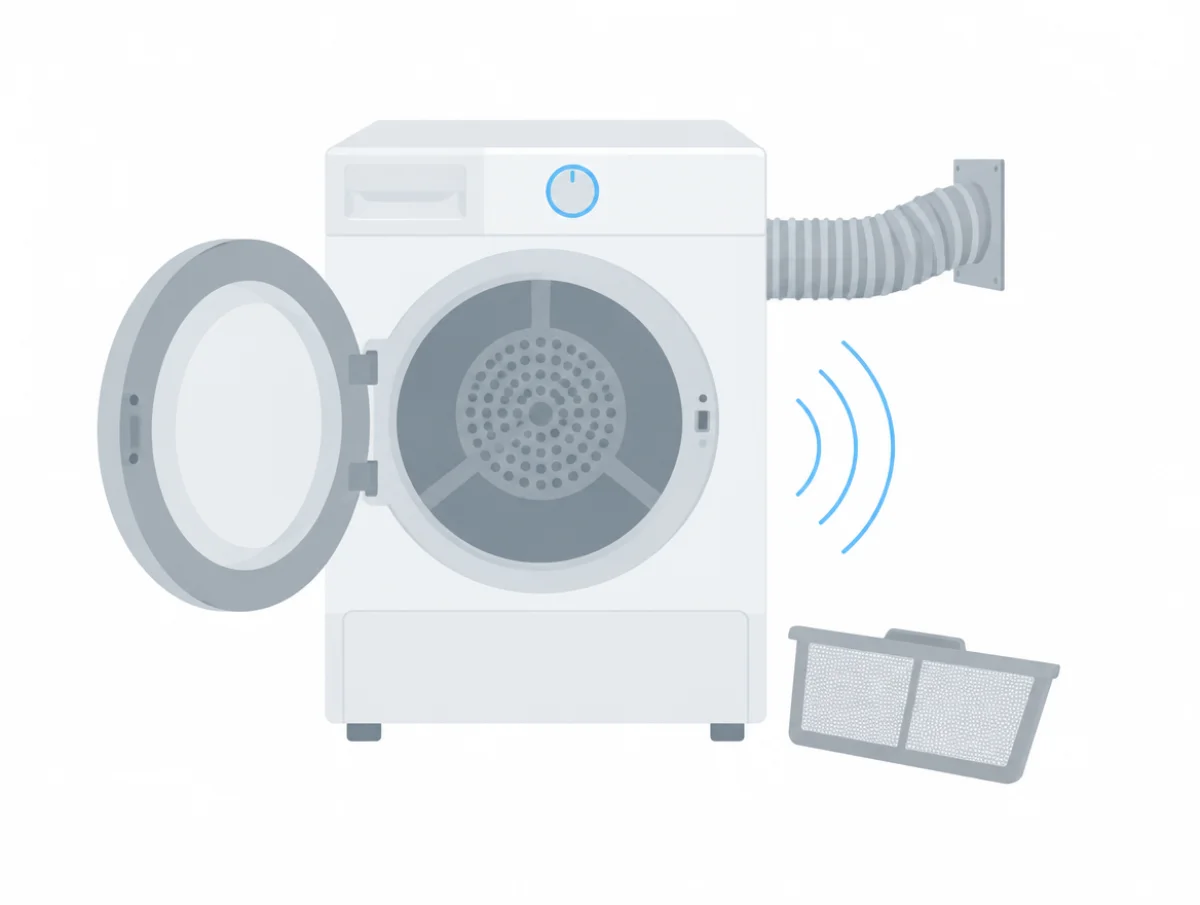
A dryer making noise is usually a dryer full of zippers, coins and wet towels, according to the companies that build them. Whirlpool, GE, Samsung, LG, Frigidaire, Bosch and Miele all publish lists of dryer sounds, and most entries trace back to the load, a dryer that is not level, or a part doing its job.
The makers send fewer sounds to a technician: a metallic scrape that lasts the whole cycle, a squeal with an ordinary load, a thump with an empty drum, and a squeak that only starts once the dryer is hot.
Below, the sounds are grouped by when you hear them: at startup, while the drum turns, while it runs, from gas and heat pump models, after the cycle, and when the drum will not turn at all. Every explanation comes from a maker's support article or dryer manual, quoted or closely paraphrased, and where two makers disagree, we say so.
Is it normal for a dryer to make noise?
Yes. A turning drum, tumbling clothes and moving air all make sound, and GE lists "The sound of the drum as it turns" among normal dryer noises. GE's owner's manual for its gas and electric dryers says "Some shaking/noise is normal."
GE splits dryer sounds into two lists, one normal and one not, which makes it the most useful single page to start from. Samsung sorts nearly all dryer sounds into four groups: "rattling, thumping, squealing or grinding, or humming."
LG puts the blame mostly on the load, saying "factors such as zippers, coins, or buttons can cause your dryer to be noisy at times."
Frigidaire says the normal operating sounds of its dryers are listed in the Complete Owner's Guide, naming the suspension rollers, the air flow system, the water valve on steam models, and the gas valve and gas burner on gas models.
Why is my dryer making noise when it starts?
A dryer making noise in its first seconds or minutes is usually a brief startup squeak, rollers that have flattened during a period of non-use, or rollers on a new dryer that have not yet worn in. GE, Whirlpool and LG all describe one of these.
GE says a squeak at startup "should go away after the first few seconds of operation", and that if it carries on, you should contact service. LG gives a reason for a short, high pitched sound at start or when the drum reverses: friction "as the belt connecting the drum and motor tightens", which it says does not mean a fault.
Whirlpool explains the thump after a dryer has been idle. The drum support rollers can flatten where they touch the drum, and "The flat spot causes the thumping sound." Once the dryer runs for a while, it says, the rollers regain their shape and the thump should stop.
A brand new dryer can rumble at first for a related reason. Whirlpool says roller sound in the first cycles after installation "will decrease over a period of regular use" as the rubber rollers conform to the drum.
Why is my dryer making noise when spinning?
A dryer making noise while the drum spins is most often reacting to what is inside it: hard fasteners, coins, heavy wet items or a load that has rolled into a ball. Whirlpool, Samsung, LG and Frigidaire all start with the load before the machine.
Why is my dryer rattling or knocking?
Rattling and knocking come mostly from small hard objects. Whirlpool names "Zippers, buckles, buttons, and rivets" along with coins, paper clips and pens. LG warns that coins, keys or lighters "can cause loud noise, damage the dryer, or create a fire hazard."
The source may also sit outside the drum. Whirlpool lists items on top of or leaning against the dryer, a washer spin that makes the dryer cabinet vibrate, and loose items in a pedestal drawer.
It also says coins or socks can fall into the lint chute and hit the blower wheel, causing a knock. Its advice is to remove the lint screen, look in the housing, and use a dryer lint brush to fish out anything you see. GE adds that the edges of that opening "could be sharp" and suggests work gloves.
Samsung's rattling advice is to level the dryer and check that the exhaust vent "should not wiggle or rattle" and is not knocking against anything such as the power cord. Frigidaire says a clank or squeak "is usually caused when the unit is on a pedestal and has become loose."
Why is my dryer thumping?
A thump during the cycle is usually the load hitting the drum wall, per Samsung and LG, and it eases as clothes dry. Samsung draws one firm line: "If the noise occurs while the dryer is empty", request service.
For a thump with clothes in it, Samsung blames overloading or large buttons, snaps and zippers, and says to turn those items inside out. LG calls a thud from heavy wet clothes "normal" and says it "will diminish as the cycle advances", and suggests spreading items evenly in the drum.
Whirlpool's thumping page adds sheets, curtains and bedspreads, which "can roll into a ball", and tennis shoes, for which it suggests a drying rack. It also says a dryer missing a leg "may rock or teeter" on an uneven floor.
GE is the one maker that ties a thump to a failing part: "A frayed or damaged Dryer belt will make a thumping sound, which would require service."
Why is my dryer squeaking or squealing?
Squeaks and squeals point to the load, lint, loose screws or wear, depending on the maker. Samsung blames a load that is too heavy, GE loose cabinet screws, and Whirlpool lint around the belt and pulleys or worn parts on an older dryer.
Samsung's instruction is direct: "immediately stop the cycle and reduce the weight of the load." It suggests drying fewer items, or running them through the washer's spin again first. If the sound happens with a normal load, which it describes as "about four wet towels", Samsung says to request service.
Whirlpool says lint build up inside "may require a service call to remove the back panel" for cleaning, and that on an older dryer the belt and pulleys can wear. It says to check with an authorized service provider which parts to replace.
GE treats two squeaks as abnormal: one that "develops after the Dryer has heated up but is not heard when the Dryer is cool", and one "that is very short and repeats every few seconds (like a chirping sound)."
If the squeak comes only from the door as you open or close it, Whirlpool's door page says the door may be out of alignment so the chrome trim rubs, or the hinge screws may have loosened, and says to tighten them.
Why is my dryer making a scraping or grinding noise?
A scrape is often a small metal object caught where the drum meets the front or back of the cabinet. Whirlpool says to turn the dryer off, check that seam along both edges, and remove anything caught there.
If nothing is caught, the makers point at worn parts. GE says objects in the drum front seal and "worn or loose drum slides" can make a metal scraping noise, and recommends service. LG says a loose drum shaft, hardened lubricant, or worn rollers or belt can squeal or screech "like metal scraping", and to contact LG Customer Support if it continues.
Why is my dryer humming or buzzing when running?
Dryer humming is where the makers split. Samsung calls a hum or buzz "completely normal", from the blower motor pulling air out, while GE lists "A humming sound" among sounds that are not normal. Heat pump dryers hum for another reason, covered below.
LG's explanation for a standard dryer is airflow. As "cool air transfers to heat inside of the drum", it says, the dryer can make "a humming airflow sound or a high-frequency beeping noise", and it calls this normal.
Whirlpool's buzzing page treats a buzz as something rattling against the cabinet. If the dryer is pushed too far back, it says, "the vent could be touching the dryer", and objects on top of or beside the dryer can buzz too.
Why is my gas dryer clicking?
A gas dryer clicks because its gas valve opens and closes during the cycle. Whirlpool calls the clicking "a normal operation sound" that "will happen numerous times throughout the cycle." GE says the valve clicks at the start of heat, at ignition and when the burner turns off.
GE describes the rest of the gas sounds in one passage: the dryer "may produce a buzzing when the solenoid valve opens", and "The flame makes a low roaring sound." Whirlpool adds that "when the gas ignites, you may hear a whooshing sound."
So a click, a short buzz, a whoosh at ignition and a low roar from the burner are all on the makers' normal lists for gas models. Whirlpool's clicking page is specific to gas, so on an electric dryer a click is more likely the load.
What should you do if you smell gas?
A smell of gas is a safety matter, not a noise to diagnose. The safety section of GE's dryer owner's manual gives these steps under "WHAT TO DO IF YOU SMELL GAS":
- "DO NOT try to light any appliance."
- "DO NOT touch any electrical switch; DO NOT use any phone in your building."
- "Clear the room, building, or area of any occupants."
- "Immediately call your gas supplier from a neighbor's phone."
- "Follow the gas supplier's instructions."
- "If you cannot reach your gas supplier, call the fire department."
The same manual says "Installation and service must be performed by a qualified installer, service agency, or the gas supplier." We do not give repair steps for gas valves, burners or gas lines, and neither do the noise pages we read.
Why is my heat pump dryer so noisy?
A heat pump dryer has a compressor, several fans and a pump, and the makers call their hum, whir and gurgle normal. Whirlpool compares the compressor's hum to "a refrigerator or an air conditioner", and Bosch, Miele and LG list the same sounds.
Whirlpool's compact heat pump page says the dryer may hum differently from your old one, and that you "may hear gurgling from the pump trying to remove that moisture." Its HybridCare page says that dryer has "several different fans that run continually throughout the cycle."
The Bosch WQB245B0UC manual gives three sounds, each marked "Not a fault": a humming noise from the active compressor, a pumping noise from the condensation pump, and a buzzing noise from compressor ventilation.
The Miele TWF160 WP manual says buzzing or humming from the compressor is "quite normal", needs no action, and "does not impair the efficient functioning of the dryer."
LG adds a seasonal note: "In cold weather, the compressor may run faster to quickly heat up the inside of the dryer. This can make the dryer sound louder than usual." Its drain pump gurgle, LG says, lasts "from about 30 seconds up to 3 minutes."
Why is my dryer making noise when off?
A dryer making noise after its cycle ends is often still working on purpose: tumbling to prevent wrinkles, cooling down, draining, or chiming. GE, Miele, Bosch and LG all describe a drum or pump that keeps going after the drying time shows done.
GE's Wrinkle Care "provides 1 hour of no-heat tumbling after the clothes are dry", and its manual says that while it runs, the display can show 00 even though the dryer is still running. Miele's Anti-Crease option turns the drum "in a certain rhythm for 2 hours, depending on the selected program."
Bosch's manual says the drum can rotate while a cooling process runs, which "takes up to 10 minutes", and calls that not a fault. LG's drain pump can run for up to 3 minutes to pump water out or clean the condenser.
Frigidaire says its dryer "may 'chime' at the end of each cycle and periodically during Wrinkle Release" when that option is on. If the dryer is truly idle, look next door: Whirlpool says a spinning washer can make the dryer cabinet vibrate, and suggests leaving space between them.
Why is my dryer making noise but not spinning?
A dryer making noise but not spinning has a drum that is not being driven, and GE's checks are the overload and the belt. GE says a heavy, wet load "may cause the drive belt to slip", so remove some clothing and try again.
The GE drum page gives one more check: whether the drum turns freely. "If it does, the belt may be broken or loose and service will be required." GE says to unplug the dryer before any maintenance, to reduce the risk of electric shock.
Beyond the overload and belt checks, none of the makers we read offers home steps for a stalled drum.
Which dryer noises mean you should call for service?
The makers send a lasting metallic scrape (LG), a thump with an empty drum or a squeal with a normal load (Samsung), a hot-only squeak, chirp, hum or thump (GE), and worn belts or pulleys (Whirlpool) to a technician.
GE's closing advice is the strictest. If unusual noises continue after its checks, "discontinue use of the Dryer until it has been checked by a qualified servicer." It explains why: "Continued use may cause wear of other parts, making the repair more costly."
Frigidaire offers a test before you call. Run an empty load: if the noise is still there with nothing in the drum, it comes from the dryer, not the clothes, and Frigidaire says to contact it. For a dryer installed in the past 30 days, it says to go back to your installer first.
A vibrating or walking new dryer gets the same treatment. Frigidaire says to make sure "all the shipping bolts have been removed" and that the dryer is level.
What should you check before calling a technician?
Before booking service, the makers' checks are the load, the pockets, the level, the space around the dryer and the lint opening. GE says to unplug the dryer before any maintenance or cleaning, and Bosch says repairs should only be made by authorized service providers.
Empty pockets and close fasteners. LG says to fasten zippers and buttons and turn clothes inside out. Samsung and Whirlpool say the same for buttons, snaps and buckles.
Check the level and the feet. Whirlpool says to replace any missing legs and level the dryer "both front-to-back and side-to-side, ensuring all four legs are in contact with the floor." Bosch's manual says to level the dryer "In order to reduce noise and vibrations", by turning the feet and checking with a spirit level. GE says the dryer should sit "on a solid, secure floor".
Clear the outside. Take objects off the top, move anything leaning against the sides, leave a gap from the washer, and empty the pedestal drawer. Whirlpool lists all four.
Look at the vent and the lint opening. Samsung says the exhaust vent should be secure, and Whirlpool says a dryer pushed too far back can rest against its vent. With the lint screen out, look for coins or socks in the chute. Whirlpool says to always run the dryer with the lint screen in.
Check screws and the drum seam. GE says loose cabinet screws may squeak and to make sure exposed screws are tight. Whirlpool says to look along the front and rear edges of the drum for anything caught there.
Cut the load. Samsung's test load is about four wet towels, and GE says not to put more than one washer load into the dryer at a time.
How loud is a normal dryer?
A normal full size dryer has no published noise figure at all. LG, Samsung, GE Profile, Whirlpool, Maytag and Miele print none for their 27 inch dryers, as our quietest dryers guide found. Only 24 inch compacts on European platforms carry one.
Where a figure exists, it sits between 61 and 67 dBA as printed. ASKO gives "Noise level drying dB(A)" of 61 for its T3HW, T5HXLW and T7HXLW, Bosch prints "Silence level 62 dBA" on the WQB245B0UC spec sheet, and Beko prints "Noise Level 66 dBA" for its HPD24412W.
No maker names a standard or a measuring distance, and Beko and Blomberg state sound power on their European energy labels, so a one or two decibel difference between brands proves little. Our compact dryer guide covers which compacts publish a figure and how they suit a closet, and our sound power vs sound pressure explainer covers why those numbers run high.
How did we put this together?
Our sources were the US dryer noise pages of Whirlpool, GE, Samsung, LG and Frigidaire, GE's dryer owner's manual 49-3000344, Bosch's WQB245B0UC user manual and Miele's TWF160 WP operating instructions, each quoted under the conditions it gives.
We did not open, test, listen to or repair any dryer, gas or electric, for this page. A sound a maker does not describe is one to take to that maker's service line, with your model number. Electrolux's European support page and Whirlpool's PDF manuals refused our requests, so neither is used here.