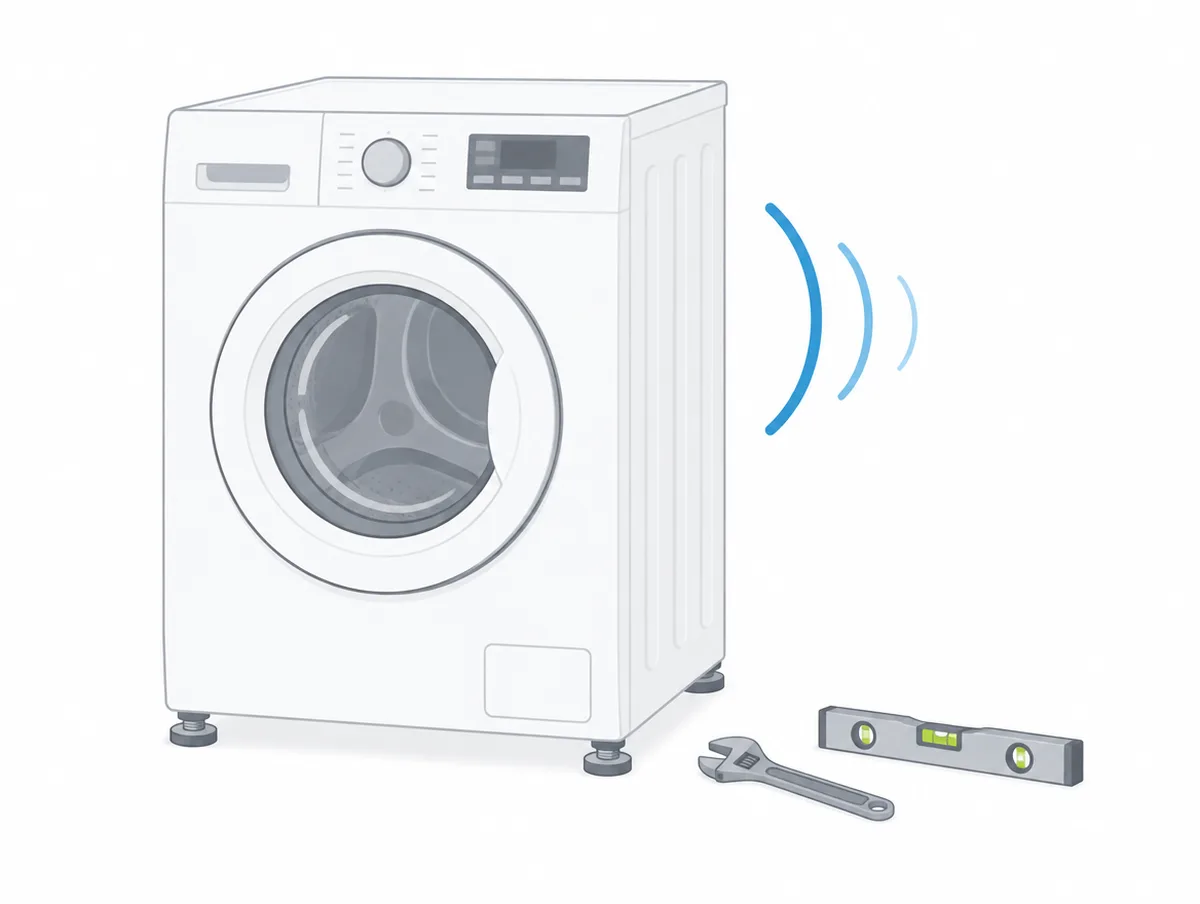
Learning how to make a washing machine quieter mostly means doing what the installation pages in the manual already ask: take out the shipping hardware, level the cabinet on short legs with tight lock nuts, and give it a firm floor with space on every side. Load size, spin speed, drain hose height and the beeps come after that.
Every step below comes from a maker's own documents, ordered from free to the ones needing a tool or a part. To work out what a particular clunk, hum or squeal means first, our guide to washing machine noises sorts the sounds by cycle phase.
How do you make a washing machine quieter?
Make a washing machine quieter by removing all shipping hardware, leveling it on short legs, locking the feet, balancing the load, lowering the spin speed, fixing the drain hose height and muting the end of cycle signal.
In rough order of cost and effort:
- Check that every shipping bolt, rod or block is out.
- Pull the washer away from walls, shelves and anything leaning on it.
- Level it, keep the legs short and tighten the lock nuts.
- Load it to a sensible size with big and small items mixed.
- Pick a lower spin speed for loads that do not need the fastest one.
- Set the drain hose at the depth and height the manual gives.
- Switch off the end of cycle melody and, where possible, the button tones.
- Firm up the floor, or fit the maker's pads, pedestal brackets or stacking kit.
What should come out of a new washer before it will run quietly?
Shipping bolts, rods, foam blocks and spacers must all come out first. Whirlpool's top load manual says removing all shipping material is needed to avoid excessive noise, and LG warns of severe vibration and noise.
LG even ties the power cord of its WM4000H to the back panel with one bolt. Its owner's manual says this is "to help prevent operation with shipping bolts in place." GE's top load page says to pull its packing just before sliding the washer into place, because a trip on a dolly without it "can cause the Washer to be noisy and vibrate."
Beko's WFTV10733XC manual adds a step: "In order to increase the sound comfort of the product, attach cover A after removing the package foam." Keep every bolt for the next move.
How do you level a washing machine so it stops shaking?
Level a washing machine by turning each foot until the cabinet sits flat both ways and no corner rocks, keeping the legs as short as the floor allows, then tightening every lock nut against the cabinet.
Short legs come first. GE's front load page warns: "The more the legs are extended, the shakier your washer will be while running, especially in the spin cycle." Samsung's shaking guide says that if one corner wobbles, shorten the other legs first and lengthen the loose one only when they cannot go shorter.
Then lock them. Speed Queen's installation instructions say that with loose locknuts the "washer will not remain stationary during operation." ASKO and Bosch both name a 17 mm wrench, and LG says the floor under the washer should not slope more than 1 inch.
On Samsung front loaders with Calibration Mode, run it after leveling: empty the drum, hold Temp. and Delay End for 3 seconds until Cb shows, then press Start. Samsung says a model whose manual never mentions Calibration Mode does not have it.
How do you stop a washing machine moving on a tiled floor?
Clean and dry the tile, then fit pads that grip. LG says feet that slide add vibration and noise, and its manual fits non-skid pads under the front feet on slippery floors.
LG's order is to wipe the floor dry, stick each pad down, set the washer on it and level again, warning that "If moisture remains, the non-skid pads may slip." Some travel is designed in: GE says a front loader is built to shift slightly with an unbalanced load, and that up to a quarter inch can be normal now and then.
Do washing machine quiet feet, pads or mats work?
Yes, in the limited sense that LG, GE and Speed Queen sell or supply pads, and Whirlpool suggests one for a weak floor. No maker we read gives a decibel figure for what a pad does.
What each maker says:
- LG: its AGF04127477 leg pads kit holds 4 plastic and 4 rubber pads and "Minimizes vibration and noise during spin cycles."
- GE: it lists washer/dryer anti-vibration pads, part WX17X10001CA, with no description of what they do.
- Whirlpool: on a surface that isn't solid, its vibration page says to "consider reinforcing the area or using a washer vibration pad to help absorb some of the movement."
- Speed Queen: "Place rubber cups (from accessories bag) on all four leveling legs."
Soft surfaces are another matter. Midea's top load manual warns that "Carpeting and soft tile surfaces can contribute to excessive vibration", and Samsung says carpet "will also cause some vibration." No manual we read mentions a full-size mat under the washer, so ask the maker before laying a thick, soft one.
LG adds that a drain pan without the feet set firmly on it "may result in increased vibration and noise during operation", and rules one out on a pedestal.
Is the floor making the washing machine louder?
Yes, often. LG says a floor that is not solid may cause severe vibration and noise, and Speed Queen says a weak floor flexing will cause excessive vibration.
Concrete is the makers' first choice. LG calls it best, accepts wood built to FHA standards, and says: "If the floor has too much flex, reinforce it to make it more rigid." Whirlpool's top load manual says the floor must carry 315 pounds, and picks the spot to "minimize noise and possible washer walk."
On wooden joists, Miele's installation instructions ask for a 24 by 24 inch plywood base, 1 3/16 inches thick, anchored to the joists rather than only the boards, and suggest a corner, "usually the most stable part of the floor." Beko also points to the corner, and Bosch wants a board at least 1.18 inches thick screwed down.
Upstairs, Electrolux offers a 30-day Second Floor Guarantee on listed front loaders that its dealer's installer sets level.
How much space should a washer have around it?
A washer needs about an inch at each side, a few inches behind, and nothing touching it. LG asks for 1 inch at the sides and 4 inches behind; Samsung, about an inch from dryer and walls.
ASKO's instructions for use say "The washing machine may not be in contact with a wall or adjacent structures", and list contact with walls or furniture as a cause of loud rattling.
How do you make a washing machine spin quieter?
Make a washing machine spin quieter by loading it to a medium size with items mixed, choosing a lower spin speed, and running bulky things like rugs with other laundry. ASKO says a higher spin speed brings more noise.
Load size and balance
Very small loads cause trouble as well as huge ones. ASKO says noise and vibration "can also be caused by unevenly distributed laundry or too small a load in the drum." Samsung calls a small load "3-5 pounds (or 1/3 full)" and says it can bunch on one side, so add items or reduce the spin speed.
Speed Queen's user's guide says not to wash a throw rug alone but to add several smaller pieces. GE's check separates laundry from machine: spread the load by hand, then run an empty rinse and spin. If the empty washer stays calm, GE blames the load.
Spin speed
ASKO ties spin speed directly to noise: "the higher the spinning rate in the spin cycle, the higher the noise and the lower the residual moisture content." Bosch's spin figures fit, with the 1,400 rpm 300 Series rated 72 dBA in the spin and the 1,600 rpm 500 Series 75 dBA.
The price is wetter laundry. Electrolux says "Increasing the spin speed will extract more water", and Bosch lists a low spin speed as the reason a load comes out too wet.
Is there a quiet or night cycle on a washing machine?
No, not on most US washers we read. Equator is the exception, with a Quiet cycle run "at low RPM with noise level less than 60 dB." Other makers offer spin choices and delay timers instead.
A timer moves the noise rather than cutting it. Miele's Delay Start can hold a program for up to 24 hours, and Bosch's Finish in sets the end time. Since the spin comes last, the end time tells you when the loudest minutes fall.
How do you make a washing machine drain quieter?
Make a washing machine drain quieter by setting the hose only a few inches into the standpipe with an air gap around it, keeping the standpipe height inside the manual's range, and cleaning the pump filter.
Some gurgle is normal, but Whirlpool's page on gurgling and humming asks about the hose: "The drain hose may be too far down inside the drainpipe (standpipe) or laundry tub." Its draining page allows 4.5 inches inside the pipe, and says "Do not seal the drain hose into the drainpipe with tape."
Electrolux's manual agrees that "A snug hose fit can cause a siphoning action." Heights vary by maker:
| Maker | Standpipe or drain height the manual gives |
|---|---|
| Whirlpool | Top of drain at least 30 inches from the floor |
| Electrolux | 24 inches minimum, 96 inches maximum |
| Midea | No shorter than 39 inches and no longer than 96 inches |
| Speed Queen | 36 inches recommended; above 4 feet drains slower |
| LG | Hose end no higher than 96 inches above the washer bottom |
| Bosch compact | Hose no higher than 39 inches above the washer's floor |
Speed Queen says a standpipe under 36 inches needs its 562P3 siphon break kit. GE adds that a clogged drain pump can make a washer shake, so clean the filter by your manual's steps if there is an access door.
How do you quiet a washing machine drain pipe?
Quiet a washing machine drain pipe by strapping the hose so it cannot jump or knock, using the elbow or clip supplied, and keeping it free of kinks. LG, Speed Queen and Electrolux supply a strap or tie.
Speed Queen's beaded strap goes round pipe and hose about 12 inches down. LG clips the hose into an elbow bracket within 4 inches of its end and adds a tie strap. Bosch's 500 Series manual asks you to "Secure the water drain hose against unintentional loosening."
How do you stop washing machine water hammer?
Stop washing machine water hammer with arrestors fitted between the fill hose and the washer, or by lowering high household water pressure. LG's manual says the bang comes from the home's plumbing.
LG puts it down to pipes that move or flex as the washer's valves shut, and says "Water hammer is not caused by a defect in the washer." Arrestors come from a hardware store; for very high pressure, LG says to turn down the regulator or call a plumber.
How do you make a Samsung or LG washing machine silent?
Make a Samsung or LG washing machine silent by switching off its end of cycle signal, usually by holding one button for 3 seconds. Samsung says button sounds stay on, and some LG models have no off setting.
How do you turn off the sound on a Samsung washer?
Press the button marked with the alarm symbol, which Samsung says is usually Super Speed, Alarm Off or Extra Rinse. When sound is that button's second function, hold it for 3 seconds.
Samsung's chime page says this silences the completion chime and the power off sound, adding "Please note that button sounds will remain on." Connected models show a Sounds switch or volume slider in SmartThings. If the manual has no steps, Samsung says the model lacks the feature.
How do you turn off the sound on an LG washer?
Press or hold the Signal button for 3 seconds on most LG washers. LG's list names other buttons on some models, and a few cannot switch the chime off.
From LG's chime page, as LG states the models:
- WT7900, WT7850, WT7800, WT7305 and WT7200C: hold Signal for 3 seconds.
- WT1101, WT1201, WT7105 and WT7010: hold Cold Wash for 3 seconds.
- WM3600H*A: hold Extra Rinse for 3 seconds.
- WM6700HA, WM5700HA, WM6500HA and WM5500HA: Options, then Additional Settings, down to Quiet/Off.
- WashTower units: hold Extra Rinse on the washer for 3 seconds.
The WT6105CW, the WM3997HWA and WM3998HBA combos and the SideKick pedestal washers have no off setting, and on every LG "The sound / melody of the signal cannot be changed."
Can you turn off the end of cycle signal on other washers?
Yes, on most other brands we read, with the button set in each manual. Several let you lower the volume instead.
- Whirlpool: on select front loaders, hold CYCLE SIGNAL or Steam Clean for about 3 seconds.
- Bosch 500 Series: Basic Settings set the end tone and button tone from 0 (off) to 4 (very loud).
- Miele WXC280: the programming level sets the buzzer and keypad tone to off, normal or loud.
- Electrolux: hold Select for 3 seconds to mute or unmute the chime.
- Speed Queen TR3 and TR5: hold Heavy Soil 3 seconds for the end signal, 10 seconds for button sounds.
- Midea MLTW44A4BWW: hold the signal button for 3 seconds.
Do pedestals and stacking kits make a washer louder?
Yes, a pedestal can add some vibration even on a level machine, Samsung says. Makers allow raised and stacked installs only with their own brackets or kits.
Samsung's words are "Some vibration is expected when using a pedestal or riser, even if the washer is properly leveled", and it asks for the pedestal to be leveled first. Bosch warns that a machine on a base may tip, and says to "Always secure the feet of the appliance to a base using the manufacturer's fixing brackets", listing its WMZ2200 brackets.
ASKO and Miele also want a raised washer fixed down, Miele with its MTS floor mounting kit. For stacks, Bosch allows only the dryer maker's kit and no mixed brands, and Electrolux rules out a dryer on a washer already on a pedestal. Whirlpool says a well leveled stacked laundry center will "help reduce noise and vibration during operation."
What should you avoid when trying to quiet a washer?
Avoid anything a manual forbids: carpet or soft flooring underneath, a platform or weak structure, legs wound out further than needed, a hose taped into the drain, contact with walls, or stacking mixed brands.
From the manuals we read:
- Carpet: Electrolux, GE, LG, Midea and Speed Queen advise against it.
- Platforms: LG and Midea say never to install on one.
- Long legs: Midea says "Extend the leveling feet only as much as is necessary."
- Sliding: Speed Queen says not to slide the washer once the legs are extended.
- Waterproof items: Midea says not to wash, spin or dry waterproof mats, citing abnormal vibration.
None of the makers tells owners to open the cabinet to quiet a washer. ASKO says unusual or louder noise is "mostly the result of improper installation", which leads back to the outside steps above.
When does a noisy washer need a technician?
A noisy washer needs a technician when the noise survives an empty cycle, returns after leveling and rebalancing, or grows over time. Speed Queen says to call for service at any increase in operating noise.
Midea says to unplug at once and call a service center for a strange noise with a burning smell or smoke. LG and Samsung send rattles or vibration that outlast their checks to service. Our guide to washer noises helps match the sound first.
How loud is a normal washing machine?
A normal washing machine is far louder spinning than washing. For its 500 Series compact, Bosch prints 51 dBA for the wash against 75 dBA for the spin, and most brands publish no figure at all.
Those Bosch numbers on the WGB24600UC page name no distance or test standard. Midea's MLTW45M4BWW page lists 80 dBA for the spin. Speed Queen's 43dB covers agitation only, and Equator's under 60 dB is for its Quiet cycle on the EW 835. Our decibel chart sets these beside household sounds.
When is a quieter washer the better fix?
A quieter washer is the better fix when the machine is level, unbolted, on a firm floor and sensibly loaded, yet the spin is still too loud for the room or the flat below.
Some washers are simply loud by design, and the spin figure is the one to shop on. Our ranking of the quietest washing machines sorts models by their makers' published figures, and separate guides cover the quietest top load washers, quietest compact washers, quietest stackable washer and dryer pairs and quietest washer dryer combos.
Where do these washer fixes come from?
Every fix here comes from a washer maker's own document: manuals and installation instructions from LG, Bosch, Miele, Electrolux, ASKO, Speed Queen, Midea and Beko, and support pages from Whirlpool, GE, Samsung and LG.
We did not level, unbolt, pad, restack or re-plumb any washing machine for this page, and tried none of these settings or accessories on a washer ourselves. Whirlpool's PDF manuals refused our automated requests, so its quotes come from its help pages and a top load manual read earlier for our washer guide.