How to make a refrigerator quieter comes down to five jobs the makers set out in their own manuals: stop it touching anything, level it on a solid floor, give it the air gap its manual asks for, keep its fans and condenser clear, and stop it working harder than it must.
Most of those cost nothing. None quiets a healthy compressor, and Sub-Zero says outright that swapping one variable speed compressor for another would not change its sound.
This page covers the fixes. To identify a particular sound first, use our guide to refrigerator noises; for a fridge that used to be quiet, see why appliances get louder. Each step names the maker that gives it, and we have not tried any of them ourselves.
Can you make a fridge quieter?
Yes, within limits. Maker fixes remove the extra noise that comes from vibration, blocked airflow, hard work and alarms. No maker offers an owner a way to quiet a sound-running compressor or fan below its design level.
In rough order, from free and quick to bigger jobs:
- Clear anything touching the cabinet, on top or inside.
- Level it, with the weight on the feet.
- Check the floor beneath it.
- Restore the clearances in your manual.
- Clear the fans and, where your model allows, the condenser.
- Ease the workload: normal settings, fewer long door openings.
- Sort out the water side: ice maker switch and pressure.
- Mute the beeps you do not need.
Why is my fridge so loud?
Usually a fridge is loud simply because it is running; every maker we read lists humming, clicking and gurgling as normal. Extra loudness most often comes from how the fridge stands, where it stands and how hard it works.
LG names the installation causes: "The refrigerator may be too close to a wall or cabinet. An uneven floor or an unlevel refrigerator can also amplify normal motor vibrations." Those, plus the cooling load, are what the steps below go after.
Does anything touching the fridge make it louder?
Yes. LG says "Anything touching the unit will amplify the sound," whether the object sits on top, presses against a side or leans on something inside. Removing those contacts is the first fix, and it is free.
Start on top. Whirlpool's rattling page lists "Items stored on the top of the refrigerator" as a cause, and LG's vibrating noise page explains that whatever rests on the cabinet picks up the slight vibration of the compressor and fans.
Then the sides and back. LG's LRKNS1400V owner's manual says to "make sure that the sides and back cannot vibrate against any wall or cabinet." Liebherr's SC5781 installation instructions add a safety reason: a power cable touching the back can be damaged by "the vibration", risking a short circuit.
Inside, bottles and loose fittings do the rattling. Bosch's B36CT manual lists "Bottles or containers are touching" and "Fittings wobble or stick". Liebherr's IRB5160 user guide says to "Leave a gap between items," and LG asks that "all door bins, drawers, and shelves are properly inserted and in place".
How do you level a refrigerator to stop vibration?
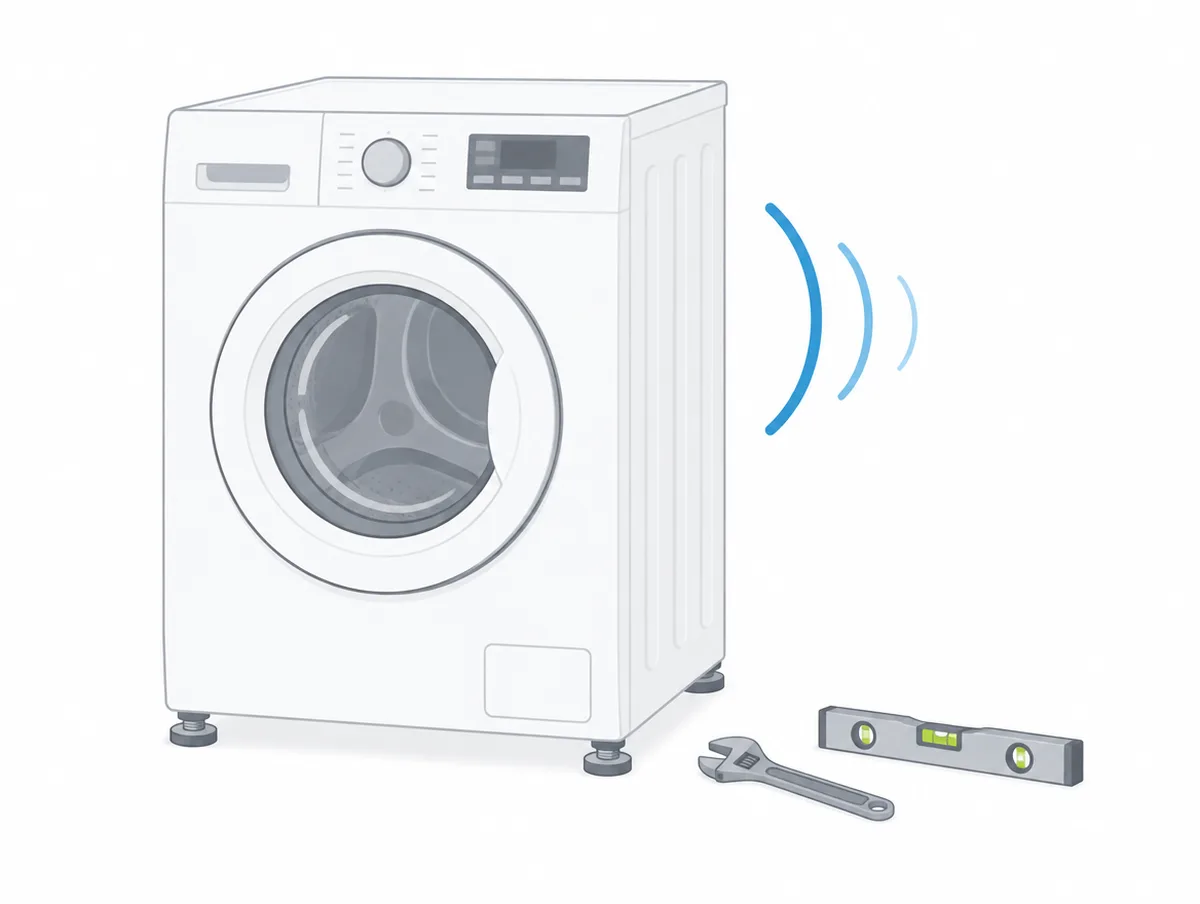
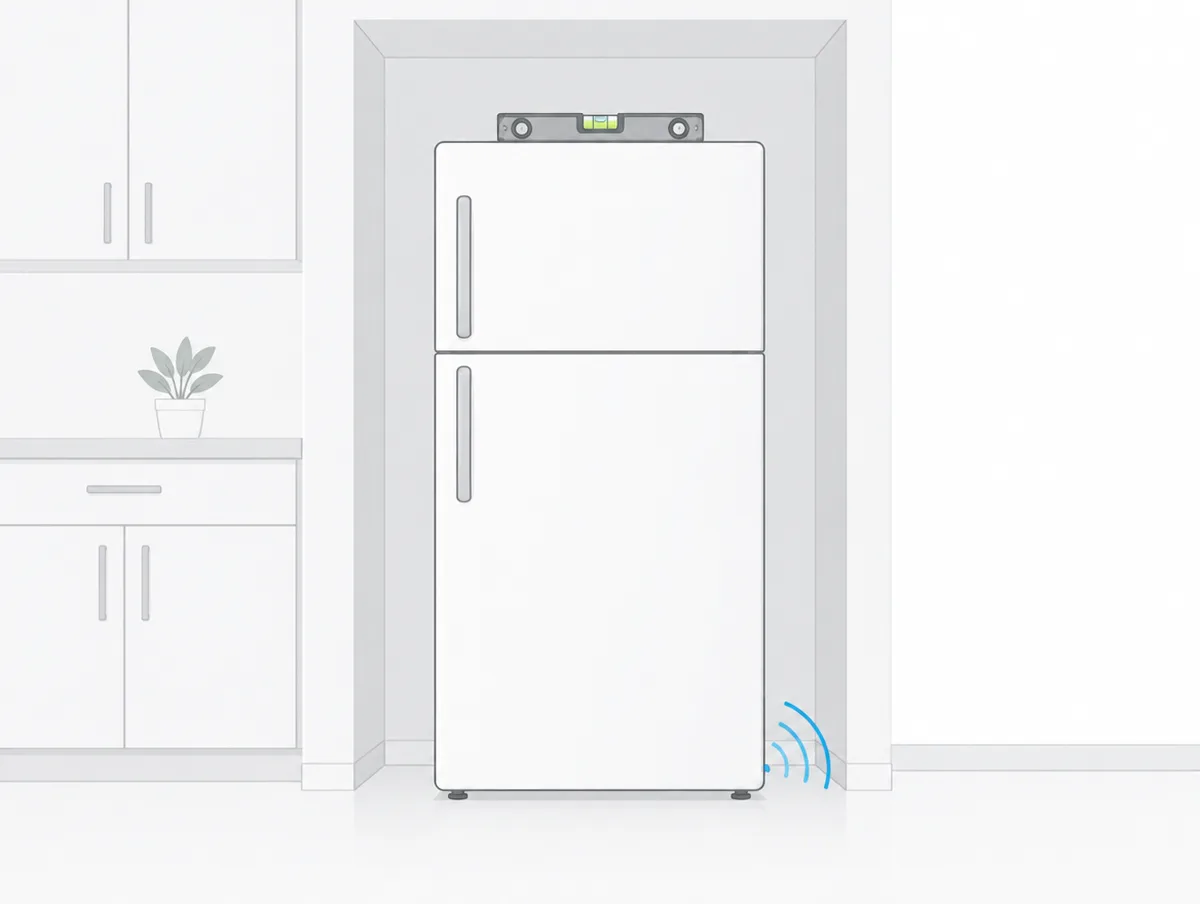
Levelling a refrigerator means turning its front feet until the cabinet sits level and its weight rests on the feet, not the rollers. Whirlpool, LG, Samsung, Bosch, Frigidaire and Fisher & Paykel all tie an unlevel cabinet to noise.
Samsung's levelling guide uses a carpenter's level and a flat-head screwdriver: raise both legs fully, check the cabinet rather than the doors, then lower the high side.
Samsung's noise page describes the result: the legs "should be in full contact with the floor and the wheels shouldn't be touching the floor at all." LG: "The weight of the refrigerator must rest on the feet, not the wheels". Frigidaire's fridge freezer manual: "All 4 corners of the cabinet must rest firmly on the floor."
Most makers want a slight lean backward so the doors swing shut. Fisher & Paykel's RF203Q guide sets the front about 3/8 inch (10 mm) higher than the back.
Whirlpool says what a tilted cabinet does: "vibrations can transfer to surrounding cabinets or the floor and sound like buzzing." LG adds a safety rule: "Moving or tilting the unit by yourself may cause it to tip over or result in severe injury."
Does the floor make a refrigerator louder?
Yes. LG's manual says the fridge "must be installed and leveled on a solidly constructed floor" to avoid noise and vibration, and Frigidaire and Fisher & Paykel both list a weak floor among the causes of noise.
LG is the most specific about surfaces: "Installing on carpeting, soft tile surfaces, a platform or weakly supported structure is not recommended." It adds that "Wood flooring may cause leveling difficulties if it flexes excessively," and that a badly uneven floor may mean moving the fridge "to a flat, solid surface".
Fisher & Paykel gives the only maker-approved shim we found. If one front foot lifts when you push gently on the top front, its guide says to fit solid packing, "hardwood, plastic, etc", under the rear roller diagonally opposite, and rules out metal that may stain or damage the floor.
How much space does a fridge need to run quietly?
Space around a fridge is set by its own installation instructions, and the figures differ widely by model. LG, Samsung and Whirlpool tie too little room to noise; the others tie it to airflow, cooling and energy.
| Manual | Sides | Top | Back |
|---|---|---|---|
| Frigidaire fridge freezer, A29913802 | 1.57 in (40 mm) | 3.54 in (90 mm) | 1.97 in (50 mm) |
| Frigidaire convertible, A31179401 | 3/8 in (9.5 mm) | 3/8 in (9.5 mm) | 1 in (25.4 mm) |
| Fisher & Paykel RF203Q | 13/16 in (20 mm) | 2 in (50 mm) vent above | 1 3/16 in (30 mm) |
| Midea MRS25I7BST | over 100 mm | over 100 mm | 50 to 75 mm |
| LG LRKNS1400V | space, no figure | space, no figure | 2 in (50.8 mm) |
| Liebherr IC5110IM, built in | per cabinet drawing | shaft at least 1 1/2 in deep | 1/2 in (13 mm) |
Each row is one model's instruction, not a range to pick from.
Samsung says moving the fridge "an inch or so, while leaving 2 inches of clearance on the top, sides, and back" can sometimes reduce whistling from its circulation fans. LG is shortest: "Clearance requirements must be observed at all times." Bosch also asks for 1 1/4 inches (30 mm) from an electric or gas stove.
How do you quiet a refrigerator fan?
Quieting a refrigerator fan means clearing whatever blocks or strikes it: packaging pressed against an inside fan, frost around it, or debris in the condenser fan underneath. The steady airflow sound of a healthy fan is normal and stays.
The condenser fan under or behind the fridge
GE gives owners a procedure for models without its NeverClean condenser: pull the fridge out, unplug it, take off the rear cover at the bottom, usually with a 5/16 inch hex head screwdriver, and remove what is in the blade's way, "such as a cheese wrapper, a credit card slip".
A large rubber strip is the exception: GE says "this will require service", because that air divider must be refitted correctly.
The fans inside the cabinet
Sub-Zero says to "Make sure food packaging is not pushed into the refrigerator or freezer fan", and to defrost the section if ice build-up is visible. Whirlpool asks owners to "keep air vents inside the compartments clear".
For frost around a fan, LG says to move the food out, pull the plug and prop the doors open until the ice thaws. Samsung says a home defrost clears the noise, "but only service will correct the original cause", and bans a hair dryer or "any other heat source".
Does cleaning the condenser coils make a fridge quieter?
Yes, on models with coils an owner can reach. Sub-Zero's first step for loud or newly loud compressor-area noise is to clean the condenser, and Whirlpool ties a buzz to airflow restricted by dust on the coils.
Sub-Zero: "If noise is loud, new, louder or more pronounced over time, or unit performance or temperatures have been negatively affected, clean the unit's condenser." Its cleaning page says "every six to twelve months", more often with pets.
The same page says "Do not bend the aluminum fins of the condenser", and that cleaning chemicals and degreasers "are not recommended by Sub-Zero." If temperatures are not back at the setpoint within 24 hours of cleaning, Sub-Zero sends you to service.
Whirlpool says "If your model allows user cleaning", unplug it and "gently vacuum dust from the condenser coils and condenser fan shroud".
Many fridges have nothing to clean. GE's NeverClean page says current automatic defrost models have a condenser "that does not require cleaning or maintenance", and its coil cleaning page ties dirty coils to poor cooling rather than noise.
For GE models with open coils, GE sells a condenser brush, part PM14X51, and says to unplug first; for coils on top, wear gloves, because "The condenser fins have sharp edges."
How do you make a refrigerator compressor quieter?
No owner fix makes the compressor itself quieter. The makers' levers all reduce its workload: recommended temperature settings, fast-cool modes used sparingly, shorter door openings and cooled food, so the compressor runs slower or less often.
Liebherr's IRB5160 guide states the link: "At less cooling output the appliance saves energy but takes longer to cool items. The volume is lower." At higher output, "The volume is higher." Its examples include functions switched on, newly stored food, a hot room and "Door opened for long periods".
Bosch says "When Super cooling is switched on, increased noise may occur", returning to normal after about 6 hours. Miele's operating instructions say SuperCool and SuperFreeze "may make more noise than usual". If night noise is the problem, start them in the daytime.
Door and food habits come next. LG says frequent door openings or hot food make the motors "run faster and sound louder". Frigidaire says to "Organize the refrigerator to reduce door openings", and that overcrowding or blocking cold air vents "causes the refrigerator to run longer". Bosch: "Allow warm food and drinks to cool down before storing them."
How do you stop ice maker and water line noise?
Ice maker and water line noise drops when an unconnected ice maker is switched off and house water pressure sits inside the maker's stated range. GE, Samsung, Whirlpool, LG, Bosch and Liebherr each give one or both instructions.
With no water line connected, switch the ice maker off. GE says to do it "either by the on/off switch or by raising the feeler arm up to the stop position (on some models)". Samsung says this avoids the noise and damage to the fridge.
Liebherr ties pressure to noise in so many words. Its SC5781 instructions give a range "for proper operation (flow rate, ice cube size, noise level)" of 21.76 to 87.02 psi, or 40 to 90 psi with the water filter, and above 6.2 bar say to "Connect a pressure reducer."
Bosch wants "at least 29 psi (200 kPa) and max. 116 psi (800 kPa)", with a pressure-reducing valve above that, and GE blames water hammer on "high water pressure in the house water supply".
Samsung lets owners turn pressure down "as long as you can still dispense 3/4 cup in under 10 seconds", and Whirlpool says to check that "the line is not kinked". Our ice maker noises guide covers the fill sounds themselves.
Can a loose drip tray make a fridge noisy?
Yes, according to Bosch. Its UK support page says the drip tray occasionally needs securing "if it comes out of place", and suggests wiping it clean while you are there.
Bosch says the tray is usually at the lower back of the fridge. Frigidaire's noise guide labels its drain pan "non-removable", so on those models there is nothing for an owner to refit.
How do you silence a refrigerator's beeps?
Silencing a refrigerator's beeps is a settings job on many models: Miele, Fisher & Paykel, Liebherr and Samsung let owners lower or switch off key tones or door alarms. The cooling system itself has no mute.
Miele lets you "switch the alarms and audible signals off if you find them annoying". Fisher & Paykel's Key mute "Deactivates sounds of all button presses", and Alarm mute "Deactivates the door alarm for 20 minutes."
Liebherr's IRB5160 door alarm can be set to 1, 2 or 3 minutes or Off, and Samsung says some models "can toggle this feature with the Alarm setting."
Sabbath mode is not a quiet mode. Frigidaire's convertible manual says in it "Sounds and alarms are off, except for the High Temperature alarm", and a fault shows no error code.
Can you soundproof a refrigerator?
No. None of the makers we read approves wrapping, boxing or blanketing a fridge. Fisher & Paykel, Bosch and Liebherr forbid covering or blocking its ventilation, and Frigidaire says the foam inside a fridge does not insulate sound.
Fisher & Paykel: "Do not cover your appliance with any material that will prevent air from flowing around the cabinet sides." Bosch: "Never cover or block the external ventilation openings," adding that with them closed off, a refrigerant leak "may result in a flammable mixture of gas and air."
Liebherr's IC5110IM installation guide warns that with covered vents the "Appliance can overheat", and says "Never block air vents of the fan." Frigidaire's manual: "Energy efficient foam in your appliance is not a sound insulator."
Is there a refrigerator noise reduction kit?
No. None of the maker documents we read sells or mentions a noise kit for a home refrigerator. The nearest items are Liebherr's levelling rails, GE's condenser brush and a pressure reducer where house water pressure runs high.
Liebherr's IC5110IM guide requires leveling rails in any recess taller than 1400 mm (55 1/8 inches), and says "The leveling rails minimize the sound level." Two rails come in the box for those installations. We found no maker recommending anti-vibration pads or acoustic panels for a full-size fridge.
When should you call a technician about fridge noise?
Call a technician when the maker says to: a fan hitting ice or an object you cannot clear, noise with a smell or smoke, a loud compressor with poor cooling, or noise that outlasts the steps above.
LG's manual is strictest: "Disconnect the power cord immediately and contact an authorized service center if there is a strange noise, odor, or smoke coming from the appliance."
Sub-Zero says that if compressor-area noises "change over time, or become louder, no further troubleshooting advice is available", and LG wants a rattling or drilling compressor that persists, or poor cooling, reported to support. Refrigerant is never a home job: if the cooling circuit is damaged, Miele says to avoid sparks, unplug, ventilate the room and "Contact Miele Service."
Before booking, note that LG's warranty excludes "Any noises associated with normal operation", and Liebherr says a call-out caused by an operating error may be charged "even during the warranty period."
How loud is a normal refrigerator?
Refrigerators in our catalog are rated 32 to 44 dB(A) where the maker prints a figure. No maker states the operating mode or measuring distance, so each number is a label, not a reading at your ear.
| Maker and model | Printed figure | Condition the maker states |
|---|---|---|
| Liebherr IRB5160 | 32, "Sound rating dB(A)" | EN 60704-3; no mode or distance |
| Beko BFFD3624ZSS | "Noise Level 35 dBA" | None |
| Miele KFN 4776 ED | 36, "dB(A) re 1 pW" | Sound power; no mode |
| Midea, most full-size models | 43 | None |
| Miele KFNF 9959 iDE | 44, "dB(A) re 1 pW" | Sound power; no mode |
LG, Samsung, GE, Whirlpool, KitchenAid and Frigidaire print no per-model figure on the US pages and spec sheets we checked. Samsung's test at home is that noises "should never get so loud that it's interrupting conversation."
Miele's "re 1 pW" marks sound power, a different quantity from the level where you stand; see sound power vs sound pressure. To take readings of your own fridge, use the method in how to measure noise at home.
What if the fridge is still too loud?
Some refrigerators are loud by design. Sub-Zero says replacing a variable speed compressor, or the whole product, "is not a resolution to variable speed compressor noise complaints", because each such unit "may produce the same sounds."
Miele says its flammable refrigerant "does, however, sometimes lead to a slight increase in the noise level of the appliance", and that "Unfortunately, this cannot be avoided".
When every step above is done and the noise still bothers you, the remaining fix is a model whose maker prints a figure. Our quietest refrigerators guide ranks full-size models by those figures, with separate pages for French door refrigerators and undercounter refrigerators.
Brand pages cover Liebherr, Miele and Bosch, and for a bedroom or office see the quietest mini fridges. A fridge in sight of the sofa is the subject of planning a quiet open-plan kitchen.
Where do these steps come from?
Every step comes from a refrigerator maker's own manual or support page, all listed below. Figures in the loudness table come from our refrigerator catalog.
We used support pages from Whirlpool, Samsung, LG, GE, Frigidaire and Sub-Zero, and owner's or installation manuals from LG, Frigidaire, Bosch, Liebherr, Fisher & Paykel, Miele and Midea.
LG's site refused plain downloads, so we read its help pages in a browser. Whirlpool's product pages refused our requests for a manual, so its advice here comes from its help pages. We did not quote Café, KitchenAid, Maytag or Electrolux separately.
We have not levelled, cleaned, defrosted or re-plumbed any refrigerator for this page, nor listened to or measured one. Where your own model's manual differs, follow it.