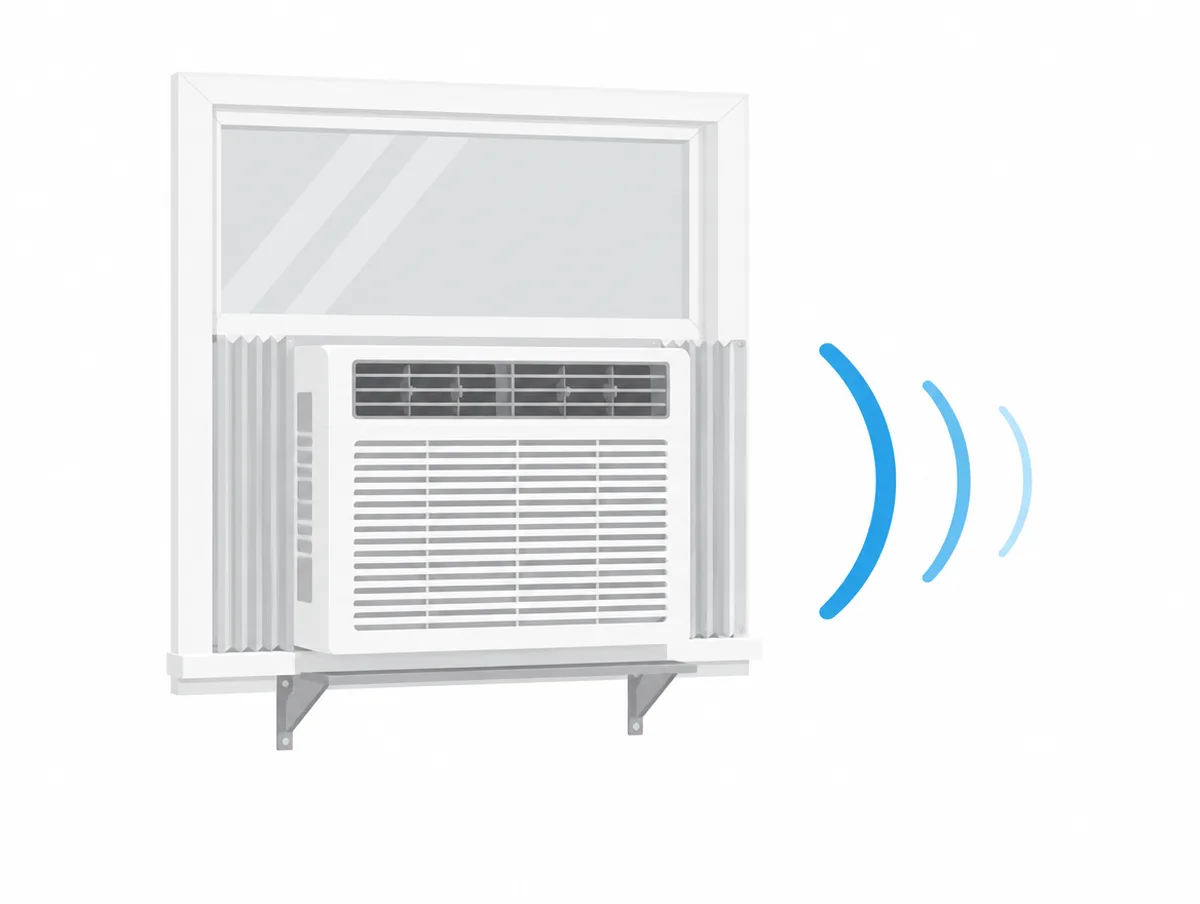
Here is how to make a window AC quieter using only what the companies that build them tell owners to do: turn the fan down or switch on quiet mode, mute the beeps, reseat the cabinet so it sits firmly with a slight outward tilt, fill the gaps with the foam from the box, and keep the filter clean.
LG, GE, Midea, Frigidaire, Friedrich, Hisense and Windmill each print some of these steps in their manuals and support pages. They run below from free and instant to an afternoon's work, and end with the sounds that call for a technician rather than a tweak.
If you still need to put a name to a sound, our guide to window AC noises matches each one to its cause. Everything here is about what to change once you know.
Why is a window AC so loud?
A window AC is loud partly by design: its compressor and outdoor fan share one cabinet with the indoor fan, inches from the room, and that cabinet rests in a window frame that can pass vibration along.
Two makers say outright that installation changes the sound. LG's LW8022IVSM manual tells installers to "Follow installation instructions exactly to avoid excessive vibration or water leakage." A footnote in Friedrich's Chill Premier brochure reads "Sound levels are also dependent on proper installation of product."
So the share of the noise an owner can change comes down to three things the manuals keep returning to: the settings you choose, how firmly the unit sits in the window, and how clean its filter is. The rest is the machine itself, and the only remedy for that is a quieter machine.
How quiet can a window AC get on its lowest setting?
A window AC on its quietest setting is rated between 40 and 56 dBA on the spec sheets below, and between 54 and 61 dBA on high fan. None of these sheets says how far away the reading was taken.
| Model | High fan | Low fan | Quiet or sleep setting |
|---|---|---|---|
| LG LW1222IVSM | 58 dBA | 46 dBA | 44 dBA (Sleep) |
| GE Profile ClearView PHNT10CC | 54 dBA | 51 dBA | 40 dBA (Quiet Mode, Low Cool) |
| GE AWCS06BBA | 61 dBA | 56 dBA | No figure |
| Friedrich Chill Premier Inverter | No figure | No figure | As low as 42 dB cooling, 32 dB fan only |
| Midea U MAW08V1QWT | No figure | No figure | 32 dBA, setting not named |
The LG LW1222IVSM sheet shows how little can separate low fan from sleep: 2 dBA on that model. GE's gaps are wider. The ClearView PHNT10CC drops 11 dBA from low fan to Quiet Mode, and the PWDV14WWF goes from 61 dBA on low to 44 dBA in Quiet Mode.
Friedrich's 42 dB figure covers the whole Chill Premier series, and Midea's 32 dBA comes with no fan speed or mode attached, so both mark a floor rather than a range. To picture those numbers, use our decibel chart; for why two makers' figures rarely line up, see dBA explained.
How do I make my window air conditioner quieter inside?
Window air conditioner noise indoors falls most cheaply through the controls: a lower fan speed, quiet or sleep mode, and muted beeps and lights. The LG, GE, Midea, Frigidaire, Friedrich and Hisense manuals each offer at least two.
Fan speed comes first. Hisense's AW-series manual labels its Low setting "for quieter cooling". GE's ClearView manual pairs Cool mode and Low fan with a middle set temperature for quieter, night-time cooling, and keeps High fan with a lower temperature for maximum cooling.
The price is airflow. On a very hot afternoon a low fan may not keep up, and Hisense and Frigidaire both suggest a faster fan when the room will not cool.
Does quiet mode make a window AC quieter?
Yes, on the makers' own sheets. GE rates its ClearView PHNT10CC at 40 dBA in Quiet Mode against 51 dBA on low fan, and LG gives 44 dBA in Sleep for the LW1222IVSM against 46 dBA on low.
The GE AWGP heat and cool manual explains the trick: Quiet mode "will set the unit in the lowest capacity and/or the lowest fan speed to achieve the best noise performance", and it works in Heat as well as Cool, so it applies to a window heat pump in winter too.
Quiet has costs. GE's ClearView manual says it is normal for the unit "to operate for a longer period at lower energy consumption levels", and GE does not suggest Quiet Mode above 104ºF. Hisense says "It takes about 2 to 3 minutes to fully enter the quiet mode" and that "Sometimes it cannot enter the quiet mode because of some protection."
Sleep modes vary more. LG says its Sleep Mode "keeps operating noise to a minimum and turns the air conditioner off after a set time." Frigidaire's Gallery guide says its Sleep "will automatically select the Auto fan speed", and that on Auto the "fan starts on High Speed". Our sleep and quiet modes explainer compares the timers and temperature drift.
How do you turn off the beeping on a window AC?
Window AC beeps and lights can usually be switched off from the panel or the remote. GE's ClearView mutes its button sounds when you hold Filter for 5 seconds, and Midea's LED button turns the display and buzzer off.
Midea's U manual says the LED button creates "a comfortable and quiet environment". On Friedrich's Chill Premier Inverter, Sleep mode mutes every button sound and turns the display off after 15 seconds, apart from the Sleep indicator.
Eco settings change the rhythm of the fan. On the ClearView, Eco ON makes the fan "cycle on and off with the compressor", while with Eco OFF "The fan runs all the time". GE does not say which is quieter, and the answer depends on whether a steady hum or a fan that stops and starts bothers you more.
How do you stop a window AC from vibrating?
Window AC vibration, in the makers' accounts, is an installation problem. The cabinet should sit firmly on a solid sill and supports, with every part from the box fitted and tightened, and nothing else touching it.
Friedrich's Chill Premier manual says to "Install the appliance on a flat, sturdy surface. Failure to do so could result in damage or excessive noise and vibration." It adds that the unit "should not be in contact with any equipment that will transmit vibration to the unit." Midea and GE both say "You MUST use all supplied parts".
Windmill gives the most hands-on answer. Its support page on noise says vibrating noises "could be from the installation not being secure enough", and suggests adding "more foam around the frame to dissipate this". It also says to take off the front grille, "place securely back on and push into the AC slightly".
If reseating means lifting the unit out, GE says to use two or more people, and that the air conditioner "must be standing upright for 2 hours prior to installation and operation." LG says to hold the unit firmly until the sash has been lowered into place behind the top channel.
How much should a window AC tilt?
Window AC tilt in the manuals we read runs from 1 degree to about 3 degrees toward the outside, set so condensate drains outdoors. Windmill asks for 1 degree, LG about 1/4 inch, Friedrich's Chill Premier about 3 degrees.
| Maker and model | Tilt the manual asks for |
|---|---|
| LG LW8022IVSM | Back about 1/4 inch lower than the front |
| Midea U | Level, or a quarter bubble down toward the outside |
| Friedrich Chill Premier Inverter | About 3 degrees, shown by about 1/3 bubble |
| Friedrich Kühl | 3/8 to 1/2 inch toward the outside, never level |
| Windmill | 1 degree toward the back |
| Hisense AW series | A slight downward slope toward the outside |
| GE Profile ClearView | Level front to back and side to side |
GE's ClearView is the odd entry. Its installation steps ask for the unit to be "level front to back and side to side", while its troubleshooting table blames indoor drips on a unit "not tilted to the outside". Friedrich's Kühl manual is the bluntest: "DO NOT LEVEL the cabinet from front-to-back."
None of these makers says the angle itself changes the sound. The tilt is for drainage, and a unit that drains properly is one less reason to take it out and reseat it. Windmill adds that a home settling can upset an installation, and that a unit left in the window for over a year may need draining and reinstalling.
A storm window frame can block the tilt. LG, GE and Midea each describe fixing a strip of wood to the inner sill to lift the unit clear of the frame, and Midea says the storm window's drain holes must not be caulked or painted shut.
Do I need a support bracket for a window AC?
Yes for some models. Midea's U-shaped units ship with a support bracket its manual treats as required, and Windmill says some buildings demand an outside bracket. Other makers use side or sill brackets screwed to the window.
Midea's bracket legs extend 12 inches below the sill, and the manual says the "Midea U bracket works on walls with thickness 3 to 10.5 inches" and "should only be used for its intended purpose." GE's ClearView uses adjustable supports set "until the unit is secure against the outside wall", then locked with a nut.
Friedrich's Kühl bolts support brackets to the wall and calls for a 1 x 4 or 2 x 4 spacer between wall and brackets on aluminum or vinyl siding. Windmill says some New York City landlords require a bracket, and that its unit works with standard single-arm brackets rated up to 85 lbs.
On materials, GE and Hisense say all supporting parts must be secured to "firm wood, masonry or metal", and LG adds vinyl and fiberglass. No maker claims a bracket alone lowers the decibel figure; in every manual its job is to hold the cabinet still.
Does the foam that comes with a window AC reduce noise?
Yes, against vibration, says Windmill, which tells owners to add foam around the frame. Most other makers describe their foam as a seal against outdoor air, insects and lost cooling rather than as a noise fix.
GE's ClearView manual says to stuff its foam top gasket between the glass and the window "to prevent air and insects from getting into the room", and to "obtain appropriate material locally" if it does not fit. Midea's final check is to cover every gap with the supplied foam, "ensuring no outdoor air leaks inside", and to cut sash foam for the space between the two sashes.
LG puts a foam strip between the upper and lower sash and heatproof foam on the curtain panels, which it says "improves the cooling capability". Hisense fits EVA foam "to minimize air leaks". Windmill says its side panels "fit snugly into the front frame to insulate well and prevent air gaps". Gradient's saddle heat pump manual adds bulb seals for the lower sash and between the sashes.
Friedrich is the one maker that ties a seal to sound in writing. On its Kühl sleeve units, a chassis seal gasket left out or badly fitted means "Operational noise and outside noise will also be amplified."
Does cleaning a window AC make it quieter?
No, not directly: no window AC maker we read promises lower noise from cleaning. LG and Frigidaire do say a clogged filter lets frost build on the cooling coil, which then chokes the airflow.
The filter intervals differ. Midea and Hisense say to check it every two weeks, LG twice a month, Frigidaire's Gallery once a month, and Friedrich's Kühl weekly. GE's ClearView lights a reminder after 250 hours of running. The manuals say to unplug the unit before cleaning, and Midea warns against water hotter than 104°F.
On the coils the makers split. LG says the outdoor condenser coils "should be checked periodically and cleaned if clogged with soot or dirt". Friedrich's Kühl manual allows vacuuming the indoor coil, warns "DO NOT BEND FINS", and lets you spray the outdoor coil gently with a garden hose. GE says dirty outdoor coils "may be professionally cleaned".
Windmill's cleaning page goes further: "Do not clean the inside of the AC unit. Only authorized personnel can clean the interior of the product." Hisense asks owners to book an annual checkup through an authorized dealer. Follow the manual for your own model on anything past the filter.
What should you never do to quiet a window AC?
Window AC makers rule out anything that blocks airflow, an extension cord, opening the cabinet and drilling the base pan. Covers, enclosures and curtains in front of either side are out.
LG says "DO NOT cover or block any of the side and top louvers" and wants no fence or wall within 20 inches of the back of the cabinet. Frigidaire says not to block airflow "inside with blinds, curtains or furniture; or outside with shrubs, enclosures, or other buildings." Midea says the rear of the unit "must be outdoors, not inside a building or garage."
On power, Midea, GE, Hisense and Friedrich each say not to use an extension cord, and LG says not to modify or extend the power cord and to use a dedicated circuit. GE's ClearView wants a grounded outlet protected by a 15-amp time-delay fuse or circuit breaker.
Leave the inside alone. GE says there is no packing material inside the ClearView to remove and to keep the cabinet closed, LG says not to disassemble or modify the product, and Hisense says "Do not drill holes in the unit." Pulling the drain plug to calm the splashing is a trade-off the makers argue over, set out in our window AC noises explainer.
Which window AC noises mean you should call for service?
Window AC noises that need service, by the makers' accounts, are clanking that does not settle, any loud noise with heat, smoke or a burning smell, and any fault that would mean opening the cabinet.
Windmill draws the clearest line. It says hums and thumps as the compressor starts are normal, and that a fan which "needs to be realigned" may settle after about 15 minutes of running. If "loud clanking sounds" continue, it asks owners to email support "with a video of the noise so shipping damage can be assessed."
Friedrich lists "Loud noise, unusual smell or excessive heat" among the signs to contact its support. Midea says to unplug the unit "if you notice unusual sounds or smells or smoke coming from it", and LG says to unplug at once and call its customer center for a strange sound with a burning smell or smoke.
Many current models are charged with R-32, a flammable refrigerant, and Hisense limits maintenance and service to technicians "properly trained and qualified in the use of flammable refrigerants."
Is a U-shaped window AC quieter?
Yes, by its makers' account. Midea says its U shape lets the window close more securely around the unit and separates the compressor from the indoor side, and it credits that layout with quieter running.
The MAW08V1QWT page says the U structure "allows your window to close more fully, helping block outside noise while keeping cool air inside." Its only figure, "as low as 32 dBA", names no fan speed, mode or distance.
GE's saddle-style ClearView gives conditions: 54 dBA on high fan and 40 dBA in Quiet Mode for the PHNT10CC. Midea's U asks more of the installation than most, and needs a clear opening of 13.75 inches, its bracket, anti-tip brackets and several kinds of foam.
A U-shaped or saddle unit is a replacement, though, and none of these steps turns a standard unit into one.
When should you replace a loud window AC instead?
Replace a window AC when it is installed as its manual asks, the filter is clean, it runs on low fan or quiet mode, and it is still too loud. Spec sheets show inverter models rated well below fixed-speed ones.
GE's own range shows the gap. The fixed-speed AWCS06BBA lists 56 dBA on low fan, and the inverter ClearView PHNT10CC lists 51 dBA on low and 40 dBA in Quiet Mode.
Our quietest window air conditioners guide compares every maker that publishes figures, and the U-shaped and saddle guide covers the designs that put the window between you and the compressor. For a particular room, see the bedroom and living room picks.
If you want heating from the same window, the quietest window heat pumps guide applies. Friedrich's manuals also rank wall mounting as quieter than window mounting, which makes our through-the-wall AC guide worth a look if you own the wall.
Where do these window AC steps come from?
Every step on this page comes from window AC makers' own manuals, spec sheets and support pages, from LG, GE, Midea, Frigidaire, Friedrich, Hisense, Windmill and Gradient, all listed in the sources below.
The manuals are LG's LW8022IVSM, GE Profile's ClearView PHNT10 and PHNT12, GE's AWGP heat and cool units, Midea's U, Frigidaire's Gallery, Friedrich's Chill Premier Inverter and Kühl, Hisense's AW series and Gradient's All-Weather 120V. The decibel figures come from LG, GE and Midea product pages and a Friedrich brochure.
Windmill's advice comes from five articles in its support center; we did not open its PDF installation guide. GE's support article on a rattling window unit loads only in a full browser, so we did not rely on it here.
Nobody at QuietSpecs fitted, shimmed, levelled, cleaned or sat beside a window unit to write this. None of the steps above has been tried by us on a real AC; each is the maker's instruction, credited to that maker. Where two makers disagree, as GE's own manual does with itself over tilt, we show both.