A window AC making noise is usually doing one of five things the makers expect: throwing water at its outdoor coil, moving refrigerant, starting its compressor, pushing air, or cycling its fan to sample the room. Pinging, splashing, gurgling, a brief chatter at switch-on and a fan that runs on its own are all on the manuals' lists of normal sounds.
The sounds the makers treat as a fault are fewer: a rattle from a loose grille, louver or mounting, water inside the room, ice on the coil, and anything that comes with smoke, heat or a burning smell.
Everything below comes from owner's manuals and support pages published by Frigidaire, GE Appliances, LG, Midea, Friedrich, Hisense and Soleus Air. It covers standard window units, U-shaped and saddle models that straddle the sill, and through-the-wall units where the maker says the same thing.
Is it normal for a window AC to make noise?
Yes. Friedrich's manual opens its noise section with "All air conditioners make some noise." Frigidaire, LG, Midea and Hisense each print a list of sounds they call normal, and the lists overlap almost word for word.
Frigidaire's Canadian support page sums up its list in one line: "It is normal to hear ‘high pitch chatter’ a sound of rushing air, gurgle/hiss, pinging or swishing and vibration. These are all normal."
Vibration is the odd one out. Every maker that lists it ties it to the wall, the window or the installation, so it is normal in the sense of expected, and also the item on the list you can do something about.
| Sound | What the makers say causes it | Called normal? |
|---|---|---|
| Pinging, splashing, trickling | Condensate thrown at the outdoor coil | Yes (Frigidaire, GE, LG, Midea, Hisense, Soleus Air) |
| Gurgle or hiss | Refrigerant in the indoor coil | Yes (Frigidaire, LG, Midea) |
| Rushing air | The indoor fan | Yes (Frigidaire, LG, Midea, Hisense) |
| Chatter or hum at start-up | The compressor starting | Yes (Frigidaire, LG, Midea, Friedrich, Hisense) |
| Click | Thermostat switching the compressor | Yes (GE, Hisense, Soleus Air) |
| Rattle or vibration | Loose parts or installation | Expected, but fix the cause |
Why does my window AC ping, splash or sound like water?
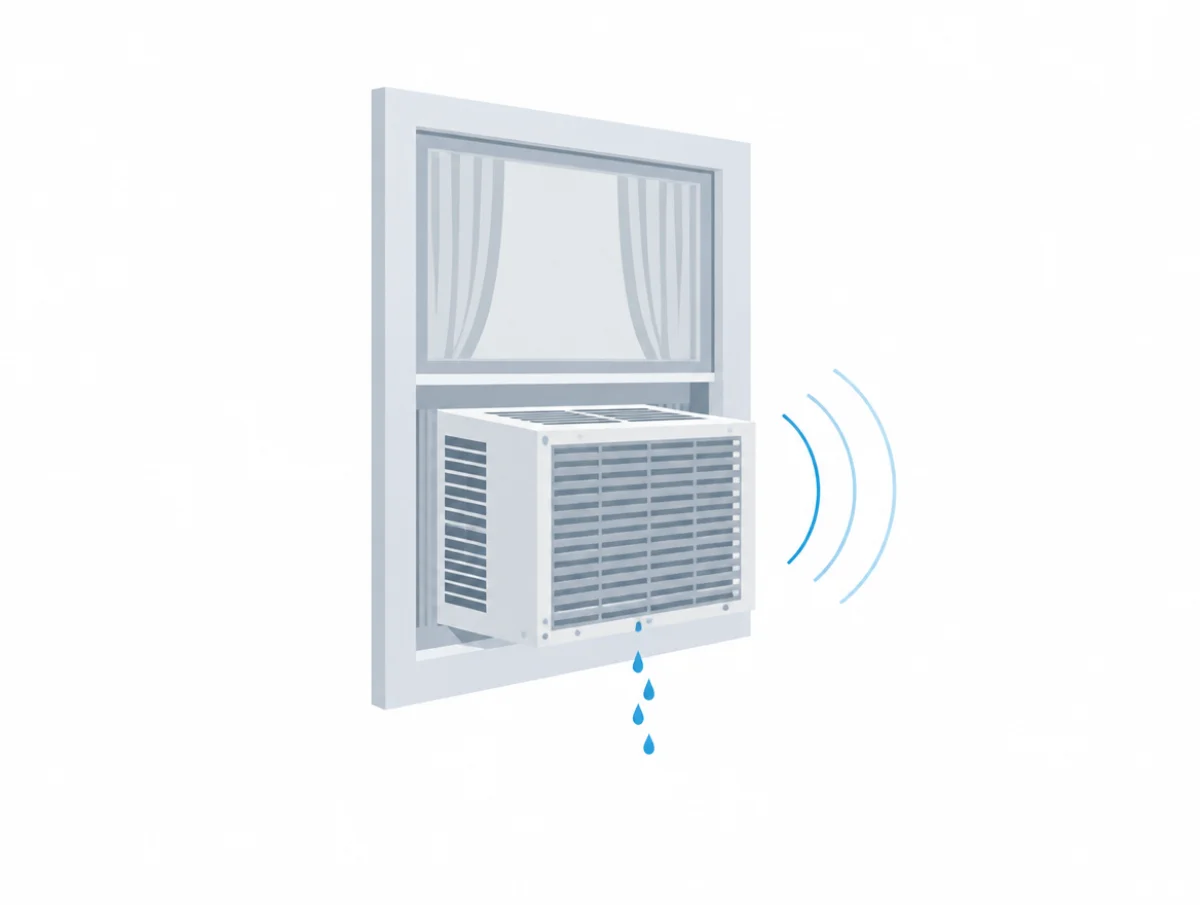
Window AC pinging and splashing comes from a slinger ring: a rim on the outdoor fan blade that dips into water collected in the base pan and throws it at the hot condenser coil. Makers built it in deliberately, to help the coil shed heat.
The LG owner's manual for the LW8022IVSM says the unit "is equipped with a slinger fan", which "picks up the condensed water from the base pan if the water level gets high enough." The water is "expelled through the condenser, making the air conditioner more efficient."
GE Appliances says on its rattling page: "If you hear a ticking or pinging noise, this may be from the slinger ring and is normal operation."
The Hisense manual lists "Droplets of water hitting the condenser, causing a pinging or clicking sound. The water droplets help cool the condenser." The Midea U manual calls the same thing a trickling sound.
Why is it louder after rain or on humid days?
More water in the pan means more for the ring to throw. GE's ClearView manual says the pinging happens "on rainy days or when the humidity is high", and that "Water will collect in the base pan during high humidity or on rainy days."
The Soleus Air manual for its saddle units gives the same reasons. A unit that splashes loudly in August and barely at all in a dry June is behaving as these makers describe.
Can you make the splashing quieter?
Some makers say yes, by letting water out of the pan, at a cost in efficiency. GE says you "can reduce this noise by opening the water hole seal located on the lower right side of the unit. Opening this seal will lower the Energy Efficiency of your unit."
Frigidaire's Gallery guide says "Removing the water plug on the bottom of the machine’s rear can reduce noise. However, doing so will also reduce the energy efficiency of the machine." It adds that "A pair of needle-nose pliers is needed to remove the water plug."
Friedrich agrees for its Chill Premier Inverter: "If the fan hits the built-up water and the sound annoys you, please remove the cap located at the back of the air conditioner to drain the water away." Its note warns: "Removing the cap may affect the heat transfer efficiency."
Two makers lean the other way. LG says that under normal circumstances its drain cap should not be removed, and keeps it for seasonal storage or a technician. Midea says "The drain plug should remain in place for optimal performance."
On one point they all agree. GE: "Do not drill hole in the base pan." Hisense: "Do not drill a hole in the bottom of the metal base and condensate pan." Frigidaire warns that drilling into or modifying the unit to silence these sounds "will void the warranty."
GE also says to drain the outdoor side only if you can reach it safely from outside, which on an upstairs window may rule it out.
Why is my window AC making noise and spitting water?
Window AC water dripping outside is normal in humid weather. Water spitting or dripping into the room is not, and every maker we read blames it first on a unit that does not slope toward the outside.
On the outside, LG's troubleshooting table reads "Water drips outside. Hot, humid weather. This is normal." Frigidaire says the unit is "removing large quantity of moisture from humid room. This is normal during excessively humid days." GE says the base pan water "may overflow and drip from the outdoor side of the unit."
Inside is a different matter. LG's installation steps ask for the back to sit about a quarter inch lower than the front, so "This will force condensed water to flow to the outside." Frigidaire and Midea say to "Tilt air conditioner slightly to the outside to allow water drainage." Hisense says the cabinet "should slope slightly downward toward the outside."
GE lists two more causes for indoor drips: "Drain plug is unplugged", fixed by making sure the plug "is pressed all the way into the unit", and a unit "not level from left to right." A storm window frame can also block the tilt; LG's manual shows a wooden strip on the inner sill to raise the unit.
Midea adds one more source of water that is not a leak: above 80% relative humidity, "there will be condensed water on the surface of the unit."
Why does my window AC rattle or vibrate?
Window AC rattling, by the makers' accounts, comes from loose parts at the front or from the way the unit sits in the window. GE names a loose front grille, loose louvers and an installation that lets the sill vibrate.
GE's rattling page lists the checks in order: "The front grille may be loose or broken", then a dirty air filter, then "The movable louvers may be loose or broken." Last, "With window models, improper installation can cause vibration in the window sill."
LG's installation section opens with "To prevent vibration and noise, make sure the unit is installed securely and firmly." LG, Frigidaire and Midea all list "Window vibration - poor installation" as a cause of noise while cooling, and send you back to the installation instructions or the installer.
LG and Midea word the structural version the same way: the unit "may vibrate and make noise because of poor wall or window construction or incorrect installation." Frigidaire says "If excessive vibration occurs, please check to see that unit is correctly installed." Hisense's list has "Vibrations or noise due to poor wall or window construction."
Is a through-the-wall unit quieter than a window unit?
Friedrich says so. Both its Chill Premier Inverter and Kühl manuals state: "An air conditioner mounted in a wall is quieter than one mounted in a window."
The Kühl manual warns that a missing or badly fitted chassis seal gasket costs you on two fronts: "Operational noise and outside noise will also be amplified." Check the gasket on any sleeve-mounted unit before blaming the compressor.
Why does my window AC gurgle or hiss?
Window AC gurgling and hissing is refrigerant moving through the indoor coil, according to Frigidaire, LG and Midea. All three list it as a normal sound during cooling.
LG's manual says "Gurgling or hissing noises may be heard due to refrigerant passing through the evaporator during normal operation." Frigidaire's Gallery guide and Midea's U manual use nearly the same sentence. None of the three gives a duration or says the sound should fade.
The LG help library, written for all LG air conditioners, files gurgling and hissing with the normal group, alongside "snapping, clicking" and "humming sounds." Plastic parts also snap and pop: LG says "internal plastic components react to temperature changes."
A sound of rushing air is a separate item. Frigidaire puts it at "the front of the unit" and blames "rushing air being moved by the fan." LG's answer for noise while cooling: "This is normal. If too loud, set to lower fan setting."
Why does my window AC make noise when the compressor turns on?
Window AC compressors often chatter, hum or make a brief double knock as they start. Frigidaire, Midea, Friedrich, LG and Hisense all describe a start-up or cycling sound and call it normal.
Midea's troubleshooting table: "A 30 second high pitched noise may occur when the unit is turned on due to the compressor starting. This is normal." Frigidaire says a da-da sound "may be heard due to the start of the compressor (inverter models only)" within the first thirty seconds, and Friedrich describes the same 30 second sound on its inverter.
Frigidaire says "Today’s high efficiency compressors may have a high pitched chatter during the cooling cycle", and LG prints the same line. Hisense describes "A high-pitched hum or pulsating noise caused by the modern high-efficiency compressor cycling on and off."
A single click is the thermostat. GE: "You may hear the thermostat click when the compressor cycles on and off." Hisense lists "Clicks from the thermostat cycle."
Several manuals also explain a silence that worries owners. Frigidaire and Midea say that after a mode change you should "Wait approximately 3 minutes and listen for compressor to restart". GE says its unit may not start cooling for 3 minutes after power returns, by design.
Why is my window AC making noise when it is off?
Window AC noise from a unit you think is off usually means it is in an energy saving mode, with the compressor stopped and the fan still cycling. LG, Frigidaire and GE all describe a fan that runs without the compressor.
LG's Energy Saver works like this: "When set temperature is achieved, the compressor and fan turn off. Approximately every 3 minutes the fan turns on to allow the unit sensor to accurately determine if more cooling is needed."
Frigidaire's Eco setting, which its Gallery uses by default the first time it runs, keeps the fan going "for 3 minutes after the compressor shuts off. The fan then cycles on for 2 minutes at 10 minute intervals" until the room warms again. GE and Soleus Air both say plainly that the fan may run when the compressor does not.
After the unit really stops, LG's help library points to plastic parts snapping as they warm, and the drips GE describes can carry on while the pan empties.
None of the manuals describes a hum or buzz from a unit that is switched off at the wall. If you hear that, the safety instructions below apply.
Why is my window AC making noise but not blowing air?
Window AC airflow that drops while the unit still runs is most often ice on the indoor coil, according to LG, GE, Frigidaire, Midea and Friedrich. Their shared fix is to run the fan without cooling until the ice melts.
GE's table says "Ice blocks the air flow and stops the air conditioner from cooling the room." LG says ice "may block the airflow" and to set "High Fan or High Cool." Friedrich blames "insufficient airflow across the coils, a dirty filter, cool damp weather, or all these", and says that in FAN ONLY "the frost will disappear."
Frigidaire lists the triggers: an outdoor temperature below 60°F, a dirty filter and a temperature "set too low for night-time cooling". For each, it says "To defrost, set to FAN ONLY mode." Midea's U gives 64°F as its cut-off and adds a check for anything "blocking the outdoor intake/exhaust."
If nothing runs at all and the reset button on the plug will not stay in, GE, LG and Soleus Air say to stop using the air conditioner and contact a qualified service technician. If the fan hums but will not turn, none of these manuals lists it as normal.
Which window AC noises mean you should stop using it?
Window AC makers say to unplug the unit for any strange sound that comes with smoke, heat or a burning smell, and to have a technician handle anything inside the cabinet. LG also names loud rattling, rapid tapping and high-pitched sounds for inspection.
LG's manual: "If you detect a strange sound, a chemical or burning smell, or smoke coming from the appliance, unplug it immediately, and contact an LG Electronics Customer Information Center." Midea: "Unplug the unit if you notice unusual sounds or smells or smoke coming from it. A damaged product may cause fire and electric shock."
Friedrich says to "Disconnect the power if strange sounds, smell, or smoke comes from it", and lists "Loud noise, unusual smell or excessive heat" among signs to contact its support.
LG's help library says the noises worth a service call include "loud rattling, rapid tapping, or high-pitched sounds", and warns: "Do not disassemble your air conditioner or attempt to repair internal components."
Newer units use flammable R-32 refrigerant, and LG's manual says that "Service should only be performed by technicians properly trained and certified in the use of flammable refrigerants." Drain plugs, filters, grilles and tilt are the owner's job in these manuals; nothing past them is.
How loud is a normal window air conditioner?
A normal window air conditioner lists roughly 40 to 59 dBA indoors on its maker's spec sheet, depending on fan speed and whether it has an inverter. The outdoor half, where the compressor and slinger ring sit, is louder.
From the figures collected in our quietest window air conditioners guide:
- Frigidaire Gallery inverter, 8,000 BTU: 40, 46 and 50 dBA from low fan to high
- LG LW8022IVSM inverter: 54 dBA on high, 50 medium, 46 low, 44 in sleep mode
- Frigidaire FHWC083TC1, a conventional 8,000 BTU unit: 53.5 to 59 dBA
None of these sheets gives a measuring distance. Soleus Air does, for its WS5 saddle units: 38 to 48 dB(A) indoors and 51 to 63 dB(A) outdoors, measured "at a distance of 3.28 ft away from the front of the unit in cooling mode."
That outdoor range is why U-shaped and saddle designs exist: the compressor sits outside the glass. On Frigidaire's own sheets, though, the U-shape Gallery and the standard Gallery share one ladder of figures, so the shape lowers nothing indoors on paper. Our U-shaped and saddle guide compares every maker that publishes a figure.
If an old conventional unit is simply loud rather than faulty, an inverter model is the change the makers' own numbers support. Our decibel chart shows what 40 or 55 dBA is close to.
Where do these answers come from?
Every answer on this page comes from eight owner's manuals and three maker support pages, all listed in the sources below.
The manuals are Frigidaire's Gallery guide, GE Profile's ClearView manual, LG's LW8022IVSM manual, Midea's U manual, Friedrich's Chill Premier Inverter and Kühl manuals, Hisense's AW-series manual and Soleus Air's WS5 manual. The support pages are GE's rattling page, LG's sound guide and Frigidaire Canada's noise answer.
We did not open, tilt, drain or listen to any window air conditioner for this page, and we have not tested the drain plug trick. Every cause and fix above is the maker's own wording or a close summary of it, credited to that maker. Where makers contradict each other, as they do over the drain plug, we show both sides.