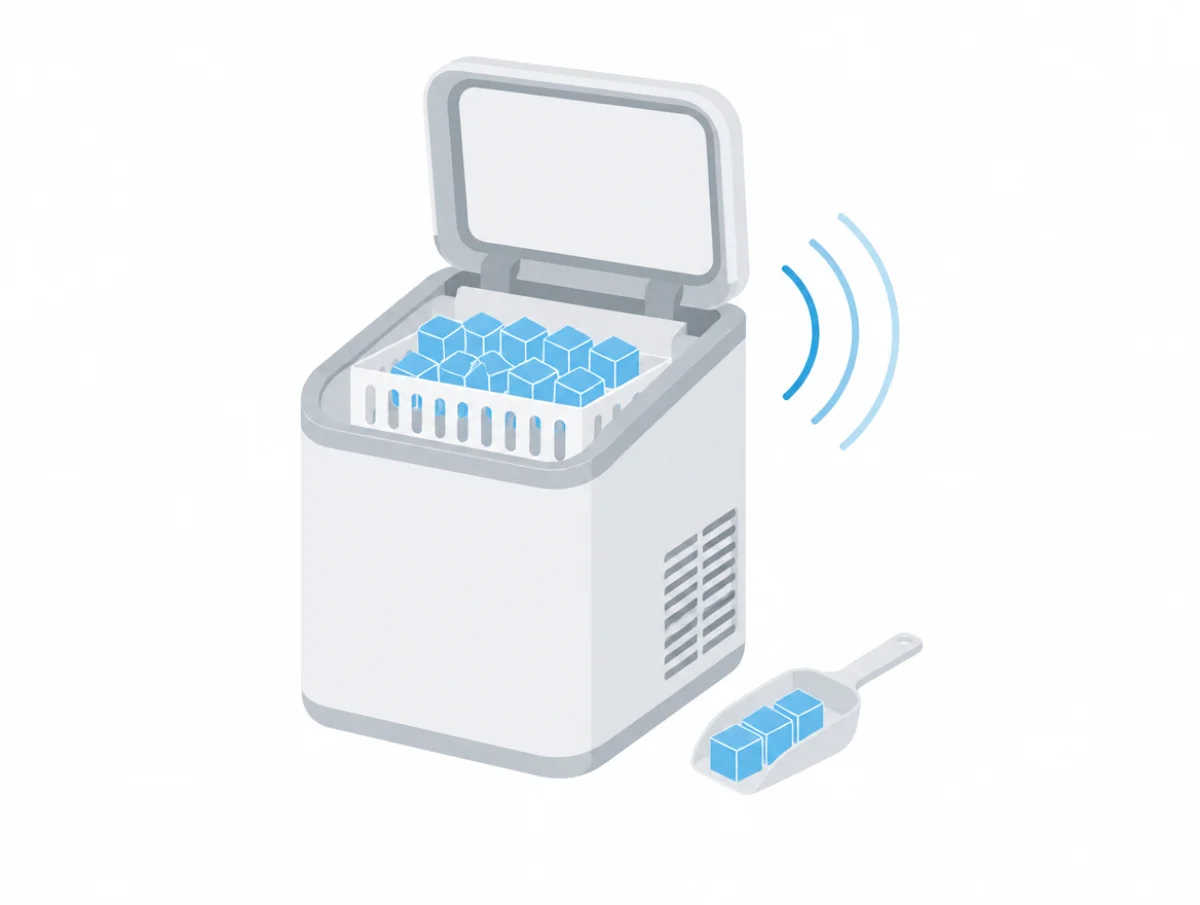
An ice maker making noise is, in most cases, an ice maker partway through a batch. The water valve buzzes as it fills the mold, a small motor drills or whirs as it pushes cubes out, the first cubes clatter into an empty bin, and a countertop machine adds a compressor, fan and pump of its own.
GE, LG, Samsung, Frigidaire, Whirlpool, Sub-Zero, Whynter and NewAir all publish lists of these sounds. The ones they send to service are fewer: a continuous grind, a fan noise that stops when you open the door, a squeal from a pump, and any sound that persists or changes over time.
A refrigerator ice maker borrows the freezer's cold and makes its noise in short bursts. A countertop nugget machine or undercounter unit has its own refrigeration system and runs far longer at a stretch.
Every explanation below comes from the makers' support pages and manuals, quoted with the conditions they give. For the rest of the fridge, the hum, the gurgle and the defrost sizzle, see refrigerator noises explained.
Is it normal for an ice maker to make noise?
Yes. Ice makers make noise as a matter of design, and every maker we read lists several normal sounds. GE puts it directly for the Opal: "There will be some noise associated with the running of these components."
Those components, in GE's words, are "a compressor, pump, motors and fans" that "power on at different times during the ice making cycle." GE says the normal noises on an Opal "typically cease after 10 to 45 minutes within the ice making cycle."
Sub-Zero is blunter about its own built-in machine. Its UC-15I page says the "Undercounter Ice Maker UC-15I(P) is noisy in general as it continuously produces ice", and that "Units with a pump will be noisier than a gravity drain."
The room matters too. GE says "Hard surfaces like the floor, walls and countertops can amplify these sounds", and the Whynter SonicSno manual warns that hard surfaces "can make the sounds seem louder than they actually are."
What noises does an ice maker make when it fills with water?
A refrigerator ice maker buzzes, hums or clicks when its water valve opens to fill the mold, and the sound repeats with every batch. A buzz far more often than that usually means the ice maker is calling for water it is not getting.
Buzzing or humming from the water valve
GE says that when the icemaker is filling, "the water valve opens and can make a buzzing or humming type of sound. This would occur briefly every 1 to 1-1/2 hours or so." It adds that "In most cases, a buzzing noise is considered normal operation."
Frigidaire lists the same buzz under its water valve, and names "the ice maker fan, water valve activation & refrigerant gas" as sources of sound "during ice making operations."
On a Samsung with a water line connected, the buzz should be faint. Samsung says you "may still hear this noise (at a much quieter volume)", and that high water pressure makes it louder.
Why does my ice maker buzz every 15 minutes?
A buzz every 15 minutes or so is GE's sign that the ice maker is switched on while its water supply is off. Each buzz is another attempt to fill. GE's intermittent buzzing page says the noise comes "every time the icemaker calls for water."
GE's fix is in the same article: "make sure the icemaker is turned OFF if water is not connected to the refrigerator."
On GE bottom freezer and side by side models with the XWF filter, a buzz of about 5 seconds once an hour can also come from an isolation valve. GE says the valve "is designed to help prevent major leaks from the filter."
A rattle from the valve with no water connected
A dry valve rattles as well as buzzing. GE says "The mechanism inside of the valve rattles against the walls when there is no back pressure from the water", and that "Typically, the water valve on a refrigerator does not make any noticeable sound when it is operating."
Repeated fill sounds when house pressure is low
Low pressure can stretch the fill into several attempts. GE's side by side owner's manual says "In homes with lower-than-average water pressure, you may hear the icemaker cycle multiple times when making one batch of ice."
What noises does an ice maker make when it drops the ice?
Harvest is the loudest moment for a refrigerator ice maker: a motor runs to push the frozen cubes out, and the cubes fall into the bin. LG calls both sounds normal and says the drop gets quieter as the bin fills.
Drilling or whirring from the ejector motor
LG calls this a drilling noise. Its ice maker "has its own motor to push the ice cubes from the freezing tray to the ice bin", and LG says the run "lasts for about 15 minutes" and comes round about every one and a half to two hours.
A machine with no water does this louder. LG says to switch the ice maker off if it is not connected to a supply, "as it will get louder when the icemaker is running dry."
Clatter, rattle or banging as cubes fall
LG says that as the ice falls, "rattling noises may be heard", and that "The volume of the falling noise may vary depending on the amount of ice in the ice bin."
Whirlpool says the same of its undercounter units: tapping or thumping as ice lands is normal, and "The noise is normally louder when the ice bucket is empty."
GE's Opal notes describe it as a click: "The first nuggets produced make the loudest sound as they fall directly onto the bottom of the ice bin. As the bin fills, this noise reduces significantly."
Clicking, snapping or grinding at the dispenser
A door dispenser has its own mechanism. Frigidaire says "When dispensing ice, you will hear a snapping, clicking or popping sound when the solenoid opens and closes the ice chute."
Samsung says grinding while dispensing, crushed or cubed, is normal too: "The sound is often the motor that's pushing the ice forward." Its limit is a grind "very loud, or happens when you're not dispensing ice", which Samsung sends to service.
What sounds does a countertop or nugget ice maker make?
A countertop nugget machine whirs, buzzes, hums, chugs, rattles, gurgles and clicks as it starts, freezes and drops ice, and GE lists every one of those as normal on the Opal. Splashing and running water are normal on Whirlpool and Whynter machines.
Starting up: whir, buzz, chug and pumping water
GE's list for the Opal starts with the fan: "When Opal is first turned on, you may notice the condenser fan spinning." The pump comes next: "When the water pump first turns on, it may be dry and slightly noisy. Once it is filled with water the noise reduces significantly."
The auger drive follows. "When the Ice Maker first starts up, the gear motor can make a chugging noise. This noise should be considerably reduced after 15 to 20 minutes, once the Opal starts making ice."
GE also says the Opal will "flush the system with water for approximately 5 minutes" at the start. If it seems loud during that flush, GE's note is that "it may need more water."
Freezing: hum, rattle, pulsing and gurgle
The compressor hums on any of these machines. GE: "The compressor is a motor. It produces a low tone humming sound while it is running." Whynter says "The high efficiency compressor may make a pulsating or high-pitched sound."
Refrigerant makes the other sounds. GE says a rattle "may be produced from the flow of the refrigerant" and "should reduce significantly once the refrigerant system has stabilized", with "a brief gurgle" when the refrigerant system shuts off.
Whynter places the gurgle "As each cycle ends", and adds that a rattle can come from the refrigerant, the water line, or items stored on top of the machine.
Splashing, running water and overflow
Undercounter clear ice machines move a lot of water. Whirlpool says "Water running from the evaporator plate to the water pan may make a splashing sound", and that on first start "The ice maker is programmed to run a rinse cycle before it begins to make ice."
You may also hear the reservoir overflow. Whirlpool says on its water circulating page that this is normal: "This overflow helps to purge minerals that were removed from the water during the ice making process."
Sub-Zero says its undercounter machines "produce a batch of ice as often as every 20 minutes" and "also have water and drain pumps that make noise during operation."
Squeaking before a defrost
A nugget machine can freeze its own auger. GE says "When Opal is in need of defrosting, it may start to squeak as ice starts to build up around the mechanisms."
The defrost is automatic. GE's defrost mode page gives "30 to 45 minutes" for the Opal ice maker and "10 to 20 minutes on the Dispenser model", while its sounds page says 10 to 45. During defrost the Opal ignores its buttons and makes no ice.
Screeching or a high-pitched whistle
NewAir names one cause: "Screeching or high pitched noises could be caused by a water pump. This is a replaceable part."
Whirlpool ties a whistle on its undercounter machines to the water supply. If the supply valve is not fully open, Whirlpool says "it could cause a whooshing or high-pitched noise", and a clogged filter "can reduce the water pressure, causing the Ice Maker to make a high-pitched sound."
High pressure does it too. Whirlpool says above 60 psi "you may hear a loud high-pitched sound during water filling", and to "Call a licensed, qualified plumber to determine the best method to reduce the supply water pressure (50 psi is recommended)."
Why is my ice maker making noise but no ice?
An ice maker that runs or buzzes without producing ice is usually short of water, still cooling down, jammed, or in a cleaning or defrost mode. The makers list those causes before any failed part.
A refrigerator ice maker that buzzes with an empty bin
Start with the water. GE's 15 minute buzz is the classic pattern of an ice maker calling for water that never arrives, and LG warns that one running dry gets louder.
Give a new fridge time. GE's owner's manual says the icemaker "will fill with water when it cools to 15°F" and that "A newly installed refrigerator may take 12 to 24 hours to begin making ice cubes."
Look for stuck cubes. GE's troubleshooting table lists "Ice cubes stuck in icemaker" and says to "Turn off the icemaker, remove cubes, and turn the icemaker back on." Sub-Zero names a jammed cube blocking the ice ejector as one cause of ice maker noise.
The same GE table says "Piled up cubes in the storage bin cause the icemaker to shut off", so level a heaped bin before assuming a fault.
A nugget machine that runs without filling the bin
On an Opal, check the mode first. GE's not making ice page says that on the round button model, a yellow button means cleaning mode, which "will not produce ice". On the newer models the display reads Cleaning or Defrosting.
If none applies, GE says to check that the ice bin is pushed fully in and to "reset the Ice Maker by unplugging the unit for 3 to 4 hours", then contact Opal Support if that fails.
Whynter's manual covers the harder case. When "The ice making process was correct, but no ice came out", its listed causes include a compressor with no refrigerant, a damaged compressor or fan motor, and a freeze alarm or ice jam, and its answer is to contact Whynter Customer Support.
Whirlpool links a pulsing water sound on its undercounter machines to ice caught between the evaporator plate and the cutting grid. "If the problem persists, run a cleaning cycle," Whirlpool says, and it also asks you to confirm the machine is level.
Why is my ice maker making noise when it is off?
Switching off a refrigerator ice maker silences its valve and motor, so a sound that remains usually belongs to the fridge. Undercounter units with a drain pump are the documented exception: Sub-Zero says the pump runs with the machine switched off.
LG lists the fridge's own fan in its ice maker article: "A humming or buzzing sound may occur while the fan is running normally." A fridge that hums, ticks or gurgles with the ice maker off is covered in our refrigerator noises explainer.
A door water dispenser still uses the valve. GE says "You may hear the water valve buzz when you get water on Refrigerators with an internal or external water dispenser."
Sub-Zero's UC-15I page is specific: "The drain pump, if present, will run even with the unit turned off (as long as the home power supply is on)."
An Opal in defrost can look switched off, since GE says it "will not respond when you press any buttons" until the cycle ends. Sub-Zero adds that if a water line or ice maker is reported as not connected, the ice maker should be turned off.
Which ice maker noises mean something is wrong?
Makers send owners to service for a continuous grind, a fan noise that stops when the doors open, a compressor buzzing on low voltage, a screeching pump, and any noise that persists or changes.
Continuous grinding
GE draws one line for the Opal: "If the Ice Maker is making a continuous grinding noise, this is not normal." It points owners to Opal Support at myopalservice.com or 866-907-6718. Samsung asks for a service request if a fridge ice maker grinds when you are not dispensing.
A noise that stops when the doors open
LG says "If the noise stops when the doors are open, but then returns as they are closed, this is likely the result of a fan noise and will require service for a proper diagnosis."
A compressor buzzing on low voltage
Whynter's troubleshooting table lists "The compressor works abnormally with a buzzing noise", gives low voltage as the cause, and says "Stop the ice maker and do not restart until the voltage is normal." Neither low voltage nor a damaged power cord, which Whynter also sends to its support team, is one to repair yourself.
Defrost that will not end
For either Opal model, GE says that if it "has been stuck in Defrost Mode for more than 1 hour, unplug the appliance for 30 minutes and restart", and to contact Opal Support if it keeps returning to defrost.
A noise that persists or changes
Sub-Zero is clear about where its help ends: "If the noise persists, or changes over time, no further troubleshooting advice is available." It sends owners to Factory Certified Service. LG likewise says that if problems continue, "the unit will require service for a proper diagnosis."
If an ice maker has simply grown louder over months, our page on why appliances get louder covers the dull causes first.
How do you make an ice maker quieter?
The makers' fixes are simple: switch a fridge ice maker off when no water is connected, open the supply valve fully, replace an old filter, correct high water pressure, and keep a countertop or undercounter machine level and well ventilated.
Turn it off when there is no water. GE, LG, Samsung and Sub-Zero all say so, and Samsung's reason is to avoid "this noise and damage to your refrigerator."
Check the supply and filter. Whirlpool's buzzing page says a supply that is "not fully opened or turned all the way on" can cause a high-pitched or buzzing sound, and that "Mineral build-up can also cause unusual noises." It recommends cleaning when the cleaning light comes on.
Leave pressure changes to the right person. Samsung allows turning the pressure down only as long as you can still dispense 3/4 cup in under 10 seconds. Whirlpool says to use a licensed plumber when supply pressure is above 60 psi.
Stand it level and give it air. Whynter says to place the machine "horizontally on a properly leveled surface". Whirlpool recommends cleaning the condenser coils "every six months" and avoiding walls or appliances that amplify sound. Sub-Zero says "Do not cover the kickplate." Unplug the unit before cleaning, as your manual directs.
Expect more noise from more ice. Sub-Zero says that on products with Max Ice, the noises "will occur more often when the Max Ice feature is turned on."
How loud is a normal ice maker?
Few makers publish a figure, and none of them for a refrigerator's built-in ice maker. Countertop claims run from under 35 dB for bullet machines to 55 to 57 dB for nugget machines, with no stated distance on most.
Sub-Zero says outright that its products have no ratings: "Sub-Zero and Wolf appliances do not have decibel or sone ratings for products". GE publishes no decibel figure for the Opal either, only its list of named sounds.
The countertop numbers come from our quietest countertop ice makers guide. Silonn says its SLIM01B bullet machine is "lower than 35dB" when making ice cubes. Whynter publishes "Noise Level: 48dBA" for the SonicSno nugget machine, and Euhomy rates its Pearl L1 Max at "less than 45 dB".
NewAir's support page gives the frankest range: "Nugget style icemaker noise range is 55db - 57db and can have a peak of up to 65db", with non nugget machines under 50 dB. Silonn's SLIM32T is the only machine whose maker names a distance: "about 50-55 dB from a distance of 1 meter".
A single figure cannot cover a hum, a chug and a clatter of falling ice, so read any of them as a rough guide. Our dBA explainer and decibel chart put the numbers in context. If you have switched off a fridge ice maker to get quiet, the quietest refrigerators guide ranks the rest of the appliance.
How we wrote this guide to ice maker sounds
QuietSpecs built this page from maker documents only, listed below the article.
The documents are GE's Opal support articles, its refrigerator buzzing and water valve pages and a side by side owner's manual, LG's ice maker noise article, Samsung's US noise guide, Frigidaire's noise guide, Whirlpool's undercounter ice maker pages, Sub-Zero's ice maker answers, the Whynter SonicSno manual and NewAir's noise article.
We did not run, open, defrost or repair any ice maker, nugget machine or water valve ourselves. Every sound, cause and fix above is the maker's, quoted with its conditions, and the decibel figures are the makers' own claims as recorded in our ice maker guide.