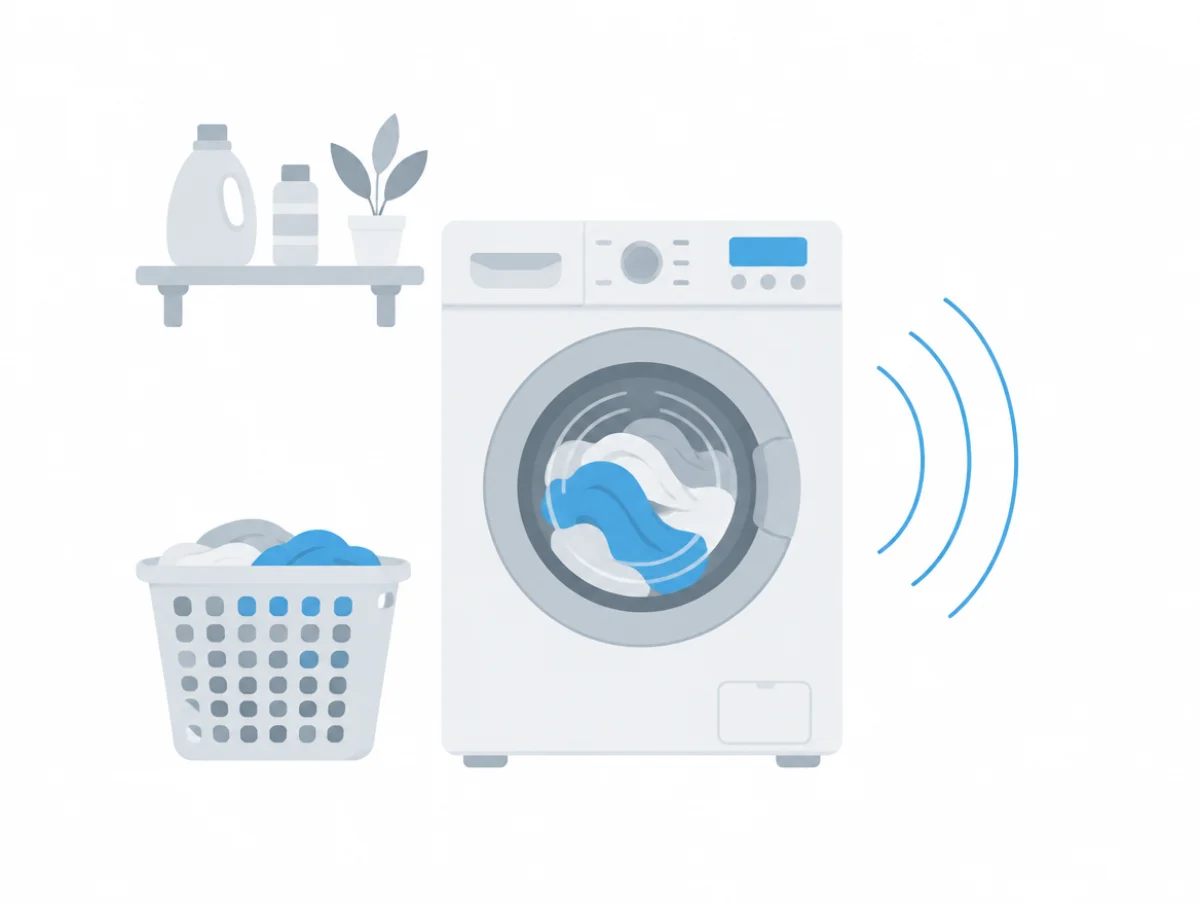
A washing machine making noise is usually telling you which part of the cycle it has reached. Clicks at the start, the rush of water as it fills, a hum and a gurgle as it drains and the motor climbing into the spin all sit on the normal sounds lists published by Whirlpool, GE, Samsung, LG, Bosch, Electrolux and Frigidaire.
The sounds the makers treat as faults make a shorter list: squealing or grinding that survives a lighter load, a roar like a jet on Samsung models, banging inside the drain pump, a noise that is still there with the drum empty, and any strange noise that arrives with smoke or a burning smell.
Below, each sound is grouped by the part of the cycle where you hear it, in the maker's own words.
Is it normal for a washing machine to make noise?
Yes. A washing machine makes some noise in every phase of a normal cycle, and the makers say so. Samsung says its washers "are generally very quiet, and most noises are either normal or can be easily corrected."
GE says on its decibel page that "a washer does make some sound when in use", naming filling, spinning and draining as "examples of normal sounds". GE also says "We do not rate the sound level of our washers".
Whirlpool warns that a newer machine will not sound like the one it replaced. Its page on grinding or rubbing noise says "This new style washer makes many different noises" and "The drive system on these units is different than previous washers", so motor and gear sounds can be "part of the normal washer operation."
Why is my washing machine making noise when spinning?
A washing machine making noise when spinning is most often reacting to an uneven load, a cabinet that is not level, or a hose or loose object knocking against it. Several spin sounds are on the makers' normal lists as well.
Thumping and banging as the spin starts
A thump as the spin begins is normal with a heavy load, according to Frigidaire. "It is normal for a heavy wash load to occasionally produce a thumping sound at the beginning of the Spin cycle." The Electrolux noises guide says the same of heavier loads, with a note to confirm the shipping bolts are out.
Samsung describes a thump that "typically has a steady pattern or beat in time to the spinning of the washer" and calls it "normal when certain large or waterproof items (like bedsheets) are being washed." When the load is ordinary, its checks are to balance the load, level the washer and confirm the shipping bolts are gone.
LG explains why a front loader can sound rough before it settles. Its spin dry page says that while the drum moves to balance the load, "vibration and noise occur and the door may shake for a short while", and "Once balance is achieved and spin dry begins, vibration and noise should decrease."
Whirlpool blames one front loader thump on the rubber door seal. Its thumping noise page says that if the noise "only occurs briefly at slow/low spin speeds, this may be caused by the bellows and its part of normal operation."
Drumming from a top loader
Drumming is a top loader sound that GE explains on its agitation noises page. Air is "being pushed out of the basket towards the outer case", which makes the cabinet "move in and out which may sound like someone is beating on a drum."
GE adds that a top loader that is not completely level will thump, drum or "rock back and forth" in the spin, and that a shipping rod left in causes bangs and rattles.
Clunks and knocks when the drive changes over
A single clunk or knock as the washer moves between washing and spinning is normal on several makers' machines. GE calls a "metallic knock, double knock, or metallic clunk" during agitation or spin "a normal sound", caused by "two components in the drive system engaging quickly".
Samsung says a thump or knock that "follows a click sound, that fades away after a moment" comes from "the clutch in the washer's motor transitioning between modes", and that "service is not required." Whirlpool says of its top loaders: "There will be a clunk noise as the drive system shifts from agitation mode to spin mode or vice versa."
Ramping up, coasting down and a jet engine whine
A rising whir in the spin is the motor stepping up through its speeds. Whirlpool says the washer "steps through increasingly higher spin speeds" to stay balanced and remove more water. GE says the motor "will speed up incrementally during the spin cycle" and afterwards will "coast until it stops."
The makers split over a sound like a jet engine. The Electrolux guide lists "High Pitch Jet Engine" as an ordinary sound and explains it in two words, "Unit Spinning". Samsung says that if its washer "makes a noise that sounds like a jet preparing for takeoff", you should request service, because "once the noise occurs, service is required."
Rattling, clattering and clacking
Rattles during the spin usually come from something loose, inside or outside the drum. Whirlpool's rattling page names hoses knocking on the back of the cabinet and things propped against the machine: "Brooms, dustpans, dryer racks, or hangers can make rattling noises", most of all at high spin speeds.
Inside the drum, LG blames clacking on "coins, hair pins, accessories" left in the load. Frigidaire says belt buckles and metal fasteners "may cause rattling or clanking sounds", and suggests fastening them or turning garments inside out.
Frigidaire's test tells a laundry noise from a machine noise: run an empty load, and "If the noise is still present during the empty load, please contact us." LG has you turn the empty drum by hand, and "If the noise continues, the washer will require repair service."
What noises does a washer make while filling and washing?
Filling and washing bring clicks from the door or lid lock, the spray and rush of water, a pop from the water valve, and a hum, swoosh or grind from the motor as it agitates. Makers call each normal under the conditions below.
Clicks at the start of a cycle
Clicks in the first minute are the lock and the load sensing. On Whirlpool front loaders, the door clicks "roughly 10 seconds after the cycle begins", and "The three sounds you hear are a lock, unlock, and lock again."
On GE top loaders, the lid locks and the basket will "spin up and coast down several times to sense the load size", so the click repeats, and a Whirlpool video page shows its top loaders humming "during sensing". Midea's top load manual says the clicks before filling check "that the lid is locked" and do "a quick drain".
Spraying, splashing and a pop from the valve
Water noise is expected. Whirlpool says that on fill "The washer will make a spraying sound", that splashing and sloshing during agitation "may be more noticeable on smaller loads", and that many cycles rinse with a spray.
Samsung singles out one fill noise that startles owners: "A sudden sound at the beginning of the filling operation that sounds like a cork coming off a bottle is the sound of the water valve opening. This is a normal sound."
Squealing, whistling or banging as it fills
A squeal or whistle during the fill usually points at water pressure. GE says it "may be caused by too much water pressure" and suggests turning down the hot and cold supply valves. If that quiets it, GE says the cause is likely the home's supply, and that a plumber can reduce the house pressure.
For a squeal or hoot, Whirlpool says to open both shutoff valves fully and check the hoses are "not kinked or clogged." GE says banging during the fill "is most likely caused by plumbing problems such as loose, rattling pipes", which it hands to a plumber.
Humming, swooshing and grinding during the wash
A motor sound during agitation is normal on most current washers. GE compares one to "an electric can opener" as the agitator turns, pauses briefly and reverses. On its HydroWave top loaders, a back and forth "swoosh" or "zip" comes from a drive that "doesn't use gears."
Whirlpool says a grinding or rubbing noise "will only occur in the cycle's agitation/wash or spin portions" and is usually the motor changing direction or "some gear sounds". An overloaded washer, it adds, "can also make a louder, grinding-type noise."
Samsung treats squealing, squeaking or grinding more seriously. It likens the sound to "an unoiled merry-go-round" and says to "immediately stop the cycle and reduce the weight of the load." Its test is a cycle with "approximately 4 soaking wet bath towels"; if the noise comes back then too, request service. Whirlpool adds that if a drain pan sits under the washer, "the tub bottom may be rubbing against the drain pan".
Why does a washing machine hum or gurgle when it drains?
A washing machine hums and gurgles while draining because the pump keeps running and starts to pull air once most of the water is gone. Whirlpool, GE, LG and Samsung all describe this as normal.
The pump "will remove most of the water and then pump air", says Whirlpool, which "may cause a gurgling sound", and "The drain portion of the cycle usually lasts 3-5 minutes." Whirlpool front loaders also pulse when "The pump may turn on and off several times with very short pauses", which its pulsing page calls normal.
GE describes the end of the drain as "a slurping or gurgling noise" from "the combination of air and water being pumped out". Samsung says a quiet hum is "most common during draining, and is louder when air is mixed in", and is also louder on a spin-only cycle.
The drain pump is also where a normal hum can turn into a fault. LG says a hum while draining before the spin is normal, but that with foreign objects stuck in the drain filter "the sound may be unusually disturbing and loud." Samsung says grating or grinding from the pump on every cycle means the pump filter needs cleaning.
The Bosch manual for the WGA14400UC calls whooshing, hissing or sucking "Not a fault". For banging or rattling in the pump itself, Bosch says "A foreign object is in the drain pump" and to clean it.
Why is my washing machine making noise but not spinning?
A washing machine making noise but not spinning or filling may simply have no water reaching it. Samsung and Whirlpool both tie a loud hum to a closed water supply, and LG ties a loud drain hum to a blocked filter.
Samsung: "A loud noise of this type will occur if the home's water supply valve is not open and the washer is not getting any water." Its remedy is to connect the line and open the valve. Whirlpool pairs a humming noise on its front loaders with the F8 E1 error code, and says to "Verify that both hot and cold water supply hoses are turned on all the way".
A drum slow to reach full speed may be fighting an uneven load. LG says rugs, mats and waterproof fabrics "prolong the spin time", and Bosch says a reduced spin speed "to eliminate an imbalance" needs no action.
Why is my washing machine making noise when not in use?
A washing machine making noise when not in use may be running an after-cycle freshness feature on purpose. Whirlpool FanFresh and GE UltraFresh Vent both move the drum for hours after the wash has finished.
Whirlpool says FanFresh "will periodically tumble the load after the end of the cycle for up to 12 hours (depending on model) while the integrated fan circulates air through the washer". It can also be started with no cycle at all, by holding its button for 3 seconds.
On GE front loaders with UltraFresh Vent, "the door will remain locked and the washer will intermittently spin at low speeds for up to 8 hours", in 15 minute spells on and off, to dry the gasket and tub. GE says the feature "may be cancelled at any time by pressing the Power pad".
No maker page we read calls noise from a switched off washer without these features normal, so take that to the maker's service line.
Is a new washing machine banging because of the shipping bolts?
Yes, on a front loader that is often the reason. Front load washers leave the factory with bolts that lock the drum, and Whirlpool, Samsung, LG, Bosch and Electrolux all name bolts left in place as a cause of noise and vibration.
Whirlpool says "All four (4) shipping bolts and the plastic spacers must be removed from the rear of the washer before you operate it", and that leaving them in "can result in noise, vibration or error codes." Bosch's troubleshooting table gives "Transit bolts have not been removed" as a reason for loud spinning and a machine that wanders.
You can check without pulling the washer out. Samsung says to open the door and push the drum: it "should rotate freely and bounce slightly when you press against it, like it's connected to springs." If it turns but does not bounce, "the shipping bolts are not removed." LG's version is to "try to shake the drum. If there is no wobble, remove the shipping bolts".
Top loaders ship with other packing. GE says its top loaders come with "either a shipping rod, Styrofoam shipping material or a cardboard base and cardboard cone", and if it stays in "the washer will vibrate and be noisy." Speed Queen's TR3 and TR5 guide says a washer kept in storage "may make a knocking sound" because "The belt may have settled", and to run it through 4 to 5 cycles.
Keep the bolts once they are out. Bosch says to fit them again before transport, and Speed Queen says its plastic shipping plug "should be saved and reinstalled any time the washer is moved."
Which washing machine noises need a technician?
Squealing that returns with a light load, a Samsung jet roar, a noise that survives an empty cycle, and any strange noise with smoke or a burning smell all need service, the makers say.
Midea's manual gives the instruction to stop at once: "If the appliance emits a strange noise, a burning smell or smoke, unplug the power plug immediately and contact your nearest service center. Failure to do so may result in electric shock or fire."
Speed Queen's guide says to call for service if you notice "an increase in operating noise", alongside water on the floor or water left in the basket after a cycle. Samsung asks for a service request for a squeal that comes back in the four towel test, a pump noise that remains after the filter is cleaned, and the jet noise.
LG says that if a noise continues after its checks, "service will be required for a proper diagnosis." Electrolux sends owners whose washer was installed within the past 30 days back to their installer first.
What should you check before calling for service?
Check the load, the level, the hoses, the space around the washer and, on a new front loader, the shipping bolts. None of these checks involves opening the cabinet.
Size and balance the load. LG says the tub "should be about 2/3 of its capacity" so laundry moves freely. Whirlpool says to avoid washing one bulky item alone and to pair "a rug or a jean jacket, with a few extra items."
Level the washer and lock the feet. Whirlpool says to rock it corner to corner, adjust any foot that teeters, and tighten the lock nuts "against the washer cabinet." Electrolux says the leveling legs "should not extend more than ½ inch below the washer bottom". Bosch says aligning the washer correctly helps "reduce noise and vibrations".
Whirlpool also says to check the floor "for flexing or sagging". For a laundry room on an upper floor, our guide to the quietest washing machines covers what the manuals say about joist floors.
Secure the hoses and clear the sides. GE and Whirlpool both name a drain hose slapping the back of the cabinet, and Whirlpool suggests the beaded strap supplied with some models or "a wire tie." LG says shelves or cabinets beside the washer can cause tapping, and advises leaving "sufficient space when installing the washer."
Empty every pocket. Whirlpool lists "coins, small objects, or other foreign objects" among the causes, and LG adds hair pins and wires.
Clean the drain pump filter with care. LG warns that "A large amount of water can spill onto the floor" when it is opened. Bosch says to turn off the faucet, switch the washer off and unplug it first, and warns that after a hot wash "the detergent solution becomes hot." Follow the steps in your own model's manual.
How loud is a normal washing machine?
A normal washing machine is much louder spinning than washing. Bosch lists its 300 Series WGA14400UC compact at 52 dBA washing and 72 dBA spinning, and most brands publish no figure at all.
Bosch prints both halves of the cycle on its WGA14400UC product page, as "Noise level washing" 52 dBA and "Noise level spinning" 72 dBA, with no test standard named. Beko's spec sheet for its 120 V WFTV10733XC compact lists 52 dBA washing and 76 dBA spinning.
Top loaders publish less. Midea's MLTW37A1BWW page lists 64 dBA for the wash and 77 dBA for the spin. Speed Queen says its TR7 measures "only 43dB during agitation", a wash figure with no weighting and nothing for the spin, so it cannot be set beside the others.
So judge a washer by its spin. Our decibel chart puts 52 and 72 dBA beside everyday sounds, and the dBA explainer covers the weighting.
If you are replacing the machine, our rankings of the quietest washing machines and the quietest top load washers use maker-published figures like these. For a closet, see the quietest stackable washer and dryer.
How did we put this washer guide together?
We worked from washer support pages and manuals only: Whirlpool's noise articles, GE's top load sound guides, Samsung US and LG US troubleshooting pages, the Frigidaire and Electrolux guides, and the Bosch, Speed Queen and Midea manuals listed below.
No washing machine was run, recorded, opened or repaired by us for this article, and none of the makers' remedies has been tried by us. Model and load conditions stay as each maker wrote them, and disagreements between makers are pointed out where they occur.