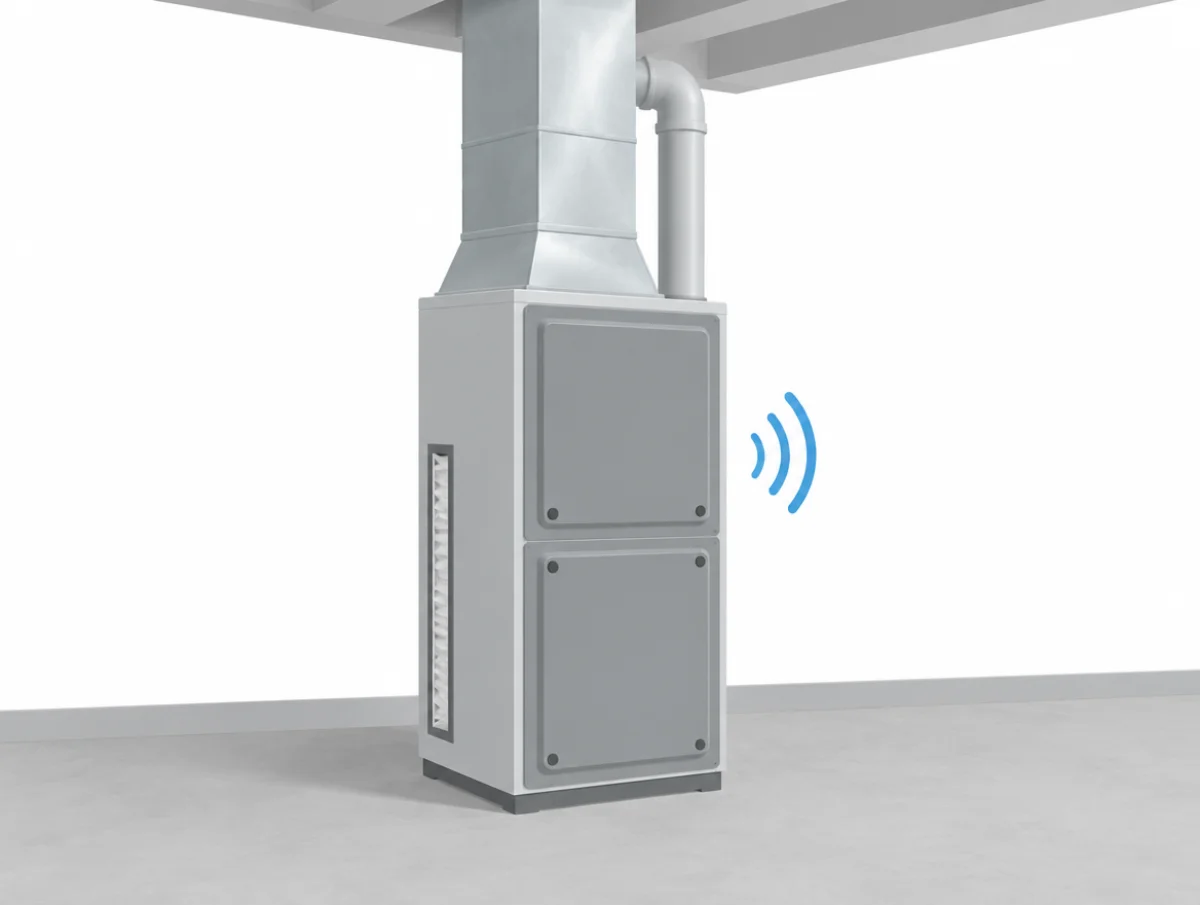
A loud bang inside the cabinet at the moment the burners light is the one furnace noise that Carrier and Bryant tell you to act on straight away. Both manuals call it delayed ignition, and both say to shut the furnace down and call the dealer.
Most of what a furnace does is quieter and harmless. A click before ignition, a whoosh as the burners catch, the blower spinning up and a steady hum are a gas furnace working through its startup, and Trane adds some pinging from the ducts as they warm. The sounds that go to a technician are a short, different list: a squeal or screech, a buzz, grinding, and a rattle that does not stop. Carrier, Bryant, Trane, Lennox, Goodman and York agree on that much, though they part ways on filter intervals and on how quiet a furnace ought to be.
The causes and remedies below are quoted from their owner's manuals, a Goodman service manual and their support pages, conditions included. Rheem's site gave us only its shutoff steps.
A furnace is allowed some noise
"Your furnace isn't completely silent, and it was never meant to be." That line is from Lennox, which counts a soft hum as the blower starts, a gentle click at ignition and "a brief whoosh as warm air moves through your vents" as normal.
The hum after ignition "is a signal that things are going smoothly", in Trane's words. Its own list of normal sounds adds "a clicking noise before ignition" and "a slight pinging or popping from your ductwork as it expands when the heat first comes on." Age changes things too: "The older your furnace gets, the more likely it is to start making noise."
Carrier is stricter. Any sound beyond the standard click and whoosh "warrants a professional inspection," according to its maintenance page, and its repair page is shorter still: "Furnaces should be relatively quiet."
Startup runs in a fixed order
An inducer fan clears the burner area, an igniter heats up, the gas valve opens and the burners light, and only then does the main blower start. York, Carrier and Goodman print that same order, which helps when you are trying to tie a sound to a part.
York's user's manual for its 33 inch multi-position furnaces walks through it: "First, the inducer motor starts to purge the heat exchanger of any remaining gases." Next "the hot surface ignitor glows and after a warm-up period, the gas valve opens and ignition occurs," and "A short time later, the blower starts".
Carrier and Goodman put times on the steps. In the Carrier owner's manual for condensing furnaces, the hot surface igniter heats "for about 20 seconds" before gas flows, and "After ignition and a time delay of up to 60 seconds, the furnace blower will start." Goodman's service manual for the GR9S80 and Amana AR9S80 uses a fixed 30 second blower delay after the burners light, then keeps the inducer running for 15 seconds after they shut off. That last figure explains the short whir after the heat stops.
What the inducer sounds like, none of these manuals says, and none gives a decibel figure for any stage. Carrier's two-stage furnace page gets closest, with "Traditional furnaces can be louder when they start at maximum capacity," and a note that its Infinity 96 (59TN6) "can operate in low stage up to 90% of the time."
Why does my furnace bang when it starts?
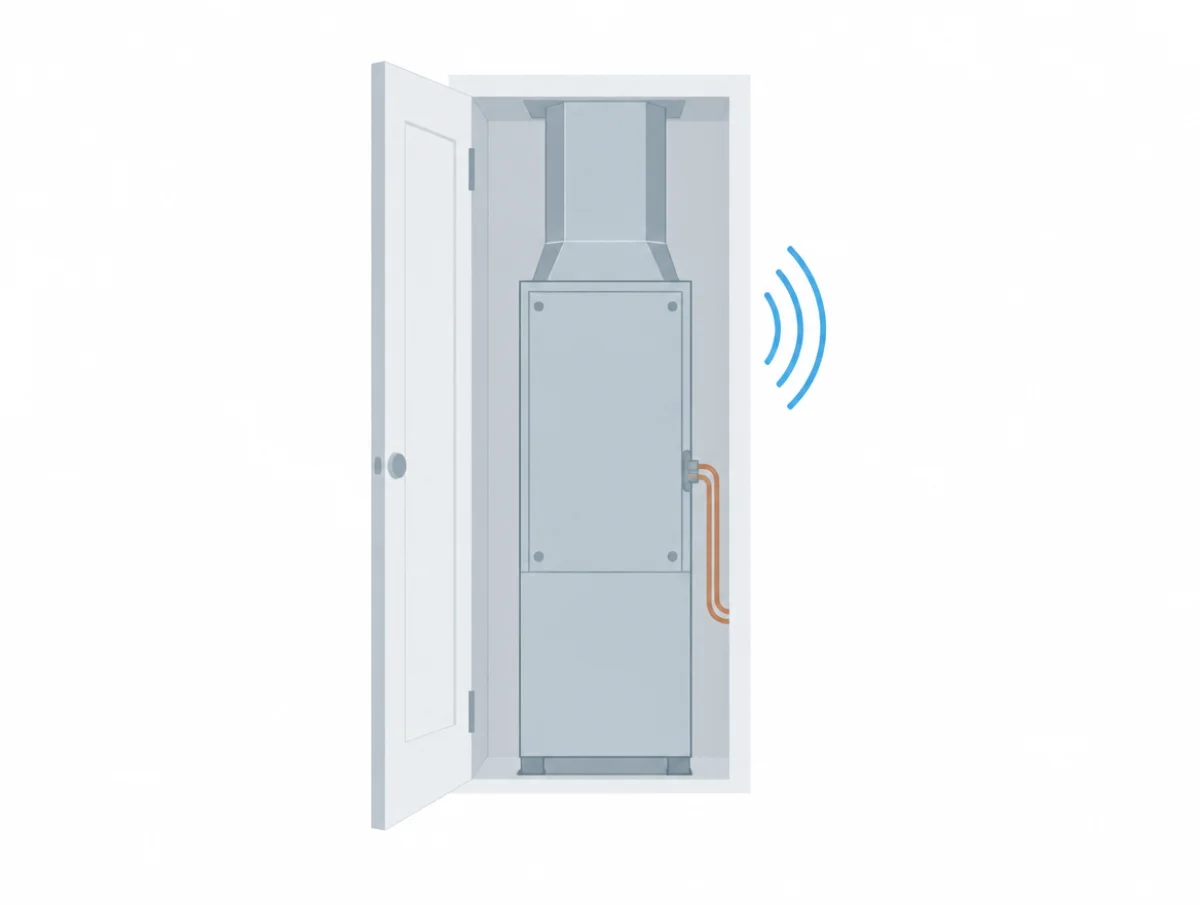
Delayed ignition. Buildup on the main burners makes the gas light late, and the result is a bang inside the cabinet. Carrier's owner's manual: "Buildups on the main burners can cause faulty firing. This "delayed ignition" is characterized by an alarmingly loud sound." Then the instruction: "If your furnace makes a loud noise when the main burners are ignited, shut down the furnace and call your servicing dealer."
Bryant's manual for its older 340MAV, 350MAV and 355MAV furnaces reads almost the same: "Accumulations on the main burners can result in firing out of normal sequence. This delayed ignition creates an alarmingly loud sound." Shut it down and call the dealer, it says, if the furnace "makes an especially loud noise when the main burners light".
The support pages are just as firm. Trane's version: "A sudden bang at the furnace when it first starts up could indicate a delayed gas ignition issue, and needs immediate attention." From Carrier's troubleshooting page: "A bang or boom when starting suggests a clogged burner delaying ignition. This requires professional diagnosis."
Goodman's service manual, written for technicians, goes into the mechanics. It defines delayed ignition as "a delay in lighting a combustible mixture of gas and air which has accumulated in the combustion chamber." It also says "Furnace design makes this extremely unlikely unless safety controls have been by-passed or tampered with," and gives the servicer gas pressure, burner position and orifices to check. A smaller cousin, flashback, "may occur at the moment of ignition, after a burner heats up or when the burner turns off. The latter is known as extinction pop." That one goes to the servicer as well.
Ducts tick and pop as they warm
Sheet metal grows when warm air reaches it. Trane treats a slight pinging or popping at the start of a heating cycle as normal, and puts banging at the registers down to the same thing: "What sounds like banging or clanging coming from the registers is just the noise your ducts make as they adjust to temperature changes."
Location is the tell: a bang at the registers is the ducts, and a bang at the cabinet as the burners light is the delayed ignition above.
A buzz from the ducts is something else. In Trane's account, ductwork "that causes a buzzing or vibrating sound indicates loose connections." It calls this no emergency and suggests asking your HVAC professional whether duct sealing would help. For rattling, Carrier's line is "Look for loose connections in the ductwork or panels." Nobody offers a fix for ordinary expansion ticking, or says how loud it can get before it counts as a fault.
Why is my furnace squealing or screeching?
Think blower motor first. Trane, Lennox and Carrier all name worn bearings, and none of them hands the job to the owner.
"A high-pitched squealing or screeching coming from your furnace is likely a sign of trouble with the blower motor," per Trane, whose page adds that ball bearings in an older furnace's fan motor "may start to wear out." The repair can be small or large: "The HVAC technician may be able to solve the problem by replacing the ball bearings and lubricating the motor, but you may need a furnace blower motor replacement."
Lennox agrees: "Sounds like screeching or squealing could mean the blower has bad bearings." The Carrier version is broader, "Unusual sounds like grinding, squealing, or banging often indicate worn-out bearings or loose components," and ends with a recommendation for a professional inspection.
Older oil furnaces can have a belt in the mix. Trane's oil furnace page: "A noisy furnace could be cause by a loose access panel or an unlubricated belt."
Leave the oil can alone on a modern gas furnace, though. "The motors in these furnaces are permanently lubricated and do not require periodic oiling," York says, and Goodman's blower and inducer motor bearings are "permanently lubricated by the manufacturer. No further lubrication is required."
Why is my furnace whistling?
Air is fighting to get through somewhere, and the filter is where Trane and Carrier both look first. In Trane's words, "A whistling sound when your furnace is running most likely points to airflow problems." Change a dirty filter, it says, and "Make sure the registers are open and the return air vents are not covered or blocked by furniture." Carrier's troubleshooting page adds the ducts: "Check for a clogged air filter or gaps in the ductwork."
How often to deal with the filter depends on whose manual you read. Carrier's owner's manual says "The furnace filter should be checked every four weeks and be cleaned or replaced if necessary." Goodman's service manual says filters "should be cleaned (permanent) or replaced (disposable) every two months or as required." On Trane's filter guide, lower MERV filters may need changing "possibly every 30 days" and thicker, higher MERV filters "more like every 90 days." York's manual simply says to replace external filters "as needed". Go by the interval in the manual for your furnace.
Carrier and Trane state one rule in the strongest terms. "Never operate your furnace without a filter in place. Doing so may damage the furnace blower motor." That is Carrier. Trane prints it in capitals: "NEVER operate your furnace WITHOUT a filter as this can lead to severe and expensive problems."
A hum is normal, a buzz is not
A steady hum while the furnace runs is fine by Trane and Lennox. Buzzing gets a different reception: it is "not a normal sound," says Trane, and to Lennox it is "your furnace's way of telling you something needs attention." In Trane's words, "Buzzing is louder than the everyday humming."
Trane's usual suspect is a loose transformer box, "A common reason for furnace buzzing", which "is more common after a new installation". A failing capacitor, an old or poorly maintained blower motor and loose ductwork are also on its list. Lennox names loose or faulty wiring, a struggling blower motor, a failing transformer or capacitor, and dirt, and does not soften the first one: "Loose wiring is a fire hazard and should be inspected and repaired by a licensed Lennox technician as soon as possible."
If the buzz carries on while the furnace is idle, suspect the transformer. A failing one, Lennox writes, "often produces a constant buzzing sound, even when the furnace isn't actively heating." A hum from a motor that never turns is a separate fault: "A humming motor that won't start often indicates a failed capacitor," Carrier writes, and it "requires professional repair."
One combination means stop now, in Lennox's words: "If you notice a buzzing sound alongside a burning smell, flickering lights, or a tripped circuit breaker, turn off your furnace immediately and call a professional."
Rumbling starts at the burners, rattling at something loose
"If when your furnace starts it makes a loud rumbling sound, it could be due to dirty gas burners." Trane, which wrote that, also allows a harmless version: "A furnace can also sound like it's rumbling if you're in the room directly above the furnace and it's running full-blast."
Rattles usually mean a loose panel, duct joint or blower part. Carrier sends you to the ductwork and panels, and Trane's oil furnace page to "a loose access panel". Lennox warns that "Hearing a rattle or banging sound could mean something is broken inside the motor."
There is a more serious cause on Trane's heat exchanger page, which lists "Banging or rattling sounds coming from your furnace" among the signs of a cracked heat exchanger. The other signs it gives are short cycling, a metallic odor, yellow flames, soot and a carbon monoxide detector that keeps tripping. A heat exchanger "should last 10-15 years or more, with good maintenance", by Trane's reckoning, so in a newer furnace a crack is unlikely.
Why is my furnace clicking but not turning on?
That is the ignition system trying to light and failing. A spark ignition system clicks with each attempt, and Carrier's owner's manual allows four: "If the main burners fail to ignite after four attempts, the furnace control system will lock out." After that, "If lockout occurs, main burners fail to light, or blower does not come on, shut down the furnace and call your dealer for service."
The ignitor page points at the obvious part: "If your furnace clicks but never roars to life, the ignitor is a likely culprit." Carrier's repair page agrees: "If burners won't light or you hear clicking without fire, the ignition system has failed."
What an owner may check, according to Trane, is short: the thermostat, the furnace power switch, the breaker, the filter and the gas shutoff near the furnace. Even the breaker comes with a warning, "don't reset it", because it "most likely tripped because there's a problem with the furnace itself." The flame sensor is off limits, "You should not attempt to clean or replace the flame sensor yourself," and so are dirty burners: "We do not recommend opening up your furnace and trying to clean them yourself."
York furnaces report their state on a status light. Slow green or amber flashes are normal, while "Rapid red flashes" mean "There is a problem with the operation of this furnace."
Sounds that mean shut it off and call someone
The list is short: a loud bang as the burners light, loud hissing, grinding or squealing from the blower, a buzz with a burning smell, and any noise that arrives with a gas smell or a CO alarm.
Carrier and Bryant both want a furnace that bangs at ignition shut down and the dealer called. Trane's gas furnace troubleshooting page adds that "Any loud hissing or banging noises could indicate a larger problem at hand" and makes a call to an HVAC professional the next step. Electrical and motor sounds come next. Lennox wants the furnace off when a buzz comes with a burning smell, flickering lights or a tripped breaker, and for a burning smell or smoke Carrier's blower table says "Turn off the furnace and seek professional service".
York's manual names conditions in which the furnace should not run at all: "Excessive amounts of dust and lint on components", "Damaged or deteriorated components or surfaces", "Leakage or blockage in the vent pipe passages" and "Water on any surface inside or outside of the furnace."
The line for owners, as Carrier draws it: "Do not attempt to diagnose or repair gas, oil, combustion, or electrical components yourself."
If you smell gas
Leave first. Under "WHAT TO DO IF YOU SMELL GAS", Carrier's owner's manual prints: "Do not try to light any appliance." "Do not touch any electrical switch; do not use any phone in your building." "Leave the building immediately."
Then: "Immediately call your gas supplier from a neighbor's phone. Follow the gas supplier's instructions." And if that fails: "If you cannot reach your gas supplier, call the fire department." York prints the same box, its phone line reading "do not use any phone (including cell phone) in your building."
Trane draws a line between a faint smell and a strong one. "Small, fleeting scents of gas coming from a furnace can be normal, especially if you've just turned it on for the heating season," but a strong, lingering smell means you need to "LEAVE YOUR HOME IMMEDIATELY and call 9-1-1. Contact an HVAC professional from a safe location."
If the carbon monoxide alarm goes off
Get out, then call. Trane: "If your carbon monoxide detector is going off, LEAVE YOUR HOME IMMEDIATELY and call 9-1-1." Carrier's repair page says to "leave the home immediately and contact emergency services", and adds that "A qualified HVAC professional should inspect the furnace before it is operated again." From Lennox: "If your CO alarm activates, leave immediately, call 911, and then reach out to a licensed HVAC technician once your household is safe."
Every home should have an alarm, gas or not, in Carrier's manual: "Carbon Monoxide is invisible, odorless, and toxic! Install a carbon monoxide alarm in your home, even if you do not own a gas appliance." It belongs "in the living area of your home and away from gas appliances and doorways to attached garages."
Turning the furnace off
Go by the label on the furnace in front of you. York points owners to "the operating instruction label on the furnace" for this, and Carrier's steps begin with the thermostat at its lowest setting and the mode at OFF, then turning the gas control switch on the furnace to off.
For a gas supply that will not shut off, or a furnace that overheats, York sets the order: "Should the gas supply fail to shut off or if overheating occurs, shut off the gas valve to the furnace before shutting off the electrical supply." Rheem's urgent help page shows where: "Locate the valve on the gas line to the furnace" and "Turn it so that it's 90° to the pipe."
What can you check yourself before the technician comes?
The filter, the access panels, the registers and returns, the space around the furnace, and a note of the noise. Everything inside the cabinet belongs to the technician.
Turn the power off first. Lennox says to "make sure to turn off your power before starting," then check the filter and "Check that all access panels are properly closed and latched." Carrier's manual adds "Check for blocked return-air or supply-air grilles."
Write down when the noise happens; Trane asks owners to "take note of when it occurs and the sound it makes" before they call. If the furnace shows a status code, Carrier wants it recorded first: "Record the LED status code BEFORE removing the blower access door or turning off 115-v power to the furnace."
Keep the area clear. York's manual: "Never use the area around your furnace as a storage area for items which could block the normal flow of air." Bleaches, detergents and powdered cleansers should be kept away because they "can cause corrosion of the heat exchangers."
If there is a viewing port, look at the flame. "Flames should be stable, quiet, soft and blue with slightly orange tips," according to Goodman, and Carrier's manual says to call your dealer if the burner flames are not clear blue. Then book the yearly service. "A qualified service agency must inspect the entire blower assembly annually," York says, and Goodman says the furnace "should be inspected by a qualified installer, or service agency at least once per year," at the start of the heating season.
Do furnace makers publish noise ratings?
Not for indoor furnaces, in anything we read. None of the manuals or support pages quoted here prints a decibel figure for a gas furnace, its blower or its inducer, and that is why the site has no furnace guide. Packaged units are the exception, since the furnace sits outdoors with the air conditioner. The packaged HVAC guide ranks those by sound power and lists Trane's 2 ton gas/electric 5YCZ5024A1060A, with a 60,000 BTUH furnace, at 65.4 dB(A).
Weighing a heat pump instead? The quietest heat pumps guide ranks outdoor units by maker figures, and heat pump noise in winter covers the defrost sounds a furnace never makes. For the indoor half of a ducted system, see the quietest air handlers. The brand pages for Carrier, Trane, Lennox, Goodman, Bryant, York and Rheem list the outdoor units these furnaces are often paired with.
A furnace often shares the basement with a water heater and a sump pump, which our water heater noise page and the quiet basement plan cover. If the whole system has grown louder over the years, start with why appliances get louder.
Manuals and pages read on 2026-11-10
Owner's manuals from Carrier, Bryant and York, a Goodman service manual written for technicians, and support pages from Trane, Lennox, Carrier and Rheem, all read on 2026-11-10. York's document site blocked our request, so its manual is an Internet Archive copy saved that day. We did not run, open or repair a furnace for this page. Where makers differ, as on filter intervals and on how much noise counts as normal, each view is given, and the gas and carbon monoxide steps are left in their words.