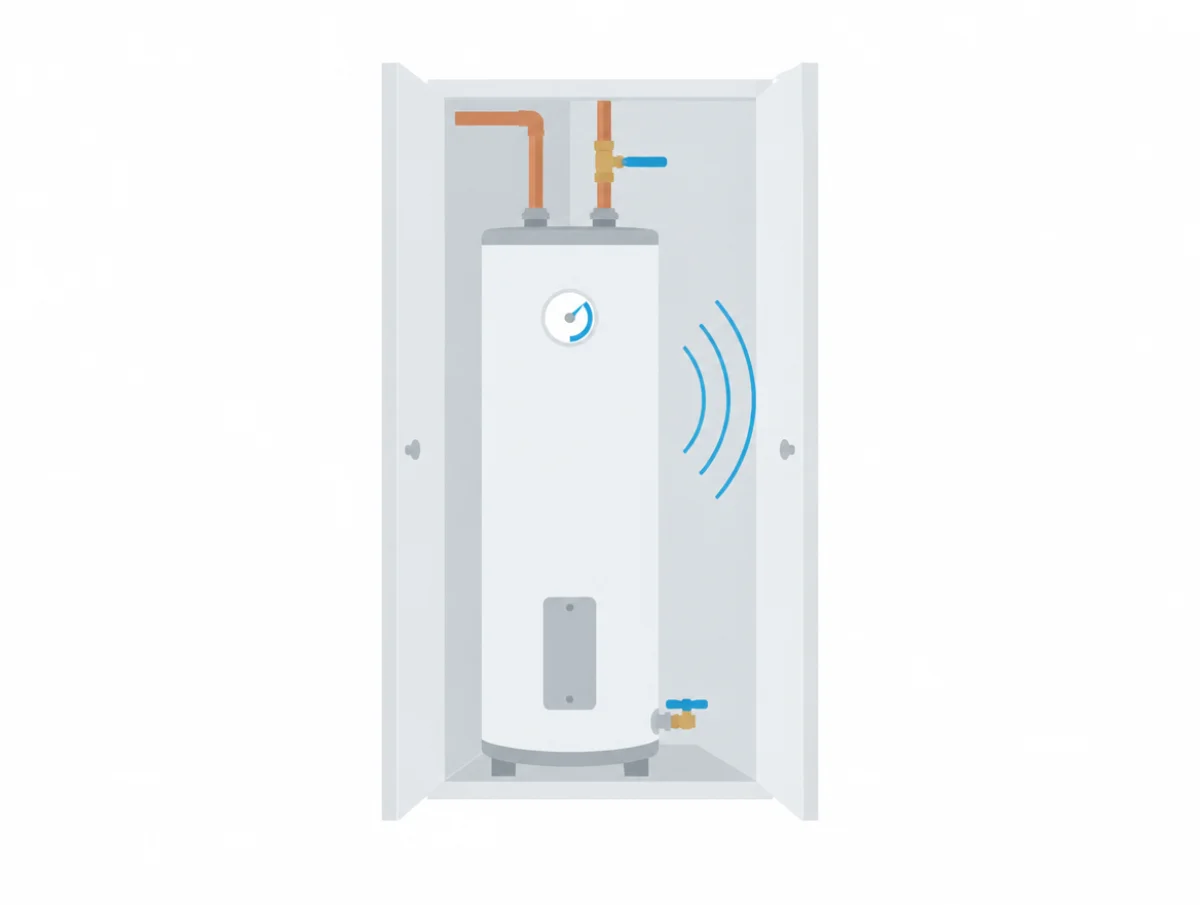
A water heater making noise is usually telling you something specific. Tank heaters tick as the metal warms and cools, sizzle as condensation drips onto a gas burner, and pop or rumble once sediment and lime gather at the bottom. Tankless units hum while they fire and keep the fan turning briefly afterward. Heat pump models whir like a vent fan.
A few sounds are warnings. Rheem treats hissing, sizzling and dripping as possibly dangerous and says to cut the power or gas and book an inspection. A relief valve that pops or drains points to pressure the makers say must be corrected, and banging pipes can strain the tank itself.
Each cause and remedy that follows is the maker's, taken from A. O. Smith, State, Rheem, Bradford White, Rinnai, Navien, Takagi and GE documents, and we add no repair steps of our own.
Is it normal for a water heater to make noise?
Yes. Rheem, A. O. Smith and State all say a water heater makes some noise in normal use, as long as the sounds are quiet, brief and tied to heating and cooling.
Rheem says "a water heater making noise is completely normal and expected", provided the sounds are "quiet, brief and at regular intervals". Its normal list is ticking or clicking, humming from electric elements, gurgling after heavy use and "Soft ignition sounds" on gas models.
A. O. Smith's power vent gas manual is more guarded: "Possible noises due to expansion and contraction of some metal parts during periods of heat-up and cool-down do not necessarily represent harmful or dangerous conditions." State carries that sentence in its manual too.
Which water heater sounds happen while it heats?
Ticking, humming, a burner sizzle and a soft gurgle are the heating sounds the makers describe, and each is on their normal list, with the limits set out below.
Ticking and clicking as the tank warms and cools
Rheem lists "Ticking or clicking" and says it is "Often caused by heat traps or pipe expansion as temperatures change." A. O. Smith says heat traps "are installed on some residential water heaters to comply with the many utility incentive programs".
Rheem's electric manual adds a rattle "during periods of water usage" from "Internal heat trap fittings in operation", and says "This is normal for heat trap fittings when in operation and does not indicate a need for service."
Humming, hissing or singing from electric elements
Rheem says humming is "Common in electric units when heating elements are active." Its electric manual adds: "Most electrical appliances, even when new, make some sound when in operation."
The limit follows in the next sentence: "If the hissing or singing sound level increases excessively, the electric heating element may require cleaning." Bradford White's hybrid manual prints the same line and ends it with "Contact a qualified installer or plumber for inspection." Rheem wants element checks made by "service personnel qualified in electric appliance repair."
Sizzling and popping under a gas burner
A sizzle from the burner of a gas tank is usually condensation, and the gas makers call it normal. A. O. Smith: "Condensation causes sizzling and popping within the burner area during heating and cooling periods and should be considered normal."
Bradford White explains the source. After a cold fill, "condensate will form on the cool tank surface and drops of water will fall on the hot burner and combustion chamber surfaces producing a 'sizzling' noise." It adds: "Condensation is normal and does not indicate a leak."
State says it is most likely after "Large amounts of hot water are used in a short time and the refill water in the tank is very cold", and that "After the water in the tank warms up (about 1-2 hours), the condition should disappear."
Gurgling
Rheem lists gurgling as "Normal water movement after periods of heavy use."
Power vent gas models with a condensate trap have one exception. A. O. Smith says that if "a sound of air bubbling through water (gurgling) is heard while the blower is operating after the first heat-up cycle, then turn the unit off and contact your plumber or service representative."
Why is my water heater popping, rumbling or crackling?
Popping, rumbling and crackling from a tank are, by the makers' accounts, mostly sediment and lime scale on the tank floor or on the elements, where trapped water boils into steam.
A. O. Smith's mineral build-up bulletin lists rumbling, crackling and popping as the symptoms, and describes "a popping of water trapped under lime deposits or the sizzling of water trapped next to elements, boiling it to steam."
The gas manual adds that lime scale "can also cause rumbling and pounding noises as air molecules trapped in the lime scale escape when heated." Rheem says settled minerals make the heater pop or rumble "as water heats beneath the debris."
On electric tanks the elements take the blame. Rheem's electric manual traces a rumbling noise to "a build up of scale or mineral deposits on the heating elements." GE's GEOSPRING sounds page says the same of its hybrid tank: "Contact a plumber for assistance."
Is a popping water heater dangerous?
No, not when sediment is the cause, says A. O. Smith, though a pop from the relief valve is a separate warning that Rheem and GE both say needs correcting.
A. O. Smith's maintenance checklist says of popping, rumbling or crackling while heating: "While not dangerous, sediment reduces efficiency and accelerates tank wear."
Rheem's electric manual lists a "Relief valve producing popping noise or draining" from "Pressure build up caused by thermal expansion in a closed system", and says: "This is an unacceptable condition and must be corrected. Contact the water supplier or plumbing contractor on how to correct this. DO NOT plug the relief valve outlet."
GE says a popping sound on the GEOSPRING "is coming from heat and pressure building up in the tank from the relief valve being closed or plugged", and to "Contact a plumber or the water utility company to correct."
Why is a new water heater crackling or popping?
A. O. Smith links crackling, gurgling or popping in a heater installed under six months to aluminum hydroxide, which forms where the water supply has "a relatively high pH (8+)".
The aluminum hydroxide bulletin says the substance "looks like 'jelly beads' or a green, blue or gray gel like substance in the heater drain or at faucet aerators."
The fix involves the anode rod, and A. O. Smith says it "should only be performed by someone with abilities equal to a licensed tradesman."
How often do the makers say to drain the tank?
Draining schedules differ by maker and model, from a few quarts each month in Rheem's hybrid manual to a full drain and flush every 6 months in A. O. Smith's power vent manual.
A. O. Smith: "It is recommended that the water heater storage tank be drained and flushed every 6 months to reduce sediment buildup." Rheem's hybrid manual suggests "a few quarts of water be drained from the water heater's tank every month to clean the tank of these deposits."
Bradford White's hybrid manual says to drain "at least once a year through the drain valve until the water runs clear", warning that skipping it "may result in noisy operation and lime and sediment buildup in the bottom of the tank."
The steps differ between gas, electric and hybrid tanks, so follow the draining section of the manual for your own heater; we do not reproduce any here. A. O. Smith's temperature page adds: "If you live in a hard water area, flush your water heater more often."
Why is my water heater making noise after flushing?
Water heater noise after a toilet flush is usually the heat traps, says A. O. Smith. Noise that carries on after the tank itself has been flushed is on Rheem's list of reasons to call a professional.
A. O. Smith's heat trap bulletin describes "Ticking", "clicking" or "tapping" caused by "fluctuations in pressure in the piping system (toilet flushing, use of faucet, etc.)." The sound "is sometimes conducted through piping and framing of the house".
The bulletin says heat traps "may be removed from the heater without affecting the safe operation of the heater", at a small cost in efficiency. That is a question for a plumber.
If a flushed tank still pops or rumbles, Rheem says "in cases of extreme buildup, a professional has the tools to perform a more thorough flush and cleaning."
A. O. Smith's repair or replace page warns that noise heard after a repair may mean "a failing heating element or a cracked tank."
Why is my water heater making noise when the water is off?
A tank keeps heating with every tap closed, so expansion ticks, element hum and burner sounds can come with no water running. Tankless and heat pump models also run a fan for a while after a draw.
A. O. Smith ties its expansion and contraction noises to "periods of heat-up and cool-down", not to a running tap. Its manual also explains a quieter effect: "As water is heated, it expands (thermal expansion)", and in a closed system that "can also cause intermittent Temperature-Pressure Relief Valve operation".
The remedy it names is plumbing, not the heater: "A properly sized thermal expansion tank must be installed on all closed systems", fitted by a local plumbing service agency.
A gas tankless unit's fan runs on after the tap shuts. Rinnai says "It will turn off on its own after a few moments."
A heat pump tank can run its fan long after the compressor stops. GE's start-up page for the GEOSPRING notes: "Fan will run for 30 minutes after any compressor operation".
Why is my water heater hissing or sizzling?
A hiss or sizzle can be harmless condensation on a gas burner, but Rheem says hissing, sizzling or dripping "can be dangerous" and tells owners to shut off the power or gas and get a professional inspection.
Rheem's causes are "Water dripping onto a hot burner (gas models)", "A leaking heating element gasket (electric models)" and "Internal condensation interacting with heated components". Its instructions: "Turn off power or gas to the unit", "Avoid using the system" and "Schedule a professional inspection immediately".
A. O. Smith's checklist says hissing or sizzling near a gas water heater "might indicate water dripping onto the burner", and that such sounds "warrant immediate professional inspection for safety."
Telling the two apart comes down to timing in State's manual. Condensation should clear once the tank warms, and State says "Do not assume the water heater is leaking until there has been enough time for the water in the tank to warm up." A. O. Smith's condensation bulletin is blunt about a real tank leak: "Leaking heaters cannot be 'repaired'."
A hiss at a hot tap, rather than at the heater, can be hydrogen. A. O. Smith says hydrogen can form in a system unused for "generally two weeks or more", that it "is extremely flammable and explosive", and that "there will probably be an unusual sound similar to air escaping through the pipe as the hot water faucet is opened."
Its warning: "There must be no smoking or open flame near the faucet at the time it is open." Rheem and Bradford White print the same caution in their manuals.
Why is my water heater whistling or screeching?
Whistling and screeching mean water forced through a narrow opening, according to Rheem, from a partly closed valve, a faulty relief valve, mineral build-up or high pressure inside the tank.
Rheem: "When water is pushed through a constricted opening, it creates a whistling or screeching sound." It says to "Make sure that all valves are fully open" and "Check pressure levels", and to have the unit inspected if the sound goes on, since "Persistent high-pitched sounds usually won't resolve on their own."
A. O. Smith's repair page agrees that "Whistling noises may indicate a blocked valve".
The temperature and pressure relief valve is a safety device, and A. O. Smith's manual says so in capitals: "DO NOT PLUG THE TEMPERATURE-PRESSURE RELIEF VALVE OPENING. THIS CAN CAUSE PROPERTY DAMAGE, SERIOUS INJURY OR DEATH." It says "Excessive water pressure is the most common cause of Temperature-Pressure Relief Valve leakage."
What causes banging or knocking in a water heater?
Banging and knocking are usually water hammer, a pressure surge when flowing water stops suddenly. Rheem says it mostly points to the plumbing, but A. O. Smith says it can deform the tank.
A. O. Smith's water hammer bulletin says "The common cause of water hammer is single lever faucets (sinks/lavatories) or automatic solenoid valves (dishwashers, washing machines, etc.)."
The bulletin says "The only effective means of control is to install water hammer arrestors", and that "failures caused by water hammer are not eligible for warranty consideration."
Rheem suggests an arrestor, lower household water pressure and secured pipes. On heat pump models, GE says that for "an abnormal noise, like a knocking, we recommend having an authorized servicer inspect the water heater."
What noises does a tankless water heater make?
A gas tankless water heater hums while it fires and keeps its fan going briefly when the tap closes. Navien likens the hum to a running refrigerator, and Rinnai says the fan stops by itself.
Navien says its heaters "are silent when not in use. When producing hot water, your tankless water heater will make a low, steady humming sound comparable to a refrigerator running."
Rinnai's Value Series manual gives a noise level of "49 dB (excluding start up or shutdown)", so the noisiest seconds sit outside that figure.
Takagi's owner's guide puts a time on the run-on. A fan still spinning after use is "normal", and it "keeps running from 15 to 70 seconds in order to re-ignite quickly, as well as purge all the exhaust gas out of the flue."
The clicks and clunks at the start of a draw are ignition. Takagi's troubleshooting table tells technicians to check for "a buzzing spark ignition sound coming from the burner" as the heater prepares to fire, and to listen for "the double 'clunk' sound coming from gas valve assembly" as it lights. For a unit that "sounds abnormal while in operation", Takagi says to contact the manufacturer.
Models with a built-in recirculation pump add a pump sound. Rinnai's RX manual says that "If the pump operation noise is not acceptable", changing the pump speed parameter to a lower setting "may reduce the noise level of the pump."
Where the heater hangs matters. Navien's NPE manual says "Avoid installation on common walls as the unit will make some operational noises while it is running." Our quietest tankless water heaters guide ranks the gas models whose makers print a sound level.
What noises does a heat pump water heater make?
A heat pump water heater adds a compressor and fan to the tank, so it whirs while heating. GE says the fan sounds like "the hum of a microwave vent fan" and runs only while the tank recovers.
GE's fan page says fan speed, and so the sound, rises and falls: "The colder the ambient temperature, the faster the fan speed", and "The lower the average tank temperature, the faster the fan will run."
GE says "A clicking noise may be heard during startup", that "Some amount of fan noise is normal, similar to the blower on a central heating and cooling system", and that a "Sound Level Increasing Over Weeks or Months" may mean the filter is dirty. "Standard Electric Mode" uses only the elements, so "there will be no sound associated with this setting."
Rheem's hybrid manual says a "Floor isolation kit is recommended to minimize vibrations (where applicable)", and lists a vibration isolation kit for "Installation on Non-Concrete floors".
The quietest heat pump water heaters guide compares the makers' figures, and a quieter basement covers where to put one.
How loud is a normal water heater?
Heat pump and tankless makers print sound figures and tank makers do not: GE gives 41 dBA for the GEOSPRING with the compressor and fan running, and Rinnai lists 47 to 55 dB across its tankless range.
GE says the GEOSPRING's "standard operating sound when the compressor and fan are running is 41 dBA." Rheem states its ProTerra condition: "Operation at 45 dBA measured at 6.28 feet using third-party certified testing procedures."
Stiebel Eltron gives "Sound pressure level* @ 3.3 feet (1 m) 52 dB(a)" for its Accelera E, and Bradford White promises "less than 50 dBA" for the AeroTherm G2. Readings at different distances cannot be ranked against one another.
Rinnai's spec sheet lists 47 dB for the RU180i with no distance or firing rate. None of the A. O. Smith, State, Bradford White or Rheem tank manuals we read gives a sound level for a gas or electric tank.
A. O. Smith's power vent manual does offer an optional "Vent Sound Silencer", which "is useful to reduce the sound level outside, near the vent terminal." To read any of these numbers, start with our dBA explainer and decibel chart.
When should you turn off a water heater and call a professional?
Rheem says to turn the unit off and contact a professional for hissing, sizzling or persistent screeching, and also names noise after flushing, repeated loud banging or rumbling, and visible leaks as warning signs.
Rheem's full list is "Noise continues after you flush the water heater", "Loud, repeated banging or rumbling", "Persistent screeching", "Hissing or sizzling sounds", "Visible leaks or moisture" and a unit roughly 8 to 12 years old or more.
If you smell gas, A. O. Smith's manual opens with the steps: "Do not try to light any appliance." "Do not touch any electrical switch; do not use any phone in your building." "Immediately call your gas supplier from a neighbor's phone. Follow the gas supplier's instructions." "If you cannot reach your gas supplier, call the fire department."
Bradford White's gas manual covers overheating: "Should overheating occur or the gas supply fails to shut off, turn off the manual gas control valve to the appliance and call a qualified service technician."
How did we put this page together?
We read A. O. Smith's noisy water heater bulletins and power vent gas manual, State's power vent manual, Rheem's noise guide and its electric and hybrid manuals, Bradford White's gas and hybrid manuals, Rinnai's and Navien's FAQs and manuals, Takagi's owner's guide and GE's GEOSPRING support pages.
We did not listen to, drain, flush, open or repair any water heater, tank, tankless or heat pump, for this page. What a sound means and what to do about it come from the maker, quoted with its conditions, and where a maker gave no figure or fix we left the gap open.