How loud are tankless water heaters?
Tankless water heaters are listed at 47 to 55 dB on Rinnai's residential sheets and 50.3 to 62.8 dB on AO Smith's, with no distance stated, so the figures rank heaters better than they predict a room.
For a sense of scale, see our decibel chart, as a rough guide only. A water heater rating printed without a distance can only be placed on it roughly, and comparing decibel ratings from two brands needs matching conditions that these sheets do not supply.
Much of what owners hear happens at the edges of a hot water draw. Rinnai's Value Series figure is printed "excluding start up or shutdown", so it leaves out the moments when the burner lights and the fan winds down. Takagi's troubleshooting steps tell owners to listen for a buzzing spark as the heater prepares to fire, then a double "clunk" from the gas valve assembly as it goes into combustion.
How loud is a Rinnai tankless water heater?
A Rinnai tankless water heater is listed at 47 to 55 dB on Rinnai's spec sheets, depending on the series, from 47 dB for the SENSEI RU180i, RU160i and RU130i to 55 dB for the REP199i with a pump.
| Rinnai series | Type | Sound Level on Rinnai's sheet |
|---|
| SENSEI RU | Condensing | RU180i, RU160i, RU130i 47 dB; RU199i 48 dB |
| SENSEI RX | Condensing | RX160i, RX130i 48 dB; RX199i, RX180i 49 dB |
| SENSEI RXP | Condensing, pump | RXP160i 48 dB; RXP199i 49 dB |
| SENSEI RUR | Condensing, pump | RUR160i 48 dB; RUR199i 49 dB |
| SENSEI RSC | Condensing, pump | RSC160i 52 dB; RSC199i 53 dB |
| Value Series | Non-condensing | V65i, V75i, V94Xi, V94i 49 dB, excluding start up or shutdown |
| RE | Non-condensing | RE199i to RE140i, indoor and outdoor, 54 dB |
| V53De | Non-condensing | 54 dB |
| REP | Non-condensing, pump | REP199i, REP160i 55 dB |
Every figure in that table is printed as a Sound Level in plain dB, with no weighting, distance or firing rate, on the same kind of Rinnai spec sheet or manual. We rank them against each other on that basis, and Rinnai does not tell us how any of them was taken.
Within a series, the smaller burner is listed level with the larger one or 1 dB below it. Across series the spread is wider: 8 dB separates the RU180i from the REP199i.
Rinnai and AO Smith figures are kept apart because the makers describe them differently: Rinnai states no condition, while AO Smith marks one figure as based on factory settings and another as measured in an anechoic chamber.
An anechoic chamber has walls that absorb sound, and a utility room has hard walls that reflect it, so a chamber reading and a room reading of the same heater need not match. AO Smith's Adapt SC figure of 51 dB carries that chamber note. Its Adapt+ figure of 50.3 dB does not.
The Adapt+ footnote, "Current numbers based on factory settings", is the same one AO Smith attaches to maximum flow, so it reads as a note about the heater's settings rather than about the test. None of the sheets says whether its figure is sound pressure or sound power; see sound power vs sound pressure for why that matters.
Is a condensing tankless water heater quieter than a non-condensing one?
No, not as a rule on Rinnai's figures: the non-condensing Value Series is listed at 49 dB, level with the condensing RX199i, while Rinnai's condensing RSC series is listed at 52 and 53 dB.
Rinnai's lowest figures do belong to condensing units, the SENSEI RU at 47 and 48 dB. Its non-condensing RE and V53De sit at 54 dB. The series matters more than the heat exchanger, and the Value Series shows a non-condensing unit can be listed low.
AO Smith's sheets point the other way within its own range. Its condensing Adapt+ and its non-condensing Adapt NC carry the same "factory settings" footnote, and the Adapt+ figure of 50.3 dB sits below every Adapt NC figure, which run from 54.4 dB outdoors to 62.8 dB indoors.
The efficiency gap is plainer than the noise gap. The condensing picks here carry a UEF of 0.95 to 0.97, and Rinnai's V75i carries 0.81.
Does a recirculation pump make a tankless water heater louder?
No, not by much on Rinnai's printed figures: a recirculation pump leaves the RXP160i at the same 48 dB as the pumpless RX160i, and puts the RUR199i 1 dB above the RU199i.
The pattern holds in the non-condensing range, where the REP199i with a pump is listed at 55 dB and the RE199i without one at 54. Rinnai never states whether the recirculation pump was switched on for any of these readings.
Rinnai's RX manual does address the pump itself. Its pump speed setting runs from 16A, the fastest, down through 16b, 16C and 16d, and the manual says that if "the pump operation noise is not acceptable", a lower setting "may reduce the noise level of the pump". A slower pump takes longer to bring hot water round the loop.
AO Smith's Adapt+ Premium has a built-in pump too, and its 50.3 dB figure at factory settings is the lowest AO Smith prints.
How quiet is an electric tankless water heater?
An electric tankless water heater has no burner, combustion fan or flue, but none of the five electric makers we checked prints a sound level, so none can be ranked, or set against a gas heater's figure.
Stiebel Eltron comes closest to a claim. Its Tempra Plus page says a Tempra "does not have any mechanical switches. It is completely silent while operating." It gives no decibel figure for that, in the brochure or in the installation manual.
EcoSmart's ECO 27 page and manual, Rheem's RTEX-24 page and documents, Bosch's Tronic 4000 C and 6100 C submittal sheets and manuals, and AO Smith's electric tankless sheets print no figure either. A gas heater's dB and an electric heater's marketing word cannot be compared, so this guide ranks gas units only.
How loud is a Navien tankless water heater?
Navien prints no sound level on the NPE-2 specification sheet we read, so a Navien heater's loudness cannot be stated from its maker's documents.
Navien's older NPE installation manual, for the NPE-180A to NPE-240S rather than the current A2 models, does mention noise. It says to "Avoid installation on common walls as the unit will make some operational noises while it is running", and to avoid 1/2 in corrugated gas connectors "as noise may occur".
The same silence on figures holds for Noritz's EZ Series spec sheet and product guide, Takagi's T-H3 spec sheets, Rheem's gas tankless pages and manuals, and Bradford White's Infiniti manuals. AO Smith's ProLine XE spec sheets print none, unlike its Adapt sheets.
Where should a tankless water heater go to keep it quiet?
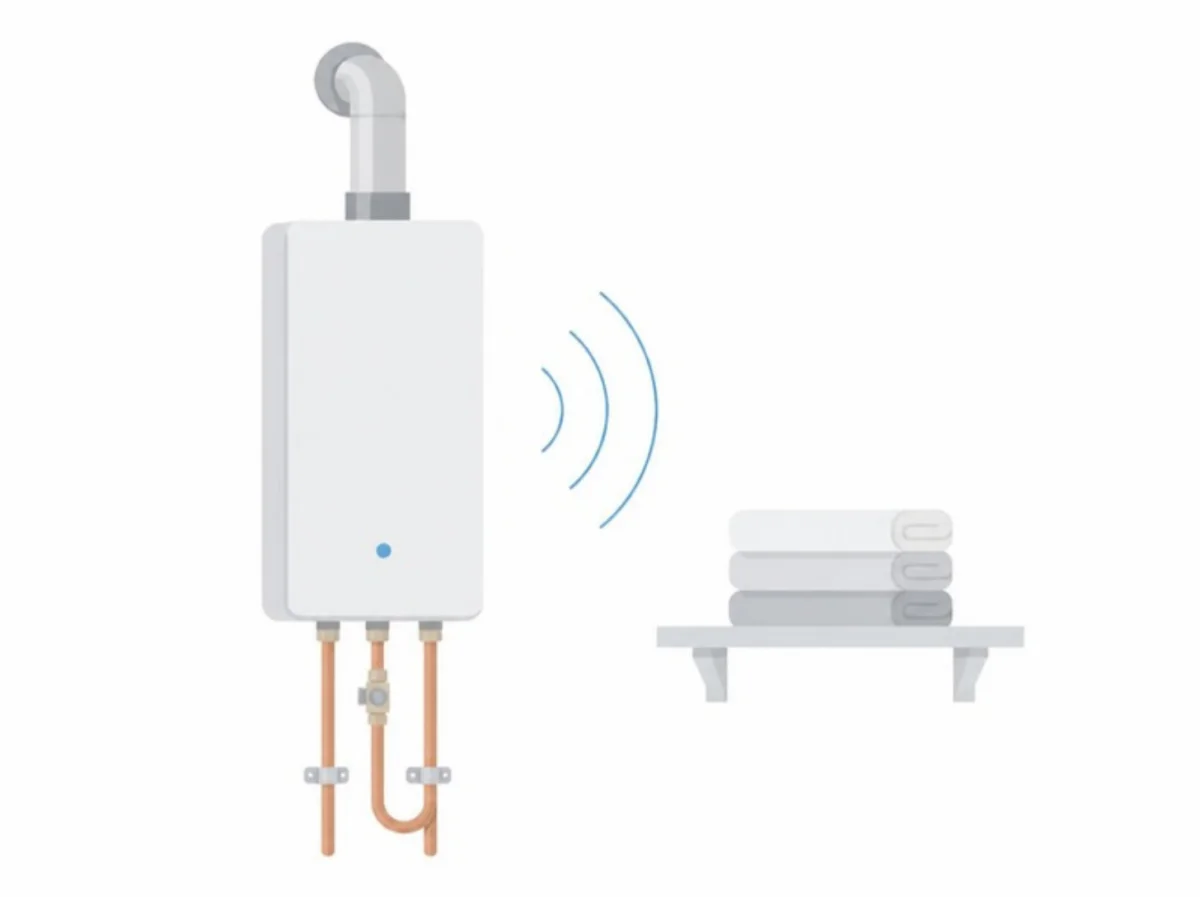
A tankless water heater is best kept off any wall shared with a bedroom, and its vent away from windows and neighbors, as Takagi's and AO Smith's manuals advise.
Takagi's manual says the maker "does not recommend installing the unit on a wall adjacent to a bedroom, or a room that is intended for quiet study or meditation". Navien's older NPE manual gives the same advice for common walls.
The vent matters as much as the heater. Takagi's manual and AO Smith's Adapt SC guide both say not to install the unit where the exhaust vent points into an opening in a building "or where the noise may disturb your neighbors", which rules out a termination beside a window or a neighbor's patio.
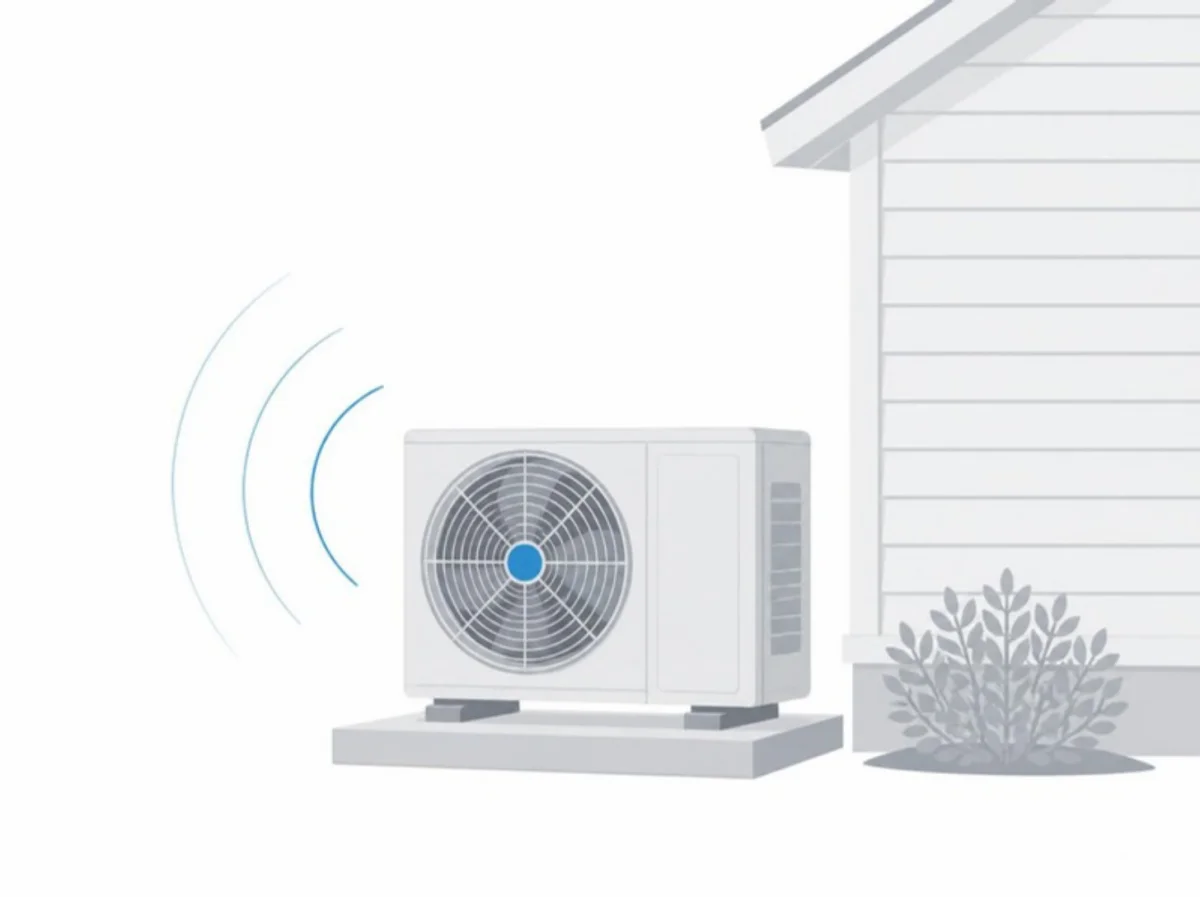
An outdoor unit keeps the fan outside. Rinnai's RX takes the RXOVC vent cap for outdoor mounting, AO Smith's Adapt+ and Adapt SC take an outdoor vent cap kit, and AO Smith's Adapt NC sheet prints lower figures for its outdoor models than for its indoor ones.
For a heater in a basement under bedrooms, see keeping a quiet basement and our quiet bedroom page.