Attic fans are bought for heat, not for silence, and the spec sheets show it. Most makers publish airflow, watts, coverage and warranty, and nothing about sound. We checked the US pages and documents of thirteen brands and found ten fans with a maker noise figure. They come in three units that cannot be ranked against each other.
The dedicated attic fans run from Attic Breeze's "< 30 dB" solar fans to iLIVING's "<63 (dB)" electric gable fans, with SolarRoyal alone in sones. AC Infinity's shutter exhaust fans, which the maker lists for attics among other rooms, add three A-weighted figures from 62 to 68 dBA.
An attic fan is not a whole house fan
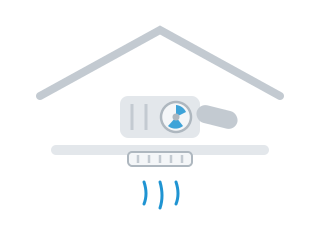
The names get swapped constantly, so first the difference. An attic fan, also called a powered attic ventilator, moves attic air only. It sits in a gable wall or on the roof and pushes superheated attic air outdoors. Replacement air comes in through soffit and gable vents, never from the rooms below. The house stays closed, and the goal is a cooler attic that radiates less heat through the ceiling.
A whole house fan does the opposite job. It sits in the ceiling between the living space and the attic, and it pulls air from the rooms, through open windows, up into the attic and out its vents. It cools the house itself, usually on summer evenings, and it runs while people sleep. That makes noise its central spec, and that category publishes far more of it. Our whole house fans guide covers those fans, from QuietCool's 33.0 dBA on low upward.
The practical difference for noise: a whole house fan has a grille in your hallway ceiling, while an attic fan is on the far side of insulation and drywall, or on an outside wall, and mostly runs in the afternoon. That is part of why attic fan makers get away with printing nothing.
Three units that do not mix
The figures we found fall into three groups, and we keep them apart.
Sones: SolarRoyal's SR1800 fans, the only attic fans we found rated this way. Sones are a loudness scale where doubling the number means twice as loud, and they cannot be turned into decibels without the test data. Our sones vs decibels explainer covers why.
Plain dB: Attic Breeze and iLIVING print "dB" with no A-weighting, no distance and no test standard, and every one of these figures is a ceiling, "<" something, rather than a measured value. We rank them against each other only because they share that form.
dBA: AC Infinity prints A-weighted figures for its AIRLIFT fans, again with no distance. Because A-weighted and unlabelled decibels are different claims, the AIRLIFT fans form their own group.
None of the ten figures names a test standard, and only SolarRoyal's hints at conditions, through a range. The comparing decibel ratings explainer says what that leaves a buyer able to conclude, which is not much across brands.
The sone group: SolarRoyal alone
SolarRoyal, a Texas maker of roof-mounted solar fans, prints "sones ≈ .5 - 2.8" for the 35 watt SR1810 and "sones ≈ .5 - 3.5" for the SR1870, which is the same fan with a second 35 watt panel. A range makes sense for a solar fan: the brushless motor speeds up as the panel sees more sun, and the top figure is the fan at full tilt. Its own store page prints "Sones ≈ .5 - 3.0" for the 35 watt fan, so the top of that range depends on which SolarRoyal document you read.
The low end, half a sone, is bathroom fan territory. The top end, near three sones, is roughly where a builder grade bath fan sits. On a roof, above an insulated ceiling, either is modest. The SR1810 leads the sone group only in the sense that its top figure is lower than the 70 watt version's; the two share the same half sone floor.
The decibel ceilings: Attic Breeze and iLIVING
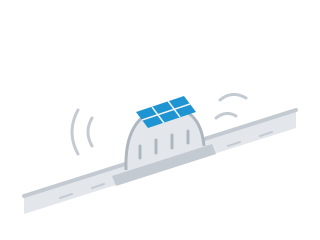
Attic Breeze publishes technical data sheets for its three solar series, and each gives one line for noise: "Noise Level" "< 30 dB". It covers every wattage in the series, from the 25 watt PRO to the 65 watt ELITE, so it is a statement about the design rather than a measurement of any one fan. The GableBreeze mounts behind an existing gable vent, the UltraBreeze and AeroBreeze go through the roof, and all three use a variable speed DC motor. On paper they share the lowest ceiling in this group.
iLIVING's electric gable fans are the other end of it. The single speed ILG8G14-12T manual says "<63 (dB)". The variable speed ILG8G14-22ST product page says "< 63 dB Noise", while the older manual linked from that page says "<60 (dB)". Both fans list 2339 CFM, 230 watts and 1010 rpm, so the two different figures describe the same motor and blade. We rank the 22ST on its page figure and print the manual figure beside it.
A 33 decibel gap between two fans of similar airflow is enormous, and neither maker says how or where they measured. What the gap suggests, at least, is the difference between a solar DC motor that slows down in weak sun and a mains motor that runs flat out. What it cannot tell you is how either sounds from your bedroom.
AC Infinity's shutter fans, in dBA
AC Infinity's AIRLIFT fans are general purpose shutter exhaust fans, not dedicated attic ventilators, but AC Infinity describes them as "designed to cool and ventilate greenhouses, garages, attics, workshops, and sheds", and in a gable wall they do the same job as the iLIVING fans. Each page prints a "Noise" figure in dBA. The 12 inch T12 lists 62 dBA at 830 CFM, the 20 inch T20 lists 65 dBA at 3425 CFM, and the 14 inch T14 lists 68 dBA at 1513 CFM. Size does not predict the order.
We left out the 16 inch T16, whose page lists "Noise: 70 dBA" in its summary and "Total Noise" "67 dBA" in its technical table, and the 10 inch T10, which lists 67 dBA for less airflow than the T12.
Where the noise actually reaches you
An attic fan's noise travels two ways. Airborne sound from the blade and motor reaches the rooms through the ceiling, which in a typical house means drywall under a thick blanket of insulation. Structure-borne vibration travels through whatever the fan is fastened to, the gable studs or the roof deck and rafters. That second path is why QuietCool fits anti-vibration pads to its gable fans and why SolarRoyal advertises a multi-layer noise dampening design, even though neither publishes a figure for the result.
A gable fan hangs on a wall that may back onto a bedroom closet or a stairwell. A roof fan spreads its vibration into the rafters but sits farther from any wall. If a room sits right under or beside the planned location, that matters more than a few decibels on a spec sheet. And a solar fan answers the most common complaint by default: it stops when the sun goes down.
The silent aisle
QuietCool, the biggest name in the whole house fan guide, publishes no noise figure for its attic fans. Its AFG SMT PRO-2.0 and AFG SMT ES-3.0 spec sheets list airflow, watts, CFM per watt and amps, and its store pages list the same. Several web summaries quote the PRO-2.0 row "Hi: 1.1 / Low: 0.65" as sones. On QuietCool's sheet that row is labelled Amps. QuietCool's main website blocked us with a captcha, so we read its spec sheets from copies hosted by The Home Depot, and its own store pages directly.
Broan-NuTone's attic ventilator pages for the 353 gable fan and the 350, 355, 356 and 358 roof fans include a "Sound Level (Sones)" field, and it reads 0 on every one. Broan's roof ventilator spec sheet mentions sones in its HVI footnote but prints no sone column. We treat the zero as a blank, not a rating. Maxx Air, Lomanco, Remington Solar and Solatube's Solar Star line describe their fans as quiet in words, "ultra-quiet" in Maxx Air's case, and publish no number. Master Flow's site and Natural Light's site would not load from our connection, and Air Vent's product pages now redirect to a Gibraltar Building Products category page with no noise figures. These fans may be quiet or loud. Their makers do not say.
We did not measure any of these attic fans. Every figure is the maker's own, quoted as published, with the unit and any condition the maker attached, and sones, plain dB and dBA are kept in separate groups throughout.