Drywall spray and building dust are the one noise cause that two attic fan makers put in writing word for word. Broan-NuTone and iLIVING both ask owners to keep it off the power unit "To avoid motor bearing damage and noisy and/or unbalanced impellers," which covers the grinding, the squeal and the wobble in a single line.
The rest of the list is short. A blade out of balance, loose mounting, an attic short of vent area, and controls that start the fan when nobody touched a switch account for nearly everything the manuals describe.
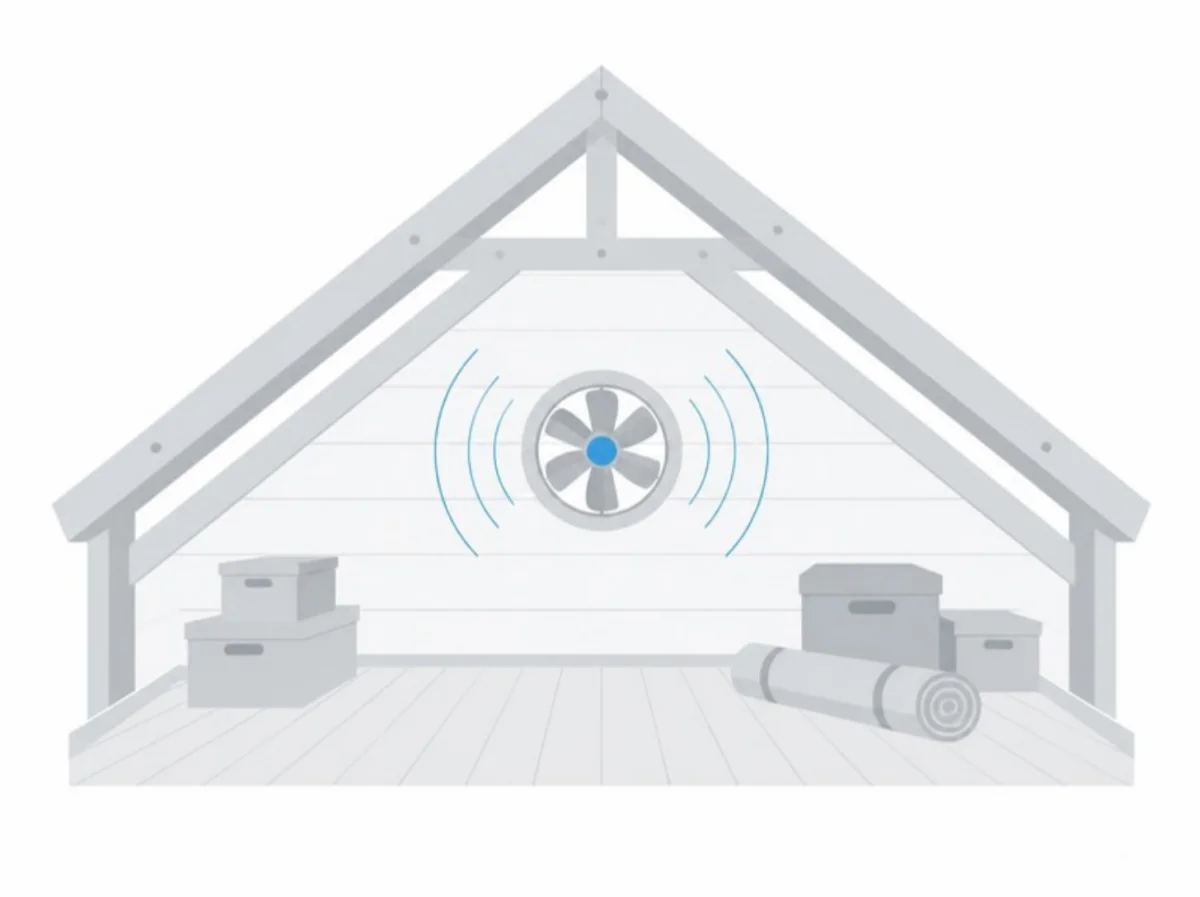
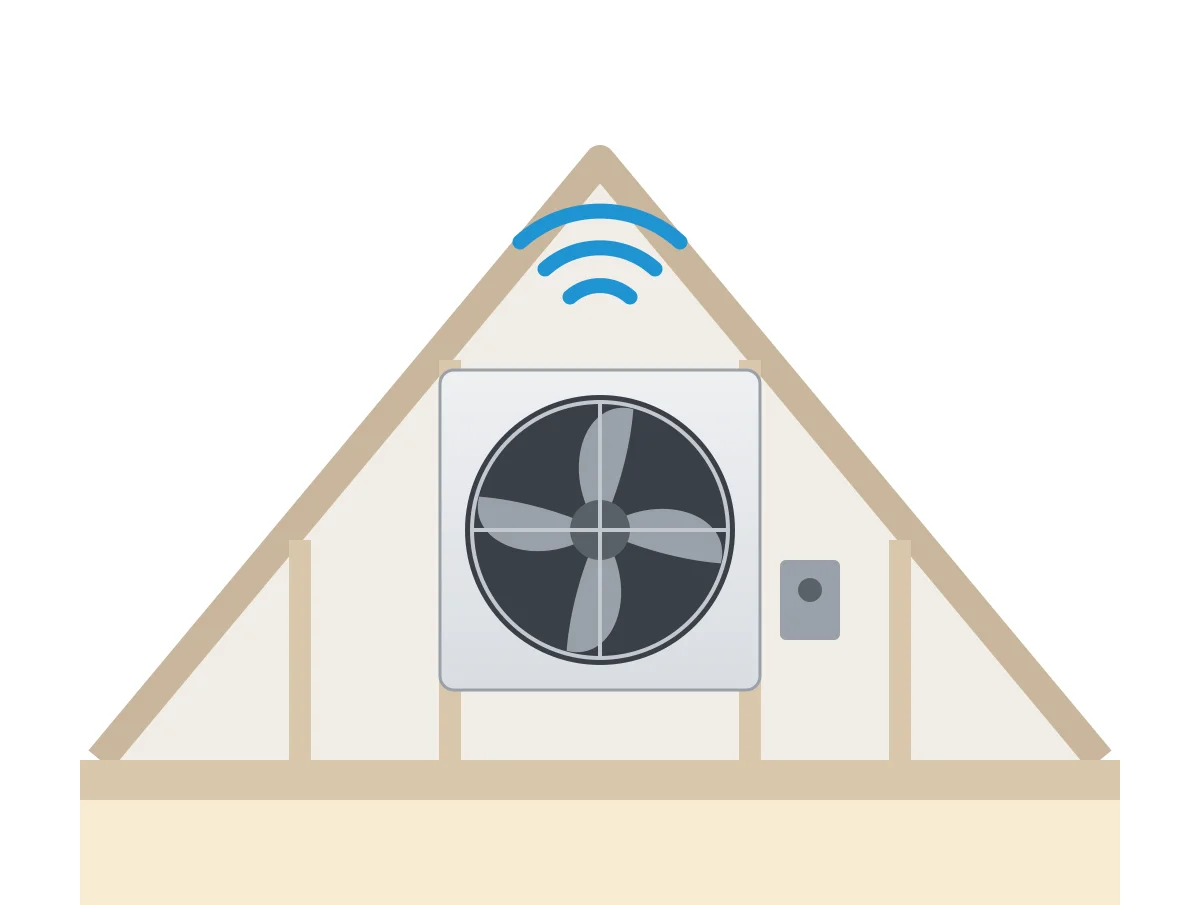
Two different machines go by the name. A powered attic ventilator sits on the roof or behind a gable louver and runs on a thermostat. A whole house fan sits in a ceiling, pulls outdoor air through open windows and pushes it out through the attic vents. The sources here are installation instructions, owner's guides and spec sheets from Broan-NuTone, Master Flow (GAF), iLIVING, Air Vent, Lomanco, QuietCool, AirScape, Cool Attic and SolarRoyal, and several of them are copies kept online by retailers and distributors because the makers' own sites refused scripted requests. Where none of these documents covers a sound, the section says so.
Every one of these fans runs on mains power or a solar panel. Start with the safety rules.
Power off and locked before you look
The makers who write about servicing agree on three things: switch the power off and lock the panel, leave wiring to a qualified person, and stay clear of a blade that can start by itself.
Air Vent's HE15 sheet spells out the first: "Before servicing or cleaning the unit, switch the power off at the service panel and lock the service panel to prevent the power from being switched on accidentally. When the service disconnecting means cannot be locked, securely fasten a prominent warning device, such as a tag, to the service panel." Broan-NuTone, iLIVING and Lomanco print nearly the same sentence.
The reason is the thermostat. "This fan is thermostatically controlled - it may start at any time if the power is not switched off at the service panel." iLIVING adds a second way a fan can surprise you, since its motor's thermal protector cuts out on overheating and comes back: "Always disconnect power before inspection or cleaning, as motor may restart unexpectedly."
Wiring is not an owner's job in any of these documents. For Air Vent it "must be done by a qualified electrician in accordance with all local codes and standards, including fire-rated construction. Failure to do the installation properly can result in fire or even death." Broan-NuTone's version is shorter, "must be done by a qualified person(s)", and Master Flow's softer: "Contact a qualified electrician if you are not comfortable or familiar with electrical codes and/or installations."
Then the blade itself. "This fan has an unguarded impeller. Do not use in locations which are readily accessible to people or animals. Do not let children play in an attic where this fan has been installed. Contact with this fan while in operation can result in injury or even death." That is iLIVING, and it is the bluntest warning in the set.
Why is my attic fan humming, squealing or grinding?
A steady hum is just the motor running.
Squealing or grinding points to the bearings, and the dust caution above is the cause both Broan-NuTone and iLIVING name: "To avoid motor bearing damage and noisy and/or unbalanced impellers, keep drywall spray, construction dust, etc. off power unit." A new house or a remodel is the risky time, because an attic fan can run for weeks in dusty air while the work goes on below it.
Oil will not help. "The motor has been permanently lubricated and does not require additional lubrication," reads Lomanco's manual, and iLIVING's line is simply "Motor is permanently lubricated." Neither manual gives owners a way to replace a bearing.
Once a fan has turned loud, Broan-NuTone's instruction is the clearest one here: "If the fan makes excessive noise or if there is unusual noise or smells of smoke, disconnect power supply and contact customer service."
Speed controls are off the table
A dimmer style control will not quiet a loud motor, and three makers forbid it on fire grounds. "Use of a solid state speed control can result in a fire causing injury or death," reads the Air Vent sheet. iLIVING's wording is "To reduce the risk of fire or electric shock, do not use this fan with any solid state speed control device", and Lomanco prints the same ban for its Lomancool 2000.
A fan that hums, stops, then restarts
iLIVING's motor "is equipped with an automatically thermal protector that will disconnect power if the motor overheats." A fan that cuts out and comes back is often doing exactly that. Starved airflow is one road to an overheated motor: Cool Attic warns that "Inadequate intake ventilation will lead to motor failure," and Master Flow wants soffit intake partly to "avoid premature ventilator motor failure."
Why does my attic fan wobble or rattle?
Wobble starts at the blade, when it is dirty, bent or loose on the shaft. Rattle usually comes from the motor, housing or wiring knocking against the framing. Blades are balanced at the factory, and a damaged one is replaced rather than repaired.
iLIVING covers all three blade problems. "The propeller is accurately balanced at the factory and should be replaced if damaged," it says, followed by "Do not bend the blades." The propeller, guard and motor "should be cleaned periodically to prevent overheating, and/or operating in an imbalanced condition." Do that cleaning only with the power off and locked.
One check needs nothing but a flashlight. Master Flow's first safety list asks owners to "Make sure the fan blade is on tight and ensure the set screw is securely tightened."
Cool Attic sells balance as a feature, with "Precision-balanced 14” fan blades for minimum vibration" and motor mounts "engineered for stability and minimum vibration." Ceiling fan makers publish balancing kits and procedures. For attic fan blades, none of these documents offers either.
Rattles from the mounting and the wiring
If the rattle comes from beside the fan rather than inside it, look at the cable. Lomanco wants the thermostat placed high and the "flexible cable does not touch the roof or rafters. (This will eliminate vibration noise.)" Master Flow leaves its flexible conduit "with some slack".
Gable fans have a fit to get right as well. "A close fit between ventilator and louver will minimize air recirculation," according to Broan-NuTone, which suggests mounting the fan on plywood "for best sealing". On Lomanco's roof vent the risk runs the other way, and the dome screw comes with a limit: "torque the mounting screw to a maximum of 100 inch pounds when reinstalled. CAUTION - DO NOT OVERTIGHTEN".
Why does my attic fan click or switch on by itself?
Usually because its thermostat or humidistat told it to. The manuals describe automatic starts in detail, though not one of them mentions the click a thermostat makes as it switches.
| Fan | Thermostat or humidity setting |
|---|---|
| Broan-NuTone 353 | Turns off "when the attic temperature is 10°F lower than the thermostat" |
| Lomanco 2000 | Factory set "to come on at 100°F., off at 85°F." |
| Master Flow ERV | Adjustable from 60°F to 120°F, 105°F from the factory and recommended |
| Air Vent HE15 | Starts "when the attic condition rises above 90°F or 65% relative humidity" |
| iLIVING ILG8G14-12T | Control range of 60ºF to 120ºF |
Humidity can run it on a cool day
A fan running when the attic is not hot is probably on its humidistat. The HE15 starts on humidity alone. Master Flow's humidistat models "should be set at 70%", Lomanco sells a humidistat "To control humidity in your attic", and SolarRoyal offers a "SolaSensor PRO (Full Range Temp/Humidistat Available)" for its solar fans.
Two wiring details can also keep a fan going. Air Vent's controls are built in, with the instruction "Do not connect this product to an existing thermostat." Broan-NuTone's 353 carries a thermostat by-pass switch that its wiring diagram says "SHOULD NORMALLY BE IN “OFF” POSITION", and a fan that never stops may simply have that switch left on.
A blade that turns with the power off
None of these documents explains an unpowered attic fan turning, so what follows is our reading rather than a maker's. The blade sits in an open vent, and air moving through that vent, from wind or from other fans, can push it round.
Lomanco does describe air taking the wrong path through an attic. "Exhaust Vents pull air from the easiest Intake source," its instructions say, and mixing power vents with roof, gable or ridge vents "could make one of these vents act as intake instead of pulling air from the soffit vents." Its rule is to install "ONLY ONE TYPE of Exhaust Ventilation within a common attic area."
Keep your hands clear of a freely spinning blade all the same. Air Vent's warning that the fan "may start at any time" holds until the breaker is off and locked.
Banging shutters and the louver
A gable fan blows through a louver or an automatic shutter whose flaps open while it runs and drop shut when it stops. Banging shutters get no direct mention, but Cool Attic's quiet shutter design hints at the cause: its CX2121AM automatic gable shutter has "Felt-padded .020 gauge aluminum louvers for ultra-quiet operation." Broan-NuTone sells an automatic shutter, Model 433, for gables with no louver, and iLIVING says the gable opening may need enlarging "to accommodate a slightly larger louver or automatic shutter".
Louver size changes how hard the fan works. "For maximum efficiency, the area of the louver should be greater than the outlet area of the ventilator," Broan-NuTone writes, and a smaller one will "restrict" airflow.
Rain noise at the louver can be normal. In a heavy rainstorm "there could be a light spray of rain into this attic space", which the 353 instructions call "a normal condition with all attic ventilators". iLIVING still wants the fan kept "a suitable distance from the louver when installed, since rain may create an electrical hazard."
Intake vents decide how hard the fan pulls
A powered attic fan can only push out the air it can pull in, and every maker here sets a minimum for intake. Missing intakes are more than a noise problem. Broan-NuTone warns they "could cause natural-draft gas appliances to backdraft."
The minimums come in different units, which makes them hard to set side by side:
| Maker | Intake rule |
|---|---|
| Broan-NuTone | "one square foot of open air inlet per 300 cfm of fan capacity", citing the Home Ventilating Institute |
| Lomanco 2000 | "at least 780 square inches of inlet area" |
| Air Vent HE15 | 4.4 square feet of air intake opening |
| Cool Attic | "a MINIMUM 600 sq inches NFA of intake ventilation" |
| Master Flow | Intake "at or near the soffit", sized with its package chart or online calculator |
Homes with a gas or oil furnace in the same space get one more rule from Master Flow. There the fan "MUST be wired with a switch or other interlocking device to prevent the furnace and ventilator from operating at the same time during the heating cycle."
Why is my whole house fan so loud?
It moves a large volume of air through a single ceiling opening. QuietCool puts a standard whole house fan at a level that "operates around 75dB; that’s equivalent to a loud vacuum cleaner running!" Its own ducted fans "average at just around 45 dB", and the difference is where the motor lives: "Our fans suspend in the attic and use an acoustical duct that connects to a ceiling box and grille."
The published figures are collected in our quietest whole house fans guide. QuietCool's ES-3100 is rated "dBA Hi: 47.4 / Low: 33.0", the Classic CL-2250 "Hi: 43.2 / Low: 37.4", and AirScape's Sierra 3400 "36 - 52 dBA (min - max)". Only AirScape's Ventura 1700 states a distance, "44 to 55 dBA @ 1m".
Speed makes the biggest difference on those sheets, and AirScape's advice follows from it: "Use high speed to 'kick-start' the cooling, and use low to run quietly through the night."
Too few windows open
With too few windows open, a whole house fan pulls against the house itself. QuietCool's fans "are capable of pulling large quantities of air, from the home and particularly if not enough windows are open. This could easily back draft gas appliances located inside your home."
How many is enough? AirScape: "Make sure at least one window is open. Opening two or more windows halfway or wider is recommended". Its FAQ goes further, "three to four windows partially open is good on medium to high speed; you can do less on low." The same need explains why its fans cannot run automatically, since "they require an inlet be open to allow airflow and keep air from being drawn through your chimney, gas lines, etc that could be dangerous."
There is a limit the other way too. "Opening windows too wide or opening too many windows will lessen the cooling breeze you feel."
Too little attic vent area
Air that comes in through the windows has to leave through the attic. QuietCool's guide shouts the requirement, "VERY IMPORTANT! - 1 SQUARE FOOT OF NET FREE VENTING PER 750 CFM", while AirScape's rule of thumb is stricter at one square foot of net free venting area "for every 500 CFM of airflow. So at 3000 CFM, you'll want six square feet of venting."
Without that area, by AirScape's account, "pressure can build up, slowing down airflow and reducing efficiency, potentially pushing hot attic air back into your living space." Net free area is a vent's opening "minus the surface area of any grilles, louvers, or screening covering it", so the size printed on a vent overstates what it lets through.
Keeping whole house fan vibration off the ceiling
The two makers who address vibration both keep the motor off the ceiling joists. QuietCool hangs the motor head "from the rafters by fastening the metal strapping that is attached to the motor head to the rafters" and tells installers to "Make sure the duct has a gentle 90 degree bend to help reduce noise level." The damper box at the ceiling is fastened to a joist and the duct strapped to the framing, which "will stabilize the entire assembly." A last line in the same guide: "Make sure the fan blade spins freely."
AirScape's FAQ agrees on the bend, "it is important for noise control to have the duct work bend 90 degrees, the orientation doesn't matter."
We could not read Tamarack's documents for this page: its support pages returned errors and its spec sheet has no readable text. Nothing in the rest of the set describes isolation pads for a fan mounted directly in the ceiling. If a direct mount fan shakes the ceiling, the general advice holds: power off, then call the installer or a qualified technician.
Sounds that mean switch it off
Excessive or unusual noise, a smell of smoke, or a damaged blade all mean cutting the power. Broan-NuTone sends those cases to customer service. iLIVING tells owners not to open the fan, in capitals: "IF YOU EXPERIENCE A PROBLEM WITH YOUR FAN, PLEASE DO NOT ATTEMP TO OPEN OR REPAIR THE FAN YOURSELF. DOING SO COULD CAUSE DAMAGE OR PERSONAL INJURY. Always consult an authorized dealer or certified electrician for further action." Elsewhere in the same manual: "Parts replacement and troubleshooting to be performed only by qualified personnel."
QuietCool takes the same line. "Only qualified service personnel should service the QuietCool system. The user should not attempt to service the product."
A Master Flow ventilator that "does not operate correctly" goes to Master Flow Technical Services at 1-800-211-9612, with a firm "Do NOT return this ventilator to retailers or distributors." Its manual also rules out improvised parts: "To reduce the risk of fire, electric shock, or Injury to persons, do not use replacement parts that have not been recommended by the manufacturer (e.g., parts made at home using a 3D printer)."
Checks before a service call
None of these needs a tool beyond a flashlight. Do every one with the power off at the panel and the panel locked or tagged.
- Dust or drywall spray on the motor and blade (Broan-NuTone, iLIVING)
- A bent or chipped blade, left unbent (iLIVING)
- A loose set screw on the blade (Master Flow)
- A power cable touching the roof or rafters (Lomanco)
- A thermostat by-pass switch left on (Broan-NuTone 353)
- Soffit and other intake vents short of the maker's minimum (all)
- On a whole house fan, too few windows open or a high speed setting (AirScape)
For a fan that will not run at all, iLIVING's troubleshooting goes from the power supply to the blade path: "Check for any obstruction. If you find any object, turn the fan “OFF”. Disconnect the fan and carefully remove the object."
Where the makers part ways
On safety, the manuals never conflict. They differ on venting ratios and thermostat settings, and few of them print a noise figure at all.
Venting first. QuietCool asks for 1 square foot of net free area per 750 CFM on its whole house fans and AirScape for 1 per 500 CFM, while Broan-NuTone quotes 1 square foot of inlet per 300 cfm for a powered attic ventilator. Those are different kinds of fan, so the numbers do not line up directly.
Thermostats vary just as much: Lomanco ships at 100°F on and 85°F off, Master Flow recommends 105°F, and Air Vent's built in control starts at 90°F or 65% humidity. A fan that runs more often than a neighbor's may just have a lower setting.
Noise figures are the thinnest part. Our quietest attic fans guide found none at all from QuietCool, Broan-NuTone or Lomanco for their attic fans. Attic Breeze prints "< 30 dB", iLIVING "<63 (dB)", AC Infinity's AIRLIFT T12 "62 dBA", and SolarRoyal's SR1800 "sones ≈ .5 - 2.8", four different ways of stating noise that cannot be put in one order.
Quieter attic and whole house fans
The quietest attic fans guide covers the ten attic fans that come with a published noise figure. The quietest whole house fans guide covers nineteen whole house fans, led by QuietCool's ES-3100 at 33.0 dBA on low.
Sones against dBA is its own puzzle, worked through in sones and decibels, and the decibel chart shows where 45 and 75 dB sit among everyday sounds. A fan in a living room ceiling rather than the attic belongs in ceiling fan noises explained, and general wear in why appliances get louder.