What is the quietest detail sander?
Festool's cordless DTSC 400 is the quietest detail sander on declared figures, with 68.00 dB(A) for the person sanding and 79.00 dB(A) of sound power in Festool's international technical data (EN 62841-2-4).
Its rectangular twin, the RTSC 400, declares the same 68.00 and 79.00. Both are 18 V tools with a 2.00 mm stroke, and both cost $349.00 as a bare tool on festoolusa.com, seen November 5, 2026.
The ranking by sound pressure at the ear, all under EN 62841-2-4:
- Festool DTSC 400: 68.00 dB(A)
- Festool RTSC 400: 68.00 dB(A)
- Festool DTS 400 REQ-Plus: 75.00 dB(A)
- DEWALT DCW200: 75.3 dB(A)
- Festool RTS 400 REQ-Plus: 76.00 dB(A)
- DEWALT DWE6411: 85 dB
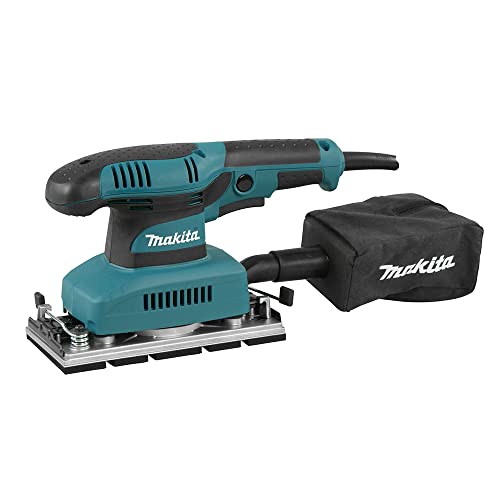
- Makita BO4556: 85 dB(A)
Sound power follows the same order: 79, 79, 83, 83.3, 84, then 93 for both corded palm sanders. DEWALT states a K of 2.5 for the DCW200, and the other six state 3, so sanders a decibel apart sit inside each other's uncertainty.
How is detail sander noise declared?
Detail sander makers selling in Europe declare noise under EN 62841-2-4, the part of the power tool standard for sanders and polishers, as LpA at the operator plus LwA sound power, each with a K value.
LpA is the pressure at the person holding the tool, the number that reaches your ears. LwA is the sound power the sander puts out in total, which better describes what the rest of the household hears. The ranking above uses LpA, and the LwA list is a separate column that never mixes with it.
DEWALT, Makita and Festool each name part 2-4. HiKOKI's manual for the Metabo HPT SV12SG names only EN62841, so its 83 dB(A) stays out of the ranking. Two Makita manuals give LpA alone, with no sound power. For more on the two quantities, see why sound power and sound pressure differ.
Are cordless detail sanders quieter than corded ones?
On Festool's and DEWALT's own figures, the battery sanders here declare seven to about ten decibels less at the ear than the corded tools with the same pad shape from the same maker.
Festool's pairs share pads and strokes, so they make a fair test. The battery DTSC 400 declares 68 against 75 for the corded DTS 400 REQ-Plus. The battery RTSC 400 declares 68 against 76 for the corded RTS 400 REQ-Plus. The cordless Festools also top out lower, at 10,000 per minute against 12,000, and Festool's US page credits the DTSC 400 with a brushless EC-TEC motor.
DEWALT's brushless DCW200 declares 75.3 in English, against 85 for its corded DWE6411, about ten decibels apart on the same 108 x 115 mm pad. A brushless motor and a lower speed range seem to matter more than the cord.
How loud are corded quarter sheet palm sanders?
The two corded quarter sheet palm sanders we could rank, DEWALT's DWE6411 and Makita's BO4556, share one pair of figures: 85 for the operator and 93 of sound power, both to EN62841-2-4.
Each pair comes from a European manual printing the very model number a US store sells. Makita's US manual for the BO4556 and DEWALT's US manual for the DWE6411 print no figure.
Makita's European manual covers four sanders on one pad size. Makita's US site lists only the BO4556, and its siblings declare less: 83 for the BO4555, 82 for the BO4558 and 79 for the BO4557. Makita does not explain the spread.
Metabo HPT's SV12SG, a 200 W quarter sheet sander, has a measured 83 dB(A) of pressure and 94 of power in HiKOKI's European manual. Because HiKOKI names no part of EN62841, we cannot say whether 83 is truly lower than the 85 of the DEWALT and Makita.
DEWALT's European DCW200 manual prints 75.3 dB(A) at the ear in its English section and 72.3 in the Danish, German, French, Spanish and eight other sections, with 83.3 sound power in all of them.
DEWALT marks the English section as the "original instructions", and 75.3 is the higher number, so we rank on it. Either way the DCW200 sits well under the corded palm sanders. The sound power and the 2.5 dB uncertainty agree in every language.
The DWE6411 has a different problem. DEWALT's 2020 type 1 manual for the Baltic market gives 82 dB(A) at the ear; the January 2025 type 2 UK manual gives 85 dB. The sound power stayed at 93. We use the current edition, and the catalog entry keeps both.
Do bigger finishing sanders make less noise?
In Makita's line they do on paper: the 1/3 sheet BO3710 declares 75 dB(A) at the ear and the 1/2 sheet BO4900V 74, both under EN62841-2-4, against 85 for the quarter sheet BO4556.
Neither manual gives a sound power figure. Each carries Makita's warning line: "The noise level under working may exceed 80dB (A)." The BO3710 runs at 11,000 orbits a minute and the variable speed BO4900V at 4,000 to 10,000, slower than the BO4556's fixed 14,000.
These are two handed sanders for flat panels rather than palm sanders, so we list them as also considered. For heavy stock removal on the same panels, our belt sander guide covers the next size up.
Milwaukee's M12 FUEL 2531-20, Makita's cordless XOB02Z, Bosch's GSS18V-40N, GSS12V-40N and GSS20-40, and BLACK+DECKER's BDEMS600 mouse sander came with no decibel number in any US page or manual we opened.
Milwaukee's operator's manual for the 2531-20 prints none, and we found no European document naming the 2531. Makita's US manual for the 18V XOB02 prints none either; Makita's European DBO480 to DBO482 manual describes the same pads and speeds but never names the XOB02.
Bosch's US operating instructions for the GSS18V-40N and GSS20-40 print no figure. BLACK+DECKER's BDEMS600 page shows none. Without a declaration we cannot place any of them in the ranking, quiet or loud.
For tight spots where a detail sander will not reach, an oscillating tool with a sanding pad is the usual answer, and our oscillating multi-tool guide ranks those by declared noise.