Which electric screwdriver is the quietest?
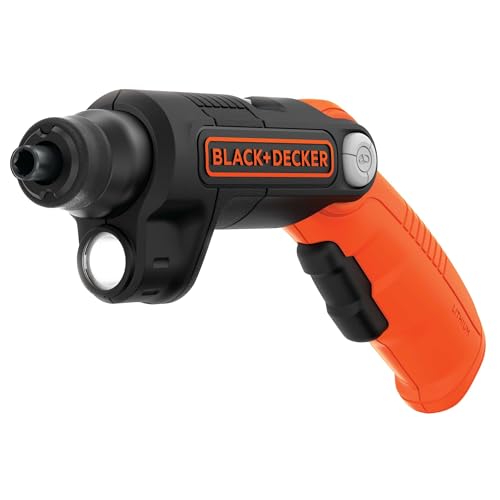
BLACK+DECKER's BDCSFL20C, at 53 dB(A) of emission sound pressure and 64 dB(A) of sound power, both declared to EN 62841-2-2:2014.
The four declarations, lowest first, each with K stated as 3 dB(A):
| Screwdriver | Sound pressure | Sound power |
|---|
| BLACK+DECKER BDCSFL20C | 53 dB(A) | 64 dB(A) |
| BLACK+DECKER BCF601AA | 60.0 dB(A) in the manual, 63 on the data sheet | 71 dB(A) |
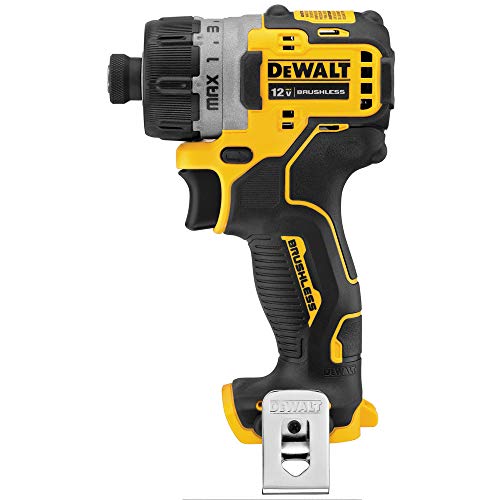
| DEWALT DCF601B | 67 dB(A) | 78 dB(A) |
| DEWALT DCF622B | 74 dB(A) | 85 dB(A) |
Every step is wider than the stated uncertainty of 3. The narrowest is 4 dB(A), between the BCF601's data sheet figure and the DCF601. Sound power agrees on the order, climbing 64, 71, 78 and 85, seven decibels at each step.
Low noise comes with low torque
On their makers' sheets the quietest screwdrivers are also the slowest and weakest. The BDCSFL20C turns at 180 RPM with 5.5 Nm, while DEWALT's DCF622 runs at 2000 rpm and up to 34 Nm.
Noise follows the motors. The 4V BDCSFL20C and the AA-powered BCF601 are household screwdrivers, DEWALT's DCF601 is a brushless 12V tool for trades, and the DCF622 is a 20V screw gun. For many buyers that trade decides more than the decibels do, because a 53 dB(A) screwdriver that stalls on a long deck screw only sends you back to a louder tool. Pick by the screw first.
Both makers test to EN 62841-2-2
EN 62841-2-2:2014 is the part of the European power tool standard covering screwdrivers. Each of the four picks gets a sound pressure and sound power pair under it, with a K value, the stated uncertainty, of 3 dB(A). DEWALT's manuals say each declared level "represents the main applications of the tool". BLACK+DECKER names no mode beside its noise rows, though it gives its vibration figures for screwdriving without impact.
A difference of 3 dB(A) or less sits inside that uncertainty, so two tools that close are level.
Why sound pressure and sound power stay in separate columns is covered on the page comparing the two measures.
Its XJ instruction manual gives 60,0 dB(A) of sound pressure; a separate product emission data sheet for the same Type H1 tool gives 63 dB. Both documents sit on the same UK service listing, both cite EN 62841-2-2, and both give 71 dB(A) of sound power. Neither is dated on its face. Which replaced the other is unknown.
The gap leaves the ranking alone. At 60 the BCF601 is 7 above the BDCSFL20C and 7 below the DCF601; at 63 it is 10 and 4 apart.
Is a screw gun louder than a cordless screwdriver?
In DEWALT's range, yes. The DCF622 screw gun declares 74 dB(A) against 67 for the compact DCF601, both to EN62841-2-2, K 3, for the main applications of the tool.
The older DCF620 drywall screw gun declares 77 dB(A) in its manual. It stays out of the picks because DEWALT's US drywall screw gun page no longer lists it, though a DCF620CM2 kit was still in stock at Amazon.
For drilling as well as driving, the cordless drill guide ranks drill drivers on their makers' declarations.
DEWALT's gyroscopic DCF680 declares 60 dB(A)
Its manual gives LpA 60 dB(A) and LWA 71 dB(A), with the uncertainty set at 1.5, and covers the DCF682 at the same figures. That would put the 8V tool level with the BCF601's manual figure. On November 8, 2026 we could not find the DCF680N2 or DCF682N1 itself for sale on Amazon, only batteries, cases and chargers, and DEWALT's US cordless screwdriver page no longer shows it.