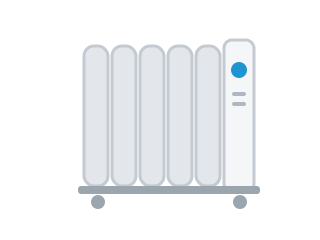
An oil-filled radiator is the heater people buy when they are tired of fan noise. It has no motor and no blades, and it warms a room the slow way: an element heats sealed oil, the oil heats the fins, and the fins warm the air, which rises and circulates by itself. In a living room in the evening, a home office during calls or a nursery at bedtime, that is exactly the appeal.
Our guide to the quietest space heaters compares every heater figure we could find and concludes that no maker measures a fanless heater. Our bedroom heater guide reads night modes and lights for sleeping. This guide stays with radiators and other fanless heaters, and asks what their makers actually say about the sounds they do make, how fast they heat, and how they behave once the room is warm. We read product pages and manuals from De'Longhi, Dreo, Costway and Pelonis, and quote them as written.
Our picks are listed above, with full specifications for each.
What the makers say about sound
Here is every noise statement we found, word for word, grouped by what kind of claim it is.
A figure. Costway says the noise of its 700 watt mini radiator "is lower than 45 db". It is the only number we found for any radiator. It is an upper limit in plain dB, with no distance, weighting, test standard or setting, so it tells you less than it seems to.
Words without a figure. Dreo lists the 521 as "Sound Level: Silent" and describes it as "low noise". It calls the 711S convection heater "HyperSilent 0dB Unheard Quietness". Pelonis claims "ultra-quiet operation" for the HO-0279. Costway's page for the ES10374US promises "Quiet operation for an enhanced sleeping experience", and another Costway radiator page says it "runs without noise, wind or dazzling light". De'Longhi says nothing about quiet at all, only that there is "no fan to stir up dust, pollen and dander".
What the manuals admit. De'Longhi's manual for the Dragon says: "It is completely normal for the appliance to emit 'creaking' sounds the first time it is run." Costway's manual for the ES10374US lists "No noise" among its features and, a page later, says: "It is normal for the product to have a slight sound and odor during heating." Those two lines are the most honest description of a radiator we found.
Because only one maker publishes a figure, there is nothing to rank. Two figures would need the same unit, the same setting and the same distance before one could be called quieter, and we have one figure with none of those. So the picks above are ordered by what each room needs, not by decibels, and no award claims a radiator is the quietest. If you want to know why dB figures from different makers rarely line up even when they exist, see why you cannot compare dB ratings across brands.
A word on 0 dB. It marks the threshold of human hearing on the decibel scale. A heater that claims it is describing itself as inaudible, not reporting a test.
The sounds a fanless heater does make
Creaking and ticking. Steel fins and the oil inside them expand as they heat and contract as they cool. In a quiet room you can hear it. De'Longhi ties it to the first run; Costway's manual describes a slight sound during heating in general. Owners say the same on the makers' own pages: one review on Costway's 700 watt page says it "makes a few creaks as it's heating up, but it's nowhere near as loud as anything with a fan."
Thermostat switching. A radiator holds a temperature by switching the element on and off. Pelonis says its mechanical thermostat "will automatically turn the heater on and off to maintain this selected temperature", and Costway's manual says the heater stops heating at the set temperature and switches itself back on when the room cools. No maker we read says whether that switching clicks, so we make no promise either way. We did not find a maker statement about relay noise for any radiator.
Beeps. De'Longhi's Dragon sounds two short beeps when you change the temperature scale and a double signal when you lock the keys. Dreo lists a mute function on the 521, and its FAQ says the overheat alarm beeps and shows FF on the display. Pelonis's manual describes dials and a power light, and no beeps. Costway does not say whether the ES10374US beeps.
Settling after a move. Costway's manual asks you to stand the radiator upright on its casters and rest it for 3 to 5 minutes before use. Oil that has been sloshed around needs to settle; give it the time before you judge the sound.
Why oil-filled radiators heat slowly
The oil is the point and the problem. It stores heat, so a radiator keeps warming the room for a while after the element switches off, and it has no hot element exposed to the air. But the element has to warm the oil and the fins before the room feels any of it. Dreo's FAQ says it directly: the heater "uses convection, which may take longer", and suggests "You can use the timer function to heat your room beforehand."
The makers disagree in tone. De'Longhi advertises "Quicker Heat Up" for the Dragon, and Costway says its radiator will "Warm up to 300 sq.ft of space quickly". Neither publishes a time. We found no radiator maker that gives a heat-up time in minutes, so treat "quick" as a comparison with other radiators, not with a fan heater.
In practice, that makes a timer the most useful feature on a radiator. The Dragon has a delayed start, so the living room can be warm before you come home. The Dreo and the Costway ES10374US have 24-hour timers. The Pelonis and the Costway 700 watt mini have none.
Watts, fins and room size
Every full-size radiator here tops out at 1,500 watts. Pelonis and Costway both state 12.5 amps, and Pelonis's manual says not to plug the heater into a circuit that already has other appliances working. The low settings matter more than the top: 600 watts on the Dreo, the Pelonis and the Costway ES10374US, and 700 on the De'Longhi.
Room size is thinly documented. Costway lists 300 square feet for the ES10374US. De'Longhi says not to use the Dragon in rooms under 43 square feet, and its product pages add that the heater "is only suitable for well insulated spaces or occasional use". Its specification tables list a "Working capacity" of 23.2 square feet for both the Dragon and the ComfortTemp, which looks like a site error, so we do not use it. Pelonis's manual says its radiator "is designed for finite space heating or as a supplementary heating source. It can not replace the main heat source during the winter."
Fins spread heat; they do not create it. De'Longhi lists 6 fins on the Dragon and 7 on the ComfortTemp, Costway lists 7 on both of its radiators, and Dreo gives no count but says its M-shaped fins provide "59.5% more dissipation area". A 700 watt radiator with 7 small fins still puts out 700 watts.
Eco modes and thermostat cycling
An ECO mode on a radiator changes the pattern of switching, which is what you hear if you hear anything. De'Longhi's manual says the Dragon "will automatically select the most convenient power level (MAX-MED-MIN-OFF)", stepping down as the room approaches the set temperature, and its display shows red, yellow or green for the level it is using. Dreo says the 521 and the 711S stop heating in ECO mode once the set temperature is reached and come back on when the room cools; if they switch off too often, Dreo suggests raising the set temperature or using Power Heat mode. Costway mentions an ECO mode on its 700 watt mini but describes only a mechanical knob, so we cannot tell you what it does.
Room by room
Living room. You want enough heat for a larger space, controls you can set once, and a display that does not glow across the room during a film. The Dragon fits: ECO stepping, a delayed-start timer and three display brightness levels. The Dreo 711S suits a living room with no floor to spare, since it can go on the wall. If you are heating the same room every winter evening, a heat pump is the long-term answer, and our guide to mini-splits for a living room compares the indoor figures makers publish.
Home office. A heater on a call needs to be silent more than it needs to be powerful, and an office circuit is often shared with a computer, monitors and a printer. The Costway 700 watt mini draws about half the current of a 1,500 watt radiator and is the only one with a figure. Our page on setting up a quiet home office covers the other machines that add noise at a desk.
Nursery. Quiet matters, and so do heat, light and supervision. Dreo says its radiator's surface "may reach 80°C maximum". Pelonis's manual says: "DO NOT leave product running unattended in a confined space around infants". The CPSC says to keep heaters three feet from anything that can burn and to turn them off when sleeping. So the right use is to warm the room before the baby goes in, with the timer set, and to keep the heater well clear of the cot and of curtains. A mute button and a screen you can turn off, as on the Dreo 521 and the Costway ES10374US, help with the last check before you leave the room. Our page on setting up a quiet nursery goes through the other machines that end up in a nursery.
Tip-over and overheat protection
Dreo lists tip-over and overheat protection for the 521 and the 711S. Costway lists "45° tip-over protection and overheat protection" for the ES10374US. Pelonis lists a tip-over switch and an overheat protection sensor. De'Longhi's manual describes a safety device that switches the heater off if it overheats, and the product title says "with TOS", but we found no description of a tip-over switch in the manual or on the page. Costway's page for the 700 watt mini lists overheating protection only, and a Costway answer in its Q&A says it has tip-over protection inside.
Every manual we read says to plug the heater directly into a wall outlet. The CPSC says the same: never an extension cord or a power strip.
The optional fan
Some radiators add a small fan to push the warm air out faster. It solves the slow heat-up and brings back the noise you bought a radiator to avoid. We found no US maker page we could open for a fan-assisted radiator, and no maker figure for one. If you buy one, assume any "silent" claim describes it with the fan off.
How we chose
We started from the fanless heaters in our space heater catalog and added four from maker documents: the Costway ES10374US and 700 watt mini radiators, Dreo's 711S convection heater and De'Longhi's ComfortTemp. We reopened each maker's product page and, where the maker publishes one, its manual, and recorded every statement about sound, heat-up, power, fins, controls, safety and room size. We looked for radiators from Honeywell, but its site refused our requests, and we found no Vornado radiator. We ranked nothing on noise, because no two makers publish comparable figures; the picks are chosen for the room each one suits.
We did not measure any of these heaters, and we did not listen to them in a living room, office or nursery. Every noise statement here is the maker's own, quoted as the maker words it, and every feature comes from the maker's product page or manual. Owner comments are quoted from reviews on the makers' own pages. Prices and stock are as the makers' sites showed them when we checked.