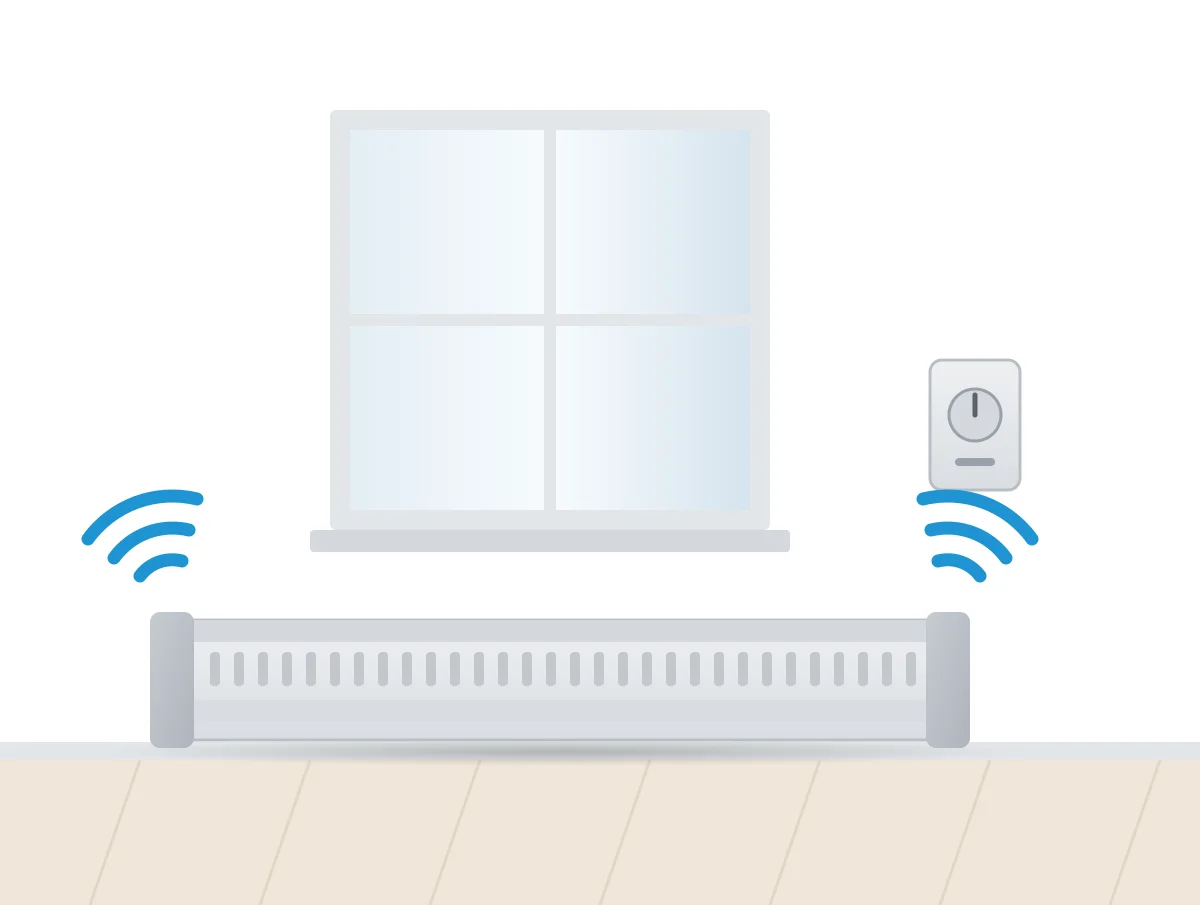
Electric baseboard heaters have no fan and no motor, and Cadet calls them "virtually noise-free". Owners still hear them. There is a tick as the element warms, a click as it cools, a hum when the element is pinched inside its cabinet, and the snap of a mechanical thermostat on the wall. Hot-water baseboard on a boiler loop adds two more: gurgling from trapped air and creaks from copper pipe moving in its holes.
Each of those sounds has a cause that a maker names, and most have a fix that takes a screwdriver or a new thermostat, not a service call. This page quotes Cadet, Stelpro, Dimplex, King, Marley, Resideo (which makes Honeywell Home thermostats), Slant/Fin, Sterling and Weil-McLain.
Boilers, circulator pumps and steam radiators are on a separate page, boiler noises explained. Portable heaters, including the oil-filled radiators that people park along a wall, are in space heater noises.
Electric baseboard is close to silent by design
"Wall heaters are also generally quieter than a regular refrigerator; baseboard heaters are virtually noise-free, making them a good choice for bedrooms." That comparison comes from Cadet's troubleshooting FAQ. With no blower, the parts left to make a sound are the element, the steel cabinet, the screws that hold it to the wall and the thermostat.
The sounds owners report therefore fall into a short list. Metal moving as it heats and cools makes ticks, clicks and pings. A cabinet bent against an uneven wall makes the element hum. A heater on the wrong voltage hums too, and a mechanical thermostat clicks each time it switches.
Why does my baseboard heater tick or click?
A baseboard heater ticks because its metal grows as the element heats and shrinks again as it cools. Stelpro and Dimplex both treat light clicking as normal.
Stelpro's answer to "My baseboards are making a noise. Is this normal?" is short: "Metal expands when the heat comes on and contracts when the temperature cools. This is what causes the clicking sounds." Dimplex describes the same thing as "A slight clicking or pinging sound is normal as metal parts expand and contract when heating."
Both draw a line, though neither gives a volume. For Dimplex, "If noise becomes loud or persistent, check that the unit is mounted securely and free from obstructions." Stelpro asks anyone who feels a sound is abnormal to contact its technical support at 1-844-783-5776.
Ticking after the heat shuts off
Clicks that carry on once the heater stops are the contraction half of the same process. Stelpro's explanation covers both directions, so a baseboard that ticks for a while after the thermostat cuts out is doing what the makers describe. Nothing we found covers a heater that clicks after it has been cold for hours.
Tight mounting screws leave no room to expand
Marley builds slack into the mounting. Its 2500 and C2500 series instructions read: "Tighten screws and then loosen screws at least ¼ turn to allow heater to expand and contract during use." The extra screws used when a heater is mounted above the floor get the same treatment, "making sure to loosen each screw at least ¼ turn."
The Model D manual goes to half a turn, "to allow for expansion and contraction", and asks for an eighth of an inch (3 mm) of clearance at each end of the heater. Where heaters run end to end, it wants "1/32-inch (1mm) of expansion space per heater between each heater."
Marley never says what a fully tightened heater sounds like. Still, the instruction points to the first thing worth checking on a baseboard that ticks loudly: whether it is screwed down so hard, or wedged so tightly between a wall and a door casing, that it cannot slide.
Why is my baseboard heater humming or buzzing?
A humming baseboard heater most often has its element pinched by a cabinet bent against a wall that is not flat, Cadet explains. A heater connected to the wrong voltage can hum as well.
Cadet's fix article calls a slight humming or popping "usually nothing to be alarmed about", then explains the cause: "the baseboard heater is built in the factory with the element square with the back of the cabinet. If the cabinet back is slightly warped when it's installed on the wall, it pinches the element, which more often than not is what causes the humming noise." A Cadet technician in the video on that page describes the result as a "ping sound or high pitched sound".
The cure is to let the element settle and then fix it in place again. Cadet's steps, condensed:
- Run the heater for 15 minutes, then switch off its breaker.
- Loosen the screws holding the baseboard to the wall, without removing them.
- Loosen the grounding screw near the middle, seen through the vent on the top front.
- Bump the cabinet with your palm so the element finds a resting position.
- Tighten the mounting screws first, then the screw on the element.
Go carefully at step 2, because "the heating element will probably still be hot to the touch." Once the breaker is back on, the heater "should be much more quiet than it was before."
Check the voltage before the screws
Cadet starts any troubleshooting here. "If you hook up a 120-volt baseboard to a 240-volt supply, it can cause a variety of issues, a humming noise being one of them." Screws will not fix that: "If you do have the wrong voltage heater, turn the breaker off. You'll need to replace the heater right away."
The rating is on the heater. Dimplex asks owners to "Ensure the power supply matches the voltage rating on the heater label," and King's troubleshooting chart lists improper voltage as a cause of a tripping breaker, with the remedy "Verify the heater voltage matches the supply voltage."
The thermostat makes clicks of its own
Electronic thermostats are sold partly on silence. Resideo, which makes Honeywell Home controls, puts the case on its TH401 page: "Unlike mechanical thermostats that operate on long cycles, our TRIAC thermostats can operate on 15-second cycles because they are entirely electronic." The payoff, in the same paragraph, is "fewer temperature swings, clicking at the thermostat, or crackling at their baseboard heaters."
That last part matters for anyone chasing ticks at the heater. Short cycles keep the element from swinging between hot and cold, and Stelpro makes the same link from the heater side: "electronic thermostats greatly reduce these expansion/contraction noises." King's chart reaches a related verdict for rooms that swing "from too hot to too cold": "Replace with a better quality thermostat. Anticipated thermostats are fairly accurate; an electronic thermostat is the best." How much quieter the switch makes a room, none of the three quantifies.
An electronic thermostat can feel warm, and that is expected. Stelpro answers the question directly: "Even when operating normally, an electronic thermostat's housing can become hot to the touch. This does not affect the thermostat's efficiency or performance."
A buzz from the thermostat itself
We found nothing from these makers on a buzzing line-voltage thermostat. What they do print is the limit each one is built for. Cadet's TH114 sheet gives "15 amps maximum load (240/208 volt) or 16.7 amps maximum load (120 volt)". When a heater draws more than a line-voltage thermostat can handle, Cadet's answer is a low voltage thermostat "combined with a relay", not a bigger switch. Thermostat wiring sits at 120 to 240 volts, and Stelpro recommends having its products installed by an electrician.
Light smoke or a smell on the first run
New elements burn off what is left from the factory. Cadet: "On initial start up, your heater may smell. This is not dangerous, and is due to the manufacturing process. It typically goes away after the heater runs for several hours." For Stelpro, "light smoke may emanate from it", and it "will disappear automatically after a few minutes of operation."
King and Marley print the same start-up routine: run the whole system steadily for half an hour, which "should remove oily residue from manufacturing. (Some smoking may occur)." King's chart adds "Open windows and allow room to vent until it stops, usually within a few minutes." A smell that comes back later is usually dust, and Dimplex's instruction for one that persists is "disconnect power and clean the unit thoroughly."
A heater that keeps switching itself off
Every electric baseboard in these manuals carries a safety limit that cuts power if the heater overheats. Marley and King use the same words for it: "During normal use, this safety control should not operate. If you find that this control is operating, make sure the heater is not being blocked. If it continues to cycle the heater off, disconnect power to heater and have it checked and repaired by a qualified electrician."
Dimplex blames "Obstructions or dust around the grille" when its limit trips. On Stelpro's electronic thermostats the sign is a home screen that disappears now and then; the fix is to keep the heater's air vents "free of any obstruction (curtains, furniture, etc.)."
Why does my hot-water baseboard gurgle?
Gurgling in hot-water baseboard is air in the loop. The Slant/Fin installation guide asks for venting "to prevent noise or blockage of circulation by air pockets."
The full passage, from a Slant/Fin guide for its residential baseboard: "Provision must be made for venting air from system, to prevent noise or blockage of circulation by air pockets. Either install a manual air vent at every drop, or install an automatic air eliminator device at the boiler and a vent at highest point of the system for extra safety." It prefers the first option, because "A vent at every drop is an advantage in case the system is later drained and refilled without purging."
On a Slant/Fin layout, then, the vents to bleed sit where the pipe drops through the floor at the end of a run. Bleeding works the same way on baseboard as on a radiator, and the steps, along with the boiler pressure check that should follow, are on our boiler noise page.
Fast water can be noisy too. Weil-McLain's High Trim instructions warn against flow above 6 gpm through a 3/4 inch element, or 10 gpm through a 1 inch element, "because of possible noise." That is a pump and piping question for the installer.
Hot-water baseboard ticks as the copper moves
Copper tubing lengthens as hot water reaches it and shortens as it cools. It ticks or scrapes when something stops it sliding: a support bracket, the cabinet, or the edge of the hole where it passes through the floor.
The installation rules are all about giving it room. Slant/Fin cuts riser holes half an inch larger than the pipe and installs the riser "snug to inside edge of hole to allow maximum room for riser to move to outside edge of hole when pipe expands." Its next instruction is direct: "Make sure cradles are centered over brackets to allow for smooth expansion without scraping noises." For long straight runs it adds a Hydro/Tite expansion coupling at the center, since "All piping expands when heated." Weil-McLain drills 1½ inch holes for risers and wants expansion joints on horizontal runs of more than 30 feet.
The brochures show how makers design the noise out. Slant/Fin's Fine/Line 30 sheet promises "No-noise expansion cradles" that "eliminate noisy metal-to-metal contact with bracket and enclosure," with fins locked to the tube so they stop pings and clicks. Sterling's Petite 7 brochure claims "Full-collared, all-aluminum fins eliminate expansion noise" and "Plastic glide rails promote quiet floating action during expansion and contraction."
Those are sales claims. In an existing house, the useful part is the checklist they imply. Is each cradle still centered on its bracket? Is a riser jammed against the edge of its hole? Neither maker explains how to rework an installed run, so moving pipe is a job for a heating contractor.
When a baseboard noise means a fault
A few cases leave the do-it-yourself list. A 120 volt heater on a 240 volt circuit has to come off the wall. A safety limit that keeps cutting the heat out after you have cleared the space in front of it calls for a qualified electrician. Clicking that becomes "loud or persistent" after the mounting has been checked is a reason to call the maker, as Dimplex and Stelpro both ask.
Before any work inside the cabinet, cut the power. Marley's and King's instructions start their maintenance section with "Make sure electrical power supply circuit coming to heater is disconnected at main disconnect or service panel before servicing this heater. Allow heater to cool before cleaning to prevent a possible burn." They also limit what an owner should do: "The user can perform some basic cleaning of the heater. All other servicing is to be done by qualified service personnel."
On a hot-water system, air that keeps coming back after bleeding, or a boiler pressure that keeps dropping, belongs to the heating contractor, as the boiler page explains.
Baseboard spec sheets carry no decibel figures
Not one of the manuals, brochures and support pages quoted here prints a sound level for a baseboard heater, electric or hot-water. That leaves nothing to rank, which is why QuietSpecs has no baseboard heater guide. The words "virtually noise-free" from Cadet are as close as any of these makers comes to a rating.
Quieter heat for bedrooms and small rooms
If a room needs more heat than its baseboard gives, the quietest space heaters and quietest oil-filled radiators guides rank portable units by the figures their makers print, and the quietest bathroom wall heaters cover fan heaters built into a wall. For a hot-water system, the quietest boilers guide starts at the source.
For the room itself, the quiet bedroom plan covers heating along with everything else that hums at night. Furnace and duct sounds are in furnace noises explained, and for an older heater whose noise has crept up, read why appliances get louder.
What this page is built from
Installation manuals from King, Marley, Slant/Fin and Weil-McLain, a Cadet product sheet, brochures from Slant/Fin and Sterling, and support pages from Cadet, Stelpro, Dimplex and Resideo, all read on 2026-11-12. The Slant/Fin installation guide is the maker's own document, hosted by the retailer SupplyHouse. Cadet's older support site would not load, so its current cadetheat.com pages are quoted instead. We did not install, run or repair a heater for this page, and where a maker is silent on a sound, the text says so rather than filling the gap.