How loud is a gas boiler?
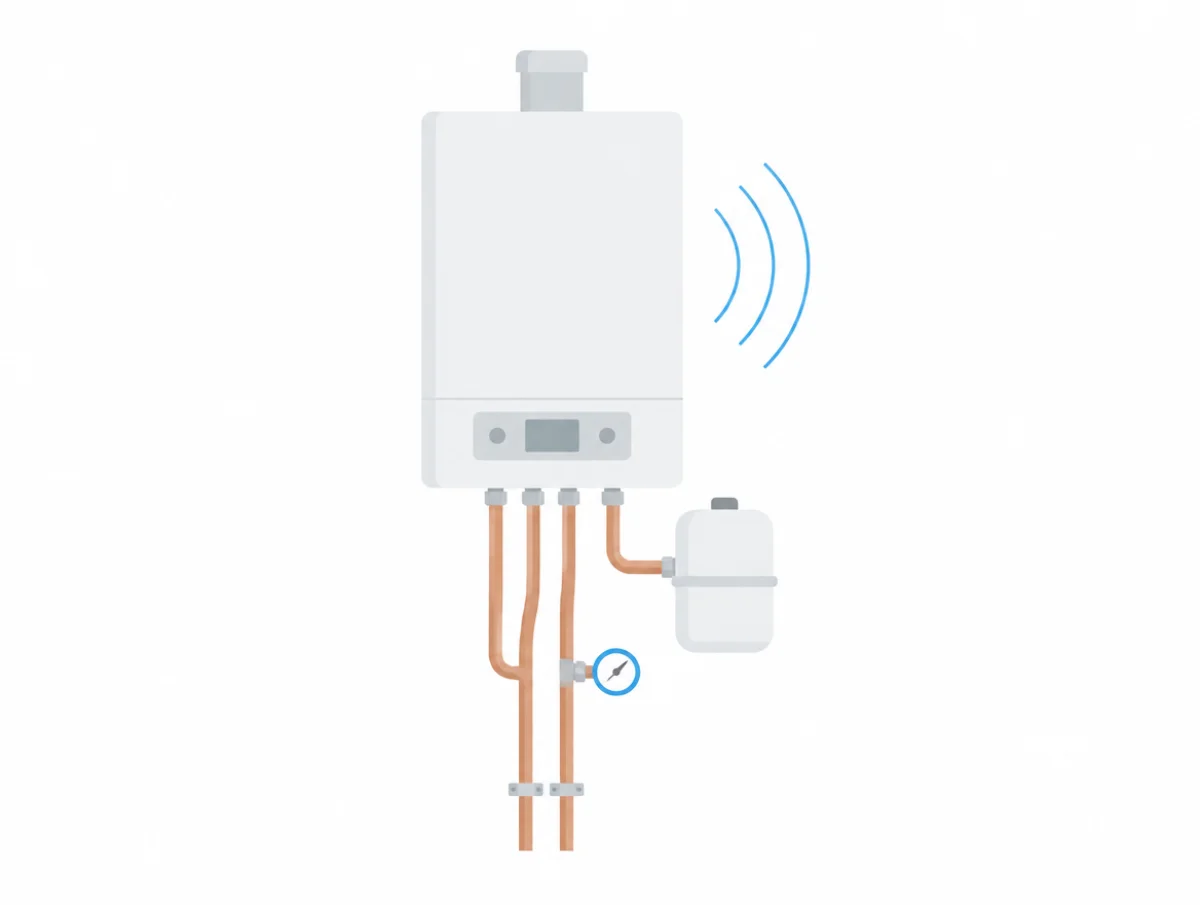
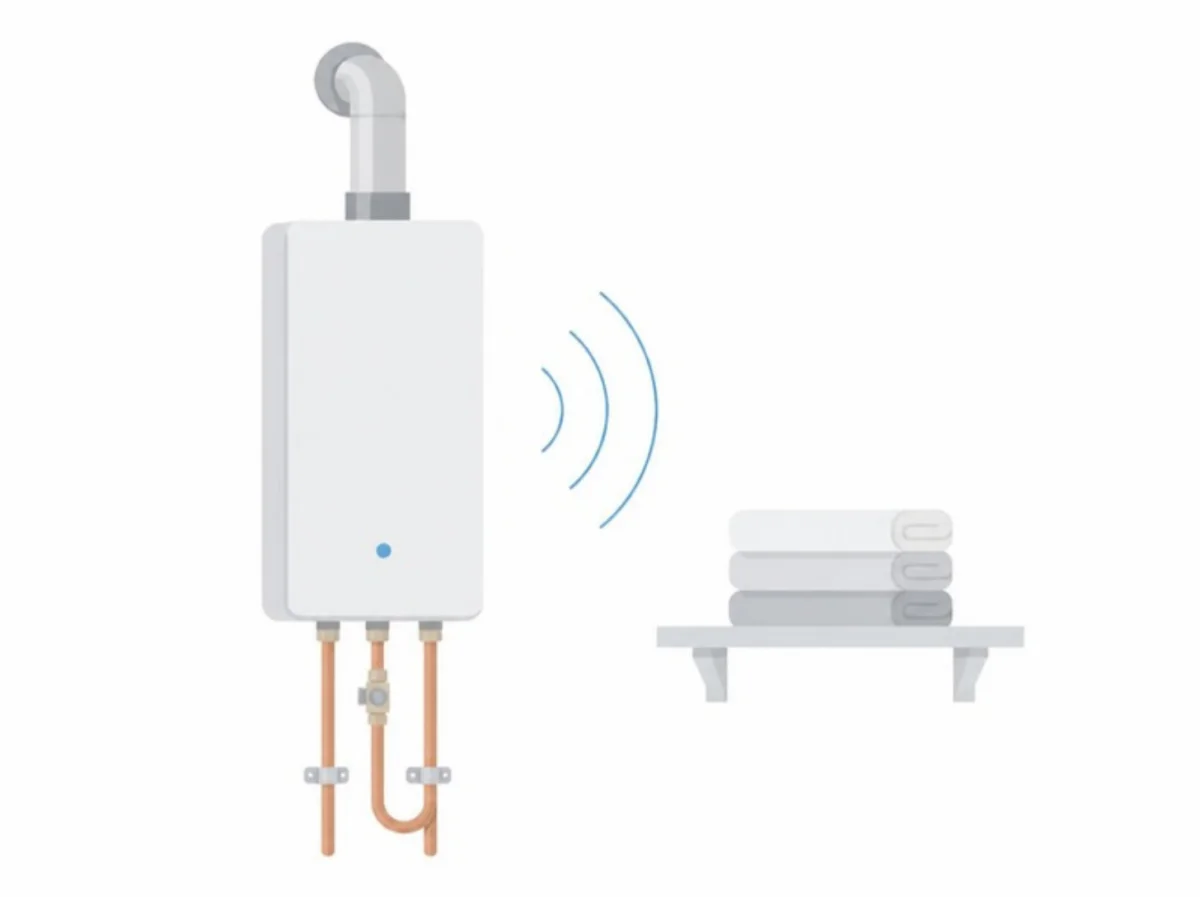
A wall-hung gas boiler is listed at 40 to 43 dB(A) by Rinnai, and at 51 to 59 dB at full load and 31 to 34 dB at partial load by Viessmann, measured 1 meter away. Those ranges come from the makers' own tables.
Here is every published figure, sorted into its maker's basis:
- Rinnai I-SERIES Plus Solo: 40 dB(A) for the IP060S, IP090S, IP120S and IP175S; 42 for the IP150S and IP199S
- Rinnai I-SERIES Plus Combi: 43 dB(A) from the IP060160C to the IP150199C; 42 for the IP175199C and IP199199C
- Viessmann Vitodens 100-W, at 1 meter: B1HE-85 52 and 34 dB, B1HE-120 and B1KE-120 59 and 34, B1HE-150 51 and 31, B1HE-199 and B1KE-199 55 and 31
- Viessmann Vitodens 200-W, maximum and minimum input: B2HE-85 52 and 34 dB, B2HE-120 59 and 34, B2HE-150 51 and 31, B2HE-199 55 and 31
Viessmann's pairs show the range a single boiler covers as it modulates. Rinnai's one number per model does not say which point in that range it describes.
Why are Rinnai and Viessmann boilers ranked separately?
Rinnai and Viessmann boilers are ranked separately because Rinnai prints one dB(A) figure with no distance or firing rate, while Viessmann prints a full load and a partial load figure in dB, 1 meter from the Vitodens 100-W.
A reading taken at 1 meter and one taken at an unstated distance cannot be put in order, and neither can a figure for an unstated firing rate and a figure for full fire. So Rinnai's 40 dB(A) is not lower than Viessmann's 51 dB in any sense this page can defend.
The Vitodens 200-W adds a third basis. Its manual labels the row "Sound Rating", at maximum and minimum input, with no distance, so it gets its own group even though its numbers repeat the 100-W table size for size.
What is the quietest combi boiler?
The quietest combi boiler on Rinnai's figures is the IP199199C or IP175199C at 42 dB(A). On Viessmann's figures it is the Vitodens 100-W B1KE-199, at 55 dB at full load and 31 dB at partial load, 1 meter away.
Rinnai's result runs against the usual pattern: its two largest combis, which fire up to 199,000 Btu/h for hot water and weigh 123.5 lb, read 1 dB lower than the six smaller combis at 43. Rinnai does not explain the difference, and 1 dB is a small margin when no distance is stated.
Viessmann's two combis differ more. The B1KE-199 reads 4 dB below the B1KE-120 at full load and 3 dB below it at partial load, and it also delivers more hot water: 4.7 US gallons a minute of continuous draw at a 77°F rise, against 3.3.
Are combi boilers noisier than heat-only boilers?
Combi boilers read slightly higher than heat-only boilers in Rinnai's tables, and the same as heat-only boilers in Viessmann's. Rinnai's Solo models list 40 or 42 dB(A) and its combis 42 or 43.
Rinnai's earlier I-Series combi manual gives a clue to why. It printed the sound level twice for each model: 42 dB(A) on central heating for the i060C, i090C and i120C, then 44 dB(A) on domestic hot water for the two smaller sizes and 47 dB(A) for the i120C. Hot water demand fires the burner harder than space heating, and the figure rose with it.
Viessmann prints no separate hot water figure. Its B1KE combis carry the same numbers as the B1HE heat-only boilers of the same size, so on Viessmann's paperwork the combi adds no noise.
How much quieter is a boiler at partial load?
A Vitodens boiler is 18 to 25 decibels quieter at partial load than at full load, according to Viessmann's Vitodens tables, which give both figures for every size at 1 meter.
The B1HE-120 shows the widest gap, 59 dB at full load and 34 at partial load. The B1HE-85 shows the narrowest, 52 and 34.
That gap is why sizing matters for noise. A boiler sized close to the heat loss of the house spends most of the season near the bottom of its range, while an oversized one fires harder and cycles more often. Rinnai's heating turndowns of 4:1 to 10:1 and Viessmann's minimum inputs, as low as 8.5 MBH on the B1HE-85, tell you how far down each one can go.
What boiler noises are normal?
Noise from trapped air is normal for the first week after a boiler is filled. Rinnai's combi manual says air "can take up to a week" to clear, during which noises can be heard as the automatic air vent works it out of the system.
Pump and flow noise is the next most common, and it can usually be tuned. Bosch's Greenstar manual tells installers to "select the lowest possible pump speed" to keep circulation noise down, and its fault table answers "Flow noises" with setting the pump speed to match the boiler's output.
Rumbling combustion is not normal. Bosch's same table points to the gas type, the inlet gas pressure, the flue and the gas to air ratio when combustion noise is too loud, which is work for a licensed technician.
Fan noise is the steady hum most owners notice. Weil-McLain fits its ECO Tec with a horn-shaped air inlet silencer that it says significantly reduces fan noise, though it prints no figure to show by how much.
Do Navien, Lochinvar and Weil-McLain publish boiler decibels?
No, Navien, Lochinvar and Weil-McLain print no decibel figure in the boiler documents we read, and Bosch prints only upper limits.
Navien's NCB-H quick facts and engineering specification list inputs, hot water flow rates and efficiency without a sound level, and its NHB quick installation guide mentions noise only from 1/2 in. corrugated gas connectors. Lochinvar's Noble NKC brochure and submittal sheet give none either. Weil-McLain's ECO Tec manual and Series 3 brochure describe the air silencer and a whisper-quiet design but print no number.
Bosch's US manual for the Greenstar ZBR and ZWB...-3A gives each size a sound pressure level with a less-than-or-equal sign, from "≤ 39" to "≤ 45" dB(A). A limit is not a reading, so the Greenstar boilers appear in the also considered list and are not ranked.