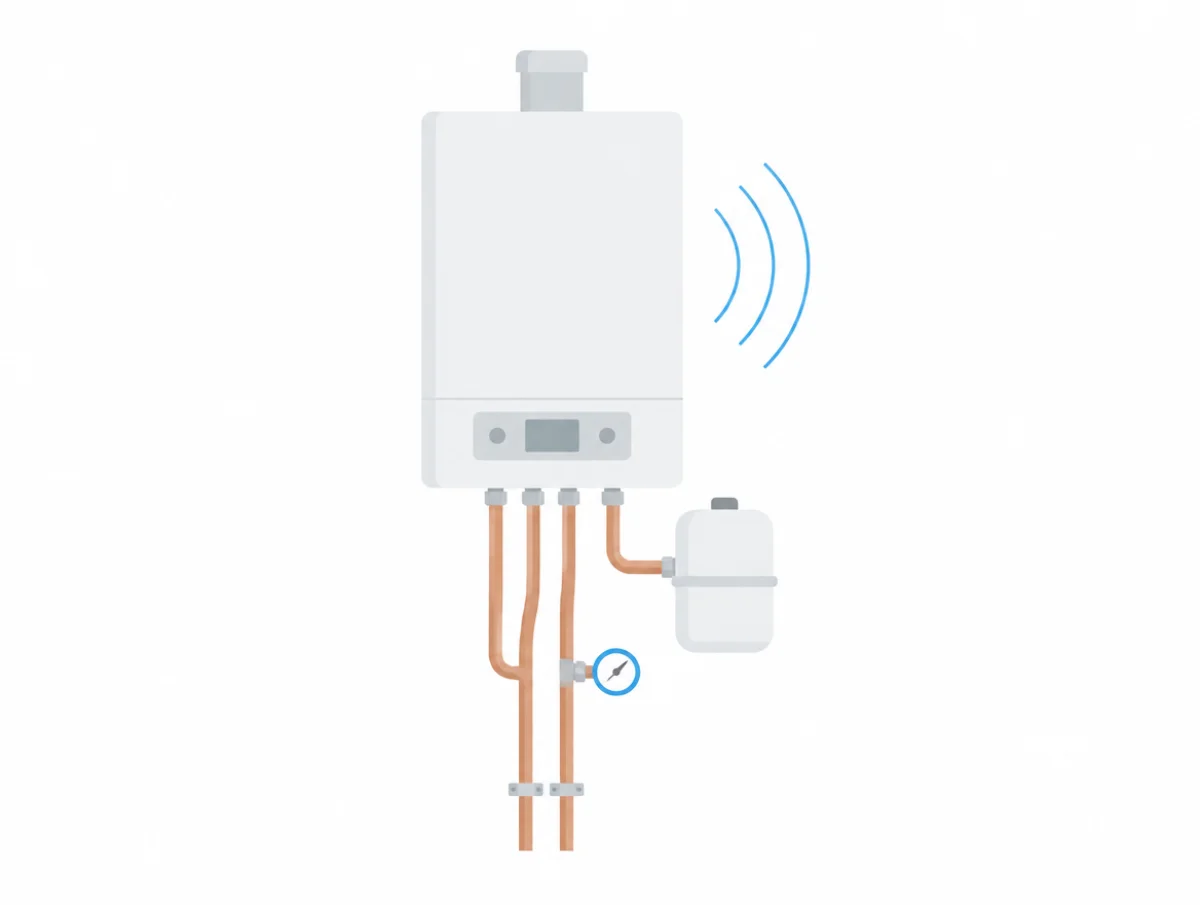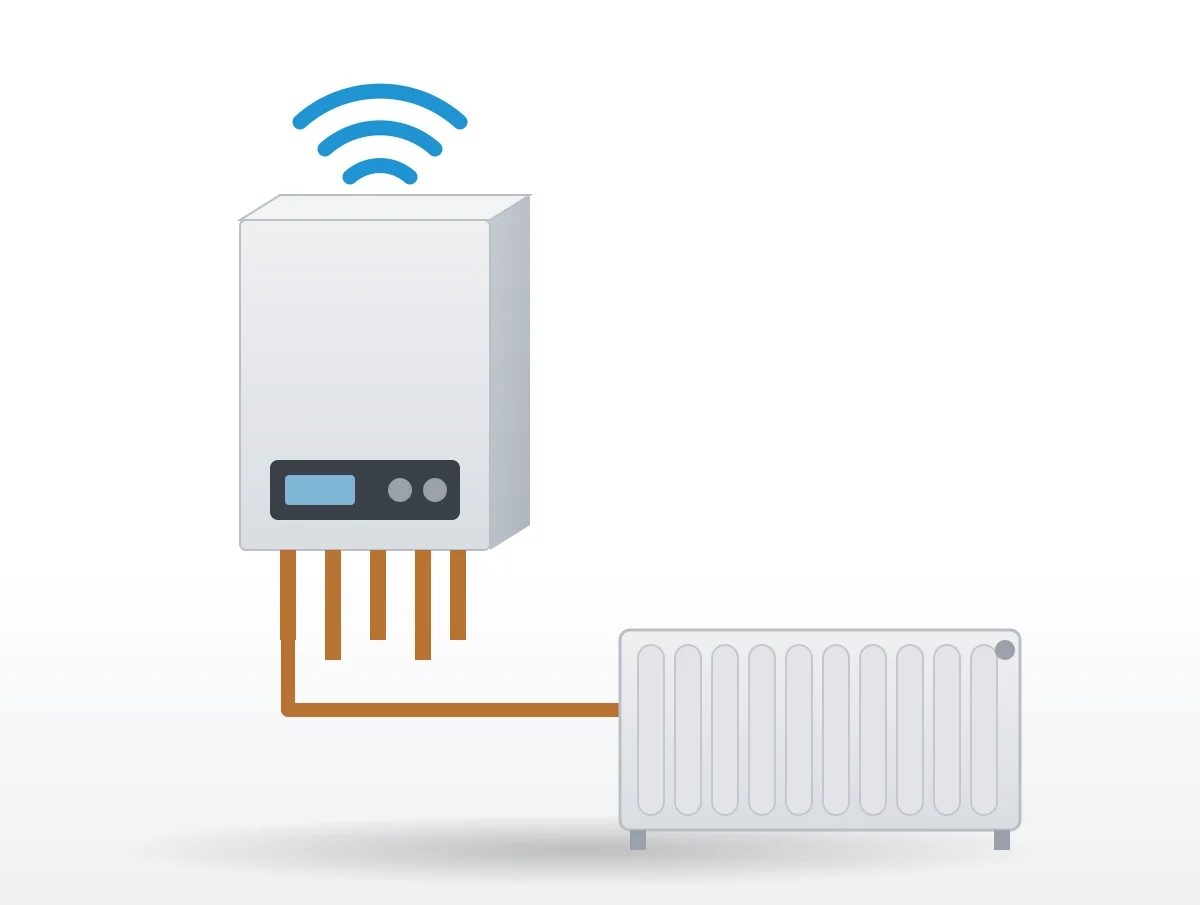
Most boiler noise is air. "Gurgling noises are a sign that air has become trapped inside the system and is mixing with the water," Vaillant explains, and bleeding the radiators to let it out is the one repair the makers leave in an owner's hands. Kettling, a droning pump, rumbling at the burner and a gauge reading past its limit all go to a technician.
A boiler heats water, or in older homes makes steam, and a pump or the steam itself carries that heat out to radiators or baseboard. The sound can start at the burner, in the pump, inside the heat exchanger or anywhere along the pipes. That is why a noise often seems to come from a room nowhere near the boiler cabinet.
This page covers gas boilers and the radiators they feed. A storage tank or tankless heater that only makes hot water belongs with water heater noises, and forced air systems with furnace noises. Several of the clearest maker pages on radiator noise are British, and each one is marked as UK where it appears.
A pump hum, a gurgle and a week of air noise are all normal
Vaillant (UK) calls it "perfectly normal for a boiler to make a noise, such as when the pilot light is ignited or when the pump circulates water around the boiler’s burner and heat exchanger."
Gurgling gets the same allowance from Viessmann's UK page: it "is usually the water moving through the system, so it’s typically not a huge cause for concern." A gurgle that turns constant or loud is another matter, one that "could be a sign that something may need adjusting."
New systems are noisier for a while. In the I-Series Plus combi manual from Rinnai, "It can take up to a week before all the air has disappeared from a newly-filled and pressurized installation. During the first week of operation, noises can be heard which indicate the presence of air."
Why is my boiler or radiator gurgling?
Trapped air, in most cases, and bleeding the radiators is the simplest fix Vaillant offers.
Viessmann widens the list. Gurgling "could also be down to low water pressure, lack of water in the header tank or a frozen condensate pipe." It also points out that the boiler is often blamed for someone else's noise: "In most cases, gurgling noises that may appear to originate in the boiler are actually caused by air elsewhere in the system."
US manuals put it in installer language. Weil-McLain's ECO Tec manual asks installers to "Vent any remaining air from system using manual vents. Air in the system will interfere with circulation and cause heat distribution problems and noise."
The frozen pipe is a winter problem on condensing boilers, whose drain runs outside. For icicles on the condensate pipe, the Viessmann advice is to "use warm water to gently melt them."
Radiators that sound like running water
That sound is air travelling with the water. In a new system it fades without help as "The automatic air vent in the boiler and air separator in the heating system will remove the air," according to Rinnai. There is a side effect to watch. As the air goes, "the water pressure will reduce some during this period," and the system needs topping up to stay in its working range.
Navien builds the vent into its combi boilers; the NCB manual says the boiler "has a built-in air vent on top of the internal circulator to efficiently remove the air in the space heating system." That only clears the boiler. Air sitting in the radiators still has to come out at the radiators.
How do you bleed a radiator?
You open the radiator's small air valve until water pushes the trapped air out. For radiators that are noisy or cold, Weil-McLain's owner manual says to "Bleed air from system through air vents in radiators or baseboard units."
Vaillant's UK page has the steps:
- Run the heating until the radiators warm up.
- Feel each one for cooler patches, which mark where the air sits.
- "Turn off the heating and allow the radiators to cool."
- Hold a bucket under the valve and open it with a radiator key until it hisses.
- "Once the hissing has stopped and only water is coming out, close the radiator valve by turning the key clockwise."
- Then "check the water pressure on your boiler to see if the level has decreased."
If bleeding does not cure it, Weil-McLain's chart moves on to low system pressure: "Fill to correct pressure. Check for leaks in boiler or piping. Have qualified service technician repair at once." Steam radiators vent differently, and they get their own sections further down.
What is boiler kettling?
Water boiling inside the heat exchanger. The Vaillant (UK) definition is "water reaching boiling point inside the boiler, which creates steam and causes pressure to potentially rise to higher levels," and the signs it gives are banging or whistling.
Vaillant's international page hears it as "a rumbling, banging, or gurgling noise" that "is typically caused by overheating water within the boiler." Underneath is slow flow. Water lingers over the burner and boils before the pump can move it on, and both Vaillant pages name the same two culprits: limescale narrowing the pipes and heat exchanger in hard water areas, and a failing pump that moves water too slowly. Low system pressure and blocked pipes make Vaillant's list as well, and Viessmann adds "a faulty boiler thermostat."
Older cast iron boilers do it too.
Weil-McLain's owner manual has a row for "Popping or percolating noise heard in boiler" and gives three causes: "Mineral deposits in sections due to constant use of makeup water," "Incorrect pH of boiler water" and "Insufficient water flow through boiler."
Fixing a kettling boiler is a technician's job
"If you suspect your boiler is kettling, you should call a Gas Safe installer to inspect your system." That is Vaillant's whole answer for owners, and it adds that kettling "can be dangerous and should only be inspected by a qualified professional."
For limescale, an installer "will most likely need to perform a chemical clean or power-flush." Even that has limits, since a flush "doesn’t always get rid of the accumulation of limescale on the heat exchanger in the boiler," Viessmann cautions. On cast iron, Weil-McLain's remedy is to "Call qualified service technician to de-lime boiler, if necessary."
Before calling, an owner can rule out two things. Whistling "may be fixed by removing some of the air in the system," so bleed first; if the whistle carries on, then "it is likely that kettling is the cause," in Viessmann's reading. And check the gauge, which Vaillant's international page wants "between 1 and 1.5 bar."
Prevention comes down to the water itself. Weil-McLain wants leaks repaired "to eliminate need for constant makeup water," and notes that "pH should be maintained between 7.0 to 8.5." On the UK side, "water softeners can reduce limescale build-up by removing minerals, preventing kettling over time," in Vaillant's account.
Why is my boiler banging?
Either kettling or the pipes moving. A boiler keeps heating cold water, so "there’s a lot of expansion and contraction involved in the system, which can cause banging noises," and over the years that movement works the pipework loose.
"Over time, the pipes can come loose under the floorboards and move when the hot water flows through them," Viessmann writes, and the bang can seem to come from the boiler. The fix is mechanical: "Screws can come loose over time and must be retightened."
The other cause brings us back to heat. "Banging can also be caused by a boiler that’s overheating the water," from limescale or a temperature set too high, and Viessmann suggests running the flow temperature "as low as practicable." A bang at the burner itself is a different fault, covered with the technician jobs at the end.
Humming, droning and vibration start at the pump
A hum can come from "a pump sending heated water around the pipework too quickly, or by the bearings in the boiler fan humming as it moves," Vaillant explains. Pressure is the other source. "Humming boiler noises can be created if water arrives from the mains at too high a pressure," and inside the house, "If the pressure in the system is too high, the valves inside your home can start to hum." Viessmann's UK target is "under 1.5 bar when the radiators are cold."
A drone is worse news. Vaillant says boilers "can sometimes sound like a drone or aeroplane is taking off," usually because of "a faulty pump," and swapping one is work for "a qualified boiler engineer" only.
Pump speed is set at installation. The Bosch Greenstar manual asks installers "to keep any water circulation noises to a minimum, select the lowest possible pump speed," and its fault table answers "Flow noises" with "Set pump speed correctly to match maximum output." When the pump sits inside a sealed combi casing, adjusting it is an engineer's job in Viessmann's view.
A whoosh points to the air intake or flue
Leaves and debris "can block the entry to the air intake pipe and create a whooshing sound," and a clogged internal air filter does the same, by Vaillant's account. Viessmann has heard of "bird nests" turning up in flues.
The owner's check is simple. Hold a hand near the outside pipe; if no air moves, something is blocking it. Clear only what is plainly in reach. Vaillant is firm on the rest: "It is very important that only a Gas Safe Registered Engineer works on the appliance." Anything inside the casing is engineer work.
What pressure should a boiler be at?
There is no single number. It depends on the system and the maker.
Rinnai's I-Series Plus combi runs between 17 and 26 PSI in normal operation; below 7.3 PSI it shows code E430 and stops. For a hot water boiler, Weil-McLain's daily check reads: "Make sure the pressure reading on the boiler pressure/temperature gauge does not exceed 24 psig. Higher pressure may indicate a problem with the expansion tank or gauge."
Steam runs far lower. A steam boiler's gauge should stay at or under 15 psig, and "Higher pressure indicates a problem with the gauge or limit control." If it keeps happening, Weil-McLain wants a technician called.
UK pages work in bar. Vaillant's range is 1 to 1.5 bar, and when a gauge drops below one bar Viessmann says to "use the filling loop to add more water." Both ends of the gauge make noise, in Viessmann's view: low pressure can bring on gurgling, and high pressure humming.
Why does my boiler make noise when the hot water runs?
A combi can be louder making hot water than heating radiators. Rinnai's earlier I-Series combi manual printed 42 dB(A) for every size on central heating, rising to 44 dB(A) on hot water, or 47 for the i120C.
The Navien NCB manual warns installers to "Avoid installation on common walls as the unit will make some operational noises while it is running." On the gas side: "Avoid using 1/2 in corrugated connectors or tubing as noise may occur."
High mains pressure can make valves hum, in the boiler or anywhere along the pipes. Rinnai's earlier combi table recommends 30 to 80 PSI of incoming water for best performance. Kettling also "can disrupt the flow and heating of water, potentially leading to inconsistent hot water supply," Vaillant adds, so a combi that kettles may show it at the tap before you hear it.
Popping in a tank or the fan run-on of a tankless unit are hot water heater sounds, and those live in water heater noises.
Ticking as the system cools is metal moving
Pipes and radiators creak and tick as they warm and cool. Viessmann ties the movement to a boiler that "repeatedly heats up cold water," and says that over time it works pipes loose.
Some piping is louder than others. Burnham's Independence steam boiler manual advises against copper for steam because its high thermal expansion can cause expansion and contraction noises "if not accounted for in piping system design and installation."
None of these manuals calls a tick a fault, and securing loose pipes is the only remedy on offer. A noise that goes on long after the boiler stops, or a radiator that stays hot when it should be cold, falls outside what they describe.
Why do steam radiators bang?
Steam has met water. According to Bell & Gossett's SteamTeam newsletter, oil left in a new boiler "sets up a foaming/priming condition that creates wet steam, leading to water hammer, lack of heat, and unhappy customers."
Skimming deals with that. Weil-McLain and Burnham both have installers skim a new steam boiler until the discharge runs clear, and Burnham warns that leftover flux "can cause poor heat transfer, surging, an unsteady water line and wet steam if not thoroughly removed during the skimming procedure."
The piping counts for as much. "Failure to pipe boiler as specified in this manual may result in excessive system noise, water line fluctuations and water carry over," the Burnham manual reads. Speed is the problem Bell & Gossett describes: "If the steam is moving too fast, the condensate can’t drain back into the main; instead, the steam will drive it toward the radiator vents." Water chemistry plays a part too. Some treatment chemicals "can promote water level instability," Weil-McLain warns, and among the reasons a system keeps needing make up water it lists "faulty steam traps, faulty air vents".
Low pressure and big vents keep steam quiet
One pipe radiators "were sized to heat the house on the coldest day of the year with less than 1 psi of steam," Bell & Gossett points out. Its advice to installers is to keep the pressure control "set as low as possible," and it puts the warning in capitals: "DON’T raise the setting of the pressuretrol, thinking it will solve a heating problem!" Set too high, a radiator vent "closes and stays closed, and any air remaining in the radiator can’t vent."
Main vents should be "the largest main vents you can get," so steam reaches the end of the main before it fills the risers.
Some gaps remain. Nothing in these manuals describes what a normal radiator vent hiss should sound like, or covers leveling and pitching a radiator to stop banging. Burnham, Weil-McLain and Bell & Gossett all write for installers, so a bang that keeps coming back in a steam system needs a technician who knows steam.
Combustion noise, buzzing and gas smells need a technician
Weil-McLain puts "combustion noise or high carbon monoxide values" in the same line, and says adjustment "must be done only by a qualified technician, using calibrated test instruments." The Bosch Greenstar fault table lists "Combustion noise too loud; rumbling noises" and sends the installer to check the gas type, inlet gas pressure, flue system and gas to air ratio. Its manual also warns of "Carbon Monoxide poisoning!" when a boiler is not converted correctly for its gas.
Carbon monoxide comes up across the manuals. Weil-McLain's installer must confirm "at least one carbon monoxide alarm is installed in the living space before the appliance is put into operation." Navien warns that running its boiler with the front cover open "may result in fire or carbon monoxide (CO) poisoning."
If you smell gas, "DO NOT try to light any appliance." The Weil-McLain instruction is to "Immediately call your gas supplier from a phone outside the structure," and if you cannot reach the supplier, "call the fire department."
A "buzzing or whining sound coming from inside your boiler is a genuine cause for concern," according to Viessmann's UK page, typically "worn pump bearings, vibrating fan bearings or a defective burner." Rinnai's maintenance list has the technician confirm the boiler is free of "loud noises, leakage or other potential issues."
Don't count on the safety devices to catch everything. They are meant to shut a boiler down "before it becomes dangerous," Vaillant notes, but that "is not 100% guaranteed." Any strange noise deserves an inspection soon.
Two makers publish boiler sound figures
Rinnai and Viessmann are the two. Our quietest boilers guide lists Rinnai I-SERIES Plus boilers at 40 to 43 dB(A). Viessmann rates its Vitodens 100-W range at 51 to 59 dB firing flat out and 31 to 34 dB at part load, both taken 1 meter away.
Those numbers describe a healthy boiler firing normally. Nobody publishes a decibel level that marks a boiler as faulty, so listen for the kind of sound rather than how loud it is.
More on heating noise
For buying, see the quietest boilers, the quietest tankless water heaters and the quietest heat pumps. Portable electric radiators are in the quietest oil filled radiators guide.
Other heating sounds have their own pages: furnace noises, water heater noises and heat pump noise in winter. If an older system has grown louder over the years, read why appliances get louder.
Everything above comes from Rinnai, Weil-McLain, Burnham, Navien and Bosch manuals, Vaillant and Viessmann help pages, and a 2015 steam newsletter from Bell & Gossett and McDonnell & Miller, all read on November 11, 2026. Worcester Bosch and Baxi help pages returned error screens, and no Lochinvar or Buderus document turned up that covers boiler sounds, so none of the four is quoted.