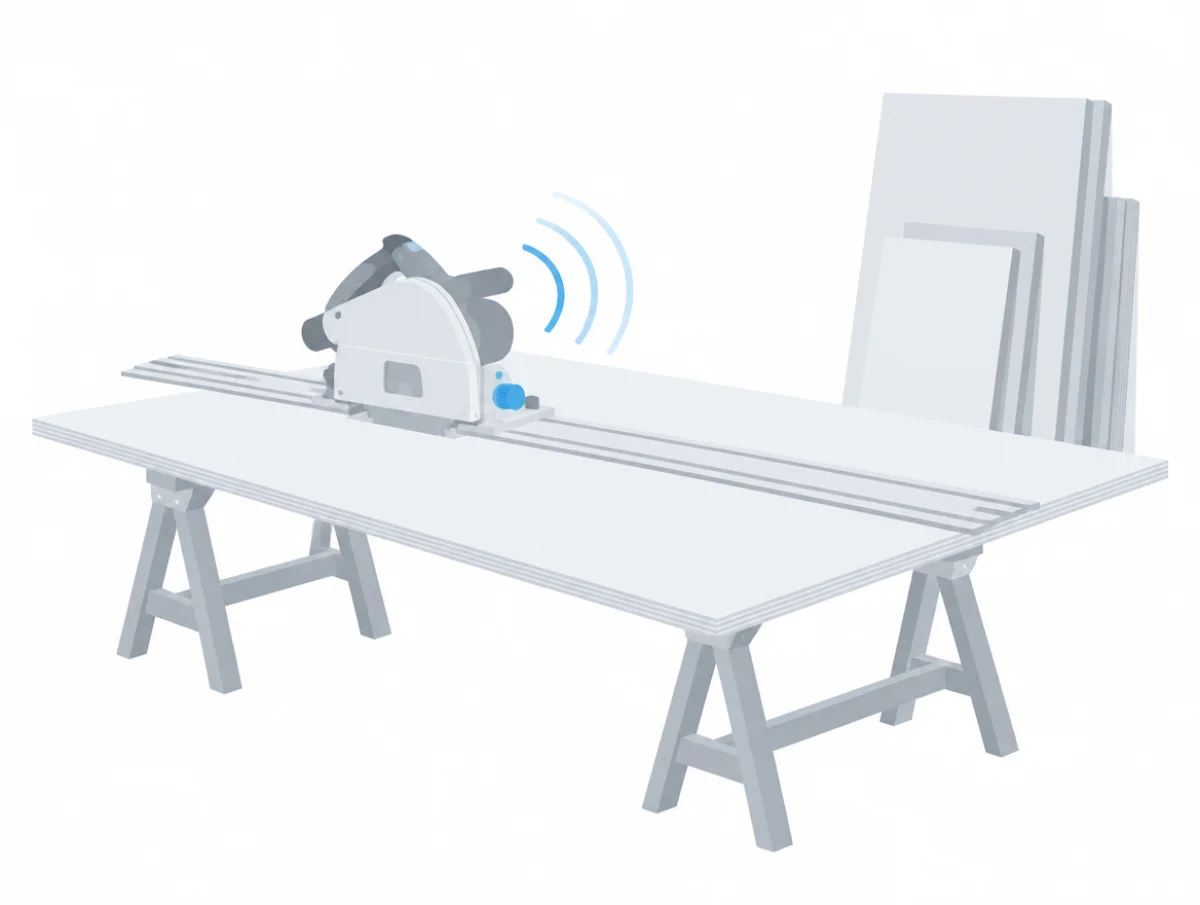
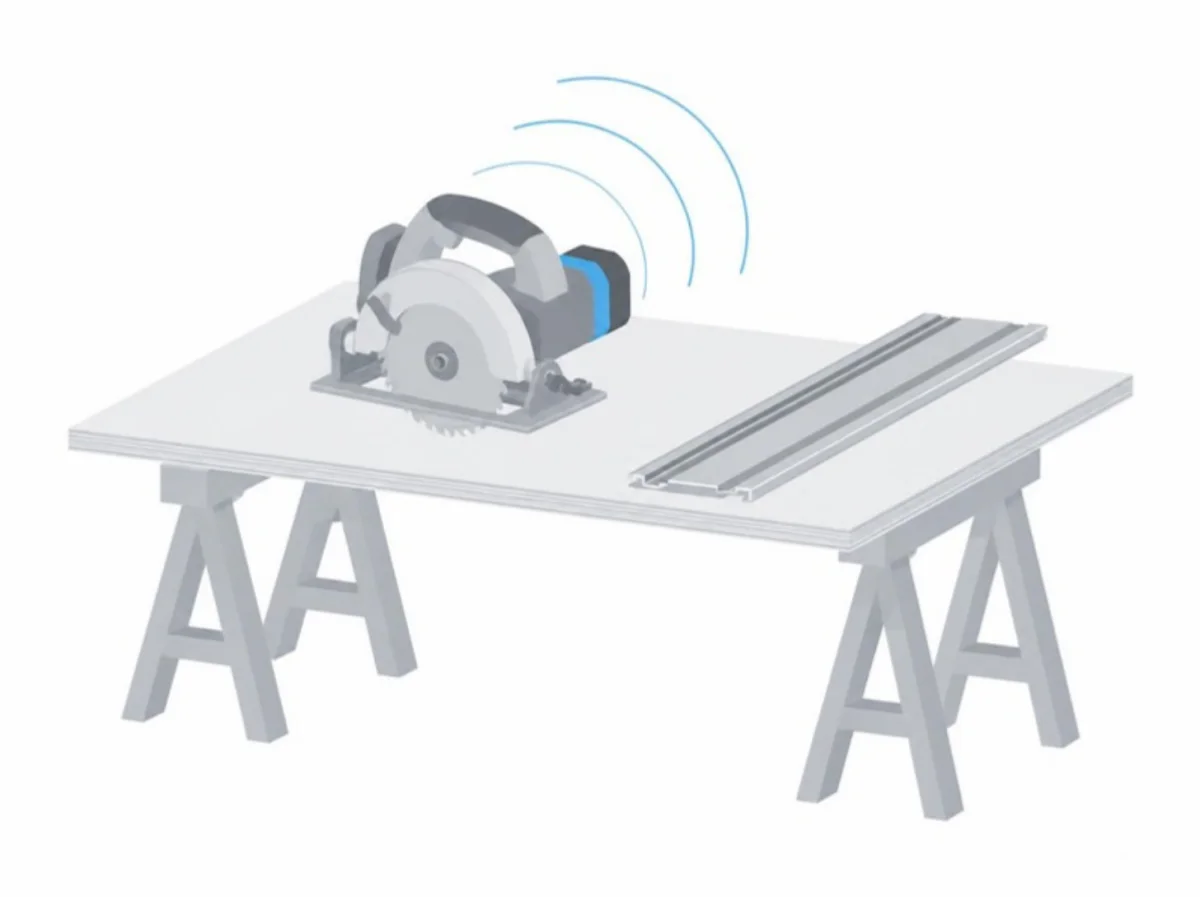
How loud is a track saw?
A track saw declares 90 to 98 dB(A) of sound pressure at the operator on the ten maker documents here, with sound power between 99 and 106 dB(A), every figure to EN 62841.
Those operator figures are LpA, the level measured where the user stands while the saw cuts. LwA is the total acoustic power the saw emits, the number that bears on someone working in the next room. The two are different measurements, so this page orders saws by LpA and lists LwA beside it without ranking on it.
Every maker here states an uncertainty K of 3 dB, which means two track saws separated by one or two decibels could trade places on a retest. The full span from Festool's TS 60 to Metabo HPT's C3606DPA, eight decibels at the operator, is wider than that margin. Why a plunge saw carries two decibel numbers at all is laid out in our page on power and pressure.
Which corded track saw is quietest?
Festool's TS 60 KEB-F-Plus is the quietest corded track saw on paper, declaring 90.00 dB(A) at the operator sawing wood, with DEWALT's DWS520 at 91 and Bosch's GKT13-225 at 92.
Here are the five corded declarations at the operator, as each maker printed them:
- Festool TS 60 KEB-F-Plus: 90.00 dB(A), K 3.00 dB
- DEWALT DWS520K: 91 dB(A), K 3 dB(A)
- Bosch GKT13-225L: 92 dB(A), K 3 dB
- Festool TS 55 FEQ-F-Plus: 93.00 dB(A), K 3.00 dB
- Makita SP6000J: 95 dB(A), K 3 dB(A)
The first three sit within two decibels, inside every maker's stated uncertainty, so price, rail system and depth of cut should settle a choice among them. Makita's SP6000 is five decibels above the TS 60, enough to clear K.
These corded figures come from European documents written for 230 V saws, and DEWALT's also covers a 115 V DWS520 with identical numbers. The US versions run on 120 V, and no maker says whether that shifts the figure.
Festool's TS 55 and TS 60 both declare 101.00 dB(A) of sound power, yet the TS 55 is three decibels higher at the operator. Sound power and operator pressure measure different things, and this pair shows they need not move together.
Which cordless track saw is quietest?
Festool's TSC 55 KSEB-Basic, the single battery model, is the quietest cordless track saw here at 91.00 dB(A) at the operator, followed by Makita's 40V GPS01 at 92 and DEWALT's DCS520 at 93.
These are the five cordless operator figures:
- Festool TSC 55 KSEB-Basic: 91.00 dB(A), K 3.00 dB, sawing wood
- Makita GPS01Z: 92 dB(A), K 3 dB(A), cutting wood
- DEWALT DCS520B: 93 dB(A), K 3 dB(A)
- Makita XPS01Z: 95 dB(A), K 3 dB(A), cutting wood
- Metabo HPT C3606DPA: 98 dB(A), K 3 dB(A)
The TSC 55 KSEB also has the lowest sound power of all ten picks, 99.00 dB(A). The Metabo HPT is seven decibels louder at the operator, though it cuts 66 mm deep where the Festool stops at 55.
Makita sells two cordless track saws in the US with the same 6-1/2 in. blade and identical depths. The 40V max GPS01 declares 92 dB(A) at the operator and the 18V X2 XPS01 declares 95, both cutting wood under EN62841-2-5.
The GPS01 also has the lower top speed, 4,900 RPM against 6,300. Makita does not link the two facts, but for anyone choosing between its platforms, the XGT saw is the lower declaration.
Is a cordless track saw quieter than a corded one?
No, battery power does not make a track saw quieter by these declarations. The lowest corded figure is 90 dB(A) and the lowest cordless one 91, and each group has a saw at 95.
Both groups are tested to the same EN 62841 family, so that comparison holds. What it shows is that motor, blade speed and housing matter more than the power source.
Festool makes the point within one brand. Its corded TS 55 declares 93 dB(A) at the operator, while its single battery TSC 55 KSEB, with the same 160 mm blade and 55 mm depth, declares 91. Its two-battery TSC 55 K, listed below the picks, comes in at 96.
Yes, on Makita's saws: Makita prints separate metal figures, and they are 3 to 7 dB above its wood figures at the operator. Festool's wood and metal rows are identical.
Makita's EU manuals show the jump clearly. The SP6000 rises from 95 to 98 dB(A), the SP001G (US GPS01) from 92 to 95, and the DSP600 (US XPS01) from 95 to 102, with sound power climbing to 110.
Festool lists "Sawing metal" rows for the TS 55 and TSC 55 KSEB, and each repeats its wood figure. DEWALT, Bosch and HiKOKI print one figure with no work mode named, so their metal noise is unknown.
For aluminum composite panel, solid surface or extrusions, a Makita owner should expect the metal row, not the wood one.
Why do US track saw pages leave out decibels?
US track saw pages leave out decibels because no maker on this page publishes noise on its American pages or in the American manuals we read.
Each number on this page was taken from a European document and paired with a US model by specification, and the matching works differently for each brand. DEWALT keeps the DWS520 and DCS520 model numbers in both markets, and Metabo HPT keeps HiKOKI's C3606DPA. Bosch's US GKT13-225 and its EU GKT 55 GCE share an article number stem, a speed range and depths.
Makita renames its cordless saws: the US XPS01 is the European DSP600 and the GPS01 is the SP001G, and each pair's manuals list identical specifications. The corded SP6000 keeps its name but not its speed, 2,000 to 5,200 RPM in the US manual against 2,200 to 6,400 in Europe, which we flag on its card.
Festool's American pages repeat the specification rows of its international pages but drop the noise lines, and the corded articles differ only by suffix letters.
Five saws with a maker figure stayed out of the order, two because the documents behind them could not support a place in the order, and three because they declare 96 to 99 dB(A) at the operator.
Milwaukee's EU page for the M18 FPS55 lists 92.4 dB(A) at the operator but names no standard or cutting mode, and its depth differs from the US 2831-20 by 2 mm. Metabo prints 93 on its US page and 89,5 in its manual for the KT 18 LTX 66 BL, and we would not choose between them.
Those three are Festool's twin battery TSC 55 K, Hilti's SC 6WP-22 and Bosch's cordless GKT18V-20GC, each at or above the loudest pick.
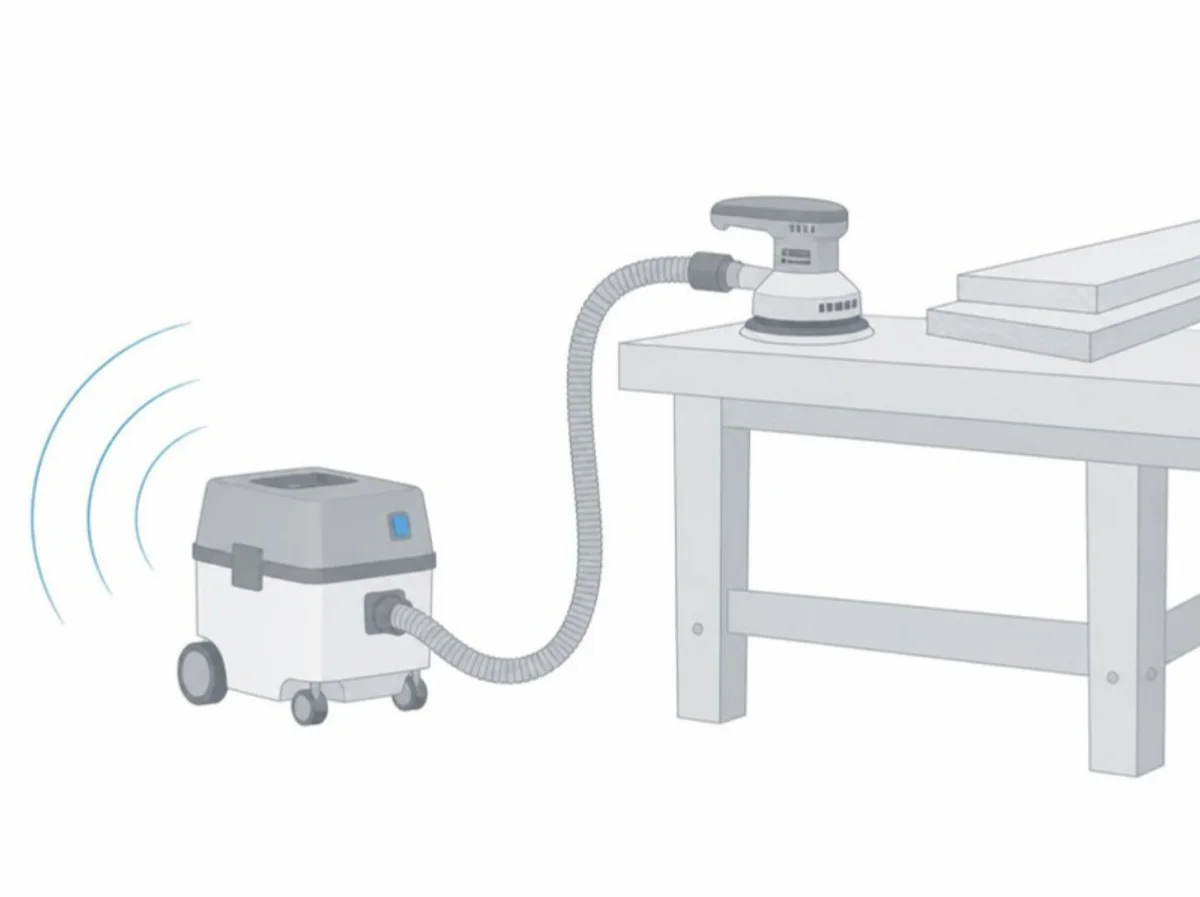
A track saw usually runs with an extractor on its dust port, which puts a second motor in the room; our dust extractor guide covers that half of the setup.