Why are Vornado, Air King and Tornado ranked separately?
Vornado, Air King and Tornado are ranked separately because none of them states the microphone distance, the test standard or the mounting position behind its noise figures, so a decibel from one cannot be weighed against a decibel from another.
Vornado prints "Sound (dBA)" rows with slash-separated values and no speed labels. Air King labels its "dB A" row high, medium and low, and marks its airflow numbers as tested to AMCA 230-99, a standard for air performance rather than sound. Tornado mentions one dB figure inside a sentence of sales copy.
Inside a maker's own line, the unknowns are at least the same unknowns. That is the basis for comparing a Transom with a Portal, or a 9155 with a 9166F, and for going no further.
Which Vornado window fan is quietest?
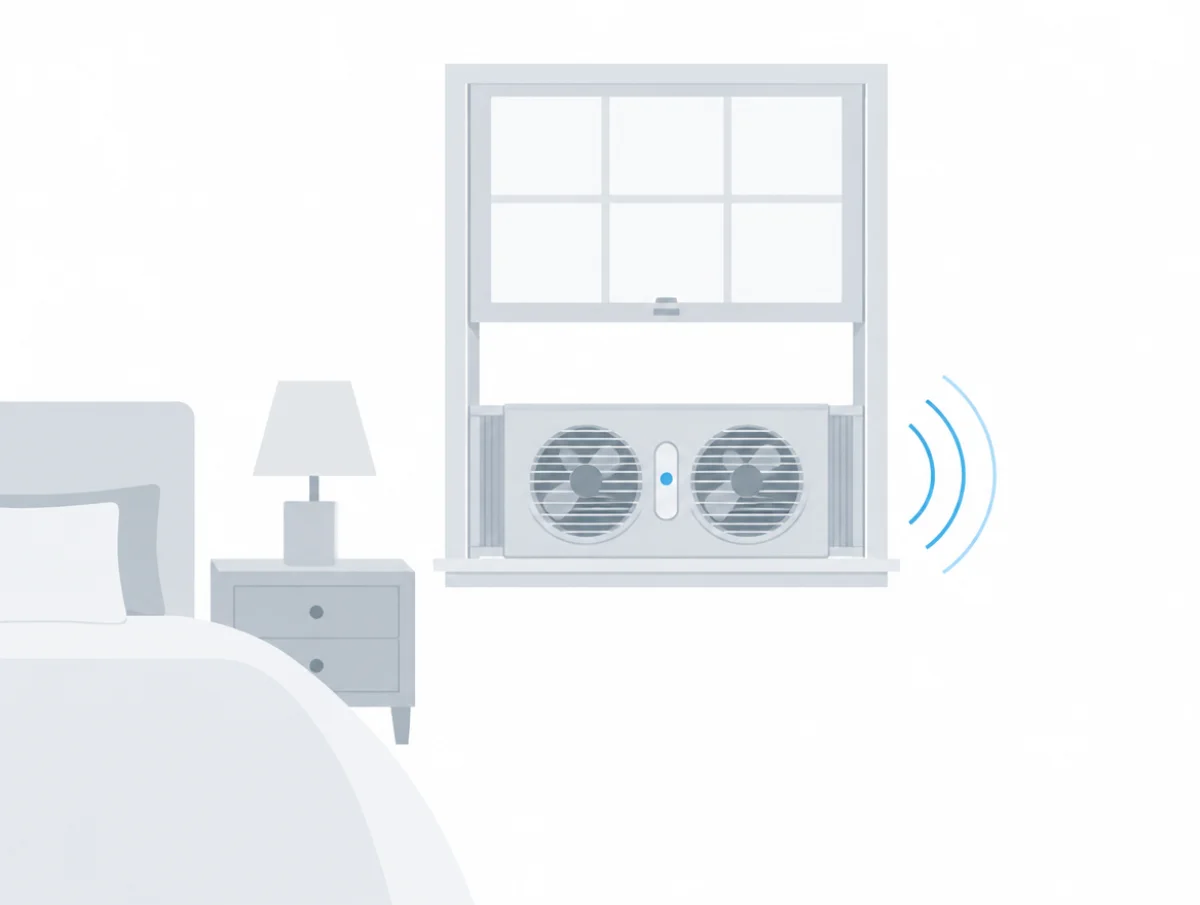
Every Vornado window fan, the Transom, Transom AE, Portal and Profile, prints 43 dBA on its bottom step, so on low the four tie. They differ only at the higher steps.
These are the four rows as Vornado prints them:
- Transom: 49/48/45/43 dBA, four speeds, $109.99
- Transom AE: 50/48/46/43 dBA, four speeds, $129.99
- Portal: 51/47/43 dBA, three speeds, $89.99
- Profile: 52/46/43 dBA, three speeds, $99.99
The two four-speed fans share their watts row, 28/25/24/23, and their airflow row, so they pair naturally. Step by step, the Transom is equal or a decibel lower, which is why the cheaper Transom gets the pick and the Alexa-enabled AE does not.
The two three-speed fans split the honors. The Portal prints 51 at the top against the Profile's 52, and the Profile prints 46 in the middle against the Portal's 47.
Reading Vornado's unlabeled rows
Vornado never writes which speed a figure belongs to. Our reading is that each row runs from the top speed down, because it matches the order of the watts and airflow rows printed beside it, so the final 43 on every model is low.
That reading lets a low be compared with a low. It does not let the Transom's turbo be compared with the Profile's high, since a four-speed and a three-speed fan do not share a top setting.
How loud is the Air King 9166F window fan?
The Air King 9166F lists 64 dB on high, 57 on medium and 50 on low, the same labeled row on Air King's page, its 9166 spec sheet and the manual for the 9166G.
Its smaller sibling, the 16 in. 9155, lists 64, 50 and 47. The two Air Kings tie on high, and the 9155 is 7 decibels lower on medium and 3 lower on low. It also moves much less air: 1360 CFM on low against 2510 for the 9166F.
Both are built for hard use, with rotary switches, guards that Air King says meet OSHA requirements and three speeds in each direction. Neither has a remote or a thermostat.
Two tables for one 9155
The manual Air King links for the 9155 belongs to an earlier 9155J and gives 62, 51 and 48 dB A, alongside 2210 CFM on high. The current spec sheet and page give 64, 50 and 47 with 2470 CFM.
The newer sheet is the one quoted here, and the older table sits in the catalog note so readers can compare.
What does Tornado say about its window fan noise?
Tornado gives single dB figures in its product descriptions, 45, 48 and 49 for three twin 9 in. fans, without naming a speed, and lists "In - 52; Exhaust - 55" for an outdoor rated model.
A single number with no setting attached could be low, high or anything between, so the three twin fan figures are not put in order. Only the HI-FAN-BFC-9BR, at 48, was in stock on October 24, 2026, and it is the one Tornado pick.
The WINPRO-1P's two figures are the one place any maker here splits intake from exhaust. Its description also calls 55 the maximum, which makes the exhaust figure a ceiling as much as a reading.
What is the quietest window fan for a bedroom?
No window fan can be named the quietest for a bedroom across brands, since makers measure on unstated terms. Within each brand, the low setting gives the lowest figure: 43 dBA for every Vornado, 47 dB for Air King's 9155.
For sleeping, the low figure matters more than the top one, because that is the speed a bedroom fan spends the night on. Vornado's four tie there, which leaves features to decide it.
The Transom and Transom AE dim their own displays, which Vornado's guide says cuts "light pollution", and both run a thermostat mode that changes speed as the room cools. Only the Transom adds a handheld remote.
Vornado's guides for the Portal and Transom AE also say the foam side blocks create a "barrier against outside noises & temperatures". That is a claim about street noise coming through the gap, with no figure behind it.
Is there a quiet window fan with a remote?
Yes, the Vornado Transom ships with a remote and prints 43 dBA on low, the lowest step in Vornado's table. Tornado's HI-FAN-BFC-9BR also has a remote, with one 48 dB figure and no speed.
The Transom AE swaps the handheld for Alexa voice and app control, at the same 43 on low. Tornado's BFC-9ER adds an 8-hour timer to its remote and was unavailable on October 24, 2026.
Several other twin fans with remotes give no figure at all: Lasko's W09550, two Comfort Zone models and Perfect Aire's 2PAFW9. They may be quiet, but nothing their makers publish shows it.
Lasko, Comfort Zone, Genesis, Perfect Aire and Kenmore print no decibel figure for any window fan on their US sites, and Holmes and Bionaire no longer list a window fan there at all.
Lasko sells one window fan, the W09550 twin with a remote, and its page and manual give no noise row. Lasko's support site says it does not currently test fans for sound.
Comfort Zone lists eight twin and triple window fans with no figure; one description promises speeds "from a whisper-quiet low to a high-powered blast". Genesis's A1, Perfect Aire's 2PAFW9 and Kenmore's Triple Window Fan 32-33052 give speeds and features only.
Dreo, a fan maker that publishes figures for its towers, sells no window fan in the US.