Low frequency noise is sound at the deep end of human hearing, roughly 20 to 200 Hz, heard as a hum, a throb or a distant engine idling. The commonest sources are rotating machines such as compressors, pumps and fans. It passes through walls that stop higher pitches, and the dBA figures on appliance spec sheets give it very little weight.
That is why a hum can be so hard to pin down. Every figure below comes from WHO, Defra, NIOSH, the Institute of Acoustics or peer-reviewed reviews, all read in November 2026.
What is low frequency noise?
Low frequency noise is sound between about 20 and 200 Hz, the bottom of the audible range, while sound below 20 Hz is called infrasound. Some researchers, and the UK's Institute of Acoustics, start the band lower, at 10 Hz.
The cleanest wording is in a 2004 review of hearing at low and infrasonic frequencies by Møller and Pedersen of Aalborg University: "Sound at 20-200 Hz is called low-frequency sound, while for sound below 20 Hz the term infrasound is used." A 2019 NIOSH health hazard evaluation draws the same line.
Geoff Leventhall's review in the same journal issue, Low frequency noise and annoyance, sets the range at "about 10 Hz to 200 Hz". The Institute of Acoustics, the UK professional body for acousticians, follows that in its January 2024 briefing note and admits the edges between infrasound, low and higher frequencies "are not well defined".
| Term | Frequency range | Defined this way by |
|---|---|---|
| Audible range | 20 to 20,000 Hz | WHO, 1999 |
| Low frequency sound | 20 to 200 Hz | Møller and Pedersen, 2004 |
| Low frequency noise | About 10 to 200 Hz | Leventhall, 2004; Institute of Acoustics, 2024 |
| Low frequency noise | Below 200 Hz | NIOSH, 2019 |
| Infrasound | Below 20 Hz | Møller and Pedersen; NIOSH |
| Defra complaint curve | Third-octave bands from 10 to 160 Hz | NANR45, 2005 |
For scale, the IOA note places middle C on a piano at about 256 Hz. The whole band sits below it.
Infrasound starts below 20 Hz
Infrasound is audible if it is loud enough. Pure tones lose their sense of pitch around 20 Hz, Møller and Pedersen found, and "below 10 Hz it is possible to perceive the single cycles of the sound," along with pressure at the eardrums. WHO's 1999 guidelines put it simply: "Below 20 Hz we hear individual sound pulses rather than recognizable tones."
The levels needed are high. The NIOSH report cites hearing thresholds from 107 dB at 4 Hz to 88 dB at 16 Hz, against under 20 dB at 200 Hz. A 16 Hz tone therefore has to be at least 68 dB stronger than a 200 Hz tone before most people hear it at all.
What causes low frequency noise at home?
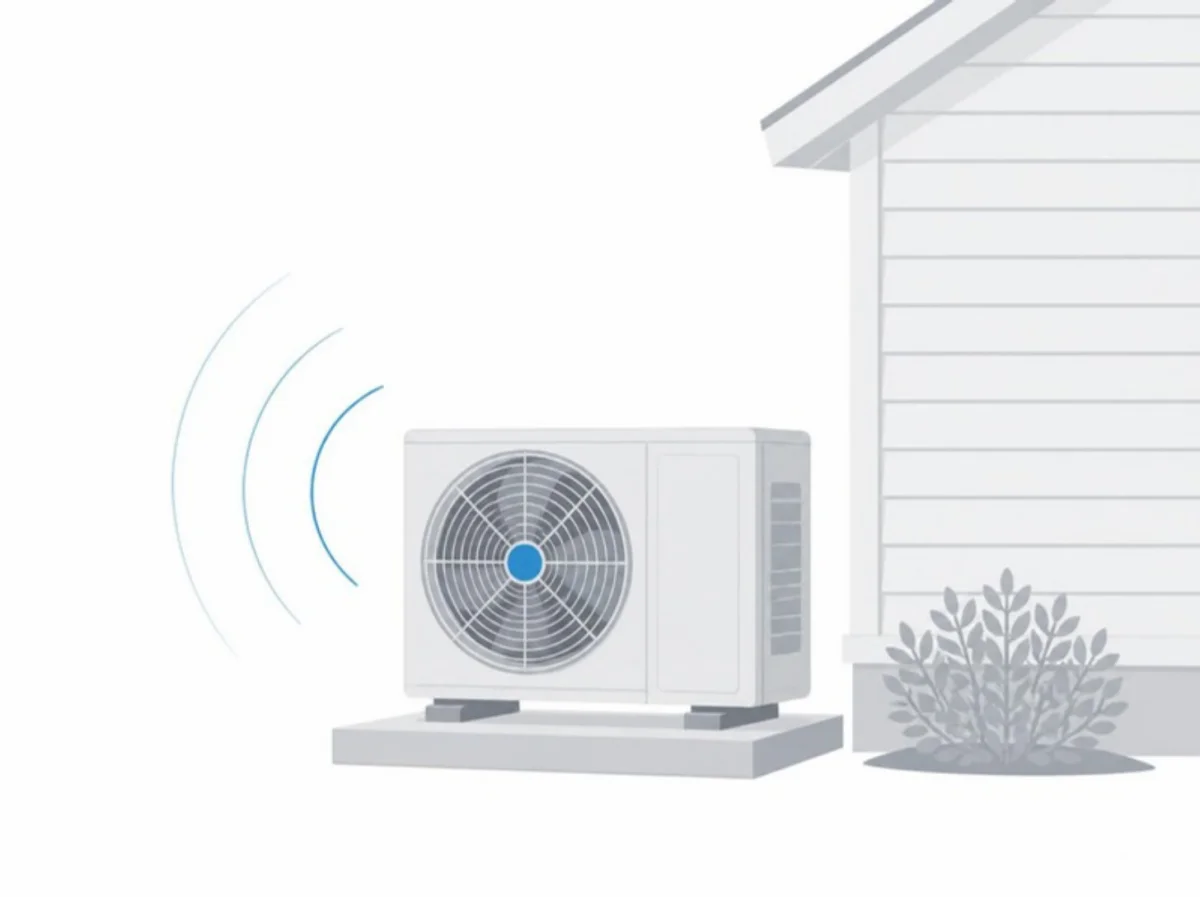
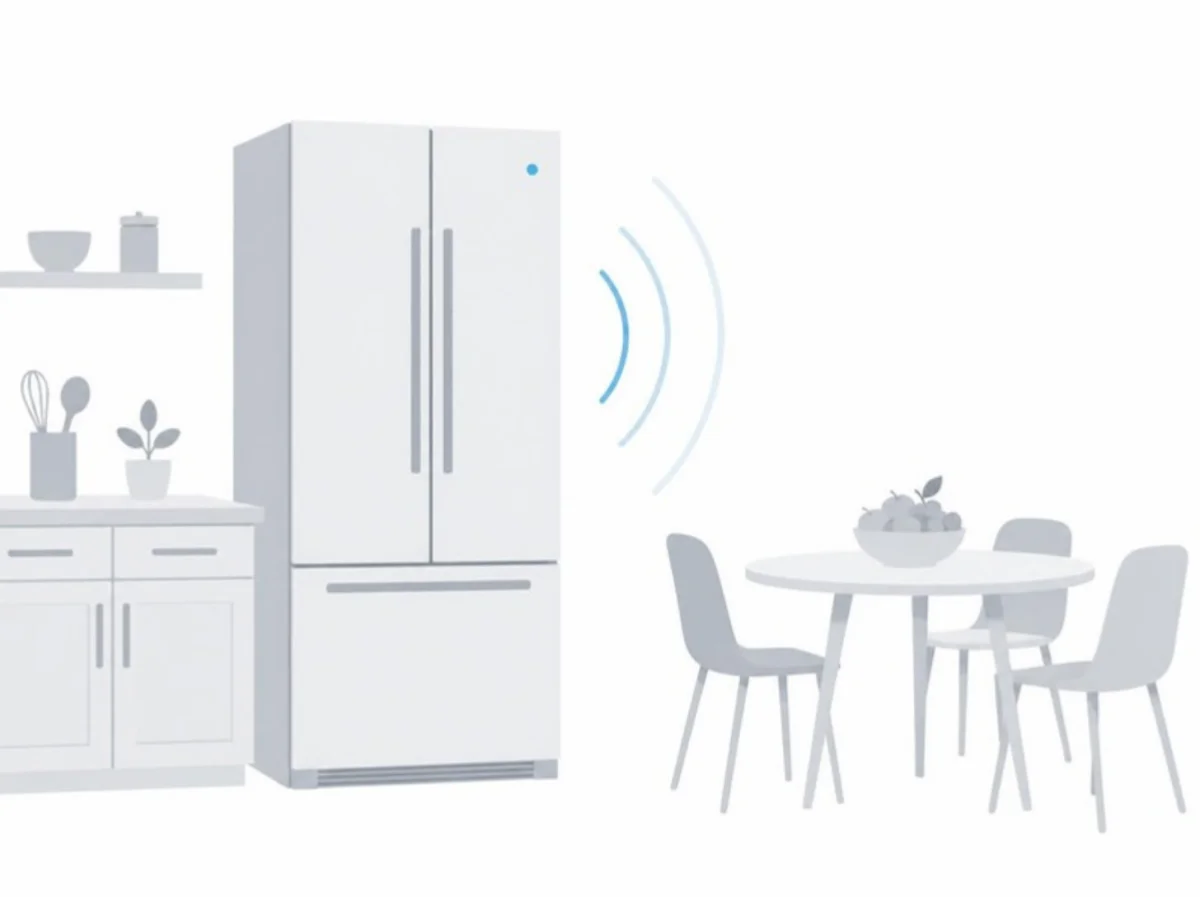
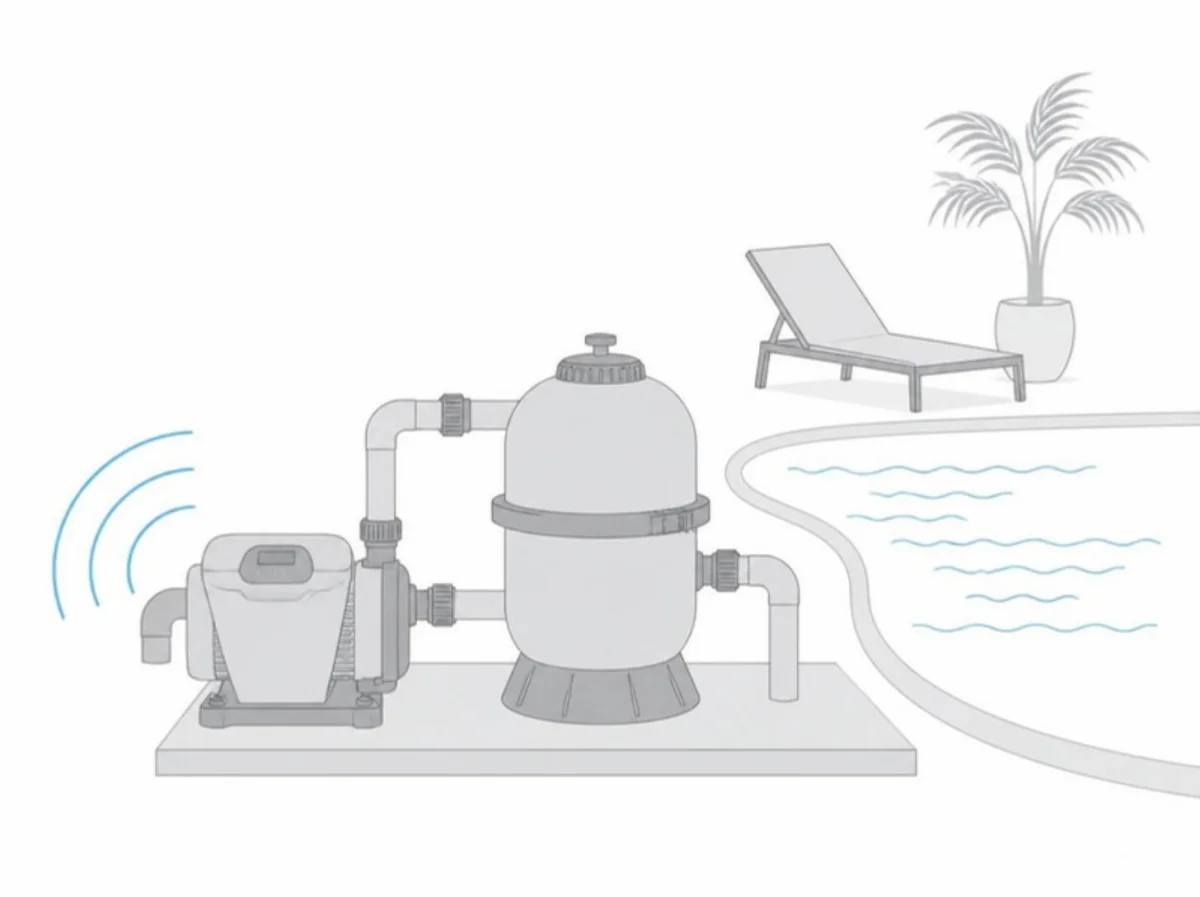
Rotating machinery is the most common source: compressors, pumps, fans and motors, inside the home, next door or kilometres away. Defra's complaint procedure names fridges, fish tank pumps and central heating pumps among the domestic culprits.
Written for the UK environment department in 2005 by a Salford University team, the procedure is known by its contract number, NANR45. It describes sources ranging "from large industrial equipment, at distances up to several kilometres away" to "small domestic items (fridges, fish tank pumps, central heating pumps), perhaps in a neighbouring property."
The WHO Guidelines for community noise widen the list. Continuous low frequency noise comes from "compressors, pumps, diesel engines, fans, public works"; intermittent bursts come from "large aircraft, heavy-duty vehicles and railway traffic"; and in residential areas the document points to "heat pumps, ventilation systems and traffic". A 1996 review by Birgitta Berglund and colleagues in the Journal of the Acoustical Society of America adds wind turbines and air-conditioning units. The IOA adds electrical power transmission systems.
| Source | What the source document records |
|---|---|
| Refrigerator | A tone "typically at between 49 and 50 Hz", cycling every 5 to 60 minutes (NANR45) |
| Mains electrical hum | 100 Hz, the second harmonic of the power line frequency (IOA, writing for the UK) |
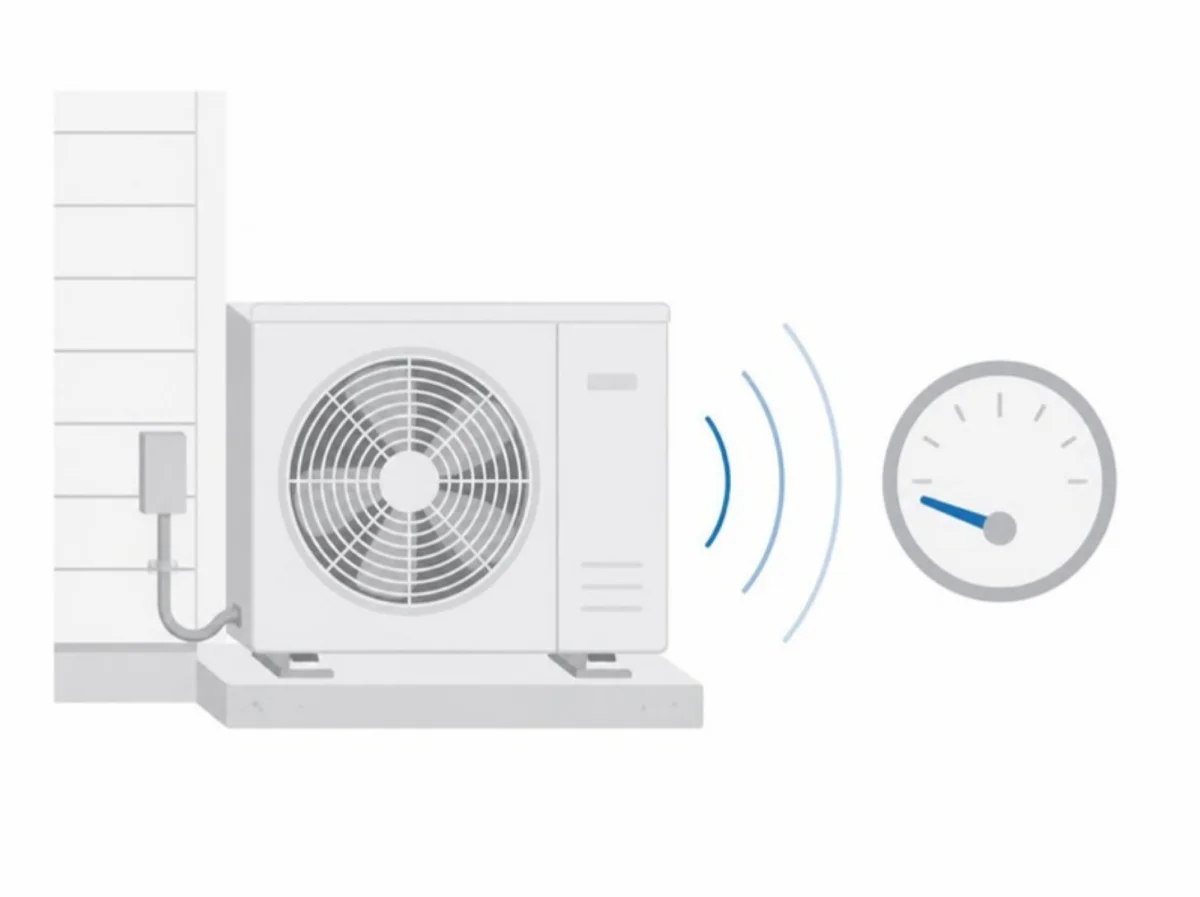
| Heat pump compressor | A low frequency "drone", against the fan's high frequency "whirring" (City of Vancouver) |
| Ventilation systems | Can disturb rest and sleep "even at low sound pressure levels" (WHO) |
| Road traffic | Can push the 80 to 160 Hz bands over Defra's curve, with peaks at rush hour (NANR45) |
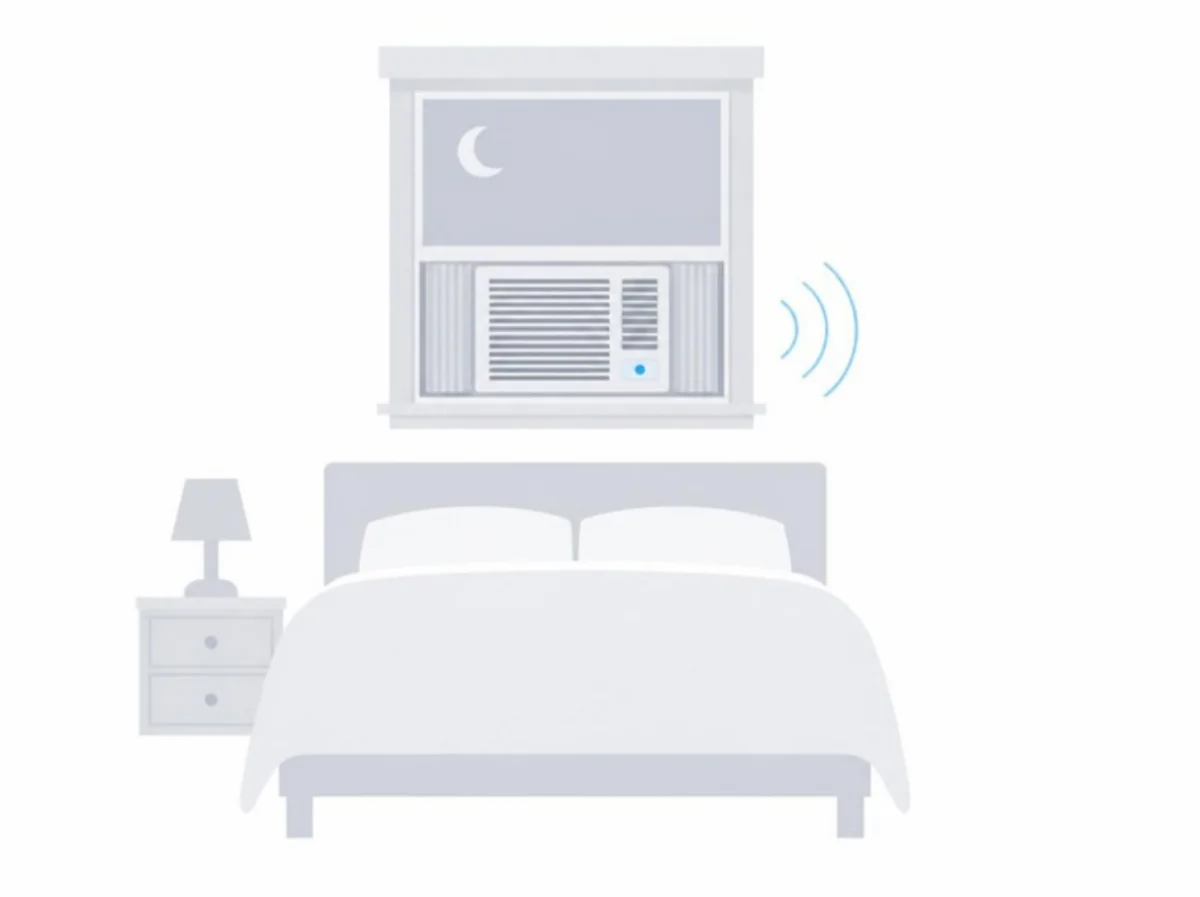
Appliance makers describe the same hums as routine. In its guide to heat pump sound, Daikin UK writes that "The compressor produces a steady, low hum". Samsung's refrigerator humming page calls the sound "usually part of normal operation" and adds that it "can become more noticeable during winter when ambient noise levels are lower." The IOA makes the parallel point about night: the sound is often more noticeable then, "when not masked by everyday sounds."
Our heat pump noise and refrigerator noise explainers separate normal hums from faults.
Walls stop high pitches far better than low ones
Low frequency sound has very long wavelengths, so it bends around barriers and loses little energy passing through ordinary walls and floors. At 20 Hz the wavelength is almost 56 feet, according to NIOSH.
The NIOSH report spells out the consequence: such sound "is difficult to stop with barriers or enclosures because of diffraction and surface propagation, and is minimally attenuated by common building structures." Berglund's review lists the "reduced efficacy of many structures (dwellings, walls, and hearing protection)" against low frequencies as a reason the noise is a special concern. The City of Vancouver's heat pump installation guide turns that into advice for homeowners: "High frequency sounds are readily reduced by structures, but lower frequencies may penetrate structures unless they are reduced at the source."
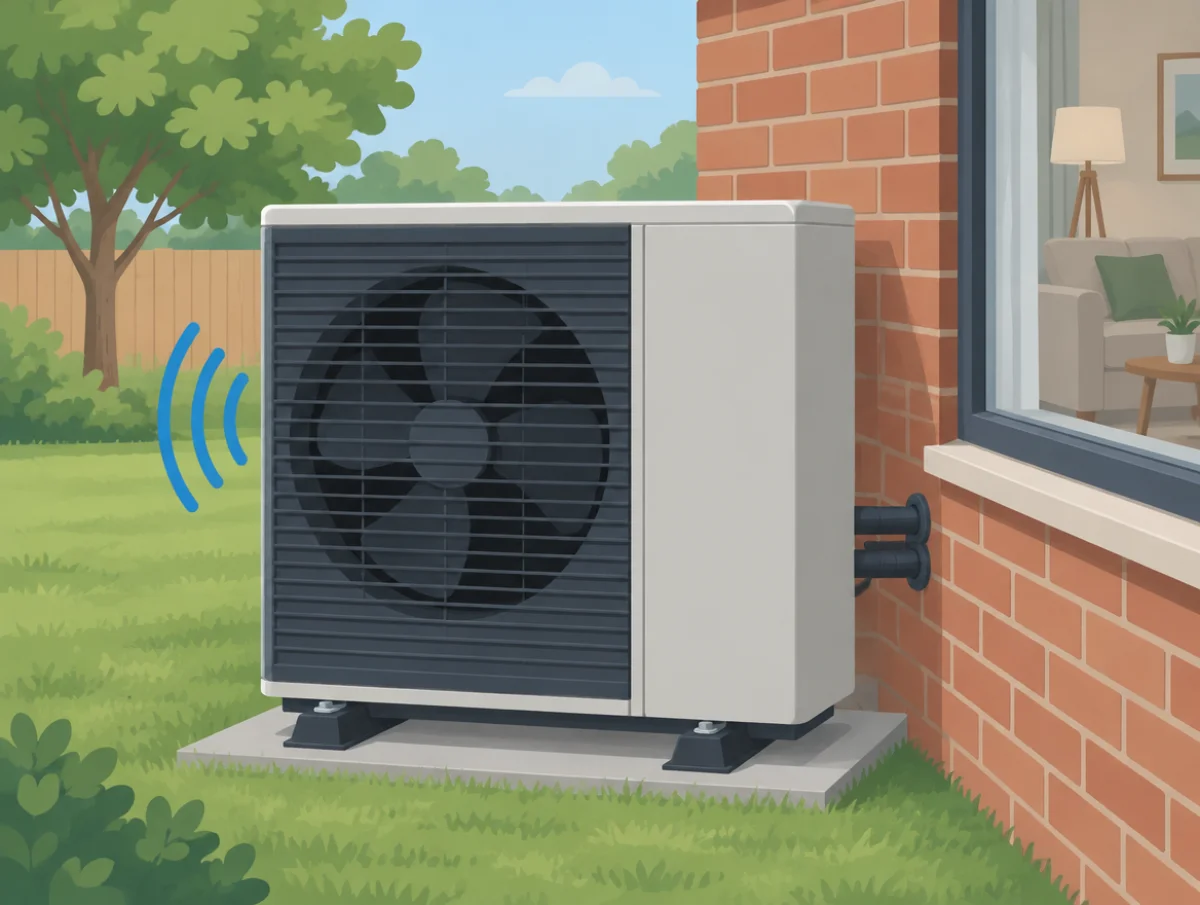
Structure-borne vibration adds a second route. WHO notes that low frequency noise "may also produce vibrations and rattles as secondary effects." Daikin's guide warns that heat pump vibration "can transfer through walls or decking if the unit is not mounted securely, creating a low-frequency hum." Vancouver's guide recommends a concrete pad with rubber pads or dampeners, and lists variable speed compressors and soft start among quieter features; our inverter compressor explainer covers those designs.
Indoors, the level shifts over short distances. NANR45 tells investigators to fix the microphone "within a few centimetres", since "low frequency sound levels can vary significantly with position in a room." For flats and shared walls, our quiet apartment guide covers which machines neighbors notice most.
Why a dBA reading understates a hum
A-weighting, the filter behind dBA, turns low frequencies down to mimic how the ear hears quiet sounds, so a dBA figure gives a deep hum little weight. C-weighting is close to flat, which keeps most of the low end in a dBC reading.
Defra's procedure says standard noise descriptors rest on "the A weighted sound level (dB(A)) which effectively filters out low frequency sounds." WHO reaches the same point from the health side: "Since A-weighting underestimates the sound pressure level of noise with low-frequency components, a better assessment of health effects would be to use C-weighting."
C-weighting is described in the NIOSH report as similar to linear weighting "except for slight attenuation at frequencies below 50 Hz and above 5,000 Hz", and above 500 Hz the two weightings "are quite similar." So the gap between dB(C) and dB(A) for one sound roughly gauges its low frequency content.
| Gap between dB(C) and dB(A) | What the source makes of it |
|---|---|
| More than 10 dB | WHO, 1999: perform a frequency analysis |
| 20 dB or more | Researchers cited by NIOSH: "indicative of an unbalanced noise spectrum" and potential low frequency noise problems |
NIOSH's own case shows how wide the gap can run. In a Maryland administrative building near a methane flare, its 2019 readings ranged from 55.9 to 67.2 dBC but only 26.5 to 39.8 dBA, gaps of 17 to 38 dB. By A-weighted standards those rooms were quiet, yet employees had reported unusual sounds and vibration, and the flare noise peaked in the 20 Hz band.
Appliance ratings are almost all A-weighted, as our dBA explainer counts, and so are the B(A) declarations covered in sound power vs sound pressure. A spec sheet in dBA says little about a machine's low end.
Is low frequency noise harmful to health?
At the levels found in homes, research links low frequency noise mainly to annoyance and disturbed sleep, and evidence for other health effects is limited. WHO nonetheless treats it as a concern and recommends lower limits where it dominates.
WHO's 1999 guidelines state that "The evidence on low-frequency noise is sufficiently strong to warrant immediate concern," and that its health effects "are estimated to be more severe than for community noises in general." For bedrooms the guideline for continuous noise is 30 dB LAeq. "For noise with a large proportion of low-frequency sound a still lower guideline value is recommended," and with low frequency sources, disturbance "may occur even though the sound pressure level during exposure is below 30 dBA."
Newer evidence is thin. A 2016 systematic review by Baliatsas and colleagues at NIVEL and RIVM in the Netherlands found only seven qualifying studies from 2000 to 2015. "Some associations were observed between exposure to LFN and annoyance, sleep-related problems, concentration difficulties and headache," the authors wrote, but evidence on chronic medical conditions "was very limited." They put the pooled prevalence of high annoyance attributed to low frequency noise at about 10%, and judged the research "scarce" with "methodological shortcomings."
Annoyance behaves differently at low frequencies. Leventhall found that it "increases rapidly with level" and raised "a possibility of learned aversion" to the sound. Defra's procedure notes that only a relatively small number of people are affected, "those who are tend to suffer severe distress", and that some sleep in a car or shed to escape it.
Intense low-frequency noise, Berglund's review adds, "appears to produce clear symptoms including respiratory impairment and aural pain", while effects at lower intensities are "difficult to establish for methodological reasons." This page gives no medical advice. Where no source can be found, the IOA reports that some sufferers benefited from a Defra-backed trial of support centres, and that an earlier approach using cognitive behavioural therapy "had useful results".
How to track down a hum that is driving you crazy
Start a written log of when and where you hear it, check whether others hear it too, and run your own appliances one at a time. Those are the opening steps of the Defra procedure UK council officers use.
NANR45 is written for environmental health officers, but its interview questions and measurement rules translate into a home log:
- Note the hours, days and seasons when the hum is present or absent.
- Mark the exact spot where it is clearest.
- Ask whether anyone else in the home hears it.
- Describe it in your own words before reading anyone else's descriptions.
- Note whether you also hear it in other buildings.
- Switch each running appliance on and off for a few minutes and record any change.
- Keep the log for at least three days, including nights.
Complainants describe the sound in fairly consistent terms, the procedure observes: "Like a diesel engine idling in the distance", "A low throbbing, beating, rumbling", or "Pressure on the ears". It also cautions that people may pick up those phrases from reading about the subject. Item 4 guards against that.
Domestic equipment is the first suspect to rule in or out. Defra's investigators leave normal appliances running but record each one on and off at the start, since "Almost all fridges produce a tone at 49.5Hz and cycle on and off on a fairly regular cycle." A pattern that repeats every 5 to 60 minutes points at the fridge; one that peaks at rush hour and dips between 2 and 4am points at traffic. Night recordings are easiest to read, because fewer other sounds interfere.
A hum heard everywhere, including places far from any likely source, raises the possibility of an "internal" sound, though the procedure stresses that only a minority of complainants turn out to have tinnitus. It also records that in "typically 50% to 80% of cases" no environmental sound is found to account for the complaint. UK councils investigate such complaints under the Environmental Protection Act 1990; none of our sources describes a US equivalent.
If the hum turns out to come from your own machine, our page on why an appliance gets louder lists the mounting and wear faults makers check first.
Can a phone app detect low frequency noise?
A phone app can log when a hum comes and goes and compare dBC with dBA, but no source we found has verified phone microphones on quiet low frequency tones. Professional investigators use calibrated meters with third-octave bands down to 10 Hz.
The NIOSH Sound Level Meter app offers "All three major weighting networks (A, C, and Z)" and runs only on iOS. NIOSH states that it meets Type 2 requirements of the IEC 61672-3 standard "with calibrated external microphone." Its 2014 accuracy study found three apps within ±2 dBA of a reference meter, using pink noise from 20 Hz to 20 kHz at 65 to 95 dB. A faint 40 Hz hum was not part of that test.
Investigators aim higher. NANR45 prefers a logging meter with third-octave filters from 10 Hz to 160 Hz, and notes that the standard UK verification of a meter checks it acoustically only down to 125 Hz, while low frequency noise "is often around 40Hz, and could extend down to 10Hz." The IOA calls for a calibrated Class 1 meter and warns that private consultants' fees can run into thousands of pounds.
Used within those limits, a phone is still useful. Readings taken at one spot on A and then C weighting show whether the gap is large, and a gap over WHO's 10 dB mark is a reason to ask for proper frequency analysis. Our guide to measuring noise at home covers placement and app settings.
The Defra reference curve
Investigators compare five-minute Leq readings in each third-octave band against this curve, and look for the band that exceeds it by the most:
| Third-octave band | Reference level (dB, Leq) |
|---|---|
| 10 Hz | 92 |
| 12.5 Hz | 87 |
| 16 Hz | 83 |
| 20 Hz | 74 |
| 25 Hz | 64 |
| 31.5 Hz | 56 |
| 40 Hz | 49 |
| 50 Hz | 43 |
| 63 Hz | 42 |
| 80 Hz | 40 |
| 100 Hz | 38 |
| 125 Hz | 36 |
| 160 Hz | 34 |
The curve is relaxed by 5 dB when the noise occurs only by day, and by another 5 dB for steady rather than fluctuating sound. Below 31.5 Hz it rests on the average threshold of hearing, so a sound up to about 5 dB under it may still be audible to the person complaining, the procedure warns.
The standards, agencies and studies behind this page
Definitions come from the 2004 Noise & Health reviews by Møller and Pedersen and by Leventhall, and from the IOA briefing note of January 2024. Sources and health findings come from WHO's 1999 guidelines, Berglund, Hassmén and Job's 1996 review, and Baliatsas and colleagues' 2016 systematic review. The method, curve and fridge and traffic signatures are from Defra's NANR45 procedure of February 2005 (the IOA cites a December 2011 revision). Weighting figures and the Maryland case are from NIOSH evaluation 2019-0119-3362. Daikin UK and Samsung describe their own products. We did not test any app or meter.