Which 80mm fan is the quietest?
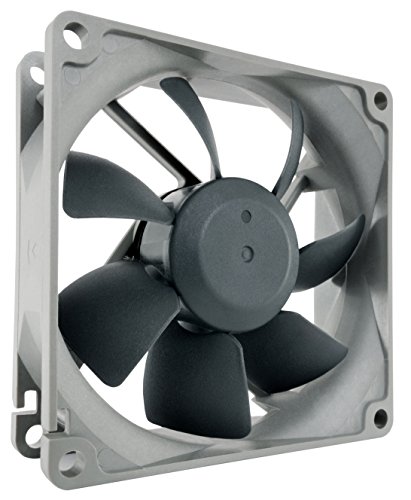
Noctua's NF-R8 redux-1200 is the quietest 80mm fan at full speed on any maker sheet we read: 9.1 dB(A) at 1200 RPM. With its adaptor, Noctua's NF-A8 ULN drops to 6.5 dB(A) at 1100 RPM.
Those two numbers share a maker and an infosheet format, so they compare cleanly with each other. They do not compare cleanly with be quiet!'s 18.2 or Thermalright's 23.3, because the three makers never say how they measured.
Each maker's lowest full-speed rating:
- Noctua: 9.1 dB(A) from the NF-R8 redux-1200 at 1200 RPM
- be quiet!: 18.2 dB(A) from the 3-pin Pure Wings 2 80mm at 1900 rpm
- Thermalright: 23.3 dBA (MAX) from the TL-8015 at 2200 RPM
- ARCTIC: 0.3 Sone and no dB(A) value for the P8, P8 PWM PST and F8
Read that list across, not down. It shows each maker's best case, not a ranking of brands.
Each figure is grouped by maker first, then by the speed it was quoted at, because a fan's dB(A) rating belongs to its own top speed and no 80mm maker publishes a test distance or standard.
Noctua prints a table with speed, airflow, noise and pressure in one column, and adds a second or third column for each adaptor in the box. be quiet! labels every row "at 100% PWM / 12V". Thermalright marks each row "(MAX)", including the rated speed, which we read as the figure at 2200 RPM.
ARCTIC prints a sone value beside a speed range, so its figure cannot be tied to one speed or set in a dB(A) list. Our page on comparing decibel ratings across brands explains why we hold back from cross-brand rankings.
What is the quietest Noctua 80mm fan at full speed?
The NF-R8 redux-1200 is the quietest Noctua 80mm fan at full speed, 9.1 dB(A) at 1200 RPM, followed by the NF-A8 ULN at 10.4 dB(A) and 1400 RPM.
Noctua's 80 x 80 x 25 mm fans, lowest full-speed figure first:
- 9.1 dB(A), 1200 RPM: NF-R8 redux-1200 (35.8 m³/h, 0.67 mmH2O)
- 10.4 dB(A), 1400 RPM: NF-A8 ULN (34.8 m³/h, 1.05 mmH2O)
- 16.1 dB(A), 2000 RPM: NF-A8 FLX (50.4 m³/h, 1.96 mmH2O)
- 17.1 dB(A), 1800 RPM: NF-R8 redux-1800, 3-pin or PWM (53.3 m³/h, 1.41 mmH2O)
- 17.7 dB(A), 2200 RPM: NF-A8 PWM, plus the 5V and 5V PWM versions (55.5 m³/h, 2.37 mmH2O)
The order follows top speed with one exception: the NF-A8 FLX at 2000 RPM lists 16.1 dB(A), a full decibel under the NF-R8 redux-1800 at 1800 RPM. The NF-A8 PWM spins 400 RPM faster than the redux-1800 and adds pressure, 2.37 mmH2O against 1.41, for 0.6 dB(A) more.
Our Noctua fan decibel page lists every size from 40mm to 200mm.
How much quieter does an adaptor make an 80mm Noctua?
Noctua's adaptors cut its 80mm figures by 3.2 to 8.2 dB(A) by lowering top speed. The NF-A8 FLX shows the full ladder, from 16.1 dB(A) at 2000 RPM to 7.9 at 1200 with the Ultra-Low-Noise Adaptor.
Each adaptor figure Noctua prints for its 80mm fans, with the capped speed:
- NF-A8 ULN with L.N.A.: 6.5 dB(A) at 1100 RPM
- NF-A8 FLX with U.L.N.A.: 7.9 dB(A) at 1200 RPM
- NF-A8 FLX with L.N.A.: 12.9 dB(A) at 1650 RPM
- NF-A8 PWM with L.N.A.: 13.8 dB(A) at 1750 RPM
One pair lines up at the same speed. At 1200 RPM the FLX on its Ultra-Low-Noise Adaptor lists 7.9 dB(A) with 28.9 m³/h, and the redux-1200 lists 9.1 with 35.8 m³/h. The newer A-series blade is quieter there, and the R8 moves more air.
On the NF-A8 PWM, Noctua says the adaptor can fix the fan at 1750 RPM or "cap the maximum speed when using automatic PWM control", so the board keeps its low end.
Is be quiet!'s Pure Wings 2 80mm quieter as a 3-pin or PWM fan?
The 3-pin Pure Wings 2 80mm lists the lower figure, 18.2 dB(A) against 19.2 for the PWM version, with both rated at 1900 rpm, 26.3 CFM and 1.85 mm H2O.
be quiet! gives no reason for the one decibel gap. The tables differ only in the connector and the input current, 0.12 A on the 3-pin fan and 0.08 A on the PWM one. Both use a rifle bearing with an 80,000 hour lifespan rating and carry three years of warranty.
The PWM version is the more useful fan on a modern board, since the header can slow it far below 1900 rpm. On a 3-pin header, the 3-pin model starts from a lower full-speed figure.
Both product pages were live on November 5, 2026 with no end-of-life note, though be quiet!'s case fan overview page listed only its 120mm and 140mm series.
How loud are Thermalright's 80mm fans?
Thermalright lists 23.3 dBA (MAX) for the slim TL-8015 and 24 dBA (MAX) for the 25 mm TL-B8, both at a rated 2200 RPM, so its 15 mm fan prints the lower figure.
The thicker fan earns its extra 0.7 dBA in pressure and air: 2.7 mm H2O and 34 CFM on the TL-B8, against 1.25 mm H2O and 28.4 CFM on the TL-8015. White versions, the TL-B8W and TL-8015W, carry the same tables.
Thermalright states no warranty term and no price on either page.
Which quiet 80mm fan pushes air through a drive cage or filter?
Thermalright's TL-B8 has the most pressure of any 80mm fan here with a decibel figure, 2.7 mm H2O at 24 dBA, and Noctua's NF-A8 PWM is next, 2.37 mmH2O at 17.7 dB(A).
Pressure decides how well a fan holds its airflow against resistance, such as a mesh filter, a stack of hard drives or a heatsink. The slow fans at the top of the noise list give much of it up:
- Thermalright TL-B8: 2.7 mm H2O at 2200 RPM, 24 dBA
- Noctua NF-A8 PWM: 2.37 mmH2O at 2200 RPM, 17.7 dB(A)
- Pure Wings 2 80mm PWM (be quiet!): 1.85 mm H2O at 1900 rpm, 19.2 dB(A)
- Noctua NF-R8 redux-1800: 1.41 mmH2O at 1800 RPM, 17.1 dB(A)
- Noctua NF-R8 redux-1200: 0.67 mmH2O at 1200 RPM, 9.1 dB(A)
ARCTIC's P8 Max claims 5.3 mmH2O at up to 5000 rpm, more than any of these, but its loudness comes as 0.6 Sone with no speed attached.
Which 80mm fans suit a 3D printer or USB power?
Noctua's NF-A8 5V and 5V PWM suit 5 V printer boards and USB power, both listing 17.7 dB(A) at 2200 RPM. Noctua makes no 24 V 80mm fan.
Noctua's own 3D printer FAQ names 40, 60 and 80mm as the sizes "most commonly used" for extra part cooling, and says its 24V versions come only in 40mm, 120 and 140mm. A 24 V printer therefore needs a step-down converter or a different fan for an 80mm slot.
Both 5 V fans ship with a USB power cable, which Noctua says lets them run on power banks, and an OmniJoin adaptor set for proprietary headers. Their airflow and pressure match the 12 V NF-A8 PWM, 55.5 m³/h and 2.37 mmH2O. Our 3D printer guide covers the printers themselves.
Why are ARCTIC's 80mm fans unranked?
ARCTIC's 80mm fans are unranked because ARCTIC rates loudness in sone, 0.3 for the P8, P8 PWM PST and F8 and 0.6 for the P8 Max, and prints no dB(A) figure at all.
A sone value measures perceived loudness on its own scale, and converting it needs a frequency breakdown ARCTIC does not publish. The fixed-speed P8 does tie its 0.3 Sone to 3000 rpm, but that still leaves nothing to set beside Noctua's or be quiet!'s numbers. Our sones and decibels explainer sets out the scales.
ARCTIC is the only maker here with a US dollar price: MSRP US$8.99 for the P8, US$10.99 for the P8 PWM PST and US$13.99 for the P8 Max. The F8 showed US$8.99 beside "currently not available" on November 5, 2026.
What should you check before fitting a quiet 80mm fan in a NAS or router?
Check the header first: a 3-pin fan can only be slowed by voltage, while a 4-pin PWM fan follows the device's own speed curve. Then check frame depth, since some enclosures fit only a 15 mm fan.
Of the picks, the NF-A8 PWM, Pure Wings 2 80mm PWM, TL-B8 and TL-8015 are 4-pin PWM fans. The NF-R8 redux-1200 and NF-A8 ULN are 3-pin fans, and Noctua supplies the ULN with a 3:4 pin adaptor. Noctua packs OmniJoin adaptors with its 5 V fans because, in its words, "many devices using 5V fans feature proprietary connectors".
Our NAS guide and router guide compare the devices those fans go into.