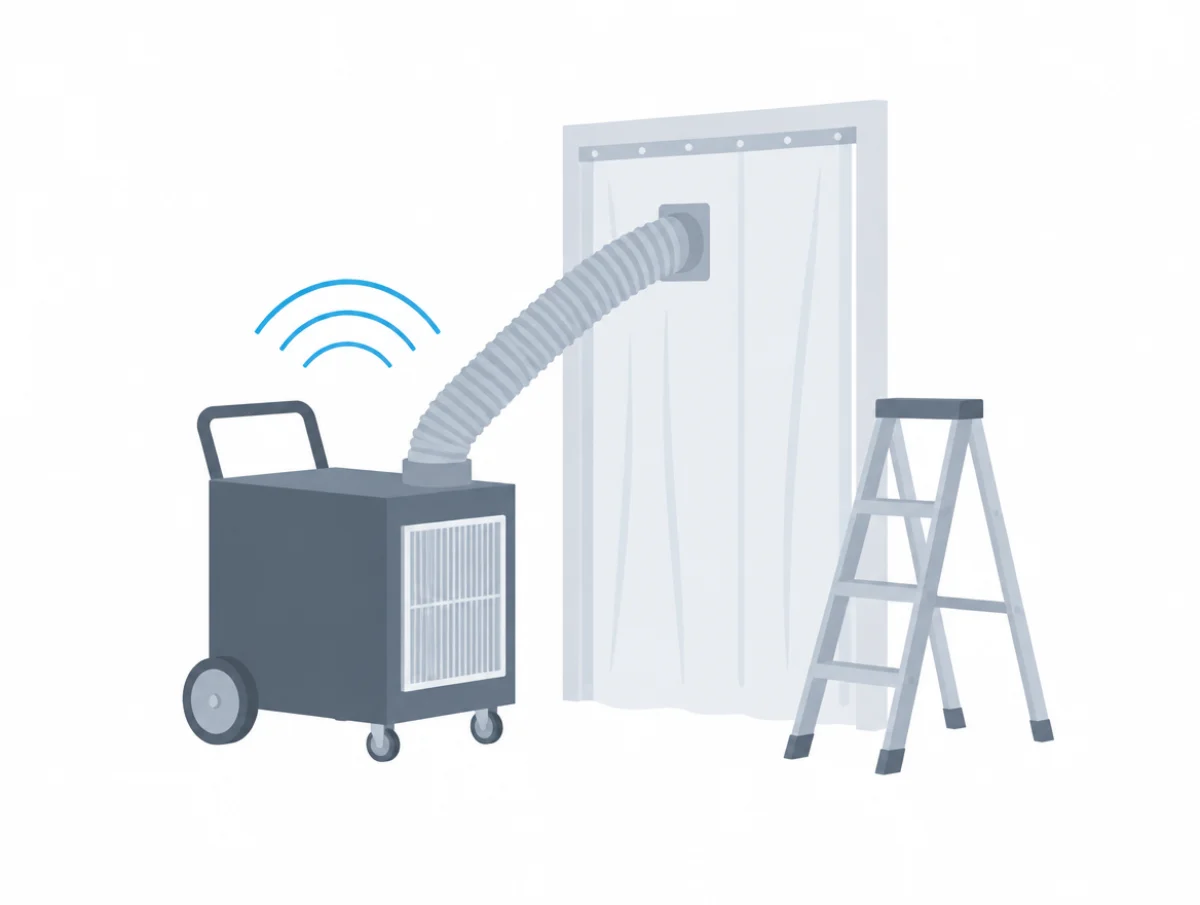
Which air scrubber is the quietest?
At full speed, the A 25, at 63 dB(A) 1 m away. On low, the A 45 and A 100 tie at 58.
| Husqvarna model | Settings printed | Sound pressure at 1 m |
|---|
| A 25 | One speed | 63 dB(A) |
| A 45 | Low, Standard, Maximum | 58, 63, 70 dB(A) |
| A 100 | Low, maximum | 58, 71 dB(A) |
All three readings sit 1.6 m up from the floor.
The A 45 on Standard matches the A 25 at 63 while moving more air, 610 cfm against 353 on Husqvarna's pages. For most rooms that makes it the stronger choice, and the A 25 earns its place in a small space run at full flow.
Air scrubber ratings use four different distances
A reading taken closer to the machine always comes out higher, and each maker picks its own spot: 1 m for Husqvarna, 5 or 10 feet for Abatement, 6 feet for Omnitec, nothing stated for Dri-Eaz.
Husqvarna at 1 m
The manuals label the figure "sound pressure noise level at the operator's ear" and footnote it as a "measurement result 1 m away from the product and 1.6 m up from the floor." Each speed of each model gets a separate number. That is rare.
Abatement Technologies at 5 and 10 feet
Most of Abatement's cut sheets print dBA "@ 5 Feet", while the PAS1700's says "@ 10 Feet". The PRED750 alone gets a single number, 65 on high. The PAS750, PRED1200 and PAS1200 read "62-67 on high speed", which is a range for one setting that this page quotes but does not rank.
Omnitec at 6 feet
Omnitec's footnote reads "Noise specifications based on decibel meter readings at a distance of 6 feet (1.83 meters) NIOSH SLM". Most of its machines then get a range such as 50 to 75 dB with no speed attached. The OA2500 Prime and Plus are the exceptions, at 70 dB for 1,600 CFM and 74 for 2,000.
Dri-Eaz with no distance
On Legend Brands' pages, Dri-Eaz units carry a "SOUND LEVEL" row and nothing about where it was taken. The HEPA 700 and HEPA 2000 show 67 dB beside "HIGH" with the low entry blank, the DefendAir HEPA 700 shows 70, and those three are compared only with one another. How distance shifts a reading is the subject of a separate explainer.
How much quieter is an air scrubber on low speed?
By 12 dB(A) on the A 45 and 13 on the A 100, going by Husqvarna's 1 m figures. Nobody else prints both a low and a high value for one model.
A drop of about 10 decibels is usually heard as roughly half as loud, so the A 45 on Low should come across as well under half its Maximum. The decibel chart puts 58 and 70 beside everyday sounds.
Air is the price. Low speed means fewer air changes per hour, and while Husqvarna says the A 100's lowest setting still gives "about 50% of maximum airflow", it offers no such share for the A 45.
BlueDri's AirShield 550 page and owner's manual carry none we could find, and neither do XPOWER's product sheets for the X-2580 and the rest of its scrubber line.
The X-2580 sheet gets as far as running "on a quiet low speed in noise sensitive environments" and stops there. Legend Brands' table for the Dri-Eaz DefendAir 400 reads "SOUND LEVEL N/A". Two more names led nowhere: Phoenix, now part of Therma-Stor, had no Guardian air scrubber page on the Therma-Stor site we reached, and the Novatek address we tried no longer served a product site.
Ducting helps, by an unpublished amount
For its PAC machines, Omnitec's manual states: "The noise level of the unit is considerably decreased when using the intake and outlet manifolds." No number comes with that claim. A duct run to a window does take the outlet's rush of air out of the room, but nobody prints a figure for a ducted unit against a free-standing one, so the size of the gain stays unknown.
Should you use an air scrubber or an air purifier for a dusty room?
Built for a job site, an air scrubber moves several hundred to a few thousand cfm, stacks, daisy-chains and takes a duct. A household air purifier moves far less air and is rated for living spaces. Once the work is done, our air purifier guide ranks household units for bedrooms and living rooms by their makers' figures. In a woodshop, dust is best caught at the source, and the dust collector guide covers machines that grab chips before they reach the air. After a flood a scrubber usually runs beside a dehumidifier, which supplies the other half of the noise; that machine is covered in the dehumidifier guide.