Camping fan figures can't be ranked across brands because each maker prints a different kind of number, and none says how far from the fan or under what test it was measured.
JisuLife fills a spec table row with a range, such as 39.3-55.5dB, running from the slowest speed to the fastest. Sharper Image and Gaiatop each print one "as low as" number, the maker's best-case figure for its gentlest setting, with nothing for the top.
Makita's US spec lists give one weighted rating per fan, "Decibel Rating : 48 dB(A)" and "Sound Rating (decibels) : 52 dB(A)", and name no speed. A floor, a range end and a speedless rating answer three different questions, so we keep them apart.
How loud are JisuLife's battery fans?
JisuLife's spec tables list 39.3-55.5dB for the Stroller Fan 4, 40-54dB for the Stroller Fan 3 and 44-62dB for the Table Fan Pro3, each a range from slowest to fastest speed.
Because one maker wrote all three rows in the same table format, they can be compared with each other. The Stroller Fan 4 starts lowest of the three; the Stroller Fan 3 starts 0.7dB higher but tops out 1.5dB lower; the Table Fan Pro3 sits highest at both ends, 4.7dB above the Stroller Fan 4 on low.
The Table Fan 1 is left out of that order. Its spec table says 42-45dB, while a banner on the same page says "As Low As 40 dB", and JisuLife does not say which is right.
On a hot night in a tent you may run a fan above its slowest speed. JisuLife's top figures show how far the noise climbs: 55.5dB for the Stroller Fan 4, 54 for the Stroller Fan 3 and 62 for the Table Fan Pro3.
JisuLife's handheld turbo fans climb much higher, to 73dB for the Handheld Fan 5 Plus and 80 for the Pro1 S, which is worth knowing before you hold one beside a pillow.
How loud are Makita's cordless fans?
Makita's cordless fans are rated 48 dB(A) for the 9-1/4 in. DCF203Z and 52 dB(A) for the 13 in. DCF301Z on Makita USA's spec lists, with no speed named for either.
Both ratings come from the same maker and the same kind of spec list, so the 4 dB(A) gap between them is a fair comparison of Makita against Makita. The bigger fan earns its extra noise with airflow: 740 CFM on High against 290 CFM for the DCF203Z.
Makita UK prints a different kind of figure for the DCF203, a sound power level of 53 dB(A). Sound power describes everything the fan radiates, not what reaches one listener, so it stays beside the US rating rather than against it. Makita's EU manual for the DCF203 prints no noise figure, though its dimensions match the US model.
Makita's Outdoor Adventure line once carried an ADCF203Z, also an 18V LXT/Corded 9-1/4 in. fan. Makita USA now lists it as discontinued, which leaves the DCF203Z as the current model.
What do Sharper Image and Gaiatop claim?
Sharper Image claims its cordless oscillating fan, item 212888, runs "as low as 20dB", and Gaiatop claims "as low as 35dB" for its AF-02, each a best-case figure for the gentlest setting.
An "as low as" figure marks a floor and nothing more. Neither brand prints a top-speed number, a distance, a weighting or a test, so neither figure can be set against the other or against JisuLife's range ends. We quote each one as written and leave it unplaced.
Gaiatop does agree with itself. Its AF-04 page says "Minimum noise is just 35dB", the same number it gives the AF-02, so within Gaiatop the two small fans start level.
How long does a battery fan last on low?
A battery fan lasts from 13 to 38 hours on its slowest speed among the makers that name one: 13 hours for JisuLife's Table Fan Pro3 at 1% speed, 38 for its Stroller Fan 4 on speed 1.
The slowest speed is where noise is lowest and runtime longest, so the two figures arrive together. Other makers give runtime without naming the setting. Sharper Image claims up to 25 hours from its 12,000mAh pack, Gaiatop up to 20 hours for the AF-02, and Gaiatop gives a 3 to 11.5 hour range for the AF-04.
Gaiatop adds one helpful behavior: the AF-02 slows itself when its battery falls to 30%, trading airflow for time. Makita lists a 19 hour maximum for the DCF203Z and 11.8 hours on a 5.0Ah pack for the DCF301Z.
Can you use a fan in a tent?
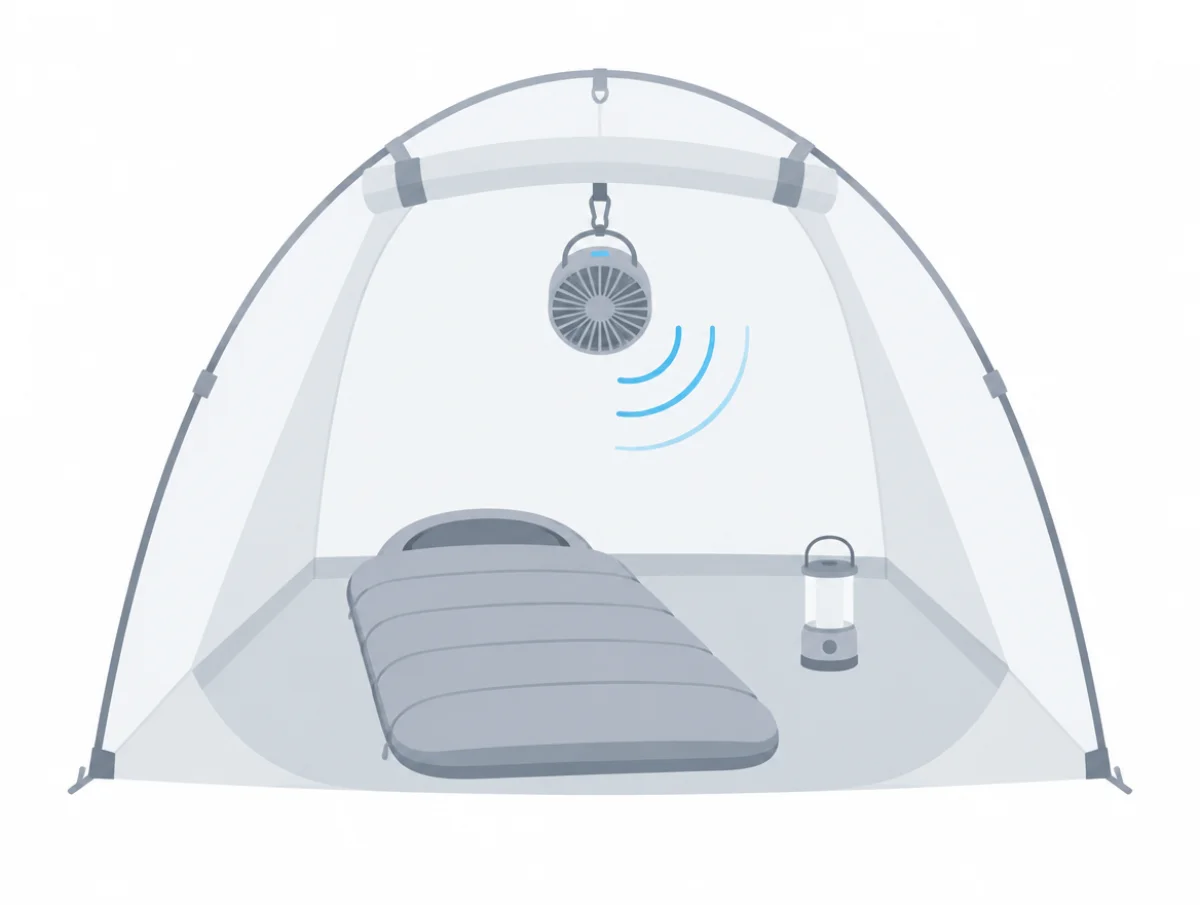
Yes, and some makers design for it: JisuLife says its Outdoor Fan Ultra1 can hang from a tent on a foldable loop, and Gaiatop's CP-01 lantern fan has a built-in hook.
Neither of those two prints a decibel figure, which is why neither is a pick. Of the fans that do, the JisuLife Stroller Fan 4 is the easiest to fix in place, with a metal clip or bendable silicone legs, and JisuLife lists it at under 400g.
Larger fans suit larger tents. The Makita DCF301Z has a tripod mount and a carry handle, and Sharper Image's fan stands on poles that set it at three heights.
O2COOL, Panergy, RYOBI, DEWALT and Milwaukee print no decibel figure for the battery fans we checked, and the camping models from JisuLife and Gaiatop carry none either.
RYOBI describes its 18V ONE+ Hybrid WHISPER SERIES 7.5 in. fan kit as "44% quieter" and gives no decibel number. Its UK page for the RF18 fan carries noise fields for sound power and sound pressure, and each one is a dash; the page text says "less than 50db", a ceiling rather than a value.
O2COOL's battery and misting fans, Panergy's camping and utility fans, DEWALT's DCE512B and Milwaukee's 0886-20 jobsite fan show no figure at all. OPOLAR prints "Around 39dB" for one handheld fan and only ceilings, such as "less than 40dB", for others.