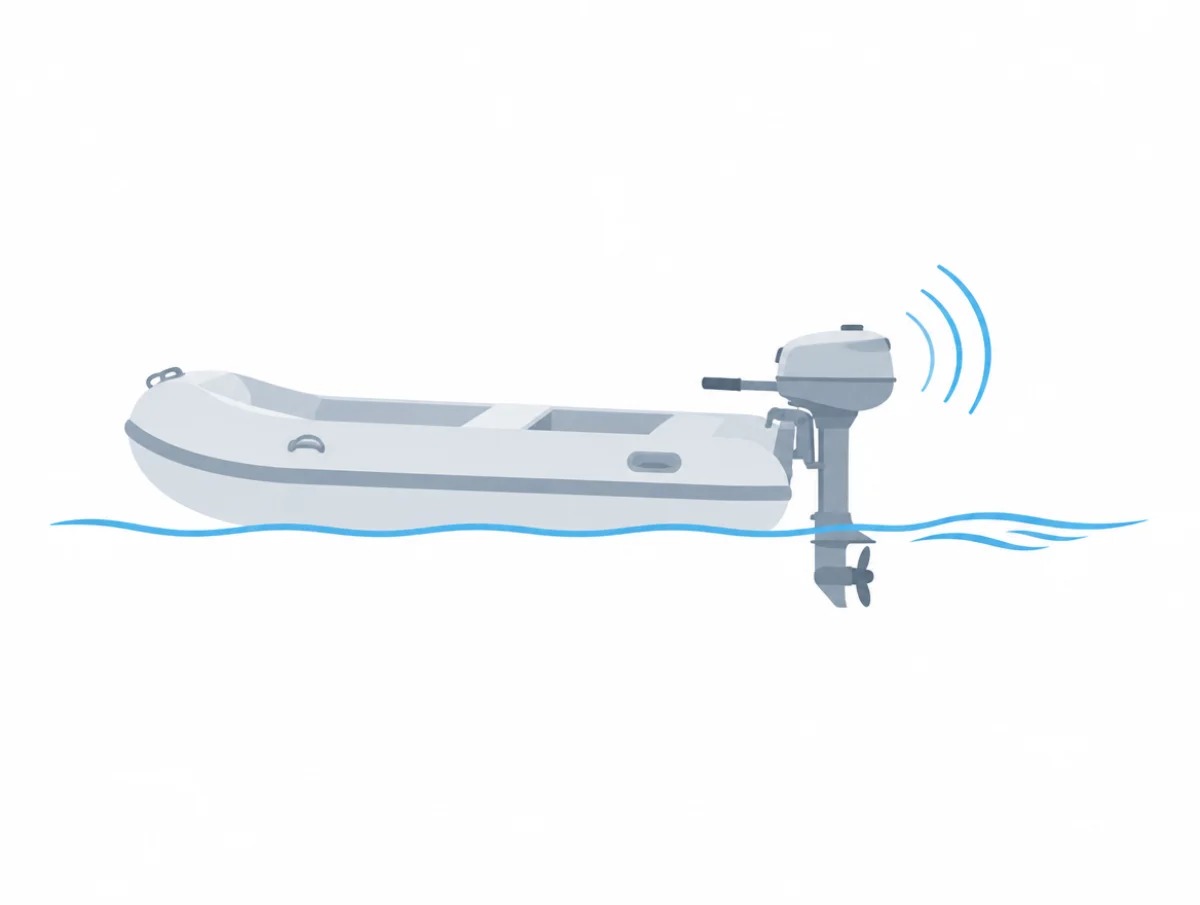
Which outboard motor is the quietest?
Tohatsu's MFS6D and MFS4D list the lowest operator sound pressure of any outboard we found, 79.0 dB(A) under ICOMIA 39/94 Rev.1, in the US owner's manual they share with the MFS5D.
These are the values in Tohatsu's current US manuals, one per engine family:
- MFS4D and MFS6D: 79.0 dB(A)
- MFS2.5C and MFS3.5C: 79.1 dB(A)
- MFS8C and MFS9.8C: 79.7 dB(A)
- MFS40A and MFS50A: 81.8 dB(A)
- MFS25D and MFS30D: 83.2 dB(A)
- MFS9.9E, MFS15E and MFS20E: 84.2 dB(A)
- MFS60A: 84.7 dB(A)
- MFS75A to MFS150A: 90.4 dB(A)
The three lowest families sit within 0.7 decibel of each other, too close to choose between on noise alone. Gearing, weight and power decide among them: the MFS2.5C has no reverse, the MFS6D does, and the MFS9.8C brings a second cylinder.
Each figure covers a family, not a single horsepower. The 9.9, 15 and 20 hp E models get one number, and so do the 75, 90, 115, 140 and 150 hp engines, so the strongest model in a family costs nothing on paper.
What is the most silent outboard motor?
No outboard maker prints a figure that shows one motor to be silent. Electric outboards are sold on near silence, but Mercury, Torqeedo, ePropulsion and Tohatsu give no decibel value for theirs, so the lowest printed figure stays with the gas MFS6D.
Mercury comes closest to a number. Its US page for the Avator 20e and 35e charts the 35e as "63% Quieter" than a "6hp Four-Stroke Combustion Outboard", under the heading "Sound Level (dB; At Full Throttle)", yet the chart prints no decibel values.
Torqeedo describes the Travel S motor as "ultra-quiet" and lists "Silent direct-drive". Tohatsu's own MEP6.0AP, a 6.0 kW electric it likens to a 9.9 hp gas outboard, has no noise row in its manual or on its US page. ePropulsion's outboard pages praise quiet running the same way, with no figure.
A percentage is not a decibel value, and "63% Quieter" does not say quieter by what measure, so no electric outboard is ranked here. Our guide to comparing decibel ratings covers why a relative claim cannot join a list of values.
Tohatsu's figure is an A-weighted sound pressure level at the operator's position, where the person steering sits, taken to ICOMIA 39/94 Rev.1. ICOMIA is the International Council of Marine Industry Associations, the boating trade body behind the test.
The manuals print the value and the standard and nothing more. They do not say at what rpm, on what boat or with which propeller the reading was made, and they give one value per family rather than one per horsepower.
Beside each value sits a hand vibration level to ICOMIA 38/94 Rev.1, the shaking felt through the tiller grip. It runs from 2.5 m/s2 on the MFS9.9E to MFS20E up to 6.8 on the MFS4D to MFS6D, so the family with the lowest noise figure is also the one that shakes most.
Operator sound pressure is not sound power, and it is not what a neighbor on the shore hears as the boat passes. How those two kinds of figure part ways is covered in our page on power and pressure.
One test, two labels
An older US manual for the MFS9.9E, MFS15E and MFS20E on tohatsu.com, OB No.003-11143-7BB1, prints the same 84.2 against "ICOMIA 39/94" with no revision.
The current edition in Tohatsu America's library says "Rev.1", as each other current manual does, so this page uses that label throughout.
Why does a 50 hp Tohatsu list less than a 20 hp?
Tohatsu does not explain why its 50 hp MFS50A lists 81.8 dB(A) against 84.2 for the 20 hp MFS20E, a 2.4 decibel gap in the larger engine's favor.
The two engines differ in more than size. The MFS50A is an 866 cm3 three cylinder that idles at 850 rpm, while the MFS20E is a 333 cm3 two cylinder idling at 950 rpm. Both send their exhaust out through the propeller hub.
What the manuals do show is that the figure follows the engine family more than the horsepower. The 30 hp MFS30D, a 500 cm3 three cylinder, lists 83.2, between the two. Only the four cylinder 75 to 150 hp engines jump clearly higher, to 90.4.
How big is the gap between Tohatsu's quietest and loudest outboards?
The gap between Tohatsu's quietest and loudest outboards is 11.4 decibels, from 79.0 dB(A) for the MFS4D and MFS6D to 90.4 for the 75 to 150 hp four cylinders.
Among the portables up to 9.8 hp the spread is only 0.7 decibel, and from 9.9 to 60 hp it is 2.9, between the MFS50A's 81.8 and the MFS60A's 84.7.
So within a size class the choice rarely turns on these numbers, while moving from a mid range engine to a four cylinder does. The decibel chart places 79.0 and 90.4 dB(A) beside everyday sounds.
Do Honda, Mercury, Yamaha and Suzuki print outboard decibels?
Honda, Mercury, Yamaha and Suzuki print no outboard decibel value in any US document we could open: Honda's manuals carry none, Mercury publishes percentages, and Yamaha's and Suzuki's US manuals stayed out of reach.
We read the 31 owner's manuals Honda Marine links from its US site, from portables to high power engines, and none prints a noise value; the only ICOMIA standard they cite is the one for power ratings. The BF2.3 page heads a section "QUIET & SMOOTH PERFORMANCE" with no number under it.
Mercury's US Verado range page promises a ride "up to 23 percent quieter than other engines", and its V10 350hp Verado page charts the engine as "40% Quieter" at cruising speed than a 350hp competitor, in tests at Mercury's own noise center. Neither page prints a decibel value or names the rival.
Yamaha sells its US owner's manuals through a manual store that asks for the engine's model code, and Suzuki's US site refused our requests, so neither maker is counted.