QuietSpecs

We may earn a commission when you buy through links on this page. As an Amazon Associate we earn from qualifying purchases. How we compare products

Quietest radon fan: Festa's 50 to 55 dB estimates and Suncourt's 4 sones

Written by
· 8 min read

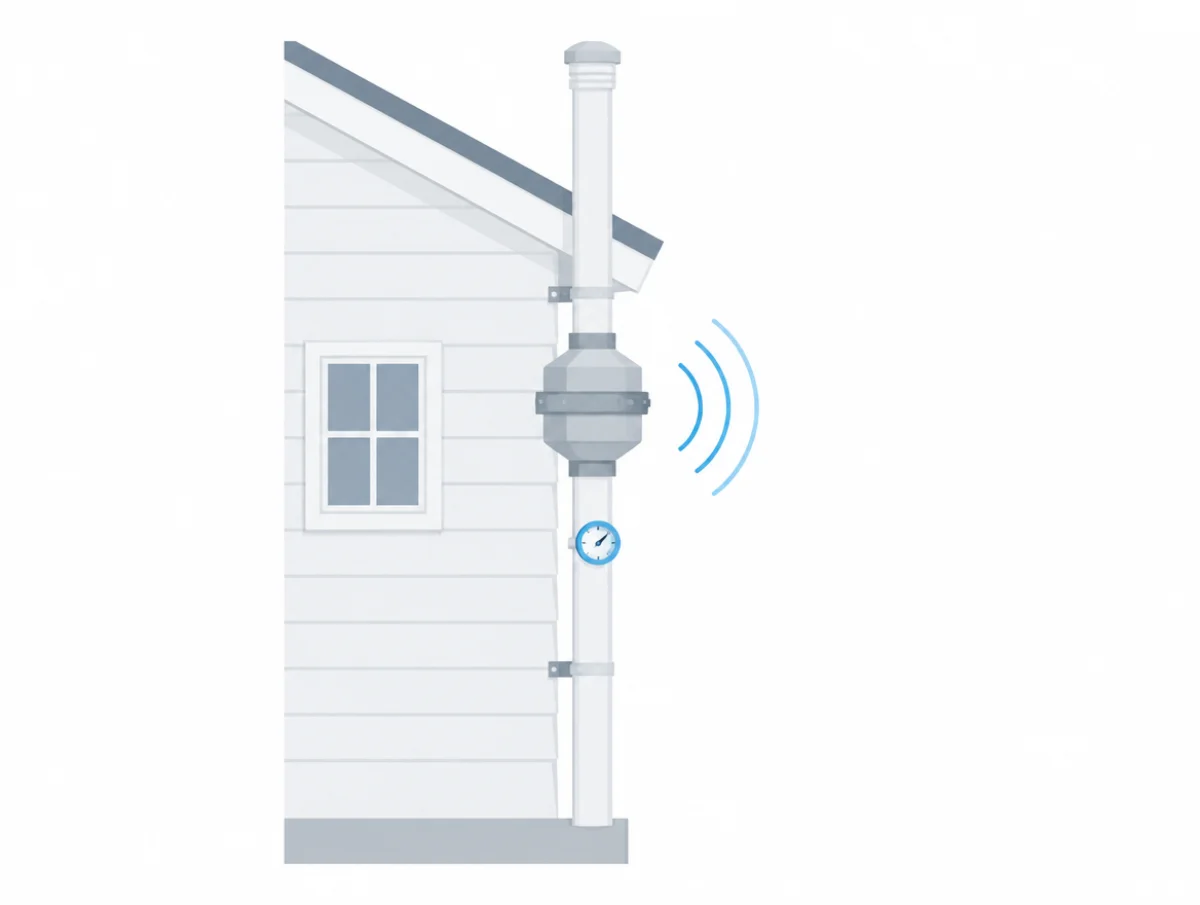
Illustration of a radon fan on a vent pipe running up an outside house wall

Festa's AMG Phoenix EC, for 4 in. pipe at $184, and AMG Triumph ECS, for 6 in. pipe at $239, carry the lowest range Festa prints for any radon fan, "50-55 dB", with the note that it "can vary depending on system configuration".

Festa gives no distance or weighting for those ranges. Suncourt's RDN04 kit is the one radon fan we found rated in dBA and sones, 59 dBA and 4 sones at $196, but its different kind of figure keeps it out of Festa's ranking.

RadonAway and Fantech publish airflow for their radon fans and no noise figure.

On this page
  1. How we chose
  2. Our picks
  3. How to choose
  4. Comparison
  5. FAQs
  6. Bottom line

A quick look at the quietest radon fans

A radon fan pulls soil gas from under a slab and pushes it up a vent pipe past the roofline, and it does that around the clock for years. Most sit in an attic, in a garage or on an outside wall, where both the motor hum and the rush of exhaust air can carry into the rooms next to them, so the quietest radon fan is worth finding before it runs for a decade.

Only two radon fan makers we checked put a noise number on their fans. Festa prints an estimated decibel range on most AMG product pages, and Suncourt prints dBA and sones on the data sheet for its RDN04 kit. RadonAway and Fantech print neither, though both sell radon fans with HVI certified performance.

Festa's ranges and Suncourt's rating are different kinds of figure, so the five Festa picks are ranked among themselves and the Suncourt kit stands alone.

How did we pick these radon fans?

Every fan here needed a noise figure printed by its own maker for a named model sold in the US.

Festa and Suncourt both sell from their own US stores, and each maker price we quote was read there on October 23, 2026.

At Festa we read every product page in the AMG fans collection; the Patriot, Force and the two low-voltage fans print no range. At Suncourt we read the RDN04 product page and the data sheet it links. At RadonAway we read the RP Pro spec sheet, the RP, GP and XP installation manual and the RP, XP, GX, EC6, GP-500, HS and LV175 pages.

RadonAway's site refused our scripted requests with an error, so we read its pages in a browser. At Fantech we read the Rn page, its radon brochure and the Rn2EC and Rn4EC manual, plus a 2018 Rn2 spec sheet hosted by a distributor. We searched HVI's directory by model. Infiltec, also on our list, sells RadonAway fans and prints no figures of its own.

We did not reach an Aprilaire radon fan document, so Aprilaire is not counted. Five Festa fans are ranked only against each other, by the bottom and then the top of each estimated range, and Suncourt's dBA and sones figures stand apart.

We did not measure any radon fan's hum in an attic, garage or yard; each range, dBA value and sones rating above was copied from a Festa product page or Suncourt's RDN04 data sheet.

QuietSpecs' picks of the quietest radon fans

Lowest Festa range for 4 in. pipe

Festa AMG Phoenix EC 4 in. Radon Fan

  • Noise: "Estimated dB Range: 50-55 dB (can vary depending on system configuration)" (Festa)
  • Price: $184.00 maker's list price, checked Oct 23
  • Best for: A newer home on a gravel base where the fan sits in an attic over living space
  • Skip it if: Your slab sits on clay or packed soil and needs more suction than 3.15 in. w.g.

Festa's page for the AMG Phoenix EC gives an "Estimated dB Range: 50-55 dB (can vary depending on system configuration)", the bottom of the scale Festa prints across its radon fans. It is a 4 in.

EC fan for gravel sub-slabs under footprints of 500 to 2,200 sq. ft., pulling up to 210 CFM or 3.15 in. w.g. on 110 W. Festa backs its EC fans for 7 years and sells this one for $184.

Lowest Festa range at 370 CFM

Festa AMG Triumph ECS 6 in. Radon Fan with Speed Control

  • Noise: "Estimated dB Range: 50-55 dB (can vary depending on system configuration)" (Festa)
  • Price: $239.00 maker's list price, checked Oct 23
  • Best for: A large footprint on gravel where a 6 in. pipe already runs to the roof
  • Skip it if: Your system uses 3 or 4 in. pipe throughout, where the Phoenix EC fits

The AMG Triumph ECS is a 6 in. EC fan rated to 370 CFM and 2.9 in. w.g., and Festa's page gives it the same "50-55 dB" estimate as the 4 in. Phoenix EC.

It carries a built in speed potentiometer, which Festa says lets you turn the fan down to "reduce noise or fine-tune suction". Festa's Triumph EC without the dial lists 55-65 dB at the same flow and pressure. It costs $239.

Lowest Festa range for clay soil

Festa AMG Surge EC High Suction Radon Fan

  • Noise: "Estimated dB Range: 50-60 dB (can vary depending on system configuration)" (Festa)
  • Price: $194.00 maker's list price, checked Oct 23
  • Best for: Clay or packed soil under a 500 to 2,500 sq. ft. footprint
  • Skip it if: Your base is open gravel, where the Phoenix EC needs less suction for a lower range

Festa built the AMG Surge EC for "dense or compacted sub-slabs like soil and clay", and its page rates the fan to 3.4 in. w.g., the highest pressure of the three EC fans here, at up to 185 CFM.

Its estimate is "50-60 dB", which overlaps the gravel fans at the bottom and stops well short of the 65-70 dB Festa lists for its AMG Eagle, also sold for clay. It sells for $194.

Festa's most popular fan, 55-60 dB

Festa AMG Maverick Radon Fan, White (AMG-MW-001)

  • Noise: "Estimated dB Range: 55-60 dB (can vary depending on system configuration)" (Festa)
  • Price: $142.00 maker's list price, checked Oct 23
  • Best for: Replacing an existing Maverick on a gravel slab without changing pipe
  • Skip it if: The fan hangs over a bedroom and the Phoenix EC's lower range is worth $42

Festa calls the AC Maverick "our most popular fan" and estimates it at 55-60 dB, five decibels above the Phoenix EC at both ends of the range. It fits 4 in.

Fernco couplers and suits newer homes of 500 to 2,200 sq. ft. on gravel, the same job as the Phoenix. Festa's page lists no flow or wattage for it. At $142 it is $42 cheaper than the Phoenix EC.

Larger AC fan at 55-60 dB

Festa AMG Hawk Radon Fan, White (AMG-HW-003)

  • Noise: "Estimated DB Range: 55-60 dB (can vary depending on system configuration)" (Festa)
  • Price: $157.00 maker's list price, checked Oct 23
  • Best for: A large gravel footprint on a tight budget
  • Skip it if: You can spend $239 on the Triumph ECS, which Festa puts lower and adds a speed dial

The AMG Hawk is Festa's bigger AC fan, which Festa says "offers more airflow than the Maverick", on 6 in. Fernco couplers for 2,000 to 3,500 sq. ft. footprints on gravel.

Festa gives it the Maverick's range, "55-60 dB", so the extra air carries no higher estimate. Festa lists its EC version, the Hawk EC, at 60-65 dB. The Hawk sells for $157.

The only radon fan rated in dBA and sones

Suncourt Radon Fan Mitigation Kit RDN04, 4 in. Centrax Fan

  • Noise: 59 dBA and 4 sones (Suncourt data sheet, no distance stated)
  • Price: $196.00 maker's list price, checked Oct 23
  • Best for: Buyers who want a sones rating to set beside a bath or inline fan they already know
  • Skip it if: Your installer has measured high suction needs, which the data sheet does not address

Suncourt's data sheet for the RDN04 kit gives one performance row: 235 CFM, 91 W, 59 dBA and 4 sones, with no distance or airflow point named. That puts it in a group of its own, since Festa's figures are estimated ranges in plain dB.

The kit pairs a 4 in. Centrax centrifugal fan with two rubber couplers, is MET listed for continuous indoor and outdoor use, and costs $196.

How to choose

New to the units? Read dBA explained or sones vs decibels.

How many decibels is a radon fan?

A radon fan spans 50 to 75 dB on Festa's estimates, from "50-55 dB" for its quietest AMG fans to "70-75 dB" for its Extreme models and the Fury. Suncourt rates its RDN04 at 59 dBA.

Festa's product pages give these estimated ranges, each followed by "(can vary depending on system configuration)":

  • Phoenix EC, Phoenix ECS and Triumph ECS: 50-55 dB
  • Surge EC and Surge ECS: 50-60 dB
  • Maverick, Hawk and Spirit: 55-60 dB
  • Triumph EC: 55-65 dB
  • Maverick EC, Hawk EC and Legend: 60-65 dB
  • Maverick ECS and Hawk ECS: 60-65 dB at maximum speed
  • Eagle: 65-70 dB
  • Prowler: 65-75 dB
  • Eagle Extreme EC, Legend Extreme EC and Fury: 70-75 dB

Festa's own blog post on fan noise puts the field in the same place, saying most properly working radon exhaust fans "produce between 50 and 75 decibels". None of the pages names a distance, a weighting, a flow point or a test, so we use the ranges to order Festa's fans against each other and for nothing else.

Why are Festa's and Suncourt's figures not ranked together?

Festa and Suncourt state radon fan noise in different ways. Festa gives an estimated range in plain dB that moves with the install, and Suncourt gives one A-weighted value plus a loudness rating in sones.

Suncourt's RDN04 data sheet lists 235 CFM, 91 watts, 59 dBA and 4 sones in a single performance row. It does not say where the microphone stood or what static pressure the fan faced. Sones are a separate loudness scale, and our sones and decibels explainer sets out why a sones figure never shares a ranking with a decibel one.

So the RDN04's 59 dBA is not called louder than the Phoenix EC's 50-55 dB, nor quieter than the Maverick's 55-60. It sits in its own group, which is why it carries no rank among the Festa fans.

Are EC radon fans quieter than AC fans?

No, EC radon fans are not quieter across Festa's own line. The Phoenix EC and Triumph ECS hold its lowest estimate, 50-55 dB, but Festa lists the Maverick EC and Hawk EC at 60-65 dB, above their AC versions.

Motor type, by Festa's figures, matters less than which job the fan was built for. The Phoenix EC and the AC Maverick both serve 500 to 2,200 sq. ft. footprints on gravel and sit five decibels apart, the EC lower. The Maverick EC serves that same footprint and Festa puts it five decibels above the AC Maverick.

One pair that does not line up

Festa lists the Triumph EC and Triumph ECS with the same 370 CFM and 2.9 in. w.g., yet gives the first 55-65 dB and the second 50-55 dB. The only difference Festa describes is the ECS's built in speed potentiometer.

Festa does not say whether its range for the ECS assumes a turned down dial, so we pick the ECS on the number Festa printed and flag the gap.

What a speed dial changes

On the Maverick ECS page, Festa writes "Estimated dB Range: 60-65 dB at maximum speed" and adds "lower speed to decrease noise level". It is the one place Festa ties a range to a setting. No lower-speed figure appears for any ECS fan, so the benefit of turning one down is real but unquantified.

Does a radon fan run all the time?

Yes, a radon fan is built to run without stopping. Festa writes that the motor "must run all day, every day", and Suncourt describes its RDN04 kit as "MET listed for continuous use and indoor/outdoor operation".

That changes how a modest number reads. A kitchen appliance at 55 dB runs for an hour; a radon fan at the same level runs through every night of the year. Festa's soundproofing post names interrupted sleep and a disturbed home office as the usual complaints, particularly when the fan sits in an attic or directly outside a living area.

Can a radon fan go in the attic, a garage or outdoors?

Yes, a radon fan can go in any of those places. Festa says the fan is "typically installed in the attic or outside the home", though its Eagle and Spirit pages add "Not For Use In Unattended Areas".

RadonAway, Fantech and Suncourt list their fans for both. RadonAway's spec sheet says its RP fans are "ETL Listed for indoor or outdoor use", and Fantech's Rn2 sheet says the fan "can be mounted both indoor, outdoor and in wet locations". Suncourt's kit is listed for indoor and outdoor operation.

Placement shapes noise as much as the fan does. Festa suggests mounting the fan outside or in an unoccupied part of the house, in line with local building codes, and running vertical pipe through a hall closet rather than a bedroom closet. A garage wall or an exterior mount keeps the motor out of the attic above a bedroom ceiling.

Do radon fan mufflers work?

Yes, radon fan mufflers help with exhaust rush, by their makers' account. RadonAway recommends its Exhaust Muffler when the "rushing" sound of outlet air disturbs people, and Festa says its Diamond Muffler uses acoustic foam to change the noise's pitch.

Neither maker gives a decibel reduction for its muffler in the documents we read. Festa argues that pitch matters more than level, writing that "the frequency of the noise rather than the decibels is usually to blame", which is a claim about how the noise feels, not a measurement.

For vibration, both Festa and Fantech point to soft couplings between fan and pipe. Fantech sells LDVI couplings it describes as low durometer vibration isolators. Festa also warns never to wrap or insulate the fan itself, because that can lead to overheating.

Why do RadonAway and Fantech print no decibels?

RadonAway and Fantech print airflow, pressure and wattage for their radon fans but no noise figure. Both cite HVI certified fan performance, and HVI's directory leaves the "Rated Sound (Sones)" column empty for their radon fans.

We searched HVI's Section I directory for RadonAway's RP140, RP145, RP260 and RP265 and for Fantech's Rn2, Rn2 EC and Rn4EC. Each has certified cfm and watts at one or more static pressures, and none has a sones value. Soler & Palau's PRF-100 is listed the same way, and its submittal sheet has a sones column with no number in it.

RadonAway's spec sheet calls the RP series "ultra-quiet", and Fantech's brochure says its Rn 2EC and Rn 4EC "produce less ambient sound". Without a number from either maker, these fans stay out of the ranking.

Does a high suction radon fan make more noise?

Yes, a high suction radon fan usually carries a higher Festa estimate. Its Eagle, at 65-70 dB, and its Extreme models, at 70-75 dB, sit well above its gravel fans; the Surge EC is the exception, reaching 3.4 in. w.g. at 50-60 dB.

That makes soil the first question for a quiet system, not brand. Festa describes each fan by the footprint and sub-slab it suits, gravel or clay. A home on open gravel can use a Phoenix EC; one on packed clay may need suction that only Festa's louder fans provide, and a sub-slab test by an installer settles which.

The inline duct fan guide covers fans that move room air through ducts, and our quiet basement page covers the other machines that share a basement or utility room with radon pipe.

How the quietest radon fans compare

ProductNoisePrice
Festa AMG Phoenix EC"Estimated dB Range: 50-55 dB (can vary depending on system configuration)" (Festa)$184.00 maker's list price
Festa AMG Triumph ECS"Estimated dB Range: 50-55 dB (can vary depending on system configuration)" (Festa)$239.00 maker's list price
Festa AMG Surge EC"Estimated dB Range: 50-60 dB (can vary depending on system configuration)" (Festa)$194.00 maker's list price
Festa AMG-MW-001"Estimated dB Range: 55-60 dB (can vary depending on system configuration)" (Festa)$142.00 maker's list price
Festa AMG-HW-003"Estimated DB Range: 55-60 dB (can vary depending on system configuration)" (Festa)$157.00 maker's list price
Suncourt RDN0459 dBA and 4 sones (Suncourt data sheet, no distance stated)$196.00 maker's list price

Frequently asked questions

What is the quietest radon fan?

On its makers' own figures, the Festa AMG Phoenix EC and AMG Triumph ECS share the lowest estimate we found, "50-55 dB", which Festa says can vary with the system. Suncourt's RDN04 is rated 59 dBA and 4 sones, a different kind of figure that cannot be placed above or below Festa's.

Is 59 dBA quieter than a 55-60 dB radon fan?

The figures cannot settle it. Suncourt gives a single A-weighted value for the RDN04, while Festa gives an estimated range with no weighting or measuring point, so 59 dBA could sit anywhere relative to 55-60 dB. We keep the two makers in separate groups for that reason.

How loud should a radon fan be?

Festa writes that most properly working radon exhaust fans produce 50 to 75 decibels, and its own estimates span that whole range, from 50-55 dB for the Phoenix EC to 70-75 dB for its Extreme fans and the Fury. RadonAway says its RP and XP fans, installed properly, make little or no noticeable noise to occupants.

Why is my radon fan suddenly loud?

Festa says a fan that suddenly becomes noisy is a sign the motor bearings have gone bad and the fan needs replacing. A new rattle or buzz can also come from pipe touching a wall or beam, which Festa says soft couplings and loose clamp checks fix.

Can a muffler make a radon fan quieter?

RadonAway recommends its Exhaust Muffler when the rushing sound of outlet air bothers people, and Festa sells a Diamond Muffler that it says uses acoustic foam to change the pitch of the noise. Neither maker gives a decibel reduction in the documents we read.

Does RadonAway publish sones for its radon fans?

No. RadonAway's RP Pro spec sheet lists watts, duct size and airflow at up to six static pressures, marks the HVI certified values, and calls the fans "ultra-quiet", but gives no sones or decibels. The HVI directory entries for the RP140, RP145, RP260 and RP265 leave the sones column empty.

Is a speed controlled radon fan quieter?

Yes, when turned down, by Festa's account. Festa gives the Maverick ECS and Hawk ECS "60-65 dB at maximum speed" and adds that you can "lower speed to decrease noise level", but it prints no figure for any lower setting.

The bottom line

I expected RadonAway to print a sone rating, since its radon fans carry HVI certification. It prints airflow and nothing about sound, and Fantech does the same. Festa surprised me: almost every AMG page carries an estimated decibel range, with a plain warning that the install changes it.

I read those ranges as Festa ranking its own fans, not as a measurement anyone could repeat. Read that way they still help. A gravel slab lets you use a Phoenix EC or Triumph ECS at the bottom of Festa's scale, while a tight clay slab pushes you toward fans Festa itself puts 10 to 20 dB higher. If the fan will hang above a bedroom ceiling, I would ask the installer about the soil before I asked about the brand.

Stanley Alu, founder and editor

What we also considered

These are worth knowing about, and why they didn't make the list.

  • Festa AMG Phoenix ECS 4 in. Radon Fan with Speed Control

    Festa lists the same "50-55 dB" range for this speed controlled Phoenix as for the Phoenix EC, at $234 against $184. Buy it if you want the dial; on Festa's figures it is no quieter at full speed.

    Search Amazon for this model
  • Festa AMG Triumph EC 6 in. Radon Fan

    Festa's page gives "55-65 dB", where the Triumph ECS with the same 370 CFM and 2.9 in. w.g. gets 50-55 dB. Festa does not explain the gap, so the ECS takes the pick.

    Search Amazon for this model
  • Festa AMG Eagle Radon Fan, White (AMG-EW-009)

    Festa estimates its clay fan at "65-70 dB" and marks it "Not For Use In Unattended Areas". The Surge EC covers a similar footprint on tight soil at 50-60 dB.

    Search Amazon for this model
  • RadonAway RP145 Pro Series Radon Fan (28461)

    RadonAway's spec sheet calls the RP series "ultra-quiet" but prints no decibel or sone figure, and HVI's directory leaves its sones column blank for the RP145.

    Search Amazon for this model
  • Fantech Rn2 Inline Radon Fan (89052)

    Fantech lists HVI-certified performance and outdoor rating for the Rn2 but no noise figure, and HVI's directory shows no sones value for it.

    Search Amazon for this model

Sources

Every figure on this page was read on one of the pages below. We did not measure anything ourselves.

All 11 sources
Manufacturer pages and manuals for every product

Related guides