Which septic aerator is the quietest?
Among pumps sold new on Amazon, HIBLOW's HP-20 and HP-40 tie at 32 dBA at one meter on HIBLOW's Product Finder. The HP-40 is rated for 40 l/min, double the HP-20. The XP-40 prints a lower 30 dBA at the same distance and the same 40 l/min rating, on 24 W where the HP-40 draws 38. An Amazon search on November 8 turned up the HP-40 and XP-80 in its place, so the XP-40 sits with the models also considered.
One maker and one stated distance mean these numbers compare directly, which is rare on this site. Airflow is the limit, because it decides which pumps you can choose between at all.
Airflow decides which pumps compete
A treatment unit is designed around one airflow and pressure. HIBLOW's spec sheets rate each pump against a set back pressure, and within each class the dBA at one meter sorts them.
| Rated airflow | Back pressure | Pump and figure at 1 m |
|---|
| 20 l/min | 9.8 kPa | HP-20, 32 dBA |
| 40 l/min | 12.8 kPa | HP-40, 32 dBA (XP-40, 30 dBA, not on Amazon) |
| 60 l/min | 14.7 kPa | HP-60 and HP-60A, 35 dBA (XP-60, 35 dBA, not on Amazon) |
| 80 l/min | 14.7 kPa | XP-80, 35 dBA; HP-80, 36 dBA |
| 200 l/min | 20 kPa | HP-200, 48 dBA |
Compare across a row, not down the table. The XP-80 leads at 80 l/min, and the HP-60 and HP-60A tie at 60.
Unsure which model a unit takes? In HIBLOW's words, "contact your treatment system manufacturer."
HIBLOW never explains why. The Product Finder row for the HP-80 reads 36 dBA at one meter, while the HP-60 and HP-80 spec sheet prints 39 and the HP-80A alarm row reads 39 too. The sheet names no distance, so 36 is the figure ranked here, as the only one with a stated basis. Even at 36 the HP-80 sits above the XP-80, which reads 35 on both its page row and its sheet.
The homeowner septic page adds a third reading of sorts. Its claim that "HIBLOW homeowner models are below 36 dBA" sits above a table listing the HP-80 at 36, so the sentence does not hold for one of HIBLOW's best-known septic pumps.
Is a septic air pump with an alarm louder?
Not at 60 l/min. The HP-60A reads 35 dBA at one meter, exactly like the plain HP-60, and keeps its 51 W draw while adding 0.4 kg.
At 80 l/min the alarm version reads 39, against 36 for the plain HP-80 on the same page.
HIBLOW also fits most HP models with a pressure tap for an external alarm sensor, which suits treatment units that carry an alarm panel. The HP-40A alarm version reads 32, the same as the HP-40, but its new Amazon listing was marked low stock on November 8, and that kept it off the pick list.
Secoh, Medo and Gast print nothing usable
No pump from those makers made this page, because none had a maker figure at a stated distance and a new Amazon listing under its exact model number.
Amazon searches for Secoh's JDK and EL pumps returned only parts and third-party pumps described as compatible, and Secoh's site failed to load over a secure connection when we tried it on November 8. Searches for Gast and Thomas linear pumps returned HIBLOW listings. Medo's LA-80BN was on Amazon from a third-party seller, and the only decibel figure for it sat on a retailer page, which this guide does not use.
Rebuild kits and clogged diffusers raise the noise
A pump fitted with a knock-off rebuild kit "can run significantly louder", HIBLOW's FAQ warns, because those kits are not made to spec. Loose nuts and bolts or unsecured internal L tubes cause noise too.
Backpressure is the other suspect. Clogged diffusers can push a pump past "the design pressure for the pump model you are using", which shortens its life, and a pump straining against a blocked line is working outside the conditions its figure was measured in.
Genuine parts exist for the common sizes: HIBLOW's online store sells an HP-60/80 sound absorber and a set of four vibration control rubbers.
A garage or shed keeps the pump cool and the house quieter
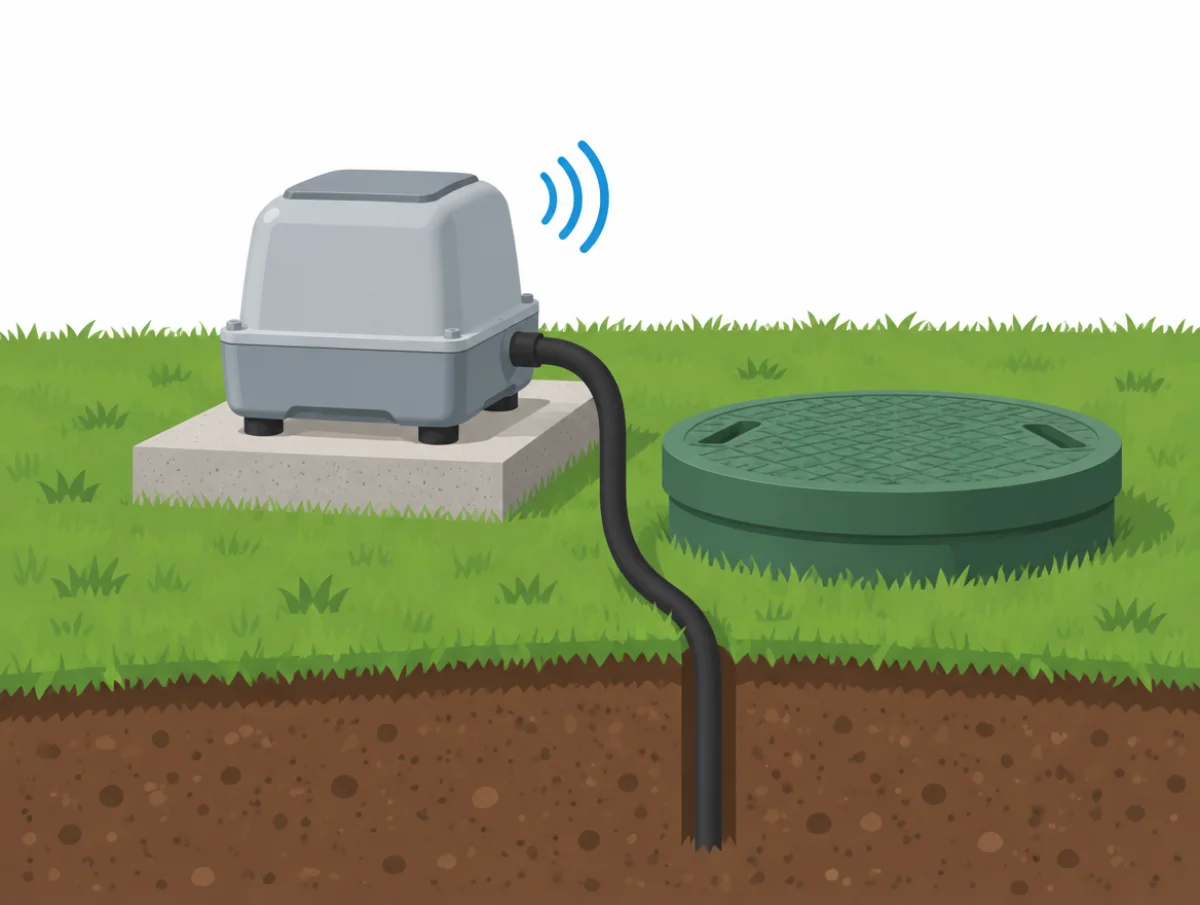
HIBLOW recommends a cool, dry spot out of the sun, naming a garage, shed or crawlspace, and asks for good ventilation if the pump has to sit outside. That advice is about heat and pump life. It helps with noise as well, since every figure here is taken one meter away, and walls or distance between the pump and a bedroom lower what you hear indoors.
The same pumps aerate garden ponds, which is why several of these models also turn up in our pond air pump guide. Smaller cousins for fish tanks are in the aquarium air pump guide.