Spec rows on 13 US product pages, and noise tables in the European instruction manuals. The US owner's manuals print none; 24 of them were opened on November 7, 2026.
The US rows read "Decibel rating 57 dB" on the QuietTech blowers, "Decibel Rating 83 dB" on the 80V backpack and "Noise level 59 dB" on each Landroid. The WG550 has no row at all, only a feature line ending "(65 dB)".
For the WG183E trimmer they read "A weighted sound pressure LpA = 75.8 dB(A)", "KpA 3.0 dB(A)", "A weighted sound power LwA = 90.2 dB(A)", followed by a declaration of a measured 90.2 and a guaranteed 94 dB(A) under directive 2000/14/EC. Even the LwA row is not used consistently. On the WG183E it repeats the measured value, on the WG163E and WG322E the guaranteed one, so measured and guaranteed values here come from the declarations, where Worx labels them.
How quiet is a Worx leaf blower?
On worx.com, the WG581.1, WG582 and WP591 lead at 57 dB each. Among the European declarations, the 20V Turbine WG547 is the quietest blower that matches a US model, at 75 dB(A) at the ear.
| US page | Blower | Figure |
|---|
| WG581.1 | 40V 530 CFM QuietTech | 57 dB |
| WG582 | 40V 780 CFM QuietTech | 57 dB |
| WP591 | Nitro 40V Quiet Tech | 57 dB |
| WG550 | 20V 620 CFM LeafJet | 65 dB |
| WG572 | Nitro 80V backpack | 83 dB |
Those are ranked within Worx only, since no basis is given; the European declarations below all fall under EN 50636-2-100.
| US model (EU twin) | Blower | At the operator's ear | Measured sound power | Guaranteed |
|---|
| WG547 (WG547E) | 20V Turbine | 75 dB(A), KpA 3 | 87 | 89 dB(A) |
| WG543 (WG543E) | 20V 410 CFM LeafJet | 78.0 dB(A), KpA 3.0 | 92.6 | 96 |
| WG572 (WG572E) | 80V backpack | 88.2 dB(A), KpA 3.0 | 99.2 | 102 |
A European twin of the 40V WG585 LeafJet puts the operator at 86.7 dB(A) under a 99 dB(A) ceiling. Its US manual gives 3.8 lbs bare where the European one gives 1.5 kg, though, so it is quoted and left unranked.
No European twin turned up for any of the three 57 dB models, which leaves their ear figures unknown. The WG572 is the one Worx blower with figures on both sides, and its 83 dB US row sits 5.2 decibels under its European ear figure, a sign the US number was not taken at the operator. Blowers that other makers rate to a stated method are in our leaf blower guide.
Every US Landroid reads 59 dB
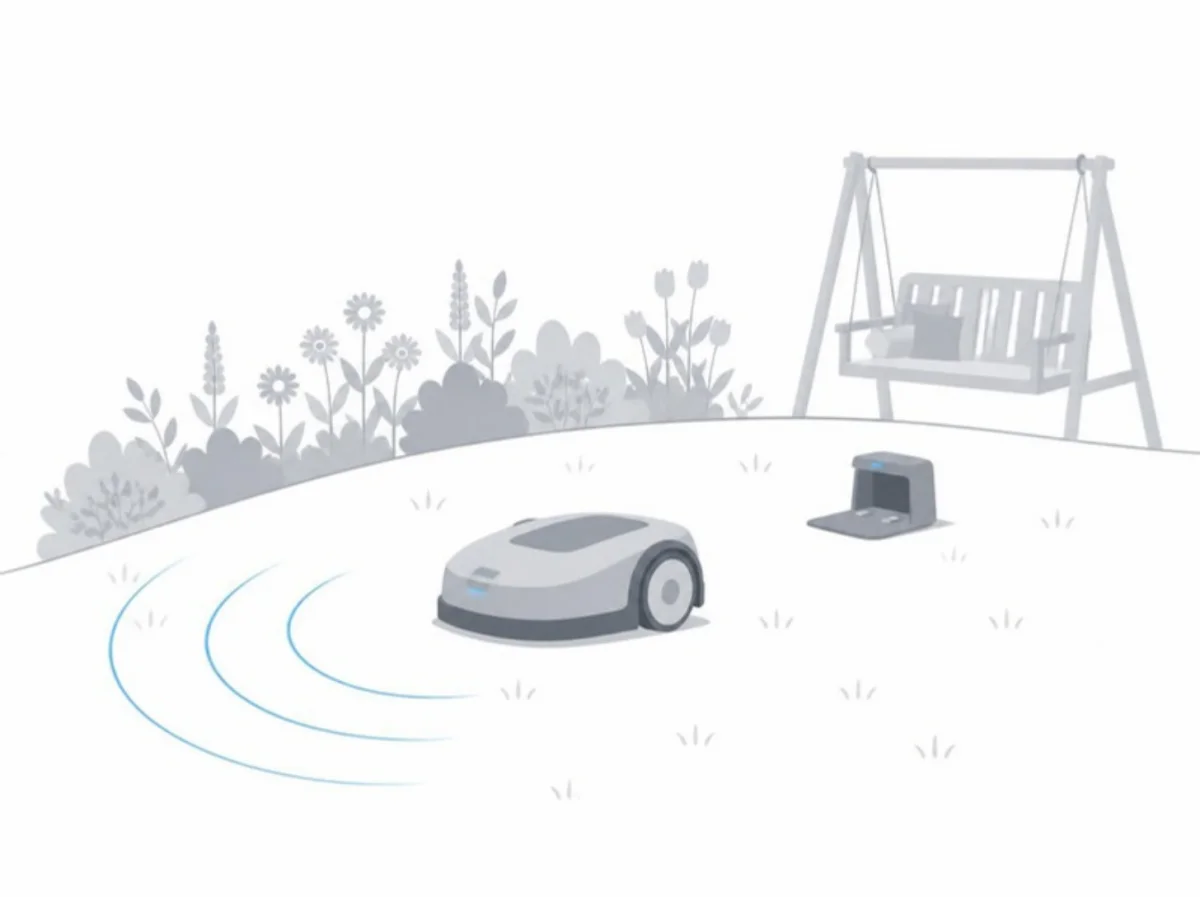
From the boundary wire Landroid S, M and L to the camera guided Vision models for 1/5 acre up to 1 acre, the row is the same, "Noise level 59 dB", and it comes with no method. Prices on November 7, 2026 ran from $999.99 for the Landroid S to $3,499.99 for the 1 acre Vision WR235. With one shared figure, size and navigation decide.
The European site disagrees for the wired models.
Its pages for the WR165E, WR147E.1 and WR155E list "Noise level 67 dB", eight decibels above the US rows for the same numbers, while its WR208E Vision page lists 59 dB, matching the US. Neither site explains the gap, and the US Landroid and Vision manuals print no noise figure. The newer Vision Cloud robots carry no decibel row on their US pages. Robots from other makers are in our robot mower guide.
Which Worx string trimmer is the quietest?
The 20V WG163, declared at 74 dB(A) at the operator's ear in the European manual for the WG163E. Three Worx trimmers sold in the US have a matching European declaration, all under EN 50636-2-91.
| US model (EU twin) | Size | At the operator's ear | Measured | Guaranteed |
|---|
| WG163 (WG163E) | 20V 12 inch | 74 dB(A), KpA 3.0 | 86 | 90 dB(A) |
| WG183 (WG183E) | 40V 13 inch | 75.8 dB(A), KpA 3.0 | 90.2 | 94 |
| WG185 (WG185E) | Nitro 40V 15 inch | 78.7 dB(A), KpA 3.0 | 91.97 | 94 |
The 15 inch Nitro is the loudest of the three on every count. Each pair lines up on what both manuals print: 7600, 6800 and 6000 rpm, 12, 13 and 15 inch cuts, and 0.065 inch line on the two smaller trimmers against 0.095 inch on the WG185. For trimmers from other brands, see quiet cordless string trimmers.
The 20V hedge trimmer declares less than the 40V
The 20V WG263 is declared at 83.05 dB(A) at the ear and the 40V WG286 at 85.83 dB(A), both under EN 62841-4-2, with guaranteed sound power of 96 and 100 dB(A).
The WG263's uncertainty is unusually tight, 1.56 dB(A) against 3 for the WG286. Both trimmers run at 3400/min and cut branches up to 1 inch, which leaves the 24 inch blade on the WG286 as the main printed difference.
The other hedge trimmers did not match. The European WG252E pole trimmer and WG261E list a shorter cutting length than the US WG252 and WG261 blades. The 40V WG284 appears on worx.com marked "(Discontinued)", and its European twin lists a larger cutting capacity than the US model. Other makers' figures are in our hedge trimmer guide.
How loud is a Worx chainsaw or pruning saw?
The 40V WG384 is quietest at the ear, 80.0 dB(A) in the WG384E manual, against 87.9 for the 20V WG322. Both are declared under EN 60745-2-13, and both carry a guaranteed 96 dB(A). Its uncertainty is 5.0 dB(A), though, wider than any other Worx figure here, so the lead at the ear is less firm than the numbers suggest; measured sound power is 91.0 dB(A) against 94.7 for the WG322.
The pruning saws use a newer standard, EN 62841-1, and form their own list. For the operator, the WG326 is declared at 78.6 dB(A) and the WG324 at 79, while their guaranteed figures split further: 91 dB(A) for the WG324 and 96 for the WG326.
Three more saws fell short on a printed spec. The WG327 pruning saw's European twin lists a slower chain than the US model, and the WG385 chainsaw and WG349 pole saw differ on weight. For other battery saws, see quiet electric chainsaws.
Two mowers matched, under different standards
Guaranteed sound power is 93 dB(A) for the 20V WG733 and 96 for the 80V WG761, the two Worx walk-behind mowers that matched. At the ear the WG733 reads 77.8 dB(A) and the WG761 80.9.
Those ear figures come from different standards, EN IEC 62841-4-3 for the WG733 and EN 60335-2-77 for the WG761, so they are listed without ranking. The guaranteed values both follow directive 2000/14/EC and EN ISO 3744, which is why they can sit side by side.
The 40V WG779, the best known Worx push mower, has a European declaration of 76.5 dB(A) for the operator with a 90 dB(A) ceiling. It stays unranked, because the US manual prints a no-load speed of 3300/3700 rpm where both European manuals print 3300/3500. For mowers from other brands, see quiet battery lawn mowers.
A European tool is usually the US model plus an E, so the US WG547 becomes the WG547E. Variant suffixes follow, and the manuals say an X variant is "only used for different customers" with "no safe relevant changes".
A shared number is the start of a match, not the end. For each pair, the specifications printed in both manuals or pages were compared: speed, cut or blade length, chain speed, airflow and weight. Where one printed value disagreed, as on the WG779, WG585, WG327 and WG385, the European figure is either quoted unranked or dropped.
The Landroids show why: the US WR165 and the European WR165E share a number, yet one page lists 59 dB and the other 67.
Edgers, cultivators, dethatchers, pressure cleaners, snow throwers, pole saws, hedge trimmers, chainsaws and walk-behind mowers show no decibel row on their US pages, and no US manual prints one.
Some have European twins that did not match. The European manuals for the Hydroshot WG620E and WG633E print pressures that do not line up with the maximums on the US pages, and the WG801 shear and shrubber lists a different no-load speed in each market.
Matching was not finished for every tool, the WG583 blower vac among them, and the Vision Cloud robots have no row on either site. Those are left out rather than estimated.