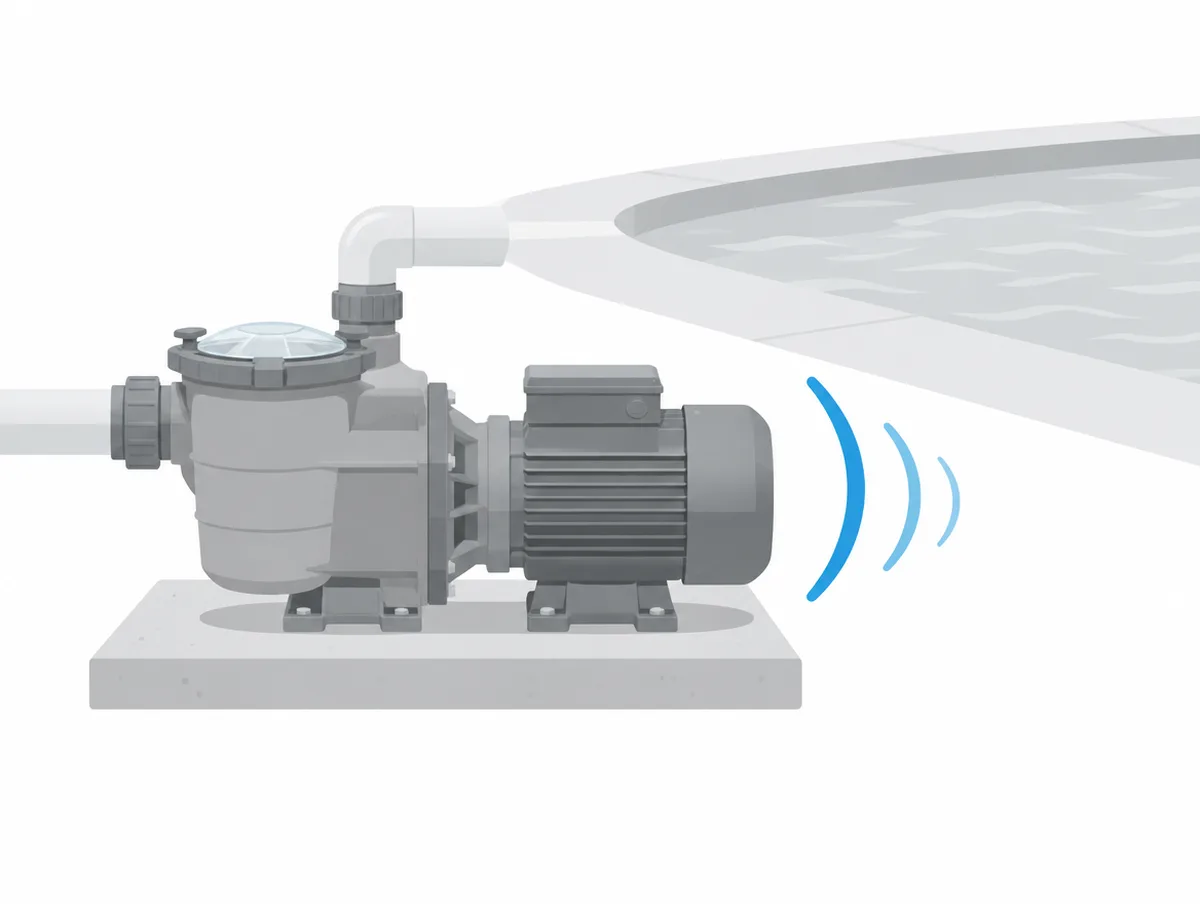
How to make a pool pump quieter starts with the controls and the baskets, not with soundproofing. The pool pump makers' own troubleshooting tables point first to speed, debris, air getting into the suction side, and a pump that is not sitting firmly on its pad.
Most of those fixes cost nothing. A few, such as resizing suction pipe or replacing worn bearings, belong to a pool professional, and the manuals say so plainly.
Every step below comes from documents published by Pentair, Hayward, Speck, Madimack and Bestway, ordered from a change of setting to a call for service. It covers in-ground pumps on an equipment pad and the filter pumps sold with above-ground pools.
Why is my pool pump so loud?
Pool pump noise has a short list of causes in the makers' tables: high speed, a packed strainer basket, air leaking into the suction side, cavitation, loose mounting, debris in the impeller, a dirty fan and worn bearings.
The IntelliFlo3 VSF guide from Pentair puts four of these in one row of its troubleshooting chart under "Pump is Noisy or Operating Loudly": debris touching the cooling fan, a clogged impeller, too much debris in the basket, and speed.
Hayward's answer on noisy pumps adds a sound that is part of the design: the motor "has an internal cooling fan that can be heard." Some hum is therefore expected. A pump that has grown louder over a season is the case the rest of this page deals with.
How loud is a normal pool pump?
Pentair's chart for the IntelliFlo3 VSF gives 55 dB at 3 feet, 45 dB at 10 feet and 30 dB at 50 feet, all at 40 to 50% speed. Few other pool pump makers state conditions.
Madimack gives its InverFLOW Plus 1HP a reading of 32.9 at 30% speed and 56.1 at 100% on its product page. The table prints no unit and no distance, so those two numbers compare with each other and with nothing else.
Hayward offers a ratio instead of a reading. Its TriStar VS sell sheet says the motor drive "delivers 30% quieter high-speed operation than other models", without naming those models. Our comparing decibel ratings page explains why a figure with no distance cannot be ranked against Pentair's.
Does a variable speed pool pump run quieter at a lower speed?
Yes, by the makers' figures. Madimack's table drops from 56.1 at full speed to 32.9 at 30% on one pump, and Pentair's noisy pump checklist ends with "Motor speed too high" and "Consider reducing the speed if possible."
Pentair's IntelliFlo3 guide sets out which jobs need which speed: "Typically lower speeds are used for filtration and heating. Higher speeds can be used for spa jets, water features, and priming." A schedule that filters at a low speed through the night and saves fast running for daytime cleaning puts the loud hours where they bother fewer people.
There is a floor. Hayward's owner's manual recommends setting the maximum speed so the pump does not exceed the flow the pipes can carry, and a pool still needs enough hours of filtration to stay clean. The right low speed for a given pool is a setting a pool professional can confirm.
Why does my pool pump get loud by itself?
Programmed modes raise the speed without anyone touching the pump. Pentair's IntelliFlo3 primes at 100% speed by default, runs Quick Clean at 70% for an hour, and in a constant flow program speeds up while a pool cleaner runs.
Pentair's fix for that last case is to schedule a constant speed program during expected cleaning times. On Madimack's InverFLOW Plus, a feature called Skimmer/Boost Mode "Activates for 5 minutes every hour", which is worth switching off at night if the app allows. Each program can be read in the pump's app or on its control panel.
Can a full basket make a pool pump noisy?
Yes. Pentair lists "Too much debris in strainer basket causing cavitation" under a noisy pump, and Speck and Pentair's WhisperFlo guide both name a dirty strainer basket. The skimmer baskets upstream count too.
Pentair says the strainer basket "should be checked at least once a week" and that both the strainer and skimmer baskets need regular cleaning. Its steps start with stopping the pump and switching it off at the circuit breaker, then opening the filter's air relief valve until the gauge reads zero before the lid comes off.
When the lid goes back on, Pentair asks owners to clean the lid O-ring and its sealing surface, fill the pot with water up to the suction port, and check the O-ring is not pinched. Hayward's manual adds two rules: never strike the basket to empty it, and never put chlorine tablets in it.
Why is my pool pump making noise but not pumping water?
Air in the suction side is the usual answer in the makers' tables. Hayward and Pentair point to a leaking lid O-ring, loose suction fittings, low pool water or a clogged basket, each able to starve the pump.
Hayward's manual gives a test owners can see from the deck: "Leaks will result in bubbles emanating from the return fittings on the pool wall." Pentair's IntelliFlo3 chart lists an air leak in suction under priming problems, with three checks: suction pipe and valve seals, the water level at the skimmer, and the strainer pot lid O-ring.
On the lid seal, Hayward suggests its own Jack's 327 and says a silicone or Teflon based lubricant suits O-rings and gaskets. Its lubricant answer adds "NEVER USE PETROLEUM JELLY", because its oils break down the rubber.
If the pump has been running without water, Pentair's guide says do not open the strainer pot, since vapor pressure can build and the pot "may contain scalding hot water." It asks owners to open the valves and wait until the pot is cool to the touch. Hayward's dry running answer says the seal can overheat and melt.
Where do air leaks on the suction side usually hide?
Hayward's list of suction leak points runs from the strainer cover and its O-ring to the strainer drain plugs, threaded fittings, glued joints, valves and a cracked pump housing. It singles out valve stem O-rings as a common leak point.
The same Hayward answer on return bubbles adds two causes outside the pump: pool water too low, so air mixes in at the skimmer, and a skimmer weir stuck in the up position. Pentair wants the water kept about halfway up the skimmer opening. Hayward says some of these repairs may need an authorized dealer.
What causes cavitation in a pool pump?
Cavitation happens when a pump asks for more water than its suction side delivers. Speck says that when the pipe is too small or raised above the water, the pump "will develop a pocket of air (cavitation) that makes noise".
Speck adds that this may shorten the pump's life. Hayward gives two hydraulic causes: suction pipe that is undersized, and too little back pressure on the return side, with water feature pumps as its example. Its fixes are a larger pipe or a smaller impeller for the first, and a valve that adds back pressure for the second. Hayward says either may need an authorized dealer.
Hayward's manual also offers a quick check for the return side. Holding a hand over a return fitting, or fitting a smaller eyeball fitting, "will sometimes prove this", and throttling the return lines can help "if practical". Speck's EasyFit table lists the same cure next to fewer fittings, less suction lift and larger pipe.
What pipe size should a pool pump have?
Pipe size sets the flow limit. Hayward's manual allows 45 gallons a minute through 1-1/2 inch pipe, 80 through 2 inch, 110 through 2-1/2 inch and 160 through 3 inch. Speck recommends 2 inch pipe within 50 feet.
The makers agree on the inlet too. Hayward and Speck want a straight run of at least five pipe diameters before the pump inlet, and Pentair turns that into an example: a 2 inch pipe needs 10 inches of straight run. Pentair also rules out a 90 degree elbow screwed straight into the inlet.
Hayward, Pentair and Speck all want the suction pipe equal to or wider than the return pipe. Re-plumbing is installer work, and the Pentair and Hayward manuals both say a qualified professional should install their pumps.
How do you stop a pool pump from vibrating?
Pool pump vibration is a mounting problem in every manual we read. Hayward says the base "must be level, rigid, and vibration free", with the pump bolted down, and Speck and Pentair list loose mounting under noise.
Hayward's owner's manual names a level concrete slab or other rigid base, with screws or bolts "to reduce vibration and stress on the pipe or hose joints." Pentair's IntelliFlo3 has two anchor points under the volute, sized for concrete anchors up to 3/8 inch.
Speck's BADU EcoM3 manual describes the same thing as a foundation that "provides a rigid and vibration-free base". Pentair's WhisperFlo table answers loose mounting with one action: make sure the mounting bolts and pump bolts are tight. That check takes a wrench and a few minutes once the power is off.
Does a rubber pad under a pool pump help?
Yes, possibly, according to Hayward, which says "A piece of old carpet or rubber between the pump's base and equipment pad might reduce the noise." We found no isolation pad sold by any pump maker we read.
Hayward pairs that suggestion with two checks: the pump must be level, and the suction lines must not sit higher than the pump. A pad does not replace the bolts each manual asks for; the pump still has to be secured so the plumbing is not strained.
Should the pipes next to a pool pump be supported?
Yes. Speck's BADU EcoM3 manual says suction and return lines "should be independently supported at a point near the pump to avoid strains being placed on the pump."
Pipe that hangs from the pump's ports passes vibration along and loads the housing. Hayward asks for joints that are tight but not overtightened, and Speck wants the EasyFit's fitting screws hand tight. Hayward also says not to use pipe dope, which can crack the plastic, and not to force a fitting past the thread stops molded into the ports.
Why is my pool pump squealing or whining?
Worn motor bearings are the cause the makers name for a whine. Hayward says bearings fail from wear, rust, overheating or chemicals, and that a leaking seal lets chlorinated water wash out their grease.
Hayward's fix is a dealer job: replace the bearings or the whole motor, and replace any seal leak "at once" so the damage does not spread. Speck's EasyFit manual gives a sign: "Noise when shaft is turned up by hand", with the motor hot around the bearing while it runs.
Oiling is not on the list. Hayward's manual says "Hayward pumps have self-lubricating motor bearings and shaft seals. No lubrication is necessary." A whine that comes back after a season of chemical spills or a dripping seal is the pattern Hayward describes.
What does a rattle or a gravel sound mean?
A rattle often means something solid inside the pump. Hayward lists "Loose stones/debris hitting the impeller", Speck lists gravel or metal in the impeller, and Pentair lists a clogged impeller, all fixed by opening the pump and removing it.
A rattle at the back of the motor can be the cooling fan. Pentair and Speck both list debris in contact with the fan, and Pentair says to clean the fan guard with compressed air. Taking the pump apart to reach the impeller is something Hayward hands to a qualified repair professional.
Can you put a cover or box over a pool pump?
No, not over most of these pumps while they run. Pentair rules out an outer enclosure for the IntelliFlo3 "unless marked accordingly", Speck does the same for its EasyFit, and Pentair says never cover a running motor.
Hayward is less strict. Its manual allows an outer enclosure as long as "adequate ventilation and free circulation of air must be provided to prevent overheating of the motor." Pentair's WhisperFlo guide says not to install that pump in one, yet its motor care section asks that "Any enclosure must be well ventilated" with ample cross ventilation. Read the manual for the model you own.
Speck's EasyFit table lists poor ventilation as a cause of a motor running hot, with the remedy "Do not tighten cover or enclosure motor." Hayward's answer on hot running says blocked air vents make the motor run hot and possibly shut down.
Shade is allowed, and the makers encourage it. Hayward advises placing the pump and filter in the shade, Speck says to shield the motor from the sun, and Hayward's vegetation answer wants nothing growing over it. Winter storage covers are a separate matter: Hayward and Pentair rule out plastic wrap.
Where should a pool pump go to be quieter?
Hayward says "under a bedroom window may not be an ideal location." Pentair's IntelliFlo3 chart shows why distance matters, falling from 55 dB at 3 feet to 30 dB at 50 feet at the same 40 to 50% speed.
Distance has a hydraulic price. Hayward and Pentair both ask for the pump to sit as close to the pool as practical, with short, direct suction pipe. A pump moved far across the yard needs more pipe, and Speck says more than ten suction fittings means a larger pipe size.
The manuals also fix some limits on the pad. Pentair wants the IntelliFlo3 at least 5 feet from the inside wall of the pool and 3 feet from a heater outlet, with 3 inches of side and rear clearance and 6 inches above. If the same pad also holds a pool heat pump, its fan is a second noise source; our quiet yard page covers outdoor equipment more broadly.
Which pool pump noises mean call a professional or an electrician?
Call for help when the motor hums but will not start, shuts itself off, whines from its bearings, or trips a GFCI. Hayward sends a jammed impeller to a qualified repair professional.
Hayward's manual traces a motor that shuts off to low voltage or a power drop, "often caused by undersized wiring". Pentair and Speck both say to contact a qualified electrician if you cannot confirm the circuit is protected by a GFCI. Pentair's IntelliFlo3 guide adds that its drive holds "a 230 VAC charge even when there is no power to the unit."
Before any work on the pump, Pentair and Speck say to switch off the circuit breaker, and Hayward says to turn off power to the motor. Pentair also warns that trapped air in a pressurized system "CAN LAUNCH SYSTEM COMPONENTS WITH DEADLY FORCE", which is why each basket cleaning starts by opening the filter's air relief valve.
For a pump that crept up in volume over several years, the general wear pattern is set out in why appliances get louder.
How do you make an above-ground pool pump quieter?
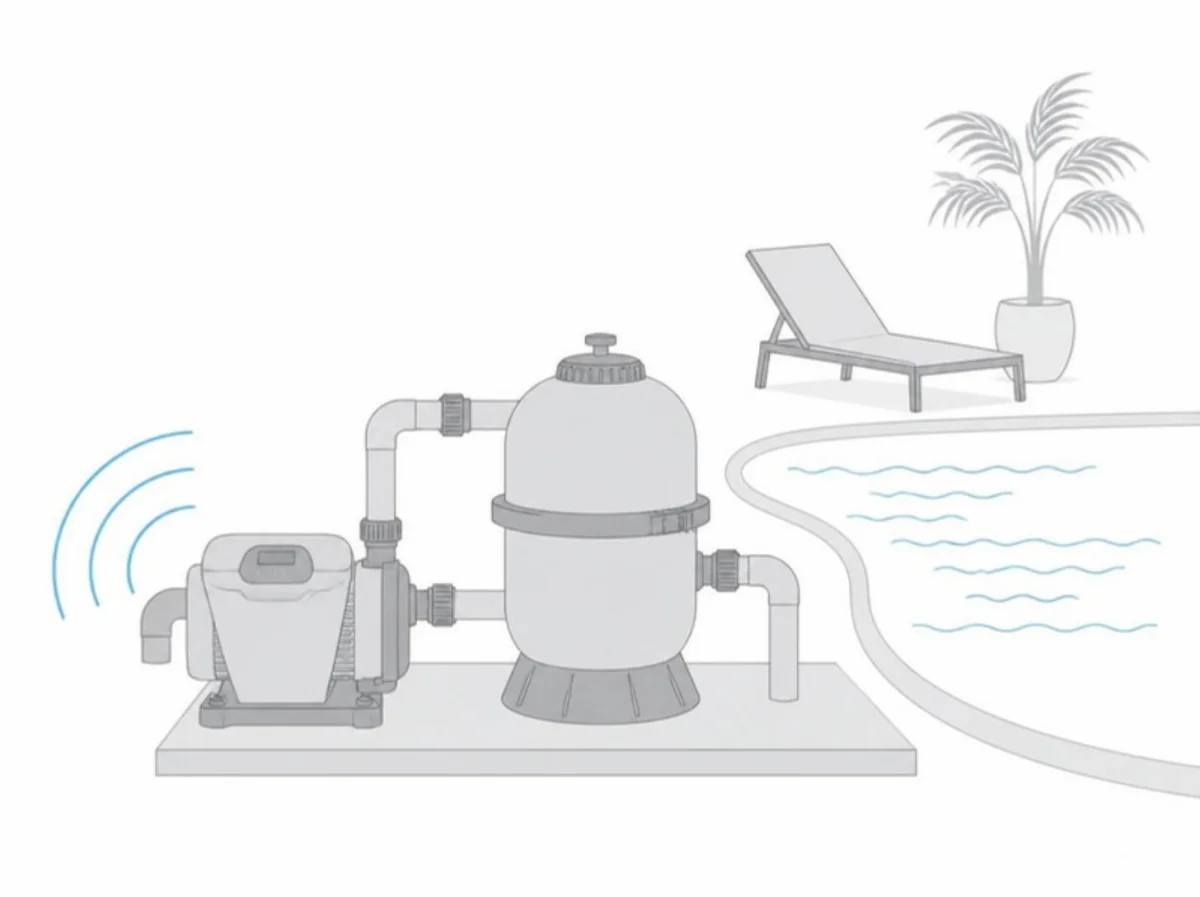
Above-ground filter pumps follow the same rules on a smaller scale. Bestway says its 58692E sand filter pump should stand on "solid, level ground, preferably a concrete slab" and be bolted to the ground or a wooden or concrete pedestal.
Bestway gives the reason as stopping the filter from falling, and its owner's manual also says not to dry run the unit and to release trapped air before switching it on. It forbids an extension cord and asks for a properly located outlet.
The two kinds of pump are not interchangeable. Bestway marks its unit for storable pools only, while Hayward and Pentair say their in-ground pumps are for permanently installed pools and Hayward says not to use them with storable ones.
What is the quietest kind of pool pump?
A variable speed pump run slowly is the quietest option the makers describe. Pentair says "Variable speed pumps operate more quietly than their single speed counterparts", and Madimack's figures fall 23 points from 100% to 30%.
A single-speed pump runs at one speed all day, so none of the speed advice above applies to it. Once the baskets, seals, mounting and pipes are in order, what remains is the motor's design, and the remedy is a different pump.
Our quietest pool pump guide compares the models whose makers publish a sound figure, sorted by how complete each figure is. If you are also choosing a heater, the quietest pool heat pumps guide covers the other machine that tends to share the pad.
Which pool pump documents did we use?
The steps come from Pentair's IntelliFlo3 VSF and WhisperFlo VST guides, Hayward's variable speed pump manual and six Hayward support answers, Speck's EasyFit and BADU EcoM3 manuals, Madimack's InverFLOW Plus page and Bestway's 58692E manual.
Pentair's homeowner sheet on IntelliFlo3 and the DOE rules supplied its line on variable speed pumps, and Hayward's TriStar VS sell sheet its 30% claim.
Jandy's US site stopped us at a security check, which we did not try to get past, so no Jandy manual is quoted here. Intex lists manuals for its filter pumps, but the download did not complete in time for this page. Hayward's single-speed and above-ground PowerFlo manuals were mostly images we could not read as text.
We did not clean a basket, reseat an O-ring, shim a pad or slow down a pool pump for this page, and we listened to none. Every step above is something a pump maker tells owners, named in the text, and each sound figure is quoted with whatever speed or distance the maker gives.