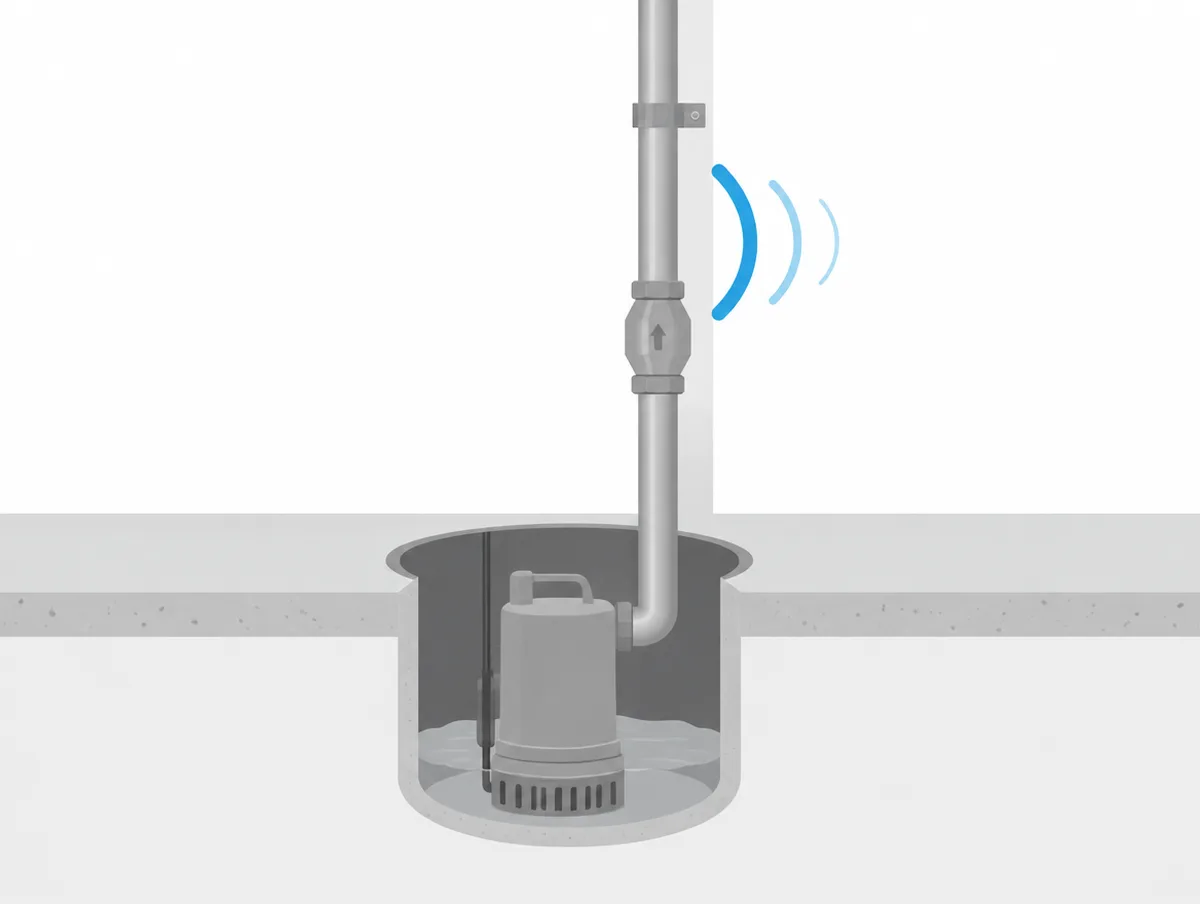
How to make a sump pump quieter starts at the discharge pipe, not the pump. The loudest sounds the makers describe come after the motor stops: a check valve slamming, a column of water dropping back, a pipe knocking against a joist. Each of those has a fix in an installation manual.
The rest is about letting the pump run as designed: sitting level on a hard base, a clear weep hole, a float that can move, and a pit big enough that it does not start every minute. Steps here come from Zoeller, Liberty, Wayne, Little Giant, Pentair and Glentronics, maker of Basement Watchdog.
It covers submersible and pedestal sump pumps, with sewage ejectors only where a maker singles them out.
How do you make a sump pump quieter, step by step?
Start with the free checks: a level pump on a hard base, a clear weep hole and a float with room to move. Then fix pipe contact, fit a quieter check valve, and test the alarm.
- Unplug the pump before touching anything in the pit.
- Set the pump level on a brick, block or maker stand, never on gravel.
- Give the float clear travel, away from the basin wall.
- Clear the weep hole between the pump and the check valve.
- Support the discharge pipe and stop it touching joists or walls.
- Fit a quiet or spring-loaded check valve if it bangs at shutoff.
- Look into short cycling if the pump starts every few minutes.
- Test the high-water alarm and learn its silence button.
- Call a plumber when the noise comes from inside the pump.
Why is my sump pump so loud?
A sump pump is loudest around each start and stop. Makers blame a check valve slamming shut, water falling back down the pipe, a pipe rattling on the framing, air at the end of a cycle, or a damaged impeller.
Pentair's troubleshooting FAQ lists four noisy cases, including a check valve that "slams shut causing a bang just after pump shuts off".
Wayne adds a design angle on its quiet performance page. It says bottom suction pumps "burp" to avoid air lock, and the weep hole that design needs adds a gurgle.
How loud is a sump pump supposed to be?
Sump pump makers do not say. Zoeller, Liberty, Wayne, Superior, Little Giant, Pentair, Flotec and Everbilt print no decibel figure for any pump we looked at. Wayne calls its pumps "ultra-quiet", with no number.
The only figures in this category are for alarms, which are meant to be loud. Liberty rates the horn on its ALM-2 indoor alarm at "86 dB (at 10 ft/3 m)", and Zoeller rates its 10-4012 APak horn at 87 decibels at 10 feet. Glentronics says its Watchdog Water Alarms sound "a loud, 110db alarm", with no distance given.
With no pump figure, there is no normal level to measure yours against; the manuals list fault sounds instead. Comparing decibel ratings explains why bare figures mislead anyway.
How do you quiet a sump pump check valve?
Replace a slamming valve with a quiet one, or cushion the pipe below it. Zoeller, Liberty and Glentronics each sell a check valve built to cut the thud at shutoff, and Pentair suggests a rubber hose section.
Zoeller explains the noise on its Quiet Check Valve page: "Standard check valves may produce a slamming sound when the water flow reverses in the discharge pipe after a pump stops." Its valve adds a hinged, spring-loaded flapper, and Zoeller says "Rapid closure against pressure before any flow reversal can occur eliminates the noise caused by hydraulic shock."
Liberty's QCV150 and QCV200 take a different route, with an angled seat that Liberty says reduces the water hammer effect. Both sizes, 1-1/2 and 2 inch, go in vertically or horizontally.
Glentronics, the company behind Basement Watchdog and Pro Series, sells the Klunkless valve. Its PHCC-2400 manual says the valve "has a built-in air chamber to counteract that pressure and muffle the sound", and calls it a conventional check valve, "only quieter."
Which way should a sump pump check valve face?
The flow arrow points up, away from the pump. Pentair says the arrow should be "pointing up toward discharge, not at pump", and Wayne lists a valve fitted backwards when a pump runs but moves little water.
Orientation is where the manuals part ways. Zoeller and Liberty sell quiet valves for vertical or horizontal pipe. Little Giant's Model 6 manual asks for the check valve horizontally, warning "If installed vertically, solids may settle in the valve and prevent it from opening at start-up."
Location is more settled. Zoeller places its Unicheck "preferably just above the basin to allow easy removal of the pump", and Wayne puts its check valve just above the basin too.
How often should a check valve be replaced?
Liberty sets no fixed interval. It asks for periodic inspection and says "The valve should be replaced if it shows signs of wear, leakage, sticking, or improper operation."
A leaking valve also makes the pump run more. Liberty's 230-Series manual lists a check valve "not installed, stuck open, or leaking" under a pump that cycles too often.
Why does my sump pump bang when it shuts off?
Water hammer, as Zoeller and Liberty call it. Water rising in the pipe stops, reverses and hits the closing check valve. Pentair adds that a pump with more horsepower than the job needs makes the slam worse.
Pentair's FAQ says an oversized pump "is causing the water to move too fast in the pipe. After the pump shuts off the water column keeps moving upward for a moment, then slams down." A bigger pump, in that case, is a louder pump.
For a bang at shutoff, Pentair's fix is "a section of flexible rubber hose (like radiator hose) between the pump discharge and the discharge pipe to provide noise insulation."
How do you quiet sump pump discharge pipes?
Stop the discharge pipe touching the house, and support it so it cannot swing. Pentair suggests insulating foam between pipe and framing, and Wayne a rubber coupling between pump and plumbing.
For a rattling pipe, Pentair says "Put insulating foam between pipe and wall and/or joists" or hang it "with an exhaust hanger from an auto parts store."
Wayne's sump pump manual lists "Piping attachments to building structure too rigid or too loose" as a cause of a pump that runs noisily or vibrates, and its remedy is to "Install rubber coupling (available at local hardware stores) to isolate pump vibration from discharge plumbing."
The same Wayne manual still requires rigid pipe: "IT IS REQUIRED TO USE RIGID PIPING AND FITTINGS to secure the pump in the basin and reduce pump movement," and "Do not use flexible hosing." A coupling joins rigid pipe; a hose in its place is ruled out.
Little Giant says to "Support the pump and piping", or risk broken pipe and "motor bearing failures."
Should the discharge pipe be bigger to cut noise?
No maker ties pipe size to noise. Zoeller says "DO NOT use a discharge pipe smaller than the pump discharge", and Liberty says larger pipe may be needed over long runs to cut friction loss.
Liberty's 250-Series manual also wants the line short "with a minimum number of turns", and Little Giant "as few elbows as possible."
What is the weep hole on a sump pump pipe?
The weep hole is a small hole drilled in the discharge pipe between the pump and the check valve. Trapped air escapes through it so the pump can prime. A spray of water from it while running is normal.
| Maker | Hole size | Where it goes |
|---|---|---|
| Zoeller | About 3/16 inch | Even with the top of the pump, below the basin cover |
| Liberty | 1/8 inch, no larger | Just above the pump's discharge outlet |
| Little Giant | 1/8 or 3/16 inch | Below the floor line, between pump and check valve |
| Pentair | 1/16 to 1/8 inch | Just above the pump, just below the check valve |
| Glentronics Pro Series | 3/16 inch | Above the water line, angled 45 degrees down |
Glentronics angles the hole "toward the bottom of the sump to avoid splashing water outside the sump pit". Zoeller adds that a vent hole on a high head installation "may cause too much turbulence", and gives a priming procedure for owners who skip it.
Liberty says "Bleeding off the air could take from several seconds to more than a minute" after the pump starts. Zoeller says the hole must be "CLEANED PERIODICALLY."
How do you quiet sump pump vibration?
Sit the pump level on something hard, and keep it upright and clear of the basin walls. Wayne, Liberty, Zoeller and Little Giant all rule out setting a pump on gravel or bare earth.
Zoeller's FM2676 instructions say "DO NOT install on sand, gravel or dirt" and "Pump must be level and float mechanism(s) clear of sides of basin before starting pump."
Wayne requires "A brick or block" under the pump for a solid base. Liberty sells "The Brick", part 4445000, which raises its 250, 280 and 290-Series pumps 2-1/2 inches off the basin floor.
Wayne warns that "Vibrations during operation can cause it to fall or tilt onto one side", jamming the float, and asks for a check three or four times a year that the pump has not moved.
A pump that shakes on its own, with everything else in place, is a different matter. Pentair says to inspect the impeller for broken or missing blades.
Does a sealed sump pit lid make a pump quieter?
No maker we read sells or rates a lid for noise. Makers require a basin cover for safety and to keep debris out, and a sealed, gasketed one where sewage gases or odors have to be contained.
Wayne's manual says to "Secure the basin cover and gasket to the basin to prevent debris from falling into the basin, prevent personal injury, and to contain gases and/or odors." Zoeller says all installations need a basin cover, and that sewage basins need gas-tight seals and a vent pipe.
Why does my sump pump turn on and off so often?
Short cycling, as Liberty calls it, comes from a float switch out of adjustment, a basin that is too small, or more water coming in. Zoeller and Little Giant add a missing or leaking check valve.
Liberty's short cycling answer names the first three. Zoeller's checklist for "Pump starts and stops too often" adds "check valve stuck or none installed in long distance line."
Basin size is the one fix that makes every cycle longer. Liberty asks for a 14 inch basin at least and says a larger one "allows for a longer pump cycle and reduced float switch cycling." Zoeller recommends an 18 inch or larger pit, and Little Giant asks for at least 18 inches across and 24 deep.
Why does my sump pump gurgle or slurp at the end of a cycle?
Air reaching the pump's intake as the water drops, according to Pentair. Its fix is to "Adjust float switch per the owner's manual so it shuts off before it starts sucking air."
Check what your manual allows first. Wayne says of its tether float, "This float is not adjustable", and that changing it can affect the pump's life. Liberty says the turn OFF level in its tables must be kept as the minimum water level.
Why is my sump pump humming but not pumping?
Air lock, a blocked intake, or a check valve stuck shut or fitted backwards. Pentair lists all three, and Liberty's fix for air lock is to turn the pump off and let it sit several minutes.
For a pump that "runs or hums, but does not pump", Liberty's table says "Turn pump off and let set for several minutes, then restart." Pentair says a humming motor likely has debris blocking its suction, and to disconnect power before servicing.
How do you silence a sump pump alarm?
Press the silence or mute button, then find out why it sounded. Liberty, Zoeller, Wayne and Glentronics all build in a timed silence, and the warning light stays on until the water drops.
| Alarm | How to silence | How long |
|---|---|---|
| Liberty ALM-Series indoor | Silence button | 6 hours |
| Zoeller APak | Brief press of Silence | 24 hours, light flashes |
| Wayne Basement Guardian | Mute button, pressed up to 8 times | 1 hour per press, 8 hours at most |
| Glentronics Pro Series PHCC-2400 | Hold RESET 1 second, or 5 seconds | 2 minutes, or 24 hours |
Liberty's ALM-Series manual has the alarm sound until the water drops, and its alarm answer says "Do not ignore an alarm." Zoeller's APak resets with a 3 second hold once the water is gone.
A short chirp is usually the battery. Liberty says its alarm chirps about twice a minute when the 9 volt backup battery is low, and asks for a new battery every 12 months.
How do you silence a Basement Watchdog alarm?
Slide the "Audible Alarm" switch to off, on the Basement Watchdog Emergency backup system. Its 2018 manual says the power and pump alarms can be silenced that way, but the water and battery alarms cannot.
The Watchdog Emergency manual asks owners to slide the switch back on once the emergency ends, "or you will not be warned the next time an emergency occurs." A pump alarm then clears with the red button on the control panel.
Watchdog models differ. On units without the front switch, the RESET button silences a pump alarm. The standalone Watchdog Water Alarms, rated at 110 dB, are separate battery units.
How often should you test a sump pump alarm?
Liberty says every 6 months, and Zoeller says once a week for its APak. Liberty raises the water in the pit or holds a cup of water up to the float; Zoeller lifts the float manually.
Zoeller's weekly test is a hold of the Silence button for more than 3 seconds. Zoeller also asks owners to inspect and test the whole pump system at least every three months, and Wayne three to four times a year.
Which sump pump noises mean call a plumber or replace the pump?
Noise or vibration from the pump itself, once the pipe and base are sorted. Wayne blames worn bearings or a broken impeller and says to replace the pump, and Liberty lists unusual noise and vibration as signs of failure.
Liberty's failure answer adds reduced pumping, frequent overload trips and failure to start. In Wayne's chart, worn bearings and a broken impeller share one remedy: "Replace pump."
Zoeller says "Do not attempt to service or otherwise disassemble pump", sending repairs to its authorized service centers, and warns that its pumps' internal oil gets hot and pressurized: allow 2-1/2 hours after disconnecting before service. Little Giant voids its warranty if the motor housing cover, impeller or seals are removed.
Electrical faults are for an electrician. Wayne sends a pump that trips its GFCI to one, and Zoeller says that under flooded conditions you should contact your electric company or a licensed electrician to disconnect power. For a pump that has grown louder over months, see why appliances get louder.
What should you not do to quiet a sump pump?
Do not block the weep hole, skip the check valve, set the pump on gravel, shrink the discharge pipe or run it from an extension cord. Each manual here rules one or more of these out.
Zoeller says "DO NOT use an extension cord with a sump pump." Pentair wants the pump plugged straight into an outlet that is alone on its breaker, and Liberty wants any alarm on a separate circuit.
Do not reach into the pit with power on: Zoeller and Liberty say to disconnect power before handling the pump. And do not silence an alarm and walk away, since the water that set it off is still there.
Is there a quieter sump pump to replace a loud one?
No maker can show one on paper. No pump maker we checked publishes a noise figure, so a quieter replacement comes down to claims and design choices you can check in the manual.
Wayne is the only maker we read that sells on quiet, crediting top suction, which needs no weep hole, and ball bearing motors, with no figure. Pentair ties the bang at shutoff partly to a pump with more horsepower than needed, so bigger is not quieter.
What the manuals let you control is the installation around any pump: a quiet check valve, a supported pipe, a level base and a pit big enough for long cycles. If the sump pump is one of several machines under a bedroom, our basement noise page and the guide to the quietest dehumidifiers for a basement cover the others.
What are these sump pump steps based on?
Manuals, alarm instructions, product pages and support answers from Zoeller, Liberty, Wayne, Little Giant, Pentair and Glentronics, listed in the sources. Each quote names its maker.
Basementwatchdog.com refused our requests, so the Watchdog steps come from Internet Archive copies of Glentronics' own manuals. We found no maker-hosted manual for Superior Pump or Everbilt, only retailer copies, which we do not cite, and none of the manuals covered pedestal pumps separately.
We did not install, level, re-pipe, test or listen to a sump pump, check valve or alarm for this page, and we measured nothing. The alarm decibel figures are the makers' own, with the distance each one states.