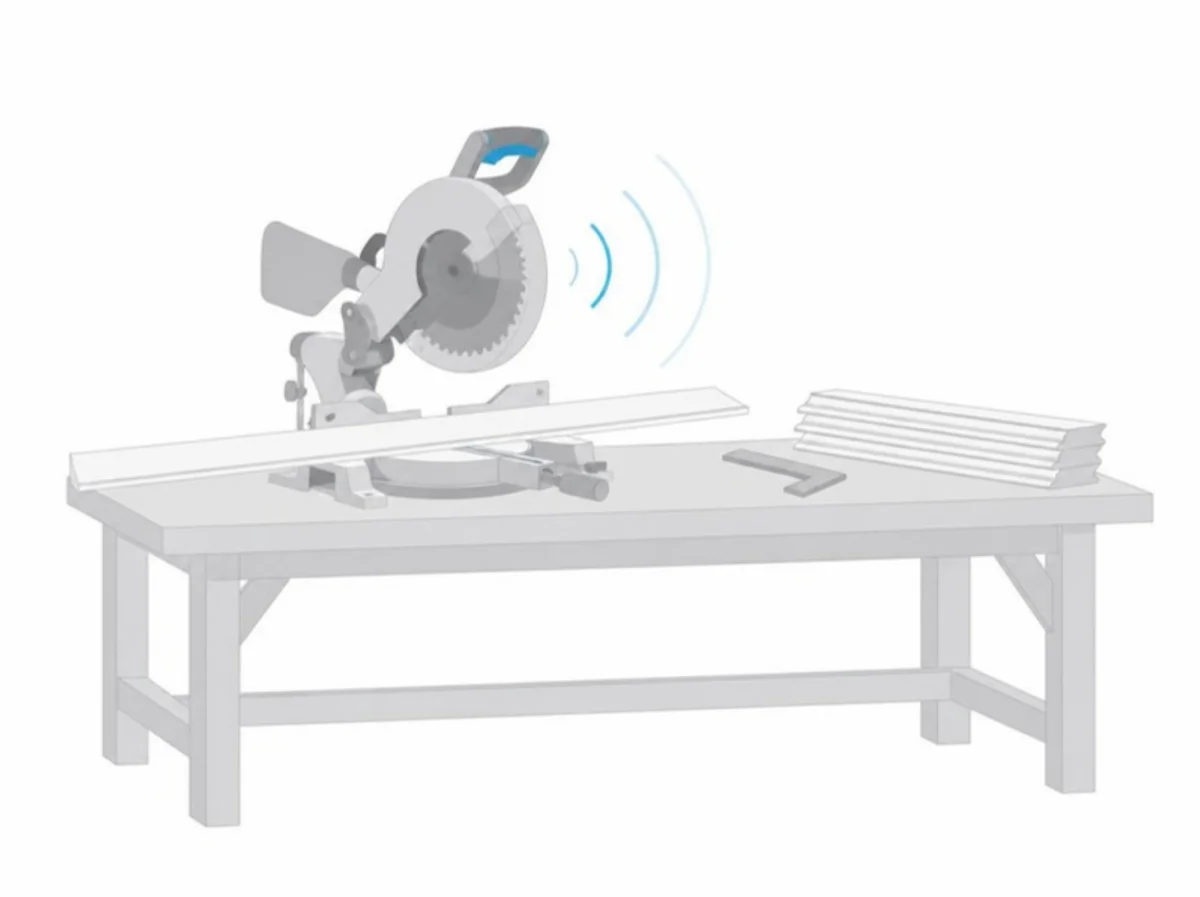
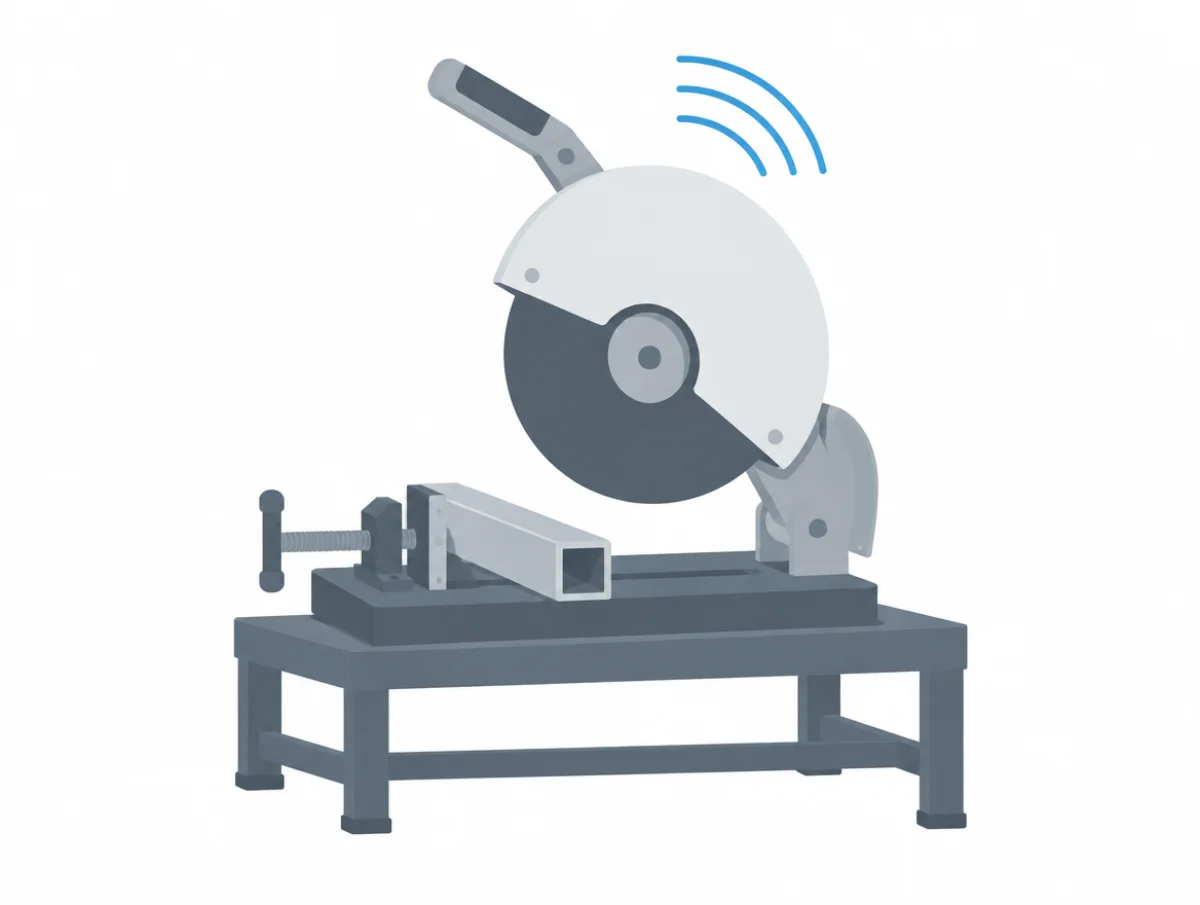
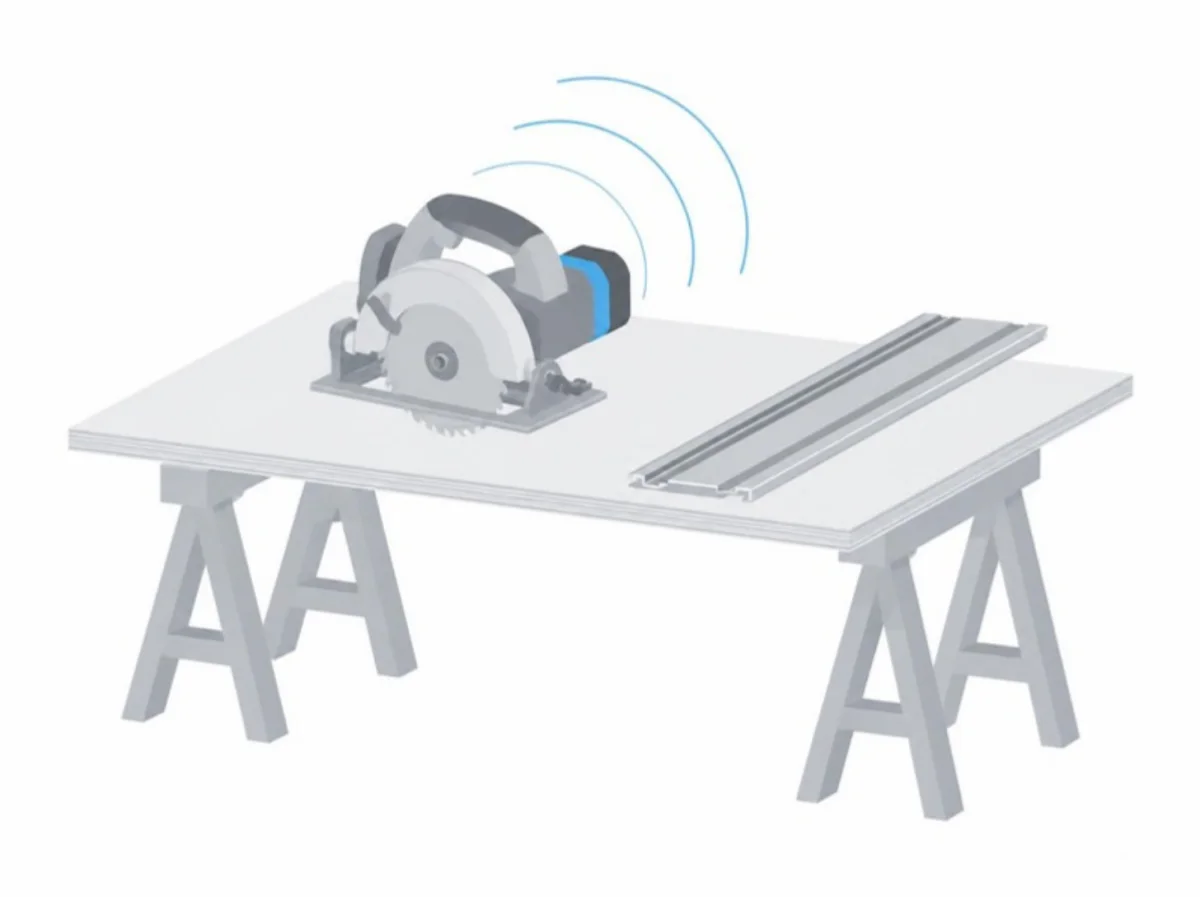
Miter saw owners hear grinding, a loud clunk at stop, a blade that freewheels, sparks at the back of the motor or a rattle across the bench. The manuals rarely use those words. They talk about an electric brake that skips, carbon brushes that have not seated, a belt that has failed and a blade that no longer runs true.
This page lines each sound up with the nearest passage in seven instruction manuals, read in November 2026: two from DEWALT, two from Milwaukee, and one each from Bosch, Makita and Evolution. It covers corded and cordless sliding compound miter saws, with one section on circular saws and one Evolution passage on a chop saw. Metabo HPT, Ryobi, SKIL, Craftsman and Delta manuals were not opened for it.
| What you hear or see | What the manuals point to | Try first |
|---|---|---|
| Blade coasts instead of stopping | Brake skipped or did not engage (DEWALT, Bosch, Milwaukee, Makita) | Switch on and off four or five times |
| Brake slow or erratic after new brushes | Brushes not yet seated (DEWALT, Bosch) | Run in at no load, as DEWALT describes |
| Flash of light at the motor as you let go | Brake working (Bosch) | Nothing |
| Heavy sparking at the motor | Dirt in the motor or worn brushes (Evolution) | Check and replace brushes |
| Motor runs, blade does not turn | Belt failed (DEWALT) | Inspect the belt |
| Saw shakes or rattles in the cut | Loose mounting, uneven floor, damaged or warped blade (DEWALT) | Tighten hardware, level the stand, swap the blade |
| Lower guard sticks or hangs loose | Guard fault (Milwaukee) | Authorized service center |
Why is my miter saw making a grinding noise?
None of the seven manuals uses the word grinding. A miter saw that sounds like it is grinding points, in maker terms, to the brake, the carbon brushes, the drive belt, the blade or the bearings, and each has its own check below.
The manuals do not sort noises by when they happen, but their passages fall into three rough groups. The brake acts at trigger release, and on DEWALT's corded DWS780 it depends on brushes of the right grade that are properly worn in. The blade and the mounting show up in the cut, as vibration. For a steady sound with the blade spinning free and nothing touching it, the makers have the least to say.
Milwaukee's maintenance section is the closest any of them comes. In the 2734-20 operator's manual for its M18 FUEL 10 in. sliding saw, owners are asked to look out for "undue noise, misalignment or binding of moving parts" and to return a tool showing them to a Milwaukee service facility. It names no particular part.
What the makers do not offer is oil for the bearings, as the section on lubrication further down explains.
Why is my miter saw brake not working?
A miter saw brake that lets the blade coast, or stops it late, has skipped. DEWALT and Bosch both treat an occasional miss as something to clear by cycling the switch, and a repeated one as a job for a service center.
Three makers give a stopping time. The DWS780 manual promises a brake that "stops the saw blade within 5 seconds of trigger release" and adds that the time "is not adjustable." Milwaukee's 2734-20 stops "in about 4 seconds." Bosch designs the GCM12SD brake to stop the blade "in about five (5) seconds."
DEWALT admits the brake will not always catch. "On rare occasions, the brake may not engage at all and the blade will coast to a stop." For a delay or a skip, its first step is to "turn the saw on and off 4 or 5 times." If the condition persists, the saw goes to an authorized DEWALT service center. The cordless DCS781 manual repeats this passage word for word.
Bosch names a cause. In the GCM12SD instructions, "contamination on the commutator and brushes or failure of motor's components can cause the brake not to activate." The cure matches DEWALT's, cycling the switch "four to five times without contacting the workpiece." Then comes a firm line: if the brake still does not consistently stop the blade in about five seconds, "DO NOT use saw and have it serviced immediately."
What Bosch's troubleshooting table lists for a slow brake
Bosch's table gives four causes for a brake that misses the 5 second mark. The first is brushes "not seated or lightly sticking or worn", with a corrective action of inspecting, cleaning or replacing them. The second is a motor overheated by a dull or overly heavy blade, an accessory Bosch does not recommend, or rapid on and off cycling. Third comes "Blade bolt loose.", fixed by tightening it. The last is simply "Other", sent to authorized service.
Milwaukee and Makita skip the diagnosis and go straight to repair. "If the brake fails to stop the blade or misses frequently, return the tool to a MILWAUKEE service facility for repair." Makita's GSL02 manual reads: "If the tool consistently fails to quickly cease to function after the switch trigger is released, have the tool serviced at a Makita service center."
None of these makers treats the brake as a guard. In the 2734-20 manual it "could fail", and DEWALT, Bosch and Milwaukee all want the blade fully stopped before it leaves the cut.
Why is my DEWALT miter saw making a loud noise?
On a corded DEWALT miter saw, the manual ties brake trouble to the carbon brushes. The DWS780 manual links the brake to the brushes in two places, and its troubleshooting table blames worn brushes when the saw will not start.
The first link is the brush grade. "Use of the correct grade of brush is essential for proper operation of electric brake," DEWALT writes, and it asks for identical DEWALT brushes only. The second is the break-in. New brushes are seated by letting the saw "run in" at no load for 10 minutes, and until they are, "The electric brake may be erratic in operation." A saw that started acting up right after a brush change may only need that run in. DEWALT adds a warning for those 10 minutes: hold the trigger by hand rather than taping or tying it on.
Wear is the third. DEWALT asks owners to inspect brushes regularly, keep them clean and sliding freely in their guides, and refit a used brush the same way round. Once they are worn to about 1/2 in. (12.7 mm), "the springs will no longer exert pressure and they must be replaced." The manual expects them to last several years.
The cordless DCS781 manual has no brush replacement section, and its troubleshooting table points elsewhere. "Saw will not start" there lists a battery that is missing or flat and a saw or battery that has overheated, with the advice "Wait several minutes for saw to cool."
Sparks or a flash at the motor when you release the trigger
A brief flash of light at the motor end cap, the moment you let go of the trigger, is the brake at work on Bosch's GCM12SD. Its electrical troubleshooting table lists that flash as a problem and answers it with "brake working properly." No corrective action is given.
Heavy or constant sparking is a different matter. Evolution's manual for the R355CPS and R14CPST chop saws, 14 in. metal cutting saws rather than miter saws, puts it this way: "Excessive sparking may indicate the presence of dirt in the motor or worn out carbon brushes." Its rule is to replace both brushes if either has less than 6 mm of carbon left, or if a spring or wire is damaged or burned.
Bosch sets a schedule for the GCM12SD: "we recommend every 2-6 months the brushes be examined." Each Bosch brush carries a wear limit line on its wide, flat side, and a brush worn to or past the line means replacing the pair. A used brush goes back the way it came out, or Bosch warns of a break-in period that will "reduce motor performance and increase brush wear."
Brush basics, and what other power tool makers say about them, are covered in the carbon brushes section of our drill noise page.
The motor runs but the blade does not turn
A motor that hums or spins up while the blade sits still has lost its drive. "If the blade does not turn when the motor is running, the belt has failed," reads the DWS780 manual. DEWALT designs the belt to last the life of the tool, though abuse of the tool could cause it to fail.
DEWALT's check is hands on. With the saw unplugged, remove the belt cover screws and look at the ribs of the belt for wear. Squeeze the two halves of the belt firmly between thumb and index finger: they should almost touch. Tension is set with a screw on the motor plate casting. Do not crank it too far. "NOTICE: Overtightening the belt will cause premature motor failure."
Bosch's GCM12SD belt is also a long life part, though dust drawn in through the vents can affect it. A belt showing signs of "drying out, cracking or tearing" is replaced, and so is one that will not track or comes off the pulleys. Bosch leaves the replacement itself to an authorized service center.
No maker here describes a squeal or slap from a belt. Treat a new sound from that side of the saw as reason to open the belt cover, not as a known symptom.
Why does my miter saw vibrate or rattle?
A miter saw that shakes or rattles in the cut is, by DEWALT's troubleshooting tables, loose on its stand, standing on an uneven floor or running a damaged blade. The same three causes appear in the DWS780 and DCS781 manuals.
Under "Machine vibrates excessively", DEWALT lists them in order. "Saw not mounted securely to stand or work bench" calls for tightening all mounting hardware. "Stand or bench on uneven floor" means moving to a flat, level surface. "Damaged saw blade" means a new blade.
The DCS781 safety rules single out the blade. "DO NOT USE WARPED BLADES. Check to see if the blade runs true and is free from vibration." DEWALT adds that a vibrating blade can damage the machine and cause serious injury.
A loose lower guard is another case. Milwaukee's 2734-20 manual sends the saw to an authorized service center if the lower guard "appears loose, sticks, or does not cover the blade when the saw head is up." It also warns never to disable or remove the guards.
Should you oil a noisy miter saw?
Not its bearings. DEWALT, Bosch and Evolution all describe the motor or saw bearings as lubricated for life, and none of their manuals asks owners to oil them.
DEWALT's DWS780 wording is direct: "All bearings are sealed. They are lubricated for life and need no further maintenance." Bosch fills its bearings "with a sufficient amount of high-grade lubricant for the life of the unit", and Evolution's chop saw manual says no further lubrication is required.
Bosch does allow a light touch elsewhere. "Periodically lubricate moving parts with a silicone, or light oil spray. Do not use grease because it tends to attract and hold sawdust." The instruction names moving parts, and by Bosch's account the bearings need nothing more. DEWALT keeps any spray or aerosol away from the plastic guard, whose polycarbonate can be attacked by certain chemicals.
A slower start that sounds softer
A saw that winds up gently rather than jumping to speed may simply have soft start. Makita builds it into the GSL02: "This function allows the smooth start-up of the tool by limiting the start-up torque." The same saw has electronic speed control, which Makita says helps keep blade speed constant "even under load."
Why is my circular saw making a grinding noise?
No circular saw manual read for this page describes a grinding noise. The one read, for Milwaukee's 2831-20 plunge track saw, covers the brake, which can pause or skip much as a miter saw brake does.
The 2831-20 manual says, "Generally, the saw blade stops within two seconds." Milwaukee then allows for a delay between trigger release and the brake taking hold, and adds: "Occasionally the brake may miss completely." A brake that misses often means the saw needs servicing by an authorized Milwaukee facility.
Like the miter saw manual, it asks owners to watch for undue noise and to return a tool showing it. Ryobi and DEWALT circular saw manuals were not opened for this page.
When to stop and send the saw for service
Stop using a miter saw whose brake keeps missing, whose lower guard sticks or whose blade wobbles. The first two go to a service center in these manuals; the third needs a new blade before the next cut.
Bosch is the most emphatic about the brake, with its "DO NOT use saw" line. DEWALT, Milwaukee and Makita each send a saw with a repeat brake failure to an authorized service center. Milwaukee does the same for a loose or sticking lower guard, and DEWALT rules out running a warped blade at all.
Brush work divides the makers. DEWALT lets owners replace DWS780 brushes or take them to a service center, and Bosch walks through the job in its manual. Bosch keeps belt replacement for its service centers, while DEWALT shows owners how to check belt tension themselves.
How loud is a miter saw in good working order?
In our quietest miter saws guide, the lowest maker declaration at the operator's ear is 88 dB(A) and the highest 96.2. DEWALT's DWS780 declares 92 dB(A) in its EU manual, and the European twin of Bosch's GCM12SD declares 93.
Those figures describe saws working as designed. No manual here sets a decibel threshold for a fault, so the useful signal is a change from how your own saw normally sounds. Metal cutting chop saws run higher: the lowest operator figure on EN 62841-3-10 in the chop saw guide is 97.5 dB(A).
The power tool hearing guide sets figures like these against NIOSH and OSHA limits, and NRR explained shows how to read the rating on earplugs and earmuffs.
Related guides and explainers
To shop by declared noise, the miter saw guide sorts fourteen saws by blade size, the circular saw guide covers circular and track saws, and the chop saw guide handles metal cutting. The quietest table saws guide ranks table saws on the same basis.
We did not operate, open or listen to any of these saws. Each cause and fix above is drawn from the maker manuals in the source list.